


Full News
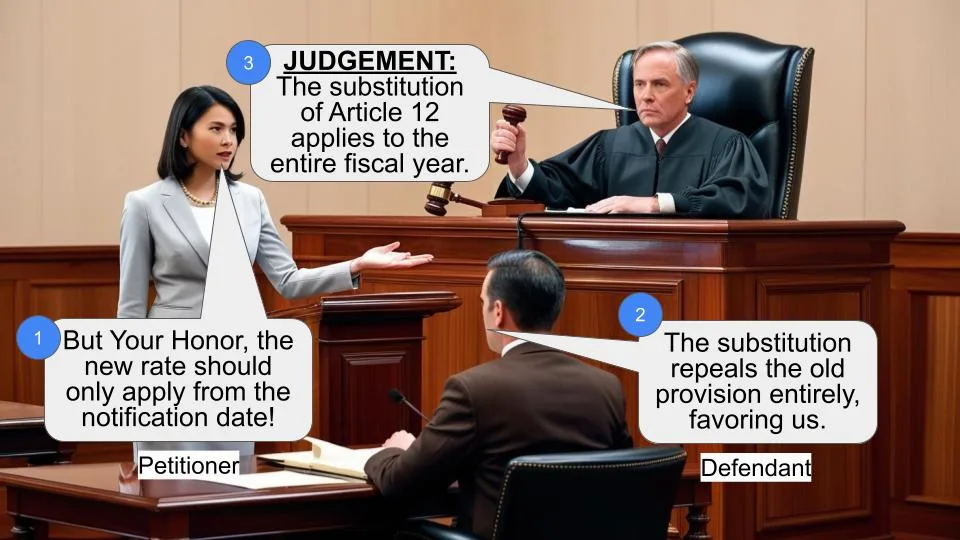
Tax Rate Substitution in DTAA Applies for Entire Fiscal Year, Rules High Court
Tax Rate Substitution in DTAA Applies for Entire Fiscal Year, Rules High Court
This case involves a dispute between the Director of Income Tax (International Taxation) and Autodesk Asia Pvt. Ltd. regarding the applicable tax rate under the Double Taxation Avoidance Agreement (DTAA) between India and Singapore for the Assessment Year 2006-07. The High Court ruled in favor of Autodesk, affirming that the substituted lower tax rate of 10% applies for the entire fiscal year.
Get the full picture - access the original judgement of the court order here
Case Name:
Director of Income Tax (International Taxation ) Vs Autodesk Asia Pvt. Ltd (High Court of Karnataka)
ITA No.133 of 2013
Date: 15th September 2020
Key Takeaways:
1. Substitution of a provision results in the repeal of the earlier provision and its replacement by the new provision.
2. When a tax rate is substituted in a DTAA, the new rate applies for the entire fiscal year, not just from the date of notification.
3. The court's interpretation favors taxpayer-friendly application of DTAA amendments.
Issue:
Was the Income Tax Appellate Tribunal correct in holding that the assessee (Autodesk Asia Pvt. Ltd.) is liable to be taxed at 10% for the entire Assessment Year 2006-07, despite the notification changing the rate being issued on 18.07.2005 with effect from 01.08.2005?
Facts:
1. Autodesk Asia Pvt. Ltd. is a Singapore-based company engaged in marketing and selling software.
2. For the Assessment Year 2006-07, Autodesk reported a turnover of USD 1,02,15,762 from software licenses and ancillary services.
3. Autodesk filed a tax return declaring 'NIL' taxable income.
4. The case was selected for scrutiny, and the Assessing Officer determined that the software supplied was chargeable to income tax from royalty and technical services.
5. The Commissioner of Income Tax (Appeals) affirmed the Assessing Officer's order.
6. The Income Tax Appellate Tribunal allowed Autodesk's appeal, applying the 10% tax rate for the entire fiscal year.
Arguments:
Revenue's Argument:
- The notification dated 18.07.2005 came into force from 01.08.2005, so the new rate should only apply from that date.
- As per Section 195(1) (of Income Tax Act, 1961), the rates in force mean the dates on which credit takes place in the account.
Assessee's Argument:
- The notification substituted the entire paragraph in Article 12 of the DTAA, effectively repealing the old provision.
- The new provision should apply for the entire fiscal year as defined in the DTAA.
Key Legal Precedents:
1. GOVERNMENT OF INDIA AND OTHERS VS. INDIAN TOBACCO ASSOCIATION, (2005) 7 SCC 396
2. U.P.SUGAR MILLS ASSN. VS. STATE OF U.P., (2002) 2 SCC 645
3. WEST UP SUGAR MILS ASSOCIATION V. STATE OF UP (2012) 2 SCC 773
4. GOVARDHAN M V. STATE OF KARNATAKA (2013) 1 KarLJ 497
These cases establish the principle that substitution of a provision results in the repeal of the earlier provision and its replacement by the new provision.
Judgement:
The High Court dismissed the revenue's appeal and ruled in favor of Autodesk Asia Pvt. Ltd. Key points of the judgment include:
1. The substitution of Article 12 in the DTAA resulted in the deletion of the old rule (12% tax rate) and the implementation of the new rule (10% tax rate).
2. The Tribunal correctly determined that the substituted rate of 10% in Clause 2 of Article 12 of the DTAA between India and Singapore is applicable for the entire fiscal year.
3. The substantial questions of law framed by the court were answered in the affirmative and against the revenue.
FAQs:
1. Q: Why did the court rule that the new tax rate applies for the entire fiscal year?
A: The court followed the principle that when a provision is substituted, it results in the repeal of the old provision and its complete replacement by the new one, effective for the entire period it covers.
2. Q: What is the significance of this judgment for international taxation?
A: This judgment sets a precedent for applying amended DTAA provisions for the entire fiscal year, potentially benefiting taxpayers in similar situations.
3. Q: How does this ruling affect the interpretation of future DTAA amendments?
A: It suggests that courts may interpret DTAA amendments in a manner that applies the most favorable rate to taxpayers for the entire fiscal year, rather than prorating based on the date of notification.
4. Q: What sections of the Income Tax Act were relevant to this case?
A: The judgment mentions Section 90 (of Income Tax Act, 1961) (under which the notification was issued) and Section 195(1) (of Income Tax Act, 1961) (regarding rates in force) of the Income Tax Act, 1961.
5. Q: How might this judgment impact other companies in similar situations?
A: Companies receiving royalties or fees for technical services under similar DTAA provisions may be able to apply the most favorable tax rate for the entire fiscal year in which an amendment occurs.

This appeal under Section 260A (of Income Tax Act, 1961) (hereinafter referred to as the Act for short) has been preferred by the revenue. The subject matter of the appeal pertains to the Assessment year 2006-07. The appeal was admitted by a bench of this Court vide order dated 12.08.2013 on the following substantial question of law:
(i) Whether the Tribunal was correct in holding that the assessee is liable to be taxed at 10% in view of replacement of 15% with 10% of tax in Article 12 of the DTAA without taking into consideration that the modification of rate of tax by way of notification dated 18.07.2005 was with effect from 01.08.2005 and recorded a perverse finding?
(ii) Whether the Tribunal was correct in extending the benefit of Notification to the whole of the Previous year, when the Notification was given effect from 01.08.2005 as per Article 7 of the DTAA?
2. Facts leading to filing of the appeal briefly stated are that the assessee is a company based in Singapore and is engaged in the business of marketing and sale of software. The assessee sold software licences to Indian customers and in connection with sale of software also provided certain ancillary services to the Indian customers. The assessee showed turnover on sale of software licences and ancillary services at USD 1,02,15,762/-, out of which 95% of software licences were sold to authorized distributors viz., INGRAM Micro India Pvt. Ltd. and M/s Tech Pacific India Limited. Thus, sales to the tune of 100,52,271$ was made to the authorized distributors. The assessee filed a return of income for the Assessment Year 2006-07 on 08.11.2006 by declaring the taxable income as ‘NIL’. The case was selected for scrutiny and notice under Section 143(2) (of Income Tax Act, 1961) was issued to the assessee, by which assessee was asked to furnish details such as agreements, invoices etc. The Assessing Officer by an order dated 26.12.2008 on examination of the agreements and documents supplied by the assessee inter alia held that software supplied is chargeable to income tax from royalty and technical services. Accordingly, the order of assessment was concluded. The aforesaid order was affirmed in appeal by an order dated 17.02.2011 by Commissioner of Income Tax (Appeals). Being aggrieved, the assessee approached the Income Tax Appellate Tribunal (hereinafter referred to as 'the Tribunal' for short). The Tribunal by an order dated 26.10.2012 allowed the appeal preferred by the assessee. In the aforesaid factual background, this appeal has been filed.
3. Learned counsel for the revenue submitted that the Notification dated 18.07.2005 issued under Section 90 (of Income Tax Act, 1961) came into force with effect from 01.08.2005. With reference to Section 195(1) (of Income Tax Act, 1961), it was contended that the rates in force mean the dates on which credit take place in the account and therefore, the Assessing Officer has rightly applied the rate of tax under the Double Taxation Avoidance Agreement (DTAA). On the other hand, learned counsel for the assessee submitted that from perusal of Article 4 of the Notification dated 18.07.2015, it is evident that paragraph 12 of Article 12 of DTAA has been deleted and has been substituted by the paragraph which provides for levy of tax on the royalties or fees for technical services at the rate not exceeding 10%. Thus, the instant case is a case of substitution by repeal and therefore, the Tribunal has rightly held that new provision which is in existence shall apply for the entire fiscal year as defined in DTAA. In support of aforesaid submission, reliance has been placed on decision of the Supreme Court in ‘GOVERNMENT OF INDIA AND OTHERS VS. INDIAN TOBACCO ASSOCIATION’, (2005) 7 SCC 396.
4. We have considered the submissions made by learned counsel for the parties and have perused the record. The singular issue which arises for consideration in this appeal is with regard to the rate of tax under the DTAA for Assessment Year 2006-07. Before proceeding further, we may advert to well settled rules of Interpretation with regard to taxing statutes. The substitution of a provision results in repeal of earlier provision and its replacement by new provision. [See: U.P.SUGAR MILLS ASSN. VS. STATE OF U.P.’, (2002) 2 SCC 645]. The aforesaid principle of law was reiterated by the Supreme Court in WEST UP SUGAR MILS ASSOCIATION V. STATE OF UP (2012) 2 SCC 773 and by this Court in GOVARDHAN M V. STATE OF KARNATAKA (2013) 1 KarLJ 497. When a new rule in place of an old rule is substituted, the old one is never intended to keep alive and the substitution has the effect of deleting the old rule and making the new rule operative.
5. In the backdrop of aforesaid well settled legal position, facts of the case may be seen. In the instant case, relevant extract of Notification dated 18.07.2005 issued under Section 90 (of Income Tax Act, 1961) reads as under: “Article 4: Paragraph 2 of Article 12 (Royalties and Fees for Technical Services) of the agreement shall be deleted and replaced by the following paragraph:
“2. However, such royalties and fees for technical services may also be taxed in the Contracting State in which they arise and according to the laws of that Contracting State, but if the recipient is the beneficial owner of the royalties or fees for technical services, the tax charged shall not exceed 10%.”
6. Thus, it is evident that paragraph 2 of Article 12, which provided for levy of tax on royalties or fees for technical services at the rate not exceeding 12% has been deleted and in its place, the provision which provides for levy of tax on the royalties or fees for technical services at the rate not exceeding 10% has been substituted. Thus, the substitution has the effect of deleting the old rule and making the new rule operative. Therefore, the Tribunal has rightly determined the rate of tax as substituted in Clause 2 of Article 12 of DTAA between India and Singapore applicable for the entire fiscal year as defined in DTAA and is liable to be taxed at 10%. For the aforementioned reasons, the substantial questions of law framed by this court are answered in affirmative and against the revenue.
In the result, we do not find any merit in this appeal. The same fails, and is hereby dismissed.
Sd/-
JUDGE
Sd/-
JUDGE
×
Similar Ripples
Questions
Tax Rate Substitution in DTAA Applies for Entire Fiscal Year, Rules High Court
Write your CommentSimilar Posts

Generic
- Reportdata/6184.pdf
