


Tax Reassessment Quashed: High Court Upholds Tribunal's Decision Against Revenu…



Full News
Tax Reassessment Quashed: High Court Upholds Tribunal's Decision Against Revenue Department
Tax Reassessment Quashed: High Court Upholds Tribunal's Decision Against Revenue Department
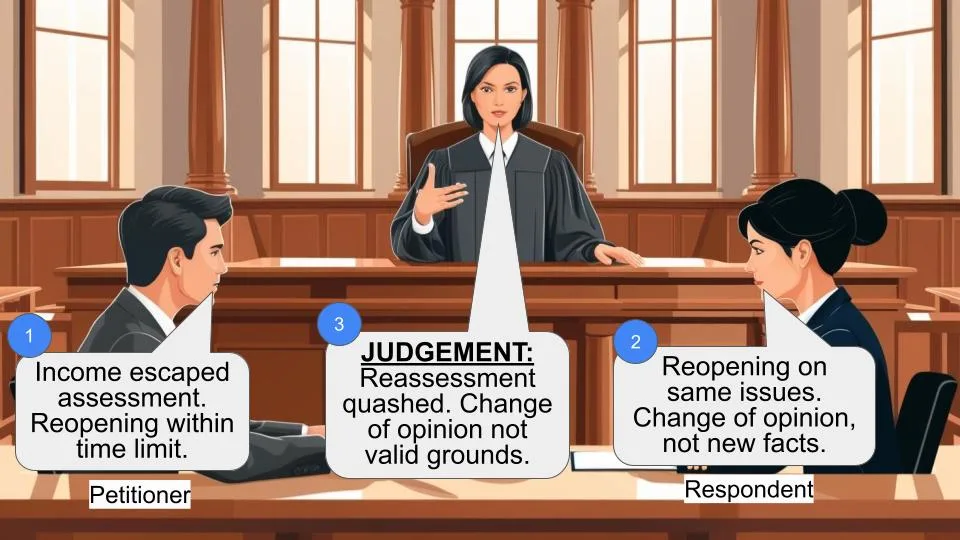
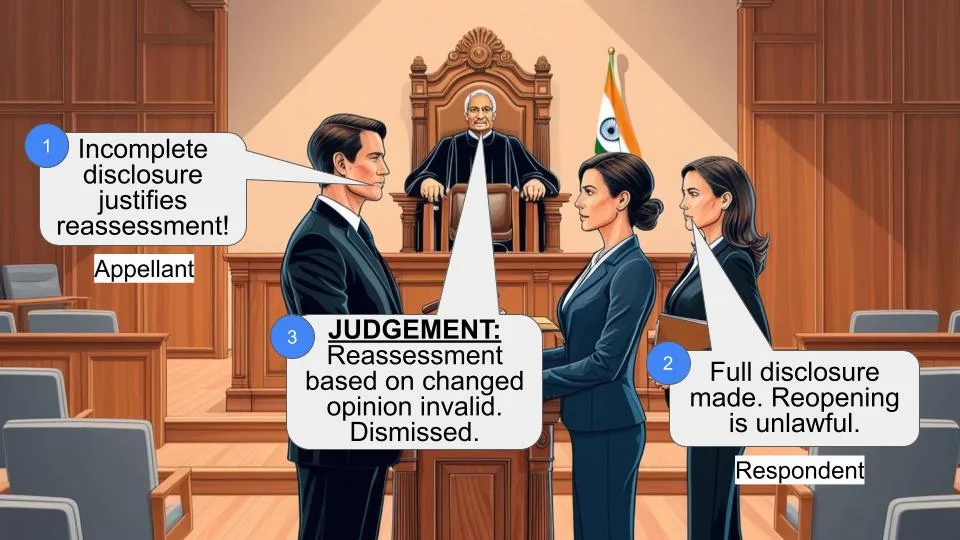
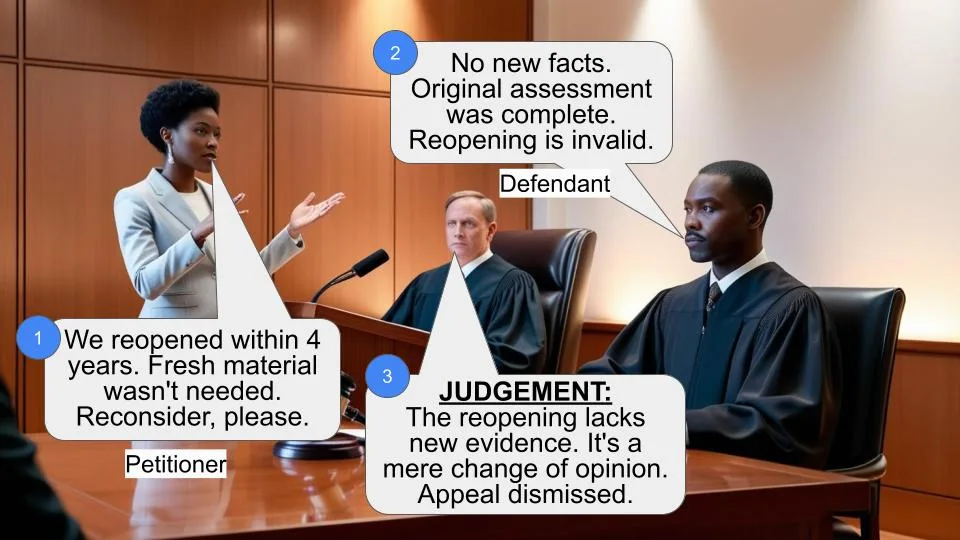
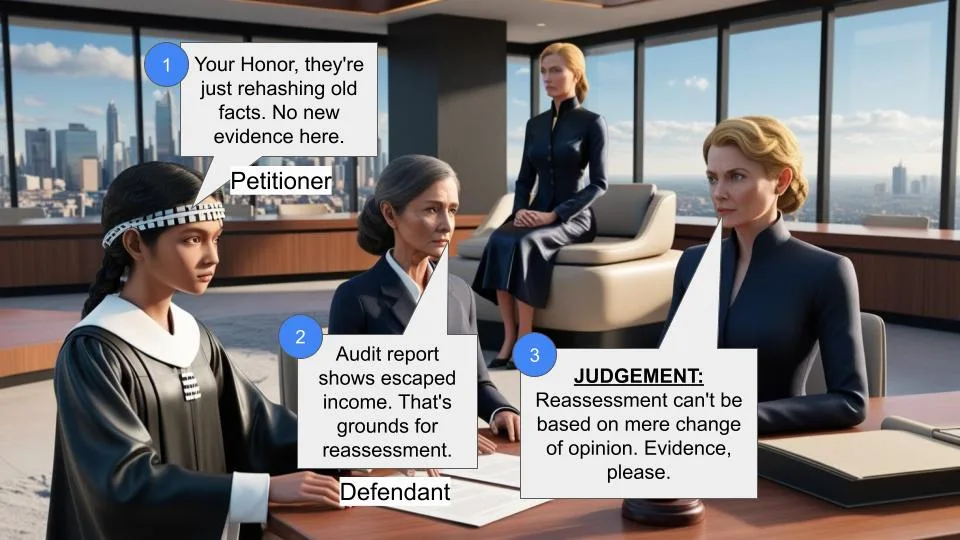
This case involves an appeal by the Principal Commissioner of Income Tax (the revenue department) against Sun Pharmaceuticals Industries Ltd. The revenue department sought to reopen tax assessments for the years 2000-01 and 2001-02, claiming that certain income had escaped assessment. The Income Tax Appellate Tribunal had earlier quashed the reassessment proceedings, and the High Court upheld this decision, dismissing the revenue department's appeal.
Get the full picture - access the original judgement of the court order here
Case Name:
Principal Commissioner of Income Tax vs. Sun Pharmaceuticals Industries Ltd. (High Court of Gujarat)
Tax Appeal No. 128 & 129 of 2016
Date: 1st April 2016
Key Takeaways:
1. Reassessment cannot be based on mere change of opinion.
2. Once an assessment order is merged with the order of the Commissioner (Appeals), it cannot be reopened for the same issues.
3. The court emphasized the importance of finality in tax assessments.
4. The revenue department cannot reopen assessments simply because a new Assessing Officer believes there's a better way to interpret the data.
Issue:
Whether the Income Tax Appellate Tribunal erred in law by quashing the reassessment proceedings initiated by the revenue department against Sun Pharmaceuticals Industries Ltd. for the assessment years 2000-01 and 2001-02?
Facts:
- Sun Pharmaceuticals filed tax returns for 2000-01 and 2001-02.
- Original assessments were completed under section 143(3) (of Income Tax Act, 1961).
- The Assessing Officer later issued notices under section 148 (of Income Tax Act, 1961) to reopen the assessments.
- The Assessing Officer made new assessments under section 143(3) (of Income Tax Act, 1961) read with section 147 (of Income Tax Act, 1961).
- The assessee appealed to the Commissioner of Income Tax (Appeals), who partly allowed the appeal.
- Both parties then appealed to the Income Tax Appellate Tribunal.
- The Tribunal quashed the reassessment proceedings.
- The revenue department appealed to the High Court against the Tribunal's decision.
Arguments:
Revenue Department:
- Claimed that income chargeable to tax had escaped assessment.
- Argued that the Tribunal erred in not considering the merits of the case.
- Contended that the reassessment was valid as it was within 4 years from the end of the relevant assessment year.
Sun Pharmaceuticals:
- Argued that the reopening was based on a mere change of opinion.
- Contended that the original assessment order had merged with the order of the Commissioner (Appeals).
- Claimed that the Assessing Officer had already examined the issues in detail during the original assessment.
Key Legal Precedents:
1. Cliantha Research Ltd. v. Deputy Commissioner of Income Tax, [2013] 35 taxmann.com 61 (Gujarat): Held that reassessment cannot be done merely because a certain angle was not considered earlier.
2. United Phosphorus Ltd. v. Additional Commissioner of Income Tax (unreported decision, 08.03.2011): Held that when an assessment order is subject to appeal, it merges with the appellate order.
3. Commissioner of Income Tax v. Kelvinator of India Ltd., (2010) 320 ITR 561: Established that reassessment cannot be based on mere change of opinion.
Judgement:
The High Court dismissed the revenue department's appeal, upholding the Tribunal's decision to quash the reassessment proceedings. The court found that:
1. The reasons for reopening were largely based on a change of opinion.
2. Issues related to deductions under sections 80IA (of Income Tax Act, 1961) and 80HHC (of Income Tax Act, 1961) had already been examined in the original assessment.
3. The original assessment order had merged with the order of the Commissioner (Appeals) for the disputed items.
4. The revenue department cannot reopen assessments simply because a new Assessing Officer believes there's a better way to interpret the data.
FAQs:
1. Q: Can tax authorities reopen assessments based on a new interpretation of existing data?
A: No, reassessment cannot be based on a mere change of opinion or a new interpretation of existing data.
2. Q: What is the significance of an assessment order merging with an appellate order?
A: Once merged, the original assessment order loses its independent existence, and those issues cannot be reopened without new evidence.
3. Q: How long after an assessment can tax authorities typically initiate reassessment proceedings?
A: Generally, within 4 years from the end of the relevant assessment year, but this doesn't override other legal principles against reopening.
4. Q: What impact does this judgment have on taxpayers?
A: It provides more certainty to taxpayers that their assessments won't be reopened without substantial new evidence, even if a new officer disagrees with the original assessment.
5. Q: Does this judgment completely prevent the reopening of assessments?
A: No, it doesn't prevent reopening in all cases, but sets a high bar for when reassessment is permissible, emphasizing that it can't be based on mere change of opinion.

1. By these appeals under section 260A (of Income Tax Act, 1961) (hereinafter referred to as “the Act”), the appellant – revenue has called in question the common order dated 21.08.2015 passed by the Income Tax Appellate Tribunal, Ahmedabad Bench “D”, Ahmedabad (hereinafter referred to as “the Tribunal”) in ITA No.1199/Ahd/2006, by proposing the following four questions, stated to be substantial questions of law:
“[1] Whether the Income Tax Appellate Tribunal committed substantial error of law in treating the reassessment proceedings as vitiated in law, quashing reassessment order, and not deciding on the issues raised by the Revenue in appeal on the ground that the order of the A.O. stood merged with the order of C.I.T. (A), following the ratio of judgment of Hon’ble Gujarat High Court in the case of United Phosphorus Ltd. v/s ACIT (2011) 56 DTR 196 (Gujarat) without deliberating on the issues involved on merits, when excepting the issue of gross interest for computing profit for the purpose of deduction u/s 80HHC (of Income Tax Act, 1961), none of the issues referred to in order u/s. 143(3) (of Income Tax Act, 1961) r.w.s. 147 (of Income Tax Act, 1961) were subject matter of assessment u/s 143(3) (of Income Tax Act, 1961) and CIT (A)’s order on assessee’s appeal against order u/s 143(3) (of Income Tax Act, 1961), whereas the Hon’ble Gujarat High Court in the case of United Phosphorus Ltd. (supra) elaborated in detail as to how the A.O.’s order u/s 143(3) (of Income Tax Act, 1961) r.w.s. 147 (of Income Tax Act, 1961) got merged with order of CIT (A)?
[2] Whether the Income Tax Appellate Tribunal committed substantial error of law in treating the reassessment proceedings as vitiated in law, quashing reassessment order, ignoring that the A.O. had reason to believe that income chargeable to tax has escaped assessment, and all the issues excepting the issue of consideration of gross interest for computing profit for deduction u/s 80IA (of Income Tax Act, 1961) were validly reopened in accordance with the provision of section 147 (of Income Tax Act, 1961), as is evident from the reasons recorded for reopening of assessment and the order disposing of assessee’s objection to the issue of notice u/s 148 (of Income Tax Act, 1961), and discussions on the issue involved in order u/s 143(3) (of Income Tax Act, 1961) r.w.s. 147 (of Income Tax Act, 1961) which finds support from various judicial decisions?
[3] Whether the Income Tax Appellate Tribunal committed substantial error of law in treating the reassessment proceedings as vitiated in law, quashing reassessment order, without considering that the Hon’ble Gujarat High Court vide its order dated 31/07/2002 and 06/08/2002 upheld the validity of reassessment proceedings on the issue of recalculation of deduction u/s 80IA (of Income Tax Act, 1961) relating to interest on overdue bills in the assessee’s case for A.Y. 1997-98 and 1999-2000, and that identical issue was involved in assessee’s case for A.Y. 2000-01?
[4] Whether the Income Tax Appellate Tribunal committed substantial error of law in quashing reassessment proceedings, ignoring the fact that the assessment was reopened within 4 years from the end of relevant assessment year, which can be reopened even though there is no failure on the part of the assessee to disclose fully and truly all material facts necessary for his assessment for that year?”
2. The assessment years are 2000-01 and 2001-02. The assessee Company filed its return of income for assessment year 2000-01 on 30.11.2000 declaring total income at Rs.15,92,260/- under section 115JA (of Income Tax Act, 1961). The return was processed under section 143(1) (of Income Tax Act, 1961) on 09.03.2000. The assessee Company filed a revised return of income declaring total income under section 115JA (of Income Tax Act, 1961) at Rs.15,92,21,250/- on 01.06.2001. The Assessing Officer finalized the assessment under section 143(3) (of Income Tax Act, 1961) on 27.11.2002 under normal provisions determining total income at Rs.11,84,80,295/- and computed income under section 115JA (of Income Tax Act, 1961) at Rs.17,75,85,674/- after making various additions/disallowances.
3. For assessment year 2001-02, the assessee filed its original return of income on 31.10.2001 and revised return on 28.12.2001. The assessment was completed under section 143(3) (of Income Tax Act, 1961) on 28.03.2003.
4. Subsequently, in relation to both the years, the Assessing Officer noticed that certain income had escaped assessment and issued notice under section 148 (of Income Tax Act, 1961) seeking to reopen the assessment for both the assessment years under consideration. The Assessing Officer framed assessment under section 143(3) (of Income Tax Act, 1961) read with section 147 (of Income Tax Act, 1961) on 31.03.2005 computing the total income of the assessee for assessment year 2000-2001 at Rs.17,40,70,520/- and for assessment year 2001-02 at Rs.3,77,36,480/-. The assessee carried the matters in appeal before Commissioner of Income-tax (Appeals), who, by an order dated 28.02.2006 partly allowed the appeal. Against the said order, both, the assessee as well as the revenue filed appeals before the Tribunal. Before the Tribunal, it was the case of the assessee that the reopening of assessment by issuance of notice under section 148 (of Income Tax Act, 1961) was bad in law as the same was based upon a mere change of opinion. The Tribunal accepted the contention of the assessee and held that the reassessment proceedings were vitiated in law and, accordingly, set aside the reassessment orders. Having quashed the reassessment order for the technical reasons set out in the order, the Tribunal dismissed the cross appeals filed by the revenue as having been rendered infructuous and academic. Being aggrieved, the revenue has preferred these appeals.
5. Mr. Ketan Parikh, learned senior standing counsel for the appellant, assailed the impugned order by submitting that the Tribunal has erred in holding that the assessment is sought to be reopened on a mere change of opinion, inasmuch as, none of the aspects on which the assessment was reopened have been considered while framing the original assessment order. Reference was made to the findings recorded by the Commissioner (Appeals) while holding the reopening of assessment to be valid, to submit that such findings have been totally brushed aside by the Tribunal. Referring to the original assessment order, it was submitted that there is no question of change of opinion as the items on which the assessment was reopened have not been considered in the original assessment order. It was submitted that the non-assessed items can always be looked into. It was submitted that none of the items on which the assessment is sought to be reopened forms part of the earlier assessment order and that there is no specific discussion by the Tribunal in this regard. It was, accordingly, urged that the impugned order passed by the Tribunal is perverse to the record of the case and therefore, the appeals require consideration on the questions of law as proposed or as may be forumlated by the court.
6. Opposing the appeals, Mr. S. N. Soparkar, Senior Advocate, learned counsel for the respondent-assessee, submitted that the Assessing Officer has reopened the assessment on the ground that certain items have not been considered while considering the deduction under section 80IA (of Income Tax Act, 1961). It was submitted that the issue was gone into in great detail by the Assessing Officer and hence, it is not permissible to reopen the assessment on the ground that the very same issue can be examined from another angle. In support of such contention, the learned counsel placed reliance upon the decision of this court in the case of Cliantha Research Ltd. v. Deputy Commissioner of Income Tax, Ahmedabad Circle-I, [2013] 35 taxmann.com 61 (Gujarat), for the proposition that when a claim was processed at length and after calling for detailed explanation from the assessee, the same was accepted, merely because a certain element or angle was not in the mind of the Assessing Officer while accepting such a claim, cannot be a ground for issuing notice for reassessment.
6.1 It was further submitted that against the order passed by the Assessing Officer in the assessment framed under section 143(3) (of Income Tax Act, 1961), the respondent – assessee had preferred appeal before the Commissioner (Appeals), who had considered the aspect of deductions under sections 80IA (of Income Tax Act, 1961) and 80HHC (of Income Tax Act, 1961) and hence, the assessment order having merged with the order passed by the Commissioner (Appeals), the issue cannot be reopened again. In support of such submission, the learned counsel placed reliance upon an unreported decision of this court in the case of United Phosphorus Ltd. v. Additional Commissioner of Income Tax rendered on 08.03.2011 in Special Civil Application No.3352 of 2001 wherein, the court had observed that when the Assessing Officer while framing the assessment had examined the taxability of certain items and such order was subject matter of challenge before the Commissioner (Appeals), qua such items in respect of which the appeal had been preferred, the order of the Assessing Officer stood merged with the order of Commissioner (Appeals) and had no independent existence of its own, and hence, the assessment could not have been reopened in respect of such items. The learned counsel further submitted that insofar as the claim under section 80IA (of Income Tax Act, 1961) and 80HHC (of Income Tax Act, 1961) is concerned, there is only one deduction. Once it is allowed, it is deemed that the Assessing Officer has looked into every aspect of the matter. It was pointed out that the Assessing Officer at the time of framing initial assessment order, had called for information from the assessee on various aspects and after examining the same, allowed the deductions under section 80IA (of Income Tax Act, 1961) and 80HHC (of Income Tax Act, 1961). Now, the Assessing Officer says that he has left out certain items. It was submitted that the assessment order passed in the first round has merged with the order of the Commissioner (Appeals) and hence, the computation under section 80IA (of Income Tax Act, 1961) and 80HHC (of Income Tax Act, 1961) has merged with the order passed by the Commissioner (Appeals) and it is now not open for the Assessing Officer to say that there was a mistake and therefore, he wants to reopen the assessment on this ground. It was submitted that for the purpose of granting deduction under section 80IA (of Income Tax Act, 1961), a large number of items are required to be satisfied and that the Assessing Officer after having considered the items and having granted deduction, it is not permissible for the Assessing Officer to seek to reopen the assessment on the ground that a particular angle in respect of the claim of deduction under section 80IA (of Income Tax Act, 1961) was not examined. It was, accordingly, urged that there is no legal infirmity in the impugned order passed by the Tribunal giving rise to any question of law and therefore, the appeals being devoid of merit, deserve to be dismissed.
7. Before examining the merits of the rival submissions, it may be germane to refer to the reasons recorded by the Assessing Officer for the purpose of reopening the assessment, which read thus:
“I. The scrutiny assessment u/s. 143(3) (of Income Tax Act, 1961) was completed in this case on 27.11.02. While scrutinising the return of income for assessment of subsequent years, it is seen that the assessee’s claims are not proper. It is seen that the assessee has submitted voluminous details along with the return of income which are not at all required to be filed along with the return of income. What is required is the Tax Audit Report, Profit and Loss Account and Balance Sheet, Other Statutory Reports pertaining to deductions u/s. 80HHC (of Income Tax Act, 1961) and 80IA (of Income Tax Act, 1961), Computation of Income, Proof of payment of Advance Tax and TDS Certificates. The various details submitted by the assessee are very confusing and complicate the matter pertaining to the assessment. The details filed by the assessee are such as filing of which are necessitated with the object to create confusion in the matter and frustrate quick understanding. The assessee has furnished the branches details. The statements furnished are not straight forward e.g. please refer to the profit calculation sheet/statement u/s. 80 (of Income Tax Act, 1961)-IA (copy enclosed) for a period of April, 1999 to March, 2000. Though the name of the statement is profit calculation u/s 80-IA (of Income Tax Act, 1961), but I do not find anywhere figure of the profit which has been determined for the purpose of 80-IA. Thus, the assessee has deliberately presented the facts in such a manner so that it is not understood by the Tax Authority easily. For example, as per the Tax Audit Report, the R&D expense are as under:-
Capital Expenses Rs.10,10,65,598/-
Revenue Exp. debited Into P&L Account Rs.8,69,39,482/-
Total Rs.18,80,05,080/-
The Schedule 17 of the Annual Account shows R&D expenses of Rs.292.38 lacs, whereas in the Tax Audit Report, the assessee has claimed R&D expenses of Rs.18,80,05,080/-. Thus, it is not clear which figure is correct.
II. While completing the assessment u/s 143(3) (of Income Tax Act, 1961) in the case of Aditya Medisales Ltd., a sister concern of the Sun Group, it was found that the profit of the Industrial Unit of Silvasa of the assessee has been inflated because the same is exempt u/s. 80IA (of Income Tax Act, 1961), by giving more interest on overdue bills by Aditya Medisales Ltd. Aditya Medisales Ltd. has been given the task of distributing the formulation drugs produced by the units at Silvasa and Vapi of Sun Pharma Industries Ltd. It pays the interest @ 21% to the latter on the overdue bills which is much more than the prevailing market rate of interest in this line of business which varies from 15% to 18%. By adopting this modus operandi, the Sun Group has reduced the taxable profit of M/s. Aditya Medisales Ltd. and at the same time it has increased the profit of Silvasa Unit because the interest income is directly added to the sales figure, on which the deduction u/s. 80IA (of Income Tax Act, 1961) is available. These facts are not clear from the working of deduction u/s. 80IA (of Income Tax Act, 1961) given by the assessee along with the return of the income. This is not permissible as per the provisions of Section 80IA(10) (of Income Tax Act, 1961) and the rate of interest payable to SPIL has to be restricted @ 15% to 18% which will automatically reduce the profits of units entitled for 80IA deduction and consequently the deduction u/s. 80IA (of Income Tax Act, 1961) claimed by the assessee will be reduced.
III. In the earlier assessment year 1999-2000, the A.O. had allocated 10% of the weighted deduction u/s.35(1) (of Income Tax Act, 1961) to the Silvasa Units (which are engaged in the manufacturing of formulation products) while working out the deduction u/s. 80IA (of Income Tax Act, 1961). This allocation was accepted by the assessee before the CIT(A). However, in A.Y. 2000-01 the assessee has wrongly debited only 10% of the Revenue expense shown under the head R&D to its Silvasa Unit. The assessee has claimed weighted deduction u/s.35(1) (of Income Tax Act, 1961) of Rs.23,04,83,379/- in the computation of income. Hence, as per the order of CIT(A) in the case of the assessee, 10% of Rs.23,04,83,379/- amounting to Rs.2,30,48,338/- should have been allocated as expense to the Silvasa Units on the basis of turnover. The turnover of Silvasa I Unit and Silvasa II Unit is in the ratio of 58.6% and 41.4%. Hence, the allocation of 10% of weighted deduction u/s.35(1) (of Income Tax Act, 1961) between the two units should be Rs.1,35,06,326/- and Rs.95,42,012/- respectively. However, the assessee has allocated Rs.18,72,973/- and Rs.13,20,088/- only in the two units respectively. Hence, the correct working of 80IA deduction of the two units is as under :-
Silvasa I Unit
Net Profit s calculated by the assessee Rs.28,51,48,292/- Add: R&D Exp. allocated by the assessee Rs.18,72,973/- Rs.28,70,21,265/-
Less: R&D Expenses actually allocable Rs.1,35,06,326/- Profit of Silvasa I Unit Rs.27,35,14,939/- Deduction u/s. 80IA (of Income Tax Act, 1961) allowable @ 30% Rs.8,20,54,482/-
The assessee has claimed deduction u/s. 80IA (of Income Tax Act, 1961) in the computation of income at Rs.8,55,84,487/-. Hence, the assessee has claimed Rs.8,55,84,487/- - Rs.8,20,54,482/- = Rs.35,30,005/- as extra deduction u/s. 80IA (of Income Tax Act, 1961) on Silvasa Unit I, which is not allowable and should be added to the income of the assessee.
Silvasa II Unit.
Net Profit as calculated by the assessee Rs.20,97,62,593/- Add: R&D Exp. allocated by the assessee Rs.13,20,088/- Rs.21,10,82,681/-
Less: R&D Expenses actually allocable Rs.95,42,012/-
Profit of Silvasa I Unit Rs.20,15,40,669/-
Deduction u/s. 80IA (of Income Tax Act, 1961) allowable @ 100% Rs.20,15,40,669/-
The assessee has claimed deduction u/s 80IA (of Income Tax Act, 1961) in the computation of income at Rs.20,97,62,593/-. Hence, the assessee has claimed Rs.20,97,62,593/- (-) Rs.20,15,40,669/- = Rs.82,21,924/- as extra deduction u/s.80IA (of Income Tax Act, 1961) on Silvasa Unit II, which is not allowable and should be added to the income of the assessee.
It is seen that the assessee is allocating R&D expenses on arbitrary basis. There is intermixing of R&D expenses of all the products, therefore, the best way to allocate the expense under these circumstances should be on the basis of profitability ratio of various unit. Since, the profitability of Silvasa Units I & II re very high, the allocation of R&D expense should be more in these two units because there is a direct nexus between the profitability of a unit and R&D expenses (because a better R&D means more profit margin in pharmaceutical line) rather than allocating only 10% of the R&D expenses.
IV. In the assessment order passed, the A.O. had not added the following amounts.
a) The assessee has shown export of Rs.35.46 lacs out the goods produced from the Silvasa I Unit. This amount has been considered for working out the deduction u/s 80HHC (of Income Tax Act, 1961). Again, deduction u/s. 80IA (of Income Tax Act, 1961) has been claimed on this amount. This means that more than 100% deduction has been claimed on the export of Rs.35.46 lacs from the Silvasa I Unit, which is not correct as per the provisions of section 80AB (of Income Tax Act, 1961).
b) While working out the deduction u/s. 80HHC (of Income Tax Act, 1961), the assessee has taken the total profit of the business at Rs.71,40,20,133/-. However, it is seen that this figure has been wrongly taken by the assessee because in the relevant assessment year, the assessee has amalgamated Gujarat Lyka Organics Ltd. which had unabsorbed depreciation loss of Rs.5,39,51,466/-. As per the provisions of Section 32 (of Income Tax Act, 1961), any unabsorbed depreciation becomes the part of the current depreciation and the same has to be allowed u/s.32 (of Income Tax Act, 1961). Therefore, for working out the profits of the business as per explanation baa to section 80HHC (of Income Tax Act, 1961), the profit of the business has to be worked out after reducing the unabsorbed depreciation of Rs.5,39,51,466/- of M/s. Gujarat Lyka Organics Ltd. This will substantially reduce the deduction u/s. 80HHC (of Income Tax Act, 1961).
The assessee has claimed that it has two business viz; pharmaceutical and finance. The assessee has set off interest payment against the gross interest receipt. This netting off is not proper. The details of interest paid clearly indicates that borrowed funds for which interest has been paid were utilised for the purpose of pharmaceutical business. Therefore, interest paid has to be considered against the receipt from pharmaceutical business and gross interest has to be taxed under the head “income from other sources”. Please refer ACIT v. Sough India Produce Co. – 262 ITR 20 (Ker.); CIT vs. Rain Ratan Exports (P) Ltd. – 246 ITR 443 (Bom.). If gross interest received is taxable under the head of income from other sources, the same has to be excluded from the business profit for the purpose of 80HHC – South India Produce Co. 262 ITR 20 (Ker) & CIT vs. AS Nizar Ahmed & Co.259 ITR 244 (Madras). Thus, whole gross interest has to be excluded from the profit of the business for the purpose of 80HHC. Principle of netting off applies only when there is direct nexus between earning of the interest income and interest paid. Please refer Madras High Court decision in the case of Sough India Shipping Corporation Ltd., 240 ITR 24 and also Kerala High Court decision in the case of Vai Kundam Rao Co. 241 ITR 50 (Kerala).
V. In view of the above, I have reason to believe that the above incomes chargeable to tax have escaped assessments. Hence, notice u/s. 148 (of Income Tax Act, 1961) is issued.”
8. On a perusal of the reasons recorded, what can be culled out is that it is the case of the Assessing Officer that:
(i) The assessee had submitted voluminous details along with the return of income which are very confusing and complicate the matter pertaining to the assessment;
(ii) The assessee has deliberately presented the facts in such a manner so that it is not understood by the Tax Authority easily;
(iii) While completing the assessment under section 143(3) (of Income Tax Act, 1961) in the case of Aditya Medisales Ltd., a sister concern of the Sun Group, it was found that the profit of the Industrial Unit of Silvasa of the assessee has been inflated because the same is exempt under section 80IA (of Income Tax Act, 1961), by giving more interest on overdue bills by Aditya Medisales Ltd.;
(iv) By adopting this modus operandi, the Sun Group has reduced the taxable profit of M/s. Aditya Medisales Ltd. and at the same time it has increased the profit of the Silvasa Unit because the interest income is directly added to the sales figure, on which the deduction under section 80IA (of Income Tax Act, 1961) is available;
(v) The assessee has claimed weighted deduction under section 35(1) (of Income Tax Act, 1961) of Rs.23,04,83,379/- in the computation of income. However, despite the fact that the turnover of Silvasa I Unit and Silvasa II Unit is in the ratio of 58.6% and 41.4%, and accordingly, the allocation of 10% of weighted deduction under section 35(1) (of Income Tax Act, 1961) between the two units should be Rs.1,35,06,326/- and Rs.95,42,012/- respectively, the assessee has allocated Rs.18,72,973/- and Rs.13,20,088/- only in the two units respectively. Thus, it is the case of the Assessing Officer that the assessee had claimed extra deduction under section 80IA (of Income Tax Act, 1961) in the computation of income at Rs.82,21,924/- on Silvasa Unit II, which was not allowable and should be added to the income of the assessee;
(vi) There is intermixing of R&D expenses of all the products, therefore, the best way to allocate the expense under these circumstances should be on the basis of profitability ratio of various units. Since, the profitability of Silvasa Units I & II are very high, the allocation of R&D expense should be more in these two units because there is a direct nexus between the profitability of a unit and R&D expenses (because a better R&D means more profit margin in pharmaceutical line) rather than allocating only 10% of the R&D expenses. The assessee had shown export of Rs.35.46 lacs out the goods produced from the Silvasa I Unit. This amount has been considered for working out the deduction under section 80HHC (of Income Tax Act, 1961). Again, deduction under section 80IA (of Income Tax Act, 1961) has been claimed on this amount. This means that more than 100% deduction has been claimed on the export of Rs.35.46 lacs from the Silvasa I Unit, which is not correct as per the provisions of section 80AB (of Income Tax Act, 1961);
(vii) While working out the deduction under section 80HHC (of Income Tax Act, 1961), the assessee has taken the total profit of the business at Rs.71,40,20,133/-. Therefore, the business has to be worked out after reducing the unabsorbed depreciation of Rs.5,39,51,466/- of M/s. Gujarat Lyka Organics Ltd.
(viii) The assessee has set off interest payment against the gross interest receipt. This netting off is not proper. Accordingly, if gross interest received is taxable under the head of income from other sources, the same has to be excluded from the business profit for the purpose of 80HHC.
9. On the aforesaid grounds, the Assessing Officer has sought to reopen the assessment of the assessee.
10. From the facts as emerging from the record, it is evident that while framing assessment under section 143(3) (of Income Tax Act, 1961), the Assessing Officer had considered the deductions under section 80IA (of Income Tax Act, 1961) and 80HHC (of Income Tax Act, 1961). Insofar as the first ground for reopening the assessment is concerned, namely, voluminous details had been filed along with the return of income which are very confusing and complicate the matter pertaining to the assessment, it does not appear to be the case of the then Assessing Officer at the time of framing the original assessment that the details were confusing, inasmuch as, the Assessing Officer at the relevant time, could have very well called upon the assessee to explain the details which were confusing. Thus, once the Assessing Officer, at the relevant time while framing the assessment under section 143 (of Income Tax Act, 1961), has been satisfied with the details provided by the assessee and did not find the same to be confusing, the successor Assessing Officer cannot be permitted to contend that such details were very confusing and complicated the matter.
11. The second ground for reopening the assessment is that the assessee had deliberately presented the facts in such a manner so that it is not understood by the Tax Authority easily. Here, the Assessing Officer who framed the original assessment under section 143(3) (of Income Tax Act, 1961), has not found the facts to have been presented in such a manner that the same cannot be understood easily, inasmuch as, he has, after hearing the assessee, framed the assessment. Besides, if any facts are put in a manner which the Assessing Officer cannot understand, it is always permissible for the concerned Assessing Officer to call upon the assessee to explain the same. Thus, when the Assessing Officer who passed the original assessment order did not find the facts to be difficult to understand, it is not permissible for the successor Assessing Officer to seek to reopen the assessment on the ground that the facts were presented in a manner which could not be easily understood.
12. Insofar as the claim of deductions under section 80IA (of Income Tax Act, 1961), which according to the Assessing Officer have wrongly been claimed by the assessee are concerned, it is an admitted position that at the time of framing the original assessment, deductions under section 80IA (of Income Tax Act, 1961) had been computed by the Assessing Officer and the claims of the assessee had been partly allowed, against which, the assessee had approached the Commissioner (Appeals), who had partly granted the reliefs. Under the circumstances, as rightly submitted by the learned counsel for the respondent – assessee, the order passed by the Assessing Officer stood merged with the order passed by the Commissioner (Appeals) insofar as the claim of deduction under section 80IA (of Income Tax Act, 1961) is concerned and hence, it did not have any independent existence in the eyes of law. It was, therefore, not permissible for the Assessing Officer to reopen the assessment in respect of those items which had already been examined by the Assessing Officer while framing the assessment under section 143(3) (of Income Tax Act, 1961).
13. It has been contended by the learned counsel for the revenue that deductions under section 80HHC (of Income Tax Act, 1961) and 80IA (of Income Tax Act, 1961) involve various aspects and hence, even if some aspects thereof has been examined at the time of framing the original assessment order, if on some other aspects it has not been examined, it is always open for the Assessing Officer to reopen the assessment in respect thereof. In this regard it may be noted that this court in Cliantha Research Ltd. v. Deputy Commissioner of Income Tax, (supra), has held that when a claim was processed at length and after calling for detailed explanation from the assessee, the same was accepted, merely because a certain element or angle was not in the mind of the Assessing Officer while accepting such a claim, cannot be a ground for issuing notice for reassessment. In the present case, the claim of deduction under section 80HHC (of Income Tax Act, 1961) and 80IA (of Income Tax Act, 1961) had been processed at length by the Assessing Officer. The mere fact that such claim was not examined from a particular angle, therefore, cannot be a ground for reopening the assessment.
14. Another ground for reopening the assessment is that according to the Assessing Officer, there is intermixing of R&D expenses of all the products, therefore, the best way to allocate the expense under these circumstances should be on the basis of profitability ratio of various units. In the opinion of this court, once the Assessing Officer while framing the assessment under section 143(3) (of Income Tax Act, 1961) has accepted the R & D expenses of all products, the successor Assessing Officer cannot claim to be wiser and seek to reopen the assessment merely because according to him there is a better way of allocation of expenses.
15. Yet another ground on which the assessment is sought to be reopened is that while framing the original assessment, the assessee has been granted deduction under section 80HHC (of Income Tax Act, 1961) and 80IA (of Income Tax Act, 1961), which is not correct. Thus in effect and substance, the Assessing Officer wants to sit in appeal over the order passed by the predecessor Assessing Officer and seeks to disallow the deductions which have already been granted by him.
16. Another reason for reopening the assessment is that the assessee has inflated its profit and at the same time shown reduced profit because the same is exempt under section 80IA (of Income Tax Act, 1961), by giving more interest on overdue bills by Aditya Medisales Ltd. In the opinion of this court, one fails to understand as to how it can be stated that the income chargeable to tax has escaped assessment if the assessee had shown inflated profits.
17. On an overall perusal of the reasons recorded for reopening the assessment, it is evident that the Assessing Officer seeks to correct the mistakes which according to him had been made by the earlier Assessing Officer while framing the original assessment, which is nothing but a mere change of opinion. As has been held by the Supreme Court in the case of Commissioner of Income Tax v. (1) Kelvinator of India Ltd., (2010) 320) ITR 561, an assessment cannot be reopened on a mere change of opinion. Under the circumstances, it is not possible to state that the impugned order passed by the Tribunal suffers from any legal infirmity so as to give rise to any question of law, much less, a substantial question of law, warranting interference.
18. The appeals, therefore, fail and are, accordingly, dismissed.
(HARSHA DEVANI, J.)
(G.R.UDHWANI, J.)
×
Similar Ripples
Questions
Tax Reassessment Quashed: High Court Upholds Tribunal's Decision Against Revenue Department
Write your CommentSimilar Posts
Generic
- Reportdata/2943.pdf
