


Tax Tribunal Rejects Revenue's Appeal on Transfer Pricing Adjustment







Full News
Tax Tribunal Rejects Revenue's Appeal on Transfer Pricing Adjustment
Tax Tribunal Rejects Revenue's Appeal on Transfer Pricing Adjustment
The Income Tax Department (Revenue) appealed against a decision made by the Income Tax Appellate Tribunal. The Tribunal had ruled in favor of Solar Turbines India P. Ltd. (the assessee) by deleting a transfer pricing adjustment made by the Tax Department. The High Court dismissed the Revenue's appeal, agreeing with the Tribunal's decision.
Get the full picture - access the original judgement of the court order here
Case Name:
Principal Commissioner of Income Tax vs Solar Turbines India P. Ltd.(High Court of Bombay)
Income Tax Appeal No.1385 of 2017
Date: 2nd March 2020
Key Takeaways:
1. The Tribunal's factual findings on transfer pricing can't be easily overturned if they're reasonable and based on evidence.
2. Transfer pricing adjustments can't be made on mere presumptions without concrete evidence.
3. The principle of consistency in tax assessments is important, especially when facts remain unchanged across years.
Issue:
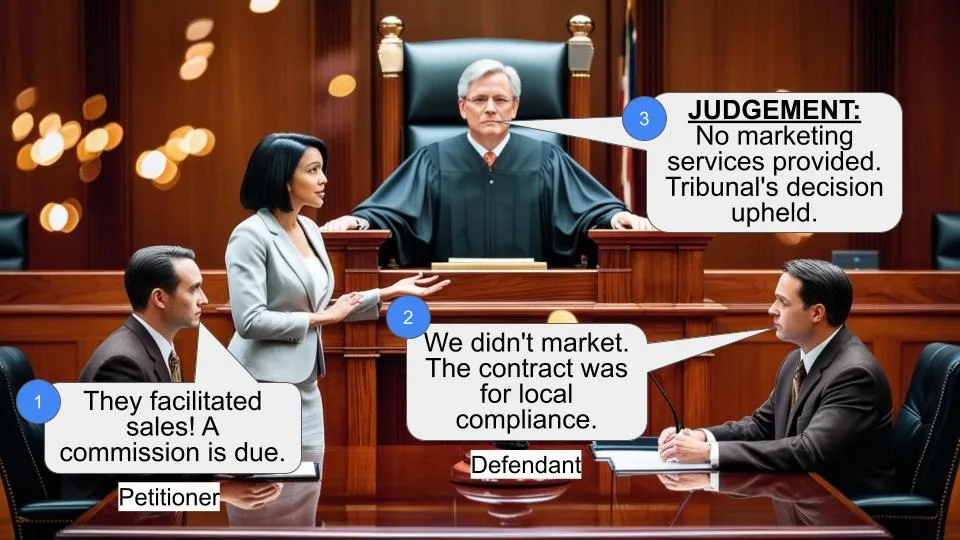
The main question here was: Did the assessee (Solar Turbines India) provide marketing support services to its Associated Enterprise (AE) for the sale of gas turbines in India, for which it should have charged a commission?
Facts:
- Solar Turbines India is in the business of designing, developing, installing, and servicing captive power plants.
- For the 2011-12 assessment year, they filed a tax return declaring an income of Rs.3,35,45,354.
- The Tax Department made a transfer pricing adjustment of Rs.32,35,68,333, claiming the company provided marketing support to its AE (Turbomach SA, Switzerland) for selling gas turbines in India.
- This adjustment was based mainly on a contract Solar Turbines India had with the Public Works Department (PWD) for the Commonwealth Games (CWG) project.
- The company appealed this adjustment, first to the Dispute Resolution Panel, which upheld it, and then to the Income Tax Appellate Tribunal, which deleted the adjustment.
Arguments:
Tax Department's side:
- Solar Turbines India acted as an agent for its AE in the PWD contract and other turbine sales in India.
- They should have charged a commission for these services.
- They calculated an arm's length price for this commission based on comparable companies.
Solar Turbines India's side:
- They didn't provide any marketing services to their AE for turbine sales.
- The PWD contract was in their name due to local registration requirements, but the AE directly supplied and billed for the turbines.
- Other Indian customers dealt directly with the AE for turbine purchases.
Key Legal Precedents:
Interestingly, the judgment doesn't cite specific case laws. However, it mentions the principle that each assessment year is independent, and res judicata (a matter already judged) doesn't generally apply to income tax proceedings. But it also notes that the rule of consistency can't be ignored if there's no material difference in facts across years.
Judgement:
The High Court dismissed the Revenue's appeal, agreeing with the Tribunal's decision. They found that:
1. The Tribunal's finding that Solar Turbines India didn't provide marketing services was based on facts and evidence.
2. There was no concrete evidence to support the Tax Department's claim of marketing services being provided.
3. The Tribunal's approach was reasonable and pragmatic.
4. The factual findings weren't perverse or irregular, so they didn't give rise to a substantial question of law for the High Court to intervene.
FAQs:
1. Q: What's transfer pricing?
A: It's the pricing of transactions between related companies, like a parent and subsidiary. Tax authorities ensure these prices are at "arm's length" to prevent tax avoidance.
2. Q: Why was the PWD contract so important in this case?
A: The Tax Department used this contract as evidence that Solar Turbines India was providing marketing services to its AE. However, the court found it was more about meeting local registration requirements.
3. Q: Does this mean companies can always use local entities for contracts without tax implications?
A: Not necessarily. Each case is unique. Here, the court found no evidence of actual marketing services being provided beyond the contract arrangement.
4. Q: Why didn't previous years' assessments matter more in this case?
A: While each tax year is technically independent, the court noted that consistency across years can be relevant when facts remain the same.
5. Q: What's the takeaway for multinational companies operating in India?
A: It's crucial to clearly document and justify inter-company transactions and roles. Mere contract arrangements may not be enough to establish the provision of services for transfer pricing purposes.

1. Heard Mr. Suresh Kumar, learned standing counsel, Revenue for the appellant; and Mr. Nitesh Joshi, learned counsel for the respondent/ assessee.
2. This appeal has been preferred by the Revenue under Section 260A (of Income Tax Act, 1961) (briefly “the Act” hereinafter) assailing the legality and correctness of the order dated 2nd January, 2017 passed by the Income Tax Appellate Tribunal, “K” Bench, Mumbai (“the Tribunal” for short) in Income Tax Appeal No.1075/Mumbai/2016 for the assessment year 2011-12.
3. The appeal has been preferred projecting the following two questions as substantial questions of law:-
“1. Whether on the facts and in the circumstances of the case and in law, the Tribunal was correct in holding that the assessee did not render any services to its AE in respect of marketing support services provided by the assessee to its A.E. in supply of gas turbines to PWD (CGW) by it’s A.E. and such services were required to be bench marked for determining the arm’s length price as the assessee had not charged any price for providing such marketing support services?
2. Whether on the facts and in the circumstances of the case and in law, the Tribunal was correct in holding that the assessee did not render any services to its AE in respect of marketing support services provided by the assessee to its AE, in supply of gas turbines to PWD(CWG) by its AE relying upon the fact that the TPO did not make any such adjustment in AY 2012-13 without appreciating that every assessment year is different assessment year and the principle of res-judicata is not applicable to proceedings under the Income Tax Act, 1961?”
4. From the above it is evident that both the questions relate to the same issue i.e. whether assessee had rendered any service to its associated enterprise (AE) in respect of marketing support services provided by the assessee to its associated enterprise (AE) in supplying gas turbines to the public works department (PWD) in carrying out construction for Common Wealth Games (CWG).
5. The assessee is a resident company engaged in the business of designing, developing, installation, commissioning and service of captive power plants. For the assessment year 2011-12 assessee filed return of income on 29th November, 2011 declaring total income at Rs.3,35,45,354.00.
6. After obtaining due approval from the competent higher authority reference was made by the jurisdictional Assessing Officer to the Deputy Commissioner of Income Tax (Transfer Pricing)-3(1)(1), Mumbai, referred to as Transfer Pricing Officer (TPO) for determining the arm’s length price.
7. Transfer Pricing Officer passed order dated 30th January, 2015 under Section 92CA(3) (of Income Tax Act, 1961) computing the arm’s length price with respect to international transactions of the assessee at Rs.32,35,68,333.00.
8. Against the aforesaid order, assessee filed objection before the Dispute Resolution Panel.
9. Dispute Resolution Panel passed order dated 15th December, 2015 upholding the arm’s length price computed by the Transfer Pricing Officer and rejected the objection.
10. Thereafter, the Assessing Officer passed the consequential assessment order dated 6th January, 2016 under Section 143(3) (of Income Tax Act, 1961) read with Section 144C(13) (of Income Tax Act, 1961). By the said assessment order the aforesaid amount of Rs.32,35,68,333.00 on account of transfer pricing adjustment was added to the business income of the assessee.
11. Aggrieved by the said order of assessment, assessee preferred appeal before the Tribunal under Section 253(1)(d) (of Income Tax Act, 1961). Tribunal by the order dated 2nd January, 2017 deleted the aforesaid transfer pricing adjustment by holding that there was no factual basis for determining the arm’s length price.
12. Aggrieved, present appeal has been filed.
13. Submissions made by learned counsel for the parties have been considered.
14. To appreciate the rival submissions and the questions framed it is considered apposite to advert to the order passed by the Tribunal, relevant portion of which is extracted hereunder :-
“11. We have considered the submissions of the parties and pursued the material available on record in the light of the decisions relied upon. Undisputedly, a reading of the transfer pricing order makes it clear that fulcrum of the entire transfer pricing adjustment made by the Transfer Pricing Officer with regard to the alleged marketing support services provided by the assessee to its A.E. is the supply of gas turbines to PWD (CWG) by the A.E.. On the basis of contract entered into by the assessee (formerly TIPL) with PWD (CGW) the Transfer Pricing Officer concluded that such contract has been entered into by the assessee on behalf of its A.E., or as an agent of A.E., thereby, assessee was rendering marketing support service to its A.E. which needs to be bench marked for determining the arm’s length price as the assessee has not charged any price for providing such marketing support service. On the basis of such contract entered with PWD (CWG) the Transfer Pricing Officer has also roped in the other direct sales of gas turbines by the A.E. to the customers in India for bench marking the arm’s length price of marketing support services allegedly provided by the assessee to its A.E.. At this stage, it needs to be mentioned, as far as the international transactions reported by the assessee with its A.E., the Transfer Pricing Officer has not made any adjustment in respect of them having found the price charged by the assessee to be at arm’s length. As observed earlier by us, the entire basis of transfer pricing adjustment is the contract entered with the PWD (CWG). On a perusal of relevant clauses of contract, a copy of which has been submitted in the paper book, it is noticed that the scope of work as per the NIT is as under:-
“Multipurpose air conditioned indoor stadium with required facilities for netball (competition and training venue) and 400 MT x 8 lane synthetic athletic track with required facilities (training venue) at Tyagraj Sports Complex at Tyagraj Nagar, New Delhi.”
.12. The condition for eligibility for participating for tender, inter-alia, provides for submissions of registration certificate under Delhi Value Added Tax Act, 2004. It also provides original equipment manufacturer (OEM) of gas turbines should be having experience of providing gas based turbine generating system of certain capacity and specification. Admittedly, assessee is not a manufacturer of gas turbines, but, it’s A.E. is. It is not in dispute that assessee’s A.E. i.e. Turbomach SA was not having any VAT registration certificate, hence, was not qualified in participating in the bid. Whereas, the assessee was having registration certificate under the Delhi VAT Act, 2004. Thus, for participating in the bid and obtaining the contract, there was no other option either for the assessee or its A.E. but to submit the bid in assessee’s name, though it is clearly understood by the contractee and contractor that the OEM of gas turbines is assessee’s A.E. Turbomach SA who has to provide gas turbine generation system. Further, the contract between the assessee and the PWD (CWG) clearly specifies the scope of work to be undertaken by the assessee and its A.E. The payments to be made for such work have also been specified. Further, it is a fact on record, A.E. directly raised invoice on PWD for supply of gas turbines and payments were directly made by PWD to A.E.. The contract in clear terms speaks of supply of gas turbines generating system from abroad from the assessee’s A.E. for which payment has been quantified in the contract.
Thus, the contract clearly demarcates the work to be performed by the assessee and payment to be made for such work and supplied to be made by the A.E. and payments to be made for such supply. There is nothing on record to suggest that the assessee has provided any services to its A.E. for sale of its gas based turbines either to PWD and other customers in India. Moreover, the NIT of PWD (CWG) required participation of an original equipment manufacturer which the assessee is certainly not. There is no dispute to the fact that from the earlier years also, the A.E. is supplying gas based turbine generating system to customers in India, whereas, the assessee is providing services relating to installation, commissioning, annual maintenance as well as supply of spare parts. It is also not disputed that the payments relating to gas based turbine generating systems were made to the A.E. directly by the contractees. That being the case, in the absence of any material to show that the assessee had provided any marketing services to its A.E. in relation to supply of gas turbine generating system, income relating to indenting commission cannot be computed notionally alleging provision of such services. It is further more necessary to observe that on the basis of contract with PWD (CWG), the Transfer Pricing Officer has computed commission on gas turbines sold by the A.E. to other customers in India on a presumptive basis.
Admittedly, in case of sales made by the A.E. to other parties in India the assessee is no way involved in the sales effected as the concerned parties have directly entered into contract/ negotiation with Turbomach SA for supply of gas based turbines. In this context, a reference can be made to the replies submitted by the concerned parties in compliance to notices issued under section 133(6) (of Income Tax Act, 1961) by the Transfer Pricing Officer. Though, relying upon these replies the Transfer Pricing Officer had concluded that assessee had provided marketing support services to its A.E. as regards sale of turbine to Indian customers, however, a careful reading of the replies proves otherwise. On a perusal of the aforesaid replies given by the parties in India to whom the A.E. had sold turbines, copies of which are placed in Volume-V of the paper book, it is evident all of them have categorically stated that they came to know about Turbomach SA through various OEM in Europe and they had negotiated directly with Tubomach SA for purchase of gas turbine which continued from earlier years and the assessee was no way involved in such transaction. Further, the concerned parties also stated, as far as assessee is concerned, they have independent contract for installation, maintenance of gas turbines and supply of balance plant. We have noted, the Transfer Pricing Officer has selectively used the information obtained from the parties under section 133(6) (of Income Tax Act, 1961). The Transfer Pricing Officer instead of bringing on record any substantive evidence to establish the fact that the assessee had rendered any service in respect of sale of gas turbines by the A.E. to other parties in India has simply alleged that assessee has failed to prove the fact that it had not provided and support services to its A.E. in relation to sale of turbines. When from the initial stage of the proceeding assessee had been denying that it had not provided any such services to A.E., the Departmental Authorities cannot insist upon the assessee to prove the negative. Therefore, where the Transfer Pricing Officer accepts the fact that the international transactions entered into by the assessee as reported in Form No.3CEB are at arm’s length, he cannot bench mark arm’s length price of the indenting commission alleged to have been received by the assessee for providing marketing support service to the A.E. notionally when there is no evidence to come to such a conclusion that assessee in fact has rendered any such services to A.E. That being the case, merely on presumption and surmises, the transfer pricing adjustment cannot be made unless there are concrete evidence before the Departmental Authorities to establish fact that the assessee has rendered marketing support services to the A.E. in relation to sale of gas turbines to customers in India. This view of our is fortified further from the fact that, though, nature and character of the business of the assessee and its A.E. remained the same over the years, however, in no other assessment year any transfer pricing adjustment on account of provision of marketing support services to AE has been made. This is evident from the order passed by the Transfer Pricing Officer under section 92CA (of Income Tax Act, 1961) for A.Y. 2012-13. Though, each assessment year is independent and principle of res-judicata generally do not apply to income tax proceeding, however, rule of consistency cannot be ignored if there is no material difference in facts. Therefore, there being no basis for concluding that the assessee has provided any marketing support services to A.E. or has received any commission from the A.E. for providing such marketing support services, the transfer pricing adjustment made is hereby deleted. Grounds No.1 to 5 are allowed. Since we have held that there is no factual basis for determining the arm’s length price of indenting commission for provision of marketing support services to A.E., it is not necessary to dwell upon the decisions relied upon by the parties.”
15. As noticed above, assessee had made reference to the Transfer Pricing Officer to determine the arm’s length price in respect of the international transactions entered into by the assessee. Transfer Pricing Officer found that in the relevant previous year assessee had entered into about seven international transactions with its associated enterprise (AE) i.e. Turbomach SA, Switzerland. During the proceedings before him, Transfer Pricing Officer received information from the Assessing Officer to the effect that assessee had entered into a contract with PWD (CWG), Delhi on behalf of its AE for supplying of gas turbine and that there was installation commissioning etc. According to the Transfer Pricing Officer, the entire billing process and subsequent granting of contract was attended to and coordinated by the assessee on behalf of its AE. Assessee liasoned with the Government of India on behalf of its AE. While submitting the bill assessee had bifurcated the contract value of Rs. 19,57,68,000.00 into two parts, namely, Rs.12,49,68,000.00 for the AE and Rs.7,08,00,000.00 for the assessee. It was also noticed that there was significant entries in travel cost which was not commensurate with the increase in number of employees. The travel cost included a substantial amount for traveling to Switzerland and possibly in relation to the contract.
16. According to the assessee, the turbines were not supplied by it but were directly purchased by the party from the AE. Assessee also claimed that it did not have any permanent establishment (PE) in India.
17. A question arises as to why no service charges/ commission was not charged by the assessee from the AE when the entire licensing work for the purchase of turbines by the Indian customers from the AE was undertaken by the assessee and the contract for installation/ commissioning/ maintenance of such turbines were done by the assessee. On this issue Transfer Pricing Officer sought for details from the assessee and also information from the Assessing Officer whereafter Transfer Pricing Officer took the view that the entire bill was entered into by the assessee on its own behalf as well as on behalf of its AE though in its own name. Therefore, it was concluded that though the turbine was supplied by the AE to the PWD (CWG) as per the contract, however, assessee had provided support service to the AE and had also acted like an agent in selling its turbine in India. Transfer Pricing Officer further noticed that communication by PWD was with the assessee and not with the AE from which he inferred that for supply of turbines by the AE to PWD it was essentially the assessee who was liasoning with PWD on behalf of the assessee. He also referred to information obtained from six parties to whom the AE had supplied turbines.
18. Therefore, Transfer Pricing Officer concluded that assessee had provided support service for sale, marketing and after sale service on behalf of AE in India for which it received indenting commission for providing services.
19. On that basis an exercise was carried out to determine the arm’s length price.
20. Transfer Pricing Officer obtained copies of contract of indenting commission of five other parties and noticed the rates of commission charged on the sales executed by them. Treating those as comparables, Transfer Pricing Officer took 15.83% as average rate of commission charged. He worked out the total sales value of the contract at Rs.2,04,40,19,792.00 and on the basis of the aforesaid rate of commission determined the arm’s length price at Rs.32,35,68,333.00 which was treated as the transfer pricing adjustment.
21. When objections were raised before the Dispute Resolution Panel, those were not accepted; rather Dispute Resolution Panel agreed with the Transfer Pricing Officer and confirmed its order.
22. On the basis of the directions of the Dispute Resolution Panel, Assessing Officer passed the final assessment order which was impugned before the Tribunal.
23. Finding of the Tribunal has already been extracted above.
24. Tribunal noted that the basis of the entire transfer pricing adjustment was the supply of gas turbines to PWD (CWG) by the AE. Tribunal examined the relevant clauses of the contract and noted that eligibility condition for participating in tender was submission of registration certificate under Delhi Value Added Tax Act, 2004, besides submission of certificate of being original equipment manufacturer of gas turbines. Admittedly, assessee was not a manufacturer of gas turbines but its AE was. However, the AE did not have VAT registration certificate. Therefore, it was not qualified to participate in the tender. On the other hand, assessee had registration certificate under the Delhi VAT Act, 2004. Therefore, for participating in the tender and for obtaining the contract the bid was submitted in assessee’s name though it was clearly understood by the contracting parties that the original equipment manufacturer of gas turbines was the AE. Tribunal found that there was nothing on record to suggest that the assessee had provided any services to its AE for sale of its gas based turbines either to PWD or to other customers in India. It was found as a matter of fact that in case of sales made by the Assessing Officer to other parties in India, the assessee was in no way involved in the sales affected. The six parties had stated that they had negotiated directly with the AE for purchase of gas turbines and the assessee was in no way involved in such transactions.
25. Tribunal also noted that for earlier assessment years too there were no transfer pricing adjustments. Thus, there was no basis for concluding that assessee had provided any market support services to the AE or received any commission from the AE for providing such marketing support services. In the absence of concrete evidence, transfer pricing adjustment could not have been made merely on presumptions and surmises. Therefore, the transfer pricing adjustment was deleted.
26. We do not find any error or infirmity in the approach of the Tribunal which is quite reasonable and pragmatic. That apart, the finding returned by the Tribunal that the assessee did not provide any marketing support services to the AE and did not receive any commission from the AE for providing such marketing support services is a finding of fact based on appreciation of evidence and materials on record. Such a finding of fact cannot be said to be vitiated by any material irregularity or perversity. In the absence thereof, no substantial question of law arises from the impugned order of the Tribunal.
27. Consequently, we do not find any error or infirmity in the view taken by the Tribunal. There is no merit in the appeal. Appeal is accordingly dismissed. No cost.
(MILIND N. JADHAV, J.) (UJJAL BHUYAN,
×
Similar Ripples
Questions
Tax Tribunal Rejects Revenue's Appeal on Transfer Pricing Adjustment
Write your CommentSimilar Posts


Generic
- Reportdata/6273.pdf
