


Full News
Tax Tribunal's Decision to Delete STT Penalty Upheld by High Court
Tax Tribunal's Decision to Delete STT Penalty Upheld by High Court
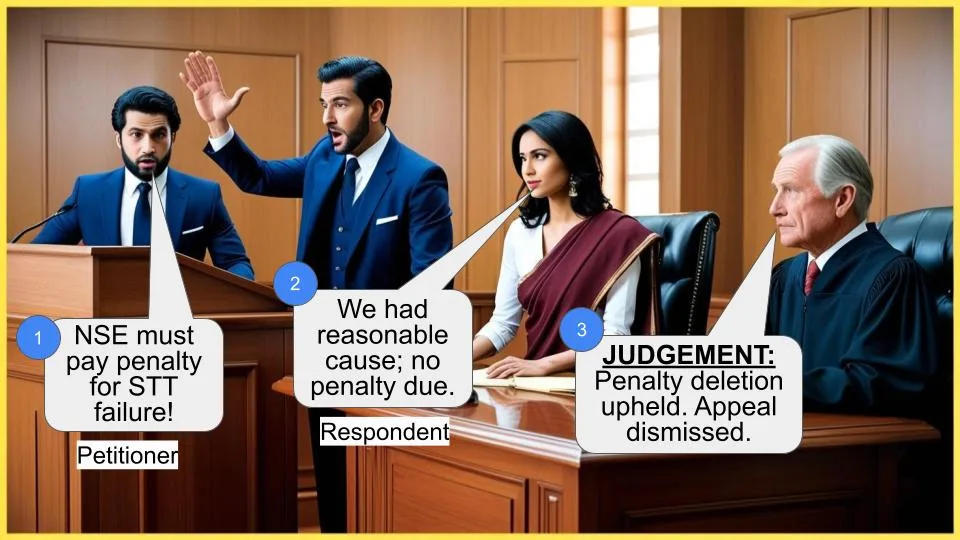
The Principal Commissioner of Income Tax (that's the Revenue department) appealed against a decision made by the Income Tax Appellate Tribunal. The Tribunal had deleted a penalty imposed on the National Stock Exchange (NSE) for allegedly failing to collect or pay Securities Transaction Tax (STT). The High Court ended up dismissing the Revenue's appeal, agreeing with the Tribunal's decision to delete the penalty. It's a win for the NSE.
Get the full picture - access the original judgement of the court order here
Case Name:
Principal Commissioner of Income Tax vs National Stock Exchange (High Court of Bombay)
Income Tax Appeal No.1171 of 2017
Date: 3rd February 2020
Key Takeaways:
1. Penalty for STT non-compliance isn't automatic - there needs to be a separate proceeding.
2. The assessee (that's the taxpayer) must be given a chance to explain before imposing a penalty.
3. If there's a reasonable cause for failing to collect or pay STT, no penalty should be imposed.
4. The court emphasized the importance of proving deliberate law defiance before imposing penalties.
Issue:
The main question here was: Did the Tribunal err in deleting the penalty levied under Section 105(a) of the Securities Transaction Tax (STT) falling under Chapter VII of Finance (No.2) Act, 2004?
Facts:
1. The case is about the financial year 2006-07.
2. The Income Tax Appellate Tribunal had deleted a penalty imposed on the National Stock Exchange.
3. This penalty was related to alleged failure in collecting or paying Securities Transaction Tax.
4. The Revenue department wasn't happy with this decision and appealed to the High Court.
5. There was a previous related case (Income Tax Appeal No.1187 of 2017) where the court had already dealt with the main tax issue.
Arguments:
The Revenue's side (the appellant) argued:
1. The Tribunal was wrong in deleting the penalty under Section 105(a) of the STT Act.
2. The NSE failed to discharge its statutory duty to collect STT at prescribed rates.
The NSE's side (the respondent) likely argued:
1. They had reasonable cause for any alleged failure.
2. The penalty was imposed without giving them a proper chance to explain.
Key Legal Precedents:
The judgment doesn't mention specific case laws, but it does refer to important legal provisions:
1. Section 260A (of Income Tax Act, 1961) - This is about appeals to the High Court.
2. Sections 105 and 108 of Chapter VII of Finance (No.2) Act, 2004 - These deal with penalties for STT non-compliance and exceptions to penalties.
Judgement:
The High Court dismissed the Revenue's appeal. Here's why:
1. They agreed with the Tribunal's decision to delete the penalty.
2. They emphasized that Section 108 (of Income Tax Act, 1961) overrides Section 105 (of Income Tax Act, 1961), meaning penalties aren't automatic.
3. The court said that before imposing a penalty, the assessing officer must conclude there was deliberate law defiance.
4. In this case, the court found no evidence of such deliberate defiance.
FAQs:
1. Q: Does failing to collect STT automatically lead to a penalty?
A: No, it doesn't. The assessee must be given a chance to explain, and if there's a reasonable cause, no penalty should be imposed.
2. Q: What's the significance of Section 108 (of Income Tax Act, 1961) in this case?
A: Section 108 (of Income Tax Act, 1961) provides an exception to penalties if the assessee can prove reasonable cause for the failure.
3. Q: Can the Revenue department appeal this decision further?
A: The judgment doesn't mention this, but typically, there might be an option to appeal to the Supreme Court if there's a substantial question of law.
4. Q: What's the main takeaway for businesses dealing with STT?
A: It's crucial to understand that even if there's a failure to collect or pay STT, you have the right to explain your case before any penalty is imposed.
5. Q: How does this judgment affect the interpretation of tax penalty laws?
A: It reinforces the principle that tax authorities must prove deliberate law defiance before imposing penalties, not just technical non-compliance.

1. Heard Mr.Suresh Kumar, learned standing counsel, Revenue for the appellant; and Mr.J.D.Mistri learned senior counsel assisted by Mr.Atul K. Jasani, learned counsel for the respondent.
2. This appeal has been preferred by the Revenue under Section 260A (of Income Tax Act, 1961) (briefly “the Act” hereinafter) against the order dated 4th April, 2016 passed by the Income Tax Appellate Tribunal, Mumbai Bench “B”, Mumbai (briefly “the Tribunal” hereinafter) in Security Tax Appeal No.01/Mum/2013 for the financial year 2006-07.
3. In this appeal the appellant has proposed the following two questions as substantial questions of law:-
(i) Whether in the facts and in the circumstances of the case and in law the Tribunal erred in deleting the penalty levied under Section 105(a) of the Securities Transaction Tax (STT) falling under Chapter VII of Finance (No.2) Act, 2004?
(ii) Whether in the facts and in the circumstances of the case and in law the Tribunal erred in deleting the penalty levied under Section 105(a) of the Securities Transaction Tax (STT) falling under Chapter VII of Finance (No.2 ) Act, 2004 in view of the failure of the assessee to discharge its statutory liability to collect the STT at prescribed rates under section 100(4) of the Securities Transaction Tax (STT) falling under Chapter VII of Finance (No.2) Act, 2004?
4. In Income Tax Appeal No.1187 of 2017, we have already set aside the order of the Tribunal dated 4th April, 2016 to the extent of deletion of the addition made by the Assessing Officer and limited by the Commissioner of Income Tax (Appeals) to Rs.2,80,78,444.00.
5. Ordinarily once the court holds that the respondent is not liable for the short deduction of STT, the penalty imposed thereon would not survive as in such a case the respondent cannot be construed to be an assessee in default. However, in addition to the above, we find that there are good grounds for interfering with the penalty imposed.
6. Section 105 of Chapter VII of Finance (No.2) Act, 2004 dealing with Securities Transaction Tax (STT) provides for penalty for failure to collect or pay STT. As per Section 105 (of Income Tax Act, 1961) any assessee who fails to collect the whole or any part of the STT as required under Section 100 (of Income Tax Act, 1961) or having collected the STT fails to pay such tax to the credit of the Central Government in accordance with sub-section (3) of Section 100 (of Income Tax Act, 1961), he shall be liable to pay penalty in addition to interest. The quantum of penalty is provided in that section itself. 7. However, as per Section 108 (of Income Tax Act, 1961), notwithstanding anything contained in the provisions of Section 105 (of Income Tax Act, 1961) or Section 106 (of Income Tax Act, 1961) or Section 107 (of Income Tax Act, 1961), no penalty shall be imposable for any failure referred to in the said provisions if the assessee proves that there was reasonable cause for the said failure and as per the proviso no order imposing a penalty shall be made unless the assessee had been given a reasonable opportunity of being heard.
8. If Section 105 (of Income Tax Act, 1961) is read in isolation, it would appear that failure to pay the tax by the assessee i.e., either failure to collect the STT or failure to deposit the STT so collected to the credit of the Central Government would automatically lead to imposition of penalty. This is so because of the use of the word “shall” in that section. However, Section 108 (of Income Tax Act, 1961) starts with a non-obstante clause by use of the expression “notwithstanding”. It is further clarified that Section 108 (of Income Tax Act, 1961) would have effect notwithstanding anything contained in Section 105 (of Income Tax Act, 1961) or the other two sections mentioned therein. In other words, Section 108 (of Income Tax Act, 1961) would have overriding effect over Section 105 (of Income Tax Act, 1961). Section 108 (of Income Tax Act, 1961) makes it abundantly clear that merely because there is infraction of Section 105 (of Income Tax Act, 1961) imposition of penalty is not automatic. For that the assessee would have to be given a reasonable opportunity of being heard and in the process of such hearing if the assessee proves that there was reasonable cause for such failure, then in such a case the Assessing Officer shall not impose any penalty.
9. A careful and conjoint reading of the two provisions i.e. Sections 105 and 108 would therefore make it clear that imposition of penalty is to be proceeded separately as a separate proceeding. Merely because in the assessment order the Assessing Officer comes to a conclusion that the assessee had failed to collect the STT or had failed to pay such STT to the credit of the Central Government, it would not ipso-facto lead to imposition of penalty. Once such a conclusion is reached, the assessee is required to be provided reasonable opportunity of hearing and during the hearing if the assessee can prove that there was reasonable cause for such failure, no penalty shall be imposed.
10. Though, as observed by the Supreme Court, the expression ‘penalty’ is a word of wide significance, but in substance penalty is in the nature of punishment. Therefore, before imposing penalty the Assessing Officer must come to the conclusion that there was deliberate defiance of the law or wilful contravention of the law by the assessee.
11. Reverting back to the facts of the present case, we find the Assessing Officer had passed a composite assessment order dated 30th March, 2011. In appellate proceedings, Tribunal had already held the respondent to be not liable for any alleged short deduction of STT which finding we have affirmed.
12. Thus in the facts and circumstances of the case and having regard to the discussions made above, we are of the firm view that the Tribunal was justified in deleting the penalty imposed on the respondent by the Assessing Officer.
13. Consequently, we find no merit in the appeal. Appeal is accordingly dismissed. No cost.
×
Similar Ripples
Questions
Tax Tribunal's Decision to Delete STT Penalty Upheld by High Court
Write your CommentSimilar Posts
Generic
- Reportdata/6302.pdf
