


Trust's Delay in Registration Appeal Dismissed: Ignorance of Law No Excuse





Full News
Trust's Delay in Registration Appeal Dismissed: Ignorance of Law No Excuse
Trust's Delay in Registration Appeal Dismissed: Ignorance of Law No Excuse
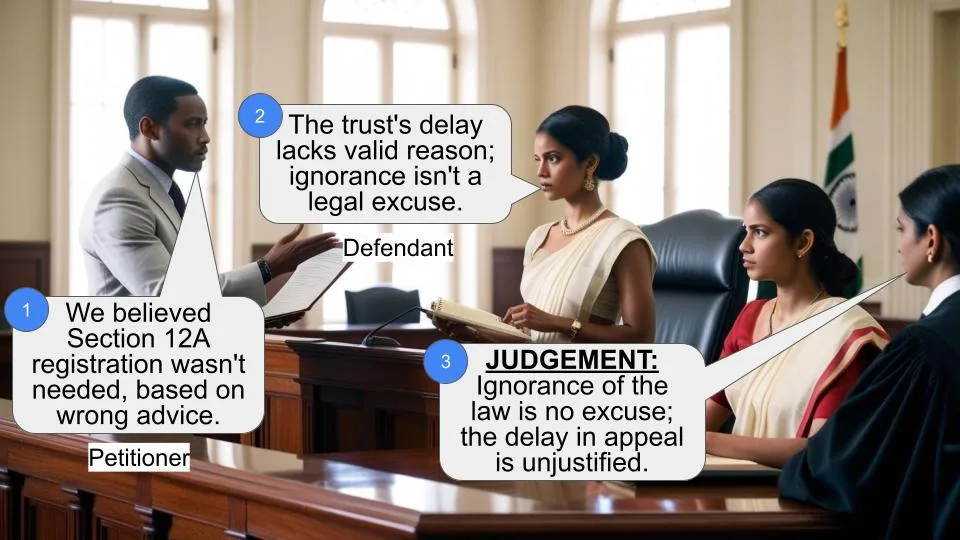
The case involves a trust that appealed against the Income Tax Appellate Tribunal's decision, which dismissed their appeal due to a significant delay in filing. The trust claimed they were under the impression that registration under Section 12A (of Income Tax Act, 1961) was not necessary for tax exemption. The court upheld the Tribunal's decision, emphasizing that ignorance of the law is not a valid excuse for the delay.
Get the full picture - access the original judgement of the court order here
Case Name:
Spporthi Sadan Convent Vs Commissioner of Income Tax (High Court of Karnataka)
ITA No. 100066 of 2015
Date: 17th February 2016
Key Takeaways:
- Ignorance of the law is not a valid excuse for failing to meet legal deadlines.
- The trust failed to provide evidence or substantiate claims of being misadvised.
- The court emphasized the importance of adhering to procedural timelines in legal matters.
Issue
Was the trust's delay in filing the appeal excusable due to their claimed ignorance of the legal requirement for registration under Section 12A (of Income Tax Act, 1961)?**
Facts
- The appellant, a trust, filed an application for registration under Section 12A (of Income Tax Act, 1961), which was rejected.
- The trust appealed the rejection to the Income Tax Appellate Tribunal with a delay of 997 days.
- The trust claimed they were under the impression that registration was not necessary for tax exemption and that they were wrongly advised.
Arguments
- Appellant (Trust): Argued that they were under a bona fide impression that registration under Section 12A (of Income Tax Act, 1961) was not required and that they were misadvised. They failed to provide evidence or the source of this advice.
- Respondent (Commissioner of Income Tax): Argued that the trust did not provide a valid reason for the delay and that ignorance of the law is not an excuse.
Key Legal Precedents
- The court referenced the case of The Swadeshi Cotton Mills Co. Ltd. vs. The Government of U.P., which established that ignorance of the law is not an excuse for failing to take appropriate steps within the limitation period.
Judgement
The court dismissed the appeal, agreeing with the Tribunal that the trust did not provide sufficient grounds for condoning the delay. The court reiterated that ignorance of the law is not a valid excuse and upheld the Tribunal's decision.
FAQs
Q1: Why was the trust's appeal dismissed?
A1: The appeal was dismissed because the trust failed to provide a valid reason for the 997-day delay in filing the appeal. Ignorance of the law was not accepted as an excuse.
Q2: What was the trust's main argument?
A2: The trust argued that they were under a bona fide impression that registration under Section 12A (of Income Tax Act, 1961) was not necessary for tax exemption and that they were misadvised.
Q3: What does this case mean for other trusts?
A3: This case underscores the importance of understanding legal requirements and adhering to procedural timelines. Trusts must ensure they are properly registered and meet all legal obligations to avoid similar issues.

1. The appellant has called in question the order dated 7/1/2015 in ITA No.168/2014 passed by the Income Tax Appellate Tribunal, Panaji Bench, Panaji (ITAT for short), dismissing the appeal as having been barred by limitation.
2. Heard Sri. S. Parthasarathi, the learned counsel appearing for the appellant and Sri. Y.V. Raviraj, learned counsel appearing for the respondent.
3. It is submitted by the learned counsel for the appellant that, the appellant had filed an application under Section 12A (of Income Tax Act, 1961), for registration of trust. The said application had been rejected vide order dated 24/6/2011 by the Commissioner of Income Tax. This order was challenged before the ITAT. The said appeal was presented with the delay of 997 days. The Tribunal on consideration of the material on record with regard to the delay in filing the appeal has recorded a finding which reads follows:
“The learned AR though vehemently
contended that it was under bonafide impression
that Registration u/s 12A (of Income Tax Act, 1961) was not a condition
precedent for the relief by way of exemption u./s
11 of the Act and that it had been advised
accordingly, but when questioned could not give
the name of the counsel who had advised in this
regard. Even when we asked for the Affidavit of
the concerned person, the ld. AR expressed his
inability to file the same. We were also surprised
to see that the Trust Deed has been notarized
even though the Trust has been created as per the
history given in the Trust Deed for the purpose of
properties of school. In our opinion, a Trust
cannot hold/acquire immovable properties until
and unless it is registered with the Sub-Registrar.
It is not a case where a person has put his
property in the Trust. Although the Trust was
created on 15/3/2010 but the led. AR could not
produce any Income & Expenditure Account and
Balance sheet, audited or otherwise, for the year
ended 31/3/2010, 31/3/2011, 31/3/2012,
31/3/2013 and 31/3/2014. Rather, he explained
his inability to submit the same. If the Assessee
has applied for condonation of delay, the onus is
on the Assessee to explain the reason for each and
every day of the delay. Except submitting that the
Assessee was not aware of the law, he could not
explain the reason for the delay occurred in filing
the appeal”.
4. After recording the aforementioned finding and
adverting to the judgement in the case of Surinder Kumar
Boveja Vs. CWT, 287 ITR 52 (Delhi), the tribunal dismissed
the appeal as having been barred by limitation.
5. A careful perusal of the findings recorded by the
Tribunal clearly points to the fact that the delay was sought
to be explained on two grounds. Firstly, that the trust was
under the bonafide impression that such a registration was
not condition precedent for seeking relief under Section 11 (of Income Tax Act, 1961) of
the Income Tax Act 1961 (‘Act’ for short). Secondly, that the
appellant Trust was advised wrongly. In order to
substantiate the said contention, no material was placed
before the Tribunal. The Tribunal has given sufficient
opportunity to the appellant to substantiate its claim that it
was ill advised by the consultants. With regard to the
requirement of registration, the trust has apparently not
shown any reasonable cause nor answered the queries raised
by the Tribunal during the course of hearing.
6. The learned counsel for the appellant before this Court
has contended that the Tribunal was not justified in
dismissing the application on the ground of limitation and
ought to have noted that to meet ends of substantial justice,
the delay ought to have been liberally construed.
7. This is not a case wherein the appellant is an illiterate
person, who may not know the repercussion in law. Further,
it is the specific case of the appellant that the Trust was
under banafide impression that Registration under Section
12A was not a condition precedent and such impression was
based on advise. But, nonetheless, the appellant neither
chose to reveal the source of such advice nor replied to the
questions posed by the Tribunal. In such circumstances, the
appeal challenging the order of the Tribunal is only a
reiteration of grounds urged before the Tribunal.
8. The learned counsel for the appellant contended that
though the counsel appearing for the appellant offered to
furnish the details sought for by the Tribunal, no time was
granted by the Tribunal. No specific ground is urged in this
behalf in the pleadings either in the form of statement of
facts or affidavit to substantiate such contention.
9. Ignorance of law is no excuse. We may usefully refer to
the judgement of the Hon’ble Supreme Court in the case of
The Swadeshi Cotton Mills Co.Ltd. vs. The Government of
U.P. and Others reported in (1975) 4 SCC 378, wherein it is
held as follows:-
“......But we are in agreement with the High
Court on the other two grounds. As mentioned
earlier, the impugned assessments were made in
1949. The writ petition was filed in 1956. The
explanation given by the petitioner for this long
delay is that he did not know the correct legal
position and he came to know about the same
after the decision of the Allahabad High Court in
the Commissioner of Sales Tax, U.P. Vs. Modi
Food Products Ltd. Every individual is deemed to
know the law of the land. The courts merely
interpret the law and do not make law. Ignorance
of law is not an excuse for not taking appropriate
steps within limitation. Therefore the argument
that the appellant did not know the true legal
position is not one that can be accepted in law.
10. In the circumstances, we are of the considered view
that the appellant has not made out any ground for
condonation of delay of 997 days before the Tribunal. We see
no error in the order passed by the Tribunal. Accordingly,
the appeal fails and stands dismissed.
Sd/-
JUDGE
Sd/-
JUDGE
×
Similar Ripples
Questions
Trust's Delay in Registration Appeal Dismissed: Ignorance of Law No Excuse
Write your CommentSimilar Posts
Generic
- Reportdata/3079.pdf
