


Court Overturns Transfer Pricing Adjustment Based on Single Disputed Comparable


Full News

Court Overturns Transfer Pricing Adjustment Based on Single Disputed Comparable
Court Overturns Transfer Pricing Adjustment Based on Single Disputed Comparable
The Delhi High Court set aside orders by the Income Tax Appellate Tribunal (ITAT) and other tax authorities regarding a Transfer Pricing Adjustment for Pyramid IT Consulting P Ltd. The court found that the adjustment, based solely on one disputed comparable company, required more detailed consideration and remanded the case for fresh determination.
Get the full picture - access the original judgement of the court order here.
Case Name:
Pyramid IT Consulting (P) Ltd. & Anr. Vs Additional Commissioner of Income Tax & Anr. (High Court of Delhi)
W.P.(C) 5198/2019
Key Takeaways:
1. A Transfer Pricing Adjustment based on a single comparable requires thorough justification.
2. Functional differences between the assessee and comparables must be carefully considered.
3. Previous relevant ITAT decisions should be taken into account in similar cases.
4. The court can remand cases for fresh determination when key issues are overlooked.
Issue:
Was the ITAT justified in upholding the Transfer Pricing Adjustment based solely on one comparable (HCCA) that the Assessee objected to due to functional differences?
Facts:
1. Pyramid IT Consulting P Ltd. is engaged in IT solutions and staffing services.
2. For AY 2010-2011, the company's international transactions were referred to the Transfer Pricing Officer (TPO).
3. The TPO rejected the Assessee's proposed comparables and introduced HCCA as a comparable.
4. Based on HCCA's margin of 20.05%, the TPO recommended an adjustment of Rs.1,03,61,078/-.
5. The Dispute Resolution Panel (DRP) upheld the TPO's order.
6. The ITAT rejected the Assessee's contention that HCCA was not a suitable comparable.
Arguments:
Assessee:
1. HCCA was functionally different as it owned intangibles, unlike the Assessee.
2. The ITAT had previously ruled in LG Chemicals India Pvt. Ltd. v. ACIT that companies owning intangibles cannot be compared with those that don't.
3. HCCA primarily provided payroll processing services, different from the Assessee's functions.
Revenue:
Argued that mere exclusion or inclusion of a comparable doesn't give rise to a substantial question of law, citing settled legal positions.
Key Legal Precedents:
1. LG Chemicals India Pvt. Ltd. v. ACIT: ITAT ruled that a company owning intangibles cannot be compared with one that doesn't.
Judgement:
1. The court set aside the ITAT's orders dated 11th July 2018 and 25th March 2019.
2. The TPO's order dated 24th January 2014 and DRP's order dated 27th October 2014 were also set aside.
3. The case was remanded to the TPO for fresh determination of Transfer Pricing adjustment.
4. The TPO was directed to examine the inclusion/exclusion of comparables proposed by both the Assessee and the Revenue.
FAQs:
Q1: Why did the court overturn the ITAT's decision?
A1: The court found that the ITAT overlooked key issues, including functional differences between the Assessee and HCCA, and didn't consider its own previous relevant ruling.
Q2: What is the significance of using only one comparable for Transfer Pricing Adjustment?
A2: Using a single comparable requires thorough justification, especially when objected to by the Assessee. In this case, it led to the court remanding the case for fresh consideration.
Q3: What should the TPO consider in the fresh determination?
A3: The TPO should examine the inclusion/exclusion of comparables proposed by both the Assessee and the Revenue, considering functional similarities and differences.
Q4: How does this judgment impact future Transfer Pricing cases?
A4: It emphasizes the need for careful consideration of functional differences between comparables and the importance of addressing all relevant arguments and precedents in Transfer Pricing cases.

1. Notice. Learned counsel for the Respondent accepts notice.
2. Both these matters concern a common issue regarding Transfer Pricing Adjustment for the international transaction involving the Petitioner/ Appellant which is headquartered in the United States of America and is engaged in the business of providing value added IT Solutions and IT staffing services to global companies including growing mid-tier firms. The Appellant claims that it is primarily engaged in the provision of contract software development (‘CSD segment’) and recruitment/manpower services.
However, the present cases concern the issue of transfer pricing for its staffing segment.
3. For Assessment Year (AY) 2010-2011 the Assessee filed a return declaring an income of Rs. 32,79,820/- and paid tax under section 115 (of Income Tax Act, 1961) JB on a book profit of Rs 1,76,61,244/-.
4. The Assessing Officer (‘AO’) after noting that there were international transactions entered into by the Assessee with its Associated Enterprises,referred the case to the Transfer Pricing Officer (‘TPO’) for determining the arm's length price (‘ALP’) of the said international transactions.
5. Admittedly before the TPO as part of the Transfer Pricing Study, the Assessee had put forth two comparables as regards the staffing segment. Both these comparables were rejected by the TPO. On the other hand, the TPO introduced another comparable i.e. HCCA Business Services Pvt. Ltd. (hereafter ‘HCCA’) and after determining that the margin of the said comparable was 20.05% recommended an adjustment of Rs.1,03,61,078/- on the staffing services segment earnings of the Assessee.
6. Aggrieved by the said order of the TPO, the Assessee went before the Dispute Resolution Panel (DRP) which by its decision dated 27th October 2014 upheld the order of the TPO.
7. The Assessee then went before the Income Tax Appellate Tribunal (ITAT) which by the order dated 11th July 2018 rejected the Assessee’s contention that HCCA was not a comparable as it was functionally different.
The Assessee then filed MA No.632/Del/2018 before the ITAT under Section 254(2) (of Income Tax Act, 1961) pointing out that in its order dated 11th July 2018 the ITAT had noted that HCCA owns ‘intangibles’ and yet it was not excluded as a comparable. The case of the Assessee was that a company owning intangibles like HCCA could not be compared with the Assessee which admittedly does not own intangibles. The Assessee pointed out that it had placed before the ITAT the decision dated 3rd May 2016 of the ITAT itself in LG Chemicals India Pvt. Ltd. v. ACIT where the same comparable i.e. HCCA had been excluded since it had a different functional profile from the Assessee in that case. It was pointed out that the said decision was not even discussed by the ITAT in its order dated 11th July 2018.
8. The said MA was dismissed by the ITAT by its order dated 25th March 2019. It is against the said order that W.P. (C) 5198/2019 has been filed by the Assessee.
9. Ms. Vibhooti Malhotra, learned counsel for the Revenue, submitted that the mere exclusion or inclusion of a comparable for the purposes of Transfer Pricing Adjustment does not give rise to any substantial question of law and this has been the settled legal position as explained in several decisions of this Court as well as other High Courts.
10. While it is correct that the mere exclusion or inclusion of a comparable may not per se give rise to any substantial question of law, in the present case the Court finds that the only comparable on the basis of which the Transfer Pricing Adjustment has been recommended by the TPO is HCCA. The two comparables proposed by the Assessee have been excluded by the TPO. These two comparables were Ma Foi Management Consultants Ltd. and Overseas Manpower Corporation Ltd. The Court further finds that when the matter went before the DRP, another comparable was introduced by the DRP viz., Nirbhay Management Services Pvt. Ltd. However even the DRP picked up only HCCA for upholding the Transfer Pricing Adjustment as proposed by the TPO. In that view of the matter it cannot be said that the impugned order of the ITAT does not give rise to any substantial question of law.
11. Admit (as far as the appeal is concerned).
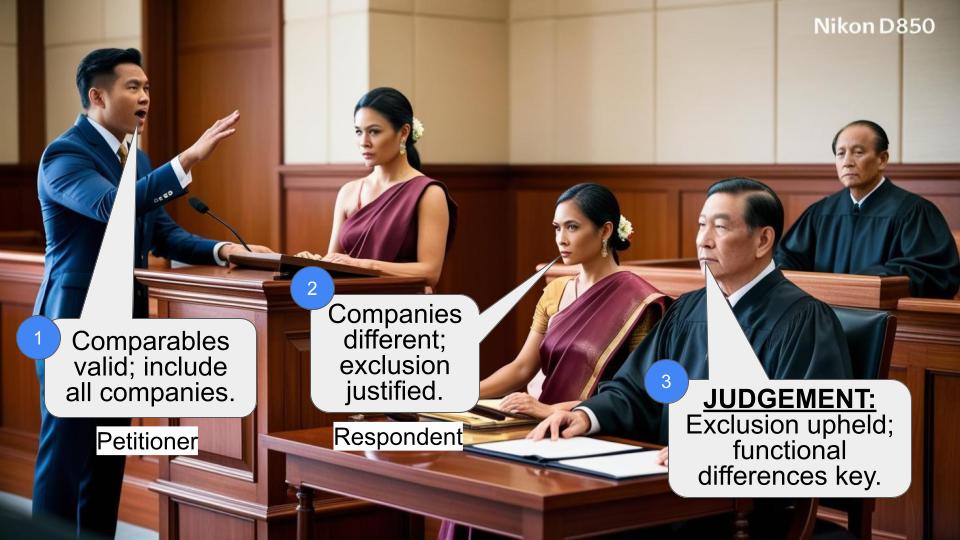
12. The question of law that arises for determination in the appeal is whether the ITAT was justified in upholding the exclusion of the comparables suggested by the Assessee and in approving the TP adjustment as proposed by the TPO only on the basis of one comparable objected to by the Assessee on account of it being functionally different from the Assessee?
13. It appears that in the impugned order dated 11th July 2018 of the ITAT there is no discussion of its earlier order in LG Chemicals India Pvt. Ltd. where it was held that a company owning intangibles cannot be compared with one which does not. Also, the order dated 25th March 2019 passed by the ITAT rejecting MA No.632 clearly notes that the agreements referred to in the audit report concerning HCCA were not before the ITAT. The ITAT appears to have overlooked the Assessee’s objections to inclusion of HCCA which according to the Assessee was only providing pay roll processing services. The difference in functionality of the Assessee and HCCA was not discussed by the ITAT.
14. Since the entire TP Adjustment has hinged only on one comparable, viz.,HCCA the objection to the inclusion of which by the Assessee required a detailed consideration, the Court is of the view that the impugned order dated 11th July 2018 of the ITAT cannot be sustained in law. The question of law is accordingly answered in the negative i.e. in favour of the Assessee and against the Revenue.
15. The Court notes that in the impugned order, the ITAT has remanded to the TPO the consideration of one of the comparables proposed by the Assessee viz., Ma Foi Management Consultants Ltd. and one other as suggested by the DRP i.e. Nirbhay Management Services Pvt. Ltd.
16. The Court is of the view that the entire issue of determining the TP adjustment if any in respect of the transactions in the staffing segment of the Assessee should be considered afresh by the TPO uninfluenced by his earlier order.
17. Accordingly while setting aside the orders dated 11th July 2018 and 25th March 2019 of the ITAT and the corresponding orders dated 24th January 2014 of the TPO and 27th October 2014 of the DRP, this Court remands the entire issue of determining the TP adjustment if any in respect of the transactions in the staffing segment of the Assessee to the TPO for a fresh determination. The TPO will examine afresh the question of inclusion and/or exclusion of comparables as proposed by the Assessee and the Revenue.
18. The writ petition and appeal are disposed of in the above terms.
S. MURALIDHAR, J.
I.S. MEHTA, J.
×
Questions
Court Overturns Transfer Pricing Adjustment Based on Single Disputed Comparable
Write your CommentSimilar Posts

Generic
- Reportdata/11148-HC-Delhi.pdf
