


Reopening Tax Assessments: Legal Misstep Overturned


Full News

Reopening Tax Assessments: Legal Misstep Overturned
Reopening Tax Assessments: Legal Misstep Overturned
This case involves the reopening of a tax assessment for an assessee, where the court found that the conditions for such reopening were not met. The court ruled that the notice for reopening the assessment was contrary to law because it did not fulfill the necessary legal requirements.
Get the full picture - access the original judgement of the court order here
Case Name
Commissioner of Income Tax & Anr. vs Jubilant Organosys Ltd. (High Court of Allahabad)
Income Tax Appeal No.413 of 2010
Date: 17th September 2015
Key Takeaways
- The court emphasized the importance of fulfilling all conditions before reopening a tax assessment, especially after four years.
- The decision highlights the necessity for the Assessing Officer to have a valid “reason to believe” that income has escaped assessment due to the assessee’s failure to disclose all material facts.
- The ruling reinforces the legal framework under Section 147 (of Income Tax Act, 1961) and Section 148 (of Income Tax Act, 1961), post-1989 amendments.
Issue
Was the reopening of the tax assessment after four years legally justified without the assessee’s failure to disclose all material facts?
Facts
The case revolves around the reopening of a tax assessment for Jubilant Organosys Ltd. The original assessment was completed under Section 143(3) (of Income Tax Act, 1961). Later, the Assessing Officer issued a notice to reopen the assessment under Section 148 (of Income Tax Act, 1961), claiming that income had escaped assessment. However, the notice did not state that the assessee failed to disclose all necessary facts, which is a prerequisite for reopening an assessment after four years.
Arguments
- For the Revenue: The revenue argued that there was a legal question regarding the Tribunal’s decision, which found the reopening of the assessment lacking the foundational requirement under Section 147 (of Income Tax Act, 1961).
- For the Assessee: The assessee contended that the reopening was unjustified as the necessary conditions, particularly the failure to disclose material facts, were not met.
Key Legal Precedents
- Section 147 (of Income Tax Act, 1961) and Section 148 (of Income Tax Act, 1961): These sections outline the conditions under which an assessment can be reopened. Post-1989, only the “reason to believe” condition is required unless the case falls under the proviso, which requires both conditions to be met.
- ACI Oils P Ltd Vs DCIT and Anr, 370 ITR 561 (All): This precedent was cited to support the decision that the reopening was not justified.
Judgement
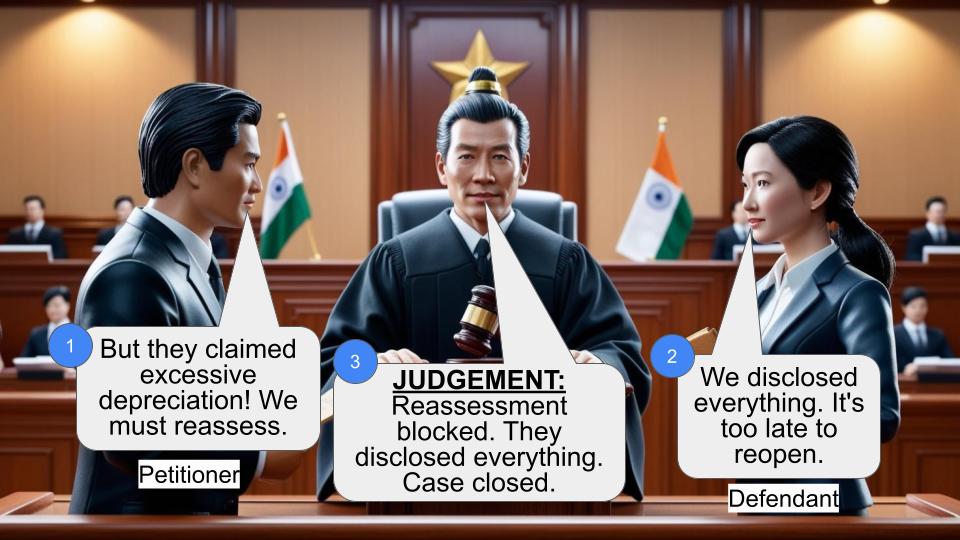
The court dismissed the appeal by the revenue, upholding the Tribunal’s decision that the reopening of the assessment was not legally justified. The court found that the necessary condition of the assessee’s failure to disclose all material facts was not met, making the notice for reopening contrary to law.
FAQs
Q: What does this case mean for future tax assessments?
A: It underscores the importance of meeting all legal conditions before reopening an assessment, particularly the need for a valid reason to believe that income has escaped assessment due to non-disclosure of material facts.
Q: Why was the reopening of the assessment considered contrary to law?
A: Because the notice did not state that the assessee failed to disclose all material facts, which is a required condition for reopening an assessment after four years.
Q: What sections of the Income Tax Act are relevant here?
A: Sections 147 and 148, which deal with the conditions and procedures for reopening tax assessments.

We have heard Sri Shubham Agrawal, the learned counsel for the appellant and Sri R.S.Agrawal, the learned counsel with Sri Rupesh Jain, the learned counsel for the assessee.
The original assessment order was passed under Section 143(3) (of Income Tax Act, 1961) (hereinafter referred to as the Act). Subsequently, proceedings under Section 148 (of Income Tax Act, 1961) were initiated and, after considering the matter, an assessment order was passed. The assessee, being aggrieved, filed an appeal, which was partly allowed. Thereafter, the assessee as well as the revenue filed an appeal before the Tribunal. The appeal of the assessee was allowed and the appeal of the revenue was dismissed. The Tribunal held that the jurisdictional condition for reopening the assessment beyond four years had not been fulfilled and that the assessment could not be reopened merely on change of the opinion without pointing out any failure on the part of the assessee to disclose fully and truly all material facts for the assessment. The revenue, being aggrieved by the order of the Tribunal, has filed the present appeal under Section 260-A (of Income Tax Act, 1961).
Sri Shubham Agrawal, the learned counsel for the appellant contended that a question of law arises, namely, that the Tribunal had committed a manifest error in holding that the foundational requirement of Section 147 (of Income Tax Act, 1961) was lacking .
Reasons for initiating the proceedings under Section 148 (of Income Tax Act, 1961) as depicted in the assessment order is extracted hereunder:
“(i) The dividend income was assessed at Rs. 1,55,39,795/- under the head “Income from other sources” and deduction of the same amount was allowed u/s 80M (of Income Tax Act, 1961). On a perusal of balance sheet for the period ending 31.03.1994, it is seen that there were secured loans as per details given here as under:
(a)Non-convertible debentures Rs.2391.64 lakhs
(b) Term loan Rs. 988,94 lakhs Total Rs. 3380.58 lakhs The assessee had also invested Rs. 793.11 lakhs in purchase of shares of UTI, Housing Development Finance Corpn. And India Glycols Ltd. as on 31.3.94. From the balance sheet, it is apparent that the assessee had made investments in these shares out of funds available after raising loans on non convertible debenture and term loan only. Investment in shares could not be made out of these two loans as one loan (cash credit) is meant for business only and unsecured loans could not be invested for long term period investments i.e. shares. It is, thus, apparent that the assessee had made investment in purchase of shares out of loan on debentures and term loans.
(ii) The assessee had paid interest on these two loans as under:-
On debentures Rs. 351.26 lakhs On Term loan Rs. 39.74 lakhs Rs. 390.00 lakhs
Thus, the part of this interest pertains to the investment in shares on which the assessee earned dividend income and disclosed in the returned income and assessed. The proportionate amount of interest is deductible while computing the dividend income as laid down u/s 52(i) (of Income Tax Act, 1961) & (iii) of I.T.Act 1961 as under:- 3.90 x 7.93 Crores = 0.91 crores 33.81
(iii) In view of the above facts, the dividend is assessable at Rs. 64 lakhs (1.55 -0.91 crores) and deduction u/s 80M (of Income Tax Act, 1961) was allowable at Rs. 63 lakhs (1.54-0.91 crores), which was allowed at Rs. 1.54 crores. The income under the head “profit & gains” computed at Rs. 6.59,18,414/- as per order dated 28.1.98 is to be increased by Rs. 91 lakh and due to this, the assessee will be entitled for extra deduction u/s 80HH (of Income Tax Act, 1961) and 801 (of Income Tax Act, 1961) & 80 (of Income Tax Act, 1961) IA (of Income Tax Act, 1961) at Rs.84,92,766/-. The deductions u/s 80M (of Income Tax Act, 1961) has been allowed in excess by Rs. 91 lakhs and assessee is entitled for further deduction of Rs. 53 lakhs, which resulted into under assessment by Rs. 36 lakh (91-55).”
The scope and effect of Section 147 (of Income Tax Act, 1961) as substituted with effect from 01.04.1989 and also Section 148 (of Income Tax Act, 1961) are substantially different from the provisions as they stood prior to such substitution. Clause (a) and (b) of Section 147 (of Income Tax Act, 1961) laid down the circumstances under which income escaped assessement could be assessed or reassessed.
Section 147 (of Income Tax Act, 1961) contemplated two conditions which were required to be satisfied, namely, that the Assessing Officer must have reasons to believe that income, profit or gain chargeable to tax have escaped assessment, and secondly, he has reasons to believe that such escapement had occurred by reason of omission or failure on the part of the assessee to disclose fully or truly all material facts necessary for the assessment. Both these conditions are conditions precedent and are required to be satisfied before the Assessing Officer could assume jurisdiction under Section 148 (of Income Tax Act, 1961) read with Section 147 (of Income Tax Act, 1961). After 01.04.1989 only the first condition is required, namely, “reasons to believe”, but both the conditions are required to be fulfilled in the event the case falls within the ambit of the proviso to Section 148 (of Income Tax Act, 1961). In the instant case, the case is covered by the proviso.
The “reasons to believe” as recorded by the Assessing Officer does not aver that the assessee had failed to fully and truly disclose all material facts necessary for the assessment, which is a condition precedent for reopening the assessment after four years. The reason to believe only indicates that the reasons for reopening is based on the assessment records and the balance sheet. In our view, the foundational requirement for reopening an assessment beyond four years had not been fulfilled, as per the proviso to Section 147 (of Income Tax Act, 1961), which is a condition precedent. Consequently, we are of the opinion that the notice issued for reopening the assessment was contrary to law since it did not meet with the foundational requirement of the proviso to Section 147 (of Income Tax Act, 1961). Similar view was held by this Court in ACI Oils P.Ltd. Vs. DCIT and Anr., 370 ITR 561 (All.), which is fully applicable in the present case.
The learned counsel for the appellant has placed reliance upon the decisions in Ema India Ltd. Vs. Assistant Commissioner of Income Tax, (2009) 226 CTR (All) 659 and in Nickunj Eximp Enterprises (P) Ltd. Vs. Assistant Commissioner of Income Tax & Anr.,(2014) 270 CTR (Bom) 494,which are not applicable.
In the light of the aforesaid, no substantial question of law arises for consideration. The appeal is dismissed.
Dt: 17.09.2015/-MAA/-
(Surya Prakash Kesarwani,J.) (Tarun Agarwala,J.)
×
Similar Ripples
Questions
Reopening Tax Assessments: Legal Misstep Overturned
Write your CommentSimilar Posts

Generic
- Reportdata/3433.pdf
