


Tax Deduction Claim Not Grounds for Penalty: High Court Ruling


Full News

Tax Deduction Claim Not Grounds for Penalty: High Court Ruling
Tax Deduction Claim Not Grounds for Penalty: High Court Ruling
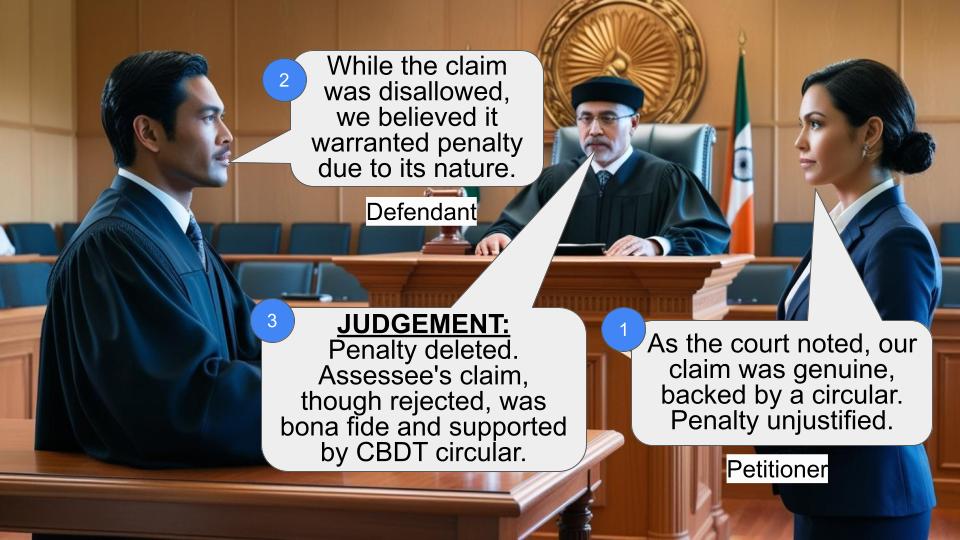
This case involves the Commissioner of Income Tax (CIT) versus Mehta Engineers Ltd. The dispute centered around whether a penalty under Section 271(1)(c) (of Income Tax Act, 1961) was justified for claiming a deduction on educational expenses. The High Court ruled in favor of Mehta Engineers Ltd., affirming that claiming a deduction, even if disallowed, doesn't automatically imply tax evasion.
Get the full picture - access the original judgement of the court order here
Case Name:
Commissioner of Income Tax Vs Mehta Engineers Ltd. (High Court of Punjab and Haryana)
ITA Nos.599 & 600 of 2007
Date: 7th February 2008
Key Takeaways:
1. Claiming a deduction that is later disallowed doesn't automatically constitute tax evasion.
2. Penalty under Section 271(1)(c) (of Income Tax Act, 1961) requires proof of intentional tax evasion.
3. The presence of a written agreement supporting a claim adds credibility, even if the claim is ultimately rejected.
4. Differences in opinion between the assessee and the Assessing Officer don't necessarily indicate concealment of income.
Issue:
Does claiming a deduction for educational expenses of a director's son, based on a written agreement for future service, warrant a penalty under Section 271(1)(c) (of Income Tax Act, 1961) if the deduction is disallowed?
Facts:
1. Mehta Engineers Ltd. (the assessee) claimed deductions for educational expenses of Varun Mehta, son of a company director, for Assessment Years 1996-97 and 1997-98.
2. The claim was based on a written agreement stating Varun would serve the company for at least three years after completing his studies abroad.
3. The Assessing Officer disallowed the deduction and added it to the company's income.
4. The Department initiated proceedings under Section 271(1)(c) (of Income Tax Act, 1961) to impose a penalty, claiming wrong deduction.
5. The Deputy Commissioner imposed a penalty of Rs.2,75,451/-, equivalent to 100% of the tax sought to be evaded.
Arguments:
Assessee's Argument:
- The deduction was claimed based on a legitimate written agreement.
- There was no intention to evade taxes or conceal income.
Revenue's Argument:
- The assessee claimed a wrong deduction in its return.
- The disallowance of the expense justifies the imposition of a penalty.
Key Legal Precedents:
1. Sai Builders case (specific details not provided in the context)
2. Harcharan Singh case (specific details not provided in the context)
3. CIT Vs. Bacardi Martini India Ltd., 288 ITR 585 - Delhi High Court held that a difference of opinion between the assessee and the Assessing Officer doesn't automatically imply an intention to conceal income.
Judgement:
The High Court ruled in favor of Mehta Engineers Ltd., affirming the decision of the Income Tax Appellate Tribunal (ITAT) and the Commissioner of Income Tax (Appeals) to delete the penalty. Key points of the judgment:
1. The assessee's claim was based on a credible written agreement.
2. There was no evidence or finding that the agreement was false or fabricated.
3. Mere disallowance of a claimed deduction doesn't automatically justify a penalty under Section 271(1)(c) (of Income Tax Act, 1961).
4. The case lacked evidence of willful omission or neglect by the assessee.
5. The court found no grounds to interfere with the ITAT's factual findings.
FAQs:
Q1: What is Section 271(1)(c) (of Income Tax Act, 1961)?
A1: Section 271(1)(c) (of Income Tax Act, 1961) deals with penalties for concealment of income or furnishing inaccurate particulars of income.
Q2: Does every disallowed deduction result in a penalty?
A2: No, the court clarified that merely because a deduction is disallowed, it doesn't automatically warrant a penalty. There must be evidence of intentional tax evasion.
Q3: What was the significance of the written agreement in this case?
A3: The written agreement provided credibility to the assessee's claim, even though the deduction was ultimately disallowed. It showed that the claim wasn't made without any basis.
Q4: Can a difference of opinion between the assessee and the Assessing Officer lead to a penalty?
A4: Not necessarily. The court referenced a previous judgment stating that a mere difference of opinion doesn't imply an intention to conceal income or furnish inaccurate particulars.
Q5: What does this judgment mean for taxpayers?
A5: This judgment emphasizes that taxpayers won't be penalized for claiming deductions in good faith, even if those deductions are later disallowed. However, there should be a reasonable basis for the claim.

This order shall dispose of ITA Nos.600 and 599 of 2007 which have been filed by the revenue against the order dated 18.05.2007 passed by the Income Tax Appellate Tribunal (hereinafter referred to as the ITAT') in ITA Nos.739/Chandi/2004 and 213/Chandi/2006 in case of the respondent-assessee for the Assessment Years 1996-97 and 1997-98, respectively.
In this case, the assessee filed the return of income for the Assessment Years 1996-97 and 1997-98 in which he had claimed certain amount as business expenditure incurred by it on studies of Shri Varun Mehta son of Director of the company on the ground that under agreement between the company and the said Varun, he was to serve the company for at least three years after finishing his studies abroad.
The Assessing Officer disallowed the said expenditure and the same was added towards the income. On appeals by the assessee, the said order became final up to the ITAT. Thereafter, the Department started proceedings under Section 271(1)(c) (of Income Tax Act, 1961) (hereinafter referred to as `the Act') against the respondent for imposing penalty on the ground that the assessee claimed wrong deduction in its return. Vide order dated 15.10.2001, Deputy Commissioner of Income Tax, Ludhiana imposed a penalty of Rs.2,75,451/- equivalent to 100% of the tax sought to be evaded.
Feeling aggrieved against the above order, the assessee filed an appeal before the Commissioner of Income Tax (Appeals), who vide order dated 30.03.2004 deleted the penalty imposed by the Assessing Officer under Section 271(1)(c) (of Income Tax Act, 1961) while coming to the conclusion that the case was fit for imposition of penalty for concealment under Section 271(1)(c) (of Income Tax Act, 1961). Against the said order of the Commissioner of Income Tax (Appeals), the revenue filed two separate appeals before the ITAT, who vide order dated 18.05.2007 dismissed the same while observing as under:-
“....The disallowance has been sustained for the reason that assessee failed to justify that the expenditure incurred was for furtherance of the purposes of its business. In so far as the proceedings u/s 271(1)(c) (of Income Tax Act, 1961) is concerned, it is a trite law that the same stand on an altogether different footing than the assessment proceeding. The findings of the Revenue authorities in the assessment proceedings may be relevant but cannot be considered as conclusive for justifying the imposition of penalty u/s 271(1)(c) (of Income Tax Act, 1961).
9. In the instant case there is no allegation by the Assessing Officer that the assessee did not disclose the full particulars of the claim. The deduction claimed by the assessee by way of a debit in the profit & loss account cannot be said to be bereft of bona fides. This is for the reason that the assessee incurred expenditure as an obligation under agreement by way of which the beneficiary was to serve with the assessee company for a stipulated period after finishing his studies in abroad. It is, of course, a different matter that the claim of the assessee has not ultimately found favour with the Revenue authorities but that by itself does not justify an inference that it was lacking in bona fides. It is a well settled legal proposition that mere disallowance of expenditure claimed cannot ipso-facto be considered to be giving rise to penal action u/s 271 (of Income Tax Act, 1961)(10(c) of Act unless it is demonstrated that the claim was made as a result of a willful omission or neglect on the part of the assessee. No such inference is justifiable in the instant case for the reason that the Revenue has not brought on record any material to support the same. A gainful reference can be made to the decision of our coordinate Bench in the case of Sai Builders (supra) and Harcharan Singh (supra) in this regard. We may also refer to the judgment of Delhi High Court in the case of CIT Vs. Bacardi Martini India Ltd., 288 ITR 585 wherein it has been held that merely because there is a difference of opinion between the assessee and the Assessing Officer, for allowing or disallowing an expenditure, it cannot ipso-facto be said that the assessee had intention to conceal its income or for furnishing inaccurate particulars of its income. In the instant case, we find that the assessee had made the claim on the basis of a credible material and also furnished necessary explanations in the course of assessment proceedings. The reasoning advanced by the assessee has been found to be unsatisfactory and thus rejected by the AO. However, the explanations furnished by the assessee were neither found to be false and nor is there any finding by the A.O. either in the order of assessment or even during the penalty proceedings that the assessee did not offer complete particulars or details of the expenditure whenever considered necessary by the Assessing Officer. Therefore, considering the totality of the circumstances and the fact position in the instant case, we do not find it a fit case for imposition of penalty u/s 271(1)(c) (of Income Tax Act, 1961). Hence, we hereby affirm the decision of the CIT (Appeals) on this aspect.”
We have heard the counsel for the appellant and perused the impugned order. Undisputedly, in this case, the assessee had only claimed certain expenditure incurred on the education of Mr.Varun Mehta on the basis of a written agreement, according to which, he was to serve the company for at least three years after finishing his studies abroad. It is neither the case of the revenue nor there is any material to this effect available on the record that the said agreement was false and fabricated document. Moreover, there is no such finding recorded by any adjudicating authority. Therefore, in view of the said fact and the finding of fact recorded by the ITAT as reproduced above, we are of the opinion that the Commissioner of Income Tax (Appeals) has rightly deleted the penalty while coming to the conclusion that it is not the case where the assessee had claimed intentionally and deliberately the expenditure in order to evade the tax liability. Thus, we do not find any ground to interfere in the finding of fact recorded by the ITAT.
No substantial question of law is involved in both the appeals and the same are hereby dismissed.
(SATISH KUMAR MITTAL)
JUDGE
(RAKESH KUMAR GARG)
JUDGE
February 07, 2008
×
Questions
Tax Deduction Claim Not Grounds for Penalty: High Court Ruling
Write your CommentSimilar Posts


Generic
- Reportdata/4875.pdf
