


AO's Order Upheld: PCIT's Revision Quashed in Tax Scrutiny Case


Full News

AO's Order Upheld: PCIT's Revision Quashed in Tax Scrutiny Case
AO's Order Upheld: PCIT's Revision Quashed in Tax Scrutiny Case
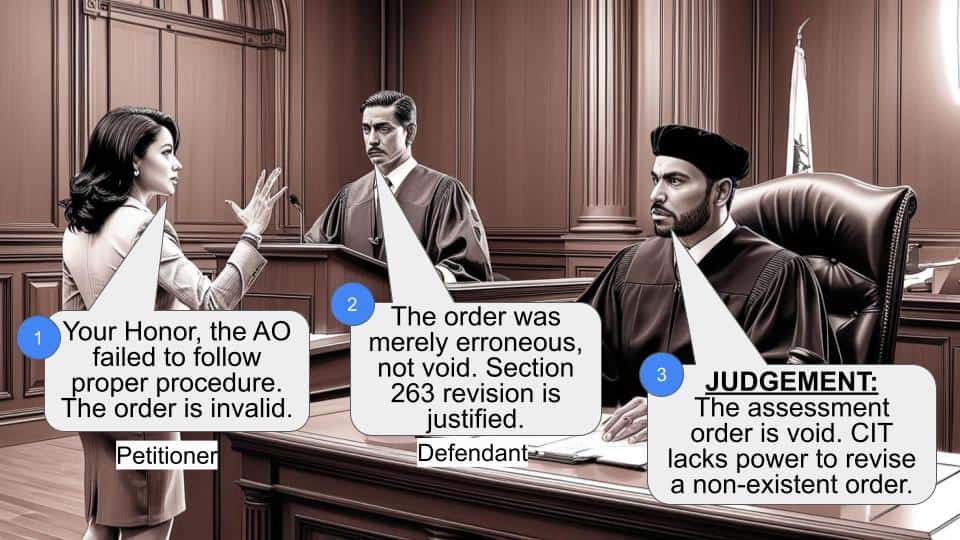
This case involves an appeal by the Revenue (Income Tax Department) against an order passed by the Income Tax Appellate Tribunal (ITAT). The ITAT had set aside a revision order under Section 263 (of Income Tax Act, 1961), which was issued by the Principal Commissioner of Income Tax (PCIT). The High Court dismissed the Revenue's appeal, affirming the ITAT's decision and upholding the original assessment order passed by the Assessing Officer (AO).
Get the full picture - access the original judgement of the court order here
Case Name:
Commissioner of Income Tax Vs Late Shri Vijay Kumar Koganti (High Court of Madras)
T.C.A.No.335 of 2020
Date: 29th September 2020
Key Takeaways:
1. An assessment order cannot be considered erroneous and prejudicial to revenue interests if the AO has addressed the issues that form the basis for invoking Section 263 (of Income Tax Act, 1961).
2. The PCIT must specifically point out how an assessment order is erroneous and prejudicial to revenue interests when exercising revisionary powers.
3. Factual findings by the ITAT are generally not interfered with by higher courts unless substantial questions of law arise.
Issue:
Was the Income Tax Appellate Tribunal correct in quashing the revisional order passed by the PCIT under Section 263 (of Income Tax Act, 1961), especially when the PCIT claimed that the Assessing Officer had passed the order without making proper enquiries?
Facts:
1. The original assessee filed a return for the assessment year 2014-15, declaring a total income of Rs.25,83,290/-.
2. The case was selected for limited scrutiny through CASS (Computer Aided Scrutiny Selection).
3. The AO completed the assessment after verification on 23.12.2016.
4. The PCIT invoked Section 263 (of Income Tax Act, 1961) powers, claiming the assessment order was erroneous and prejudicial to revenue interests.
5. The PCIT set aside the original assessment order for fresh assessment on 03.1.2019.
6. The assessee challenged this order before the ITAT, which set aside the PCIT's order.
7. The Revenue then filed this appeal before the High Court.
Arguments:
Revenue's Arguments:
1. The assessee's financial position was distorted, camouflaging certain transactions.
2. The AO failed to adequately verify the source of increase in capital.
3. The PCIT had explicitly pointed out the AO's failure in verification, which should be sufficient to hold the assessment order as erroneous and prejudicial to revenue interests.
Assessee's Arguments:
1. The issues raised by the PCIT were already considered by the AO during the limited scrutiny.
2. Proper explanations were provided for the increase in capital and conversion of preference shares.
3. The PCIT's order under Section 263 (of Income Tax Act, 1961) was not justified as the AO had made necessary inquiries.
Key Legal Precedents:
1. Malabar Industrial Co. Ltd. Vs. CIT [reported in (2000) 243 ITR 83]:
The Supreme Court held that for exercising jurisdiction under Section 263 (of Income Tax Act, 1961), the assessment order should be not merely erroneous but also prejudicial to revenue interests.
2. CIT Vs. Maithan International [reported in [2015] 56 Taxmann.com 283]: This case dealt with the genuineness of loans taken by the assessee, but was distinguished from the present case.
3. Ashok Leyland Ltd. Vs. CIT [reported in (2003) 181 CTR Mad 332]:
This case involved an assessment order passed without application of mind, which was not applicable to the present case.
Judgement:
1. The High Court dismissed the Revenue's appeal, upholding the ITAT's order.
2. The court found that the issues forming the basis for invoking Section 263 (of Income Tax Act, 1961) were already considered by the AO during the limited scrutiny.
3. The PCIT failed to specifically point out how the assessment order was erroneous and prejudicial to revenue interests.
4. The court deemed the issue to be factual, with no substantial question of law arising from the Revenue's contentions.
FAQs:
1. Q: What is Section 263 (of Income Tax Act, 1961)?
A: Section 263 (of Income Tax Act, 1961) gives the Principal Commissioner or Commissioner of Income Tax the power to revise orders that are erroneous and prejudicial to the interests of revenue.
2. Q: Why did the High Court dismiss the Revenue's appeal?
A: The court found that the Assessing Officer had already considered the issues raised by the PCIT during the limited scrutiny, and the PCIT failed to specifically point out how the assessment order was erroneous and prejudicial to revenue interests.
3. Q: What is the significance of this judgment for taxpayers?
A: This judgment reinforces that tax authorities cannot arbitrarily revise assessment orders without clearly demonstrating that they are both erroneous and prejudicial to revenue interests.
4. Q: Can the Revenue appeal this decision further?
A: While the judgment doesn't mention it explicitly, the Revenue could potentially appeal to the Supreme Court if they believe a substantial question of law still exists.
5. Q: What is CASS mentioned in the case?
A: CASS stands for Computer Aided Scrutiny Selection, which is a system used by the Income Tax Department to select cases for scrutiny based on certain parameters.

This appeal, filed by the Revenue under Section 260A (of Income Tax Act, 1961) (‘the Act’ for brevity), is directed against the order dated 23.10.2019 passed by the Income Tax Appellate Tribunal, Bench ‘D’ Chennai (for short, the Tribunal) in ITA.No.1660/Chny/2019 for the assessment year 2014-15.
2. The Revenue has filed this appeal by raising the following substantial questions of law:
“1. Whether, on the facts and in the circumstances of the case, the Tribunal was right in holding that the assessment order passed under Section 143(3) (of Income Tax Act, 1961) dated 23.12.2014 was not erroneous and prejudicial to the interest of Revenue even though the Assessing Officer has failed to make adequate enquiry in the original assessment order passed ? and
2. Whether, on the facts and in the circumstances of the case, the Tribunal was right in quashing the revisional order passed by the PCIT under Section 263 (of Income Tax Act, 1961) especially when the Assessing Officer had passed the order without making proper enquiries and had merely accepted the return filed by the assessee ?”
3. We have elaborately heard Mrs.R.Hemalatha, learned Senior Standing Counsel appearing for the appellant – Revenue. In view of the limited nature of the order we propose to pass, the appeal itself is taken up for final disposal without ordering notice to the respondent.
4. The original assessee – an individual died before even the order dated 03.1.2009 was passed by the Principal Commissioner of Income Tax, Chennai-1 (for brevity, the PCIT) under Section 263 (of Income Tax Act, 1961). His wife – the legal heir had come on record and pursued the matter by filing an appeal before the Tribunal, which was allowed by the impugned order.
5. The original assessee filed the return of income for the assessment year under consideration namely AY 2014-15 on 31.10.2015 declaring a total income of Rs.25,83,290/-. The case was selected for scrutiny by issuance of a notice dated 27.7.2016 under Section 143(2) (of Income Tax Act, 1961), after which, the assessee filed necessary information and also appeared in person through his authorized representative. The Assessing Officer, after verification, completed the assessment by order dated 23.12.2016. Thereafter, the PCIT invoked his power under Section 263 (of Income Tax Act, 1961) on the ground that the assessment order was erroneous and prejudicial to the interest of the Revenue and ultimately set aside the order for fresh assessment after making due verification vide order dated 03.1.2019.
6. The said order dated 03.1.2019 was put to challenge before the Tribunal, which was set aside by the order impugned in this appeal.
7. It is submitted that the Tribunal failed to take note that the original assessee's financial position was distorted and he camouflaged certain transactions to bring in ostensible source for the increase in capital, that the shares held by the original assessee in M/s.Avanti Leathers Limited, which were shown as the source for increase in capital, were actually allotted in the financial year 2002-03 to 2007-08 and that the same were not disclosed as investment in the respective assessment year. It is further submitted that the Tribunal failed to take note of the fact that the PCIT had explicitly brought out in his order under Section 263 (of Income Tax Act, 1961) that the Assessing Officer failed to adequately verify the source for increase in capital in the finances of the assessee and that this would be sufficient to hold that the assessment order was erroneous and prejudicial to the interest of the Revenue.
8. In support of her contentions, the learned Senior Standing Counsel appearing for the appellant – Revenue has placed reliance on (i) the decision of the Hon'ble Division Bench of the Calcutta High Court in the case of CIT Vs. Maithan International [reported in [2015] 56 Taxmann.com 283];
(ii) the decision of the Hon'ble Division Bench of this Court in the case of Ashok Leyland Ltd. Vs. CIT [reported in (2003) 181 CTR Mad 332]; and
(iii) the decision of another Hon'ble Division Bench of this Court in the case of South India Shipping Corporation Ltd. [reported in (1998) 233 ITR 546].
9. We have carefully considered the submissions made before us and also perused the materials placed on record.
10. The Hon'ble Supreme Court, in the decision in the case of Malabar Industrial Co. Ltd. Vs. CIT [reported in (2000) 243 ITR 83], held that for exercise of jurisdiction under Section 263 (of Income Tax Act, 1961),it was necessary that the order of assessment should be not merely erroneous, but also prejudicial to the interest of the Revenue. Bearing this legal principle in mind, if we test the correctness of the order passed by the Tribunal, as rightly pointed out by the Tribunal, the PCIT did not point out anything specifically as to how the assessment order dated 23.12.2016 was erroneous. After rendering a finding on such aspect, the PCIT was required to render a finding that it was also prejudicial to the interest of the Revenue.
11. The reason for selecting the case for limited scrutiny through CASS was to consider two issues namely were (i) substantial increase in capital in a year; and (ii) the sale consideration of the property in the income tax return was less than the sale consideration of the property reported in AIR. These issues were considered by the Assessing Officer and after perusal of documents, verification of the income tax returns of the assessee and making enquiries with the limited company where the assessee held shares, the Assessing Officer came to the conclusion. Thus, we find that both the issues, which were the basis for exercise of the powers under Section 263 (of Income Tax Act, 1961), were, in fact, the issues, which were considered by the Assessing Officer in the limited scrutiny culminating in the order of assessment under Section 143(3) (of Income Tax Act, 1961) dated 23.12.2016.
12. When the PCIT issued the show cause notice dated 13.11.2018 calling upon the assessee to explain with regard to the increase in capital and also conversion of preference shares during the relevant years, the assessee gave a reply dated 02.1.2019. This has been extracted by the Tribunal in paragraph 3.2 of the impugned order. We find the explanation to be cogent and in fact, the factual matrix was appreciated by the Tribunal to hold that the PCIT could not have invoked the revisionary jurisdiction under Section 263 (of Income Tax Act, 1961) mainly on the ground that substantial increase in capital investment reflected by the assessee in his balance sheet as compared to the preceding year. The Tribunal further pointed out that these issues were raised by the Assessing Officer in the scrutiny assessment and that the assessee had given proper explanation, which was taken note of by the Assessing Officer while completing the assessment under Section 143(3) (of Income Tax Act, 1961).
13. Hence, we find that the entire issue is factual and no substantial question of law flows from the contention raised by the Revenue before us. The decision of the Calcutta High Court in the case of Maithan International, was with regard to the genuineness of a loan taken by the assessee from various creditors and the power under Section 263 (of Income Tax Act, 1961) was invoked on the ground that the Assessing Officer merely went by the bank statements and the and letter of confirmation. The Court held that the Assessing Officer was required to enquire the credit worthiness of the creditors. No such situation arises in the case on hand. Therefore, this decision is not only distinguishable on facts, but also does not render any assistance to the Revenue.
14. In the decision of the Hon'ble Division Bench of this Court in the case of Ashok Leyland Ltd., the Court had considered the factual position and held that the assessment order was passed without application of mind by the Assessing Officer. In the case on hand, no such finding has been recorded by the PCIT in the order dated 03.1.2019. Therefore, this decision cannot be applied to the facts of the present case.
15. The decision of the Hon'ble Division Bench of this Court in the case of South India Shipping Corporation Ltd., was on a slightly different issue though the matter travelled to the Tribunal from an order passed under Section 263 (of Income Tax Act, 1961). However, the ratio of this decision was with regard to the manner, in which, the Commissioner of Income Tax (Appeals) has to record his final conclusion. In the instant case, the assessment order is a speaking order; so also is the order passed by both the PCIT as well as the Tribunal. Thus, we find that this decision cannot be applied to the facts of the present case.
16. For all the above reasons, we find no question of law, much less, substantial question of law arising for consideration in this appeal.
Accordingly, the above tax case appeal is dismissed and the order passed by the Tribunal stands confirmed.
T.S.SIVAGNANAM,J
AND
V.BHAVANI SUBBAROYAN,J
×
Questions
AO's Order Upheld: PCIT's Revision Quashed in Tax Scrutiny Case
Write your CommentSimilar Posts


Generic
- Reportdata/6177.pdf
