


Tax reassessment beyond 4 years invalid: Court sides with assessee who disclose…


Full News

Tax reassessment beyond 4 years invalid: Court sides with assessee who disclosed all facts
Tax reassessment beyond 4 years invalid: Court sides with assessee who disclosed all facts
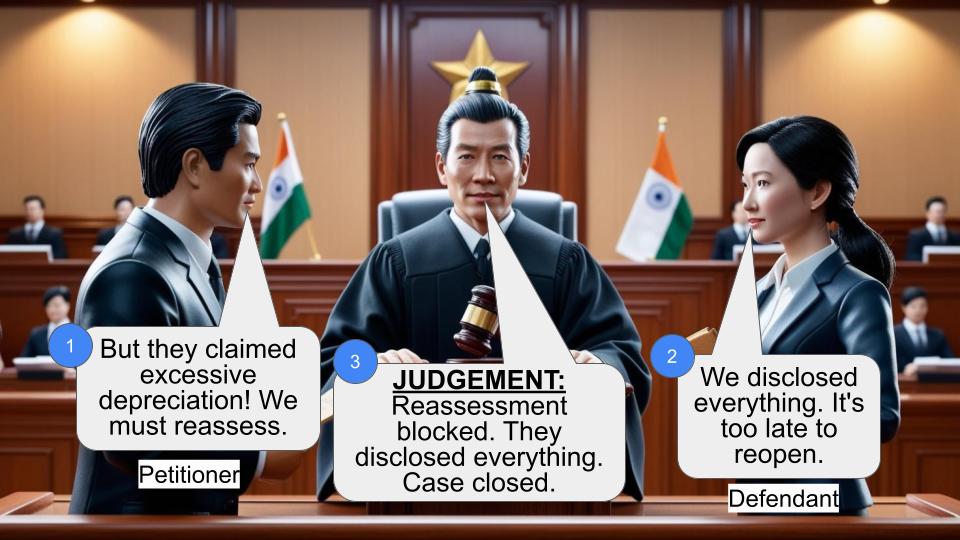
This case involves a dispute between the Commissioner of Income Tax (the Revenue) and S.K. Jain (the Assessee) regarding the validity of reassessment proceedings initiated by the Income Tax Department beyond the four-year limitation period. The High Court ruled in favor of the Assessee, holding that the reassessment was invalid as the Assessee had disclosed all material facts during the original assessment.
Get the full picture - access the original judgement of the court order here
Case Name:
Commissioner of Income Tax vs S.K. Jain (High Court of Delhi)
ITA 834/2006
Date: 22nd January 2008
Key Takeaways:
1. Reassessment beyond four years is invalid if the assessee has disclosed all material facts.
2. The Assessing Officer's failure to properly examine disclosed information doesn't justify reopening an assessment.
3. Acceptance of an issue in favor of the assessee for one assessment year should be consistently applied to other years.
Issue:
Was the Income Tax Department justified in issuing a notice under Section 148 (of Income Tax Act, 1961) to reopen the assessment beyond the four-year limitation period?
Facts:
1. S.K. Jain (our Assessee) filed tax returns claiming a deduction on interest paid to Andhra Bank.
2. Here's where it gets interesting - the property Jain owned had a bit of history. The previous owner had mortgaged it to Andhra Bank back in March 1991.
3. There was this cool arrangement where Andhra Bank occupied the property, and instead of paying rent, they adjusted it against the loan interest.
4. Jain bought this property in October 1992 and inherited this arrangement.
5. For three years straight, the Assessing Officer allowed Jain to deduct this interest amount.
6. In the 1996-97 assessment year, they did a deeper dive, asked for more info, and still allowed the deduction.
7. But then, plot twist! In June 1999, the tax department decided to reopen assessments for 1993-94 to 1996-97.
8. They went ahead and deleted the previously allowed deductions.
Arguments:
The Revenue's Side:
- They argued that not all material facts were disclosed by the Assessee, justifying the reassessment.
- They believed the original assessment didn't consider all aspects of the interest deduction claim.
The Assessee's Side:
- Jain maintained that he had disclosed all material facts during the original assessments.
- He argued that the Assessing Officer had examined and allowed the deduction for multiple years, including a detailed review for 1996-97.
- The reassessment notice beyond four years was not valid as there was no failure to disclose material facts.
Key Legal Precedents:
Interestingly, the judgment doesn't explicitly cite specific case laws. However, it refers to:
1. Section 147 (of Income Tax Act, 1961)/148 of the Income Tax Act, 1961: These sections deal with income escaping assessment and the issuance of notice for reassessment.
2. Section 260A (of Income Tax Act, 1961): This section relates to appeals to the High Court.
Judgement:
The High Court sided with Jain (our Assessee). Here's the breakdown:
1. They agreed that Jain had disclosed all material facts to the Assessing Officer.
2. The court said, "Hey, if the Assessing Officer didn't apply his mind properly the first time around, that's not Jain's fault."
3. They pointed out that for the 1997-98 assessment year, the tax department had already accepted Jain's position. So, it didn't make sense to fight over earlier years.
4. The court concluded that issuing a notice under Section 148 (of Income Tax Act, 1961) beyond the four-year period wasn't justified.
5. They dismissed the Revenue's appeal, finding no substantial question of law.
FAQs:
1. Q: What's the significance of the four-year period mentioned in the case?
A: In income tax law, there's generally a four-year limitation period for reopening assessments. Beyond this, the department needs to prove that the assessee failed to disclose material facts.
2. Q: Why did the court mention the 1997-98 assessment year?
A: The court pointed out that the tax department had accepted Jain's position for 1997-98. This showed inconsistency in the department's approach, as they were contesting earlier years on the same issue.
3. Q: What does "disclosure of material facts" mean in this context?
A: It refers to the taxpayer providing all relevant information about their income and deductions when filing their returns. In this case, Jain had provided details about the interest deduction and the property arrangement.
4. Q: Does this judgment set a precedent for other cases?
A: While each case is unique, this judgment emphasizes the importance of full disclosure by taxpayers and the need for consistency in the tax department's approach across assessment years.
5. Q: What lesson can taxpayers learn from this case?
A: It underscores the importance of maintaining thorough records and disclosing all relevant information in tax returns. Even if the Assessing Officer doesn't scrutinize everything initially, having made full disclosure can protect you from reassessment later.

The Revenue is aggrieved by an order dated 16th December, 2005 passed by the Income Tax Appellate Tribunal, Delhi Bench `F?, New Delhi (the Tribunal?) in ITA No.3597/Del/2002 relevant for the Assessment Year 1993-1994 and ITA 3589/Del/2002 relevant for the Assessment Year 1993-1994.
2. The Assessee had filed his returns in which he claimed a deduction on interest paid to Andhra Bank. It transpires that the previous owner of the house property belonging to the Assessee had taken a mortgage against the property on 19th March, 1991. In terms of the agreement executed between the previous owner and Andhra Bank, the rent to be paid by Andhra Bank for occupation of the house property was to be adjusted against the interest on the loan taken by the previous owner.
The previous owner then sold the house property to the Assessee by a sale deed dated 21st October, 1992. The arrangement that the previous owner had with Andhra Bank continued, with the result that the Assessee received rent from Andhra Bank after adjustment of the interest on the loan taken by the previous owner.
3. The Assessing Officer looked into the facts of the case and after holding regular assessment proceedings, he allowed a deduction to the Assessee on the interest amount paid by him for as many as three assessment years.
For the Assessment Year 1996-1997, the Assessing Officer decided to make
further inquiries with regard to the loan amount and after an explanation was given by the Assessee with all documentary evidence, it was held that the Assessee was entitled to deduction on the interest paid.
Much later, on 25th June, 1999, a proposal was initiated for reopening the assessment in respect of the Assessee by taking recourse to Sections 147/148 of the Income Tax Act, 1961 (`the Act?). The proposal was approved by the concerned Commissioner of Income Tax and notices were then issued to the Assessee for reopening the assessment in respect of Assessment Years 1993-94, 1994-95, 1995-96 and 1996-97.
Reassessment proceedings were conducted and the deduction earlier given to the Assessee was deleted. The Assessing Officer also made some other additions to the income of the Assessee.
4. Feeling aggrieved, the Assessee preferred an appeal before the Commissioner of Income Tax (Appeals) [`CIT(A)], which was dismissed and a second appeal was then preferred before the Tribunal.
5. The Tribunal noted that the Assessing Officer had given a deduction to the Assessee on the interest for four years, that is, from 1993-1994 to 1996-1997 on the same facts and in addition thereto, in respect of the Assessment Year 1996-1997, the Assessing Officer had looked into various documents including the Agreement dated 19th March, 1991 as well as sale deed dated 21st October, 1992. It is only thereafter that the deduction was granted to the Assessee. In other words, according to the Tribunal, the Assessee had made a full disclosure of all material facts before the Assessing Officer in respect of all four assessment years. On this basis, it was held that the notice under Section 148 (of Income Tax Act, 1961) could not be issued beyond the period of four years from the end of the relevant assessment year. 6. We do not find any error in the reasoning adopted by the Tribunal inasmuch as it appears that the Assessee had disclosed all material facts to the Assessing Officer. It seems that the Assessing Officer did not apply his mind to the returns filed by the Assessee. If that is so, the Assessee can hardly be faulted. The Assessee had made a claim for deduction on interest on the basis of certain facts. If those facts were not clear or required some further elaboration, the Assessing Officer could verify the same and call for information from the Assessee. Merely because the Assessing Officer failed to do so but nevertheless discharged his duties in accordance with law, it cannot give an adequate reason to him to reopen the assessment proceedings on the ground that all material facts had not been disclosed by the Assessee.
We may note that in a connected appeal filed by the Revenue under Section 260A (of Income Tax Act, 1961) being ITA No. 1532/2006, in the order passed by the Tribunal it has been mentioned that the Tribunal had dismissed the Revenue?s appeal on merits in respect of the next Assessment Year 1997-1998 by an order passed in March, 2004 No appeal appears to have been filed against that order meaning thereby that the Revenue has accepted the contention of the Assessee. We do not see any reason why in respect of the assessment years that we are concerned with, the Revenue should agitate the matter when it has finally accepted the issue on merits in favour of the Assessee for the Assessment Year 1997-98.
7. In the circumstances, we are of the view that the Assessing Officer was not justified in issuing a notice under Section 148 (of Income Tax Act, 1961) beyond the period of four years, which he did in respect of the Assessment Year 1993-1994, the notice having been issued on or about 25th June, 1999.
8. On merits also, we find that the Tribunal did not err particularly since the Revenue has accepted the order of the Tribunal in respect of Assessment Year 1997-98.
9. No substantial question of law arises.
The appeal is dismissed.
×
Questions
Tax reassessment beyond 4 years invalid: Court sides with assessee who disclosed all facts
Write your CommentSimilar Posts

Generic
- Reportdata/4975_.pdf
