


Retrospective Application of Second Proviso to Section 40(a)(ia) (of Income Tax…



Full News

Retrospective Application of Second Proviso to Section 40(a)(ia) (of Income Tax Act, 1961) Confirmed by High Court
Retrospective Application of Second Proviso to Section 40(a)(ia) (of Income Tax Act, 1961) Confirmed by High …
The High Court ruled in favor of Shivpal Singh Chaudhary, confirming that the second proviso to Section 40(a)(ia) (of Income Tax Act, 1961), which benefits assessees who failed to deduct TDS but whose payees have paid taxes, applies retrospectively from April 1, 2005. This decision upheld the Income Tax Appellate Tribunal's (ITAT) ruling and dismissed the revenue's appeal.
Get the full picture - access the original judgement of the court order here.
Case Name:
Principal Commissioner of Income Tax vs. Shivpal Singh Chaudhary (High Court of Punjab and Haryana)
ITA No. 558 of 2017 (O&M)
Key Takeaways
- The second proviso to Section 40(a)(ia) (of Income Tax Act, 1961) is declaratory and curative, applying retrospectively from April 1, 2005.
- Assessees are not deemed in default for failing to deduct TDS if the payee has filed a return and paid taxes.
- The High Court upheld the ITAT's decision, dismissing the revenue's appeal.
Issue
Does the second proviso to Section 40(a)(ia) (of Income Tax Act, 1961), apply retrospectively to the assessment year 2012-13?
Facts
- Shivpal Singh Chaudhary filed his income tax return for the assessment year 2012-13.
- The Assessing Officer (AO) disallowed certain payments under Section 40(a)(ia) (of Income Tax Act, 1961) for non-deduction of TDS.
- The CIT(A) and ITAT ruled in favor of the assessee, stating that the second proviso to Section 40(a)(ia) (of Income Tax Act, 1961) should apply retrospectively.
- The revenue appealed to the High Court.
Arguments
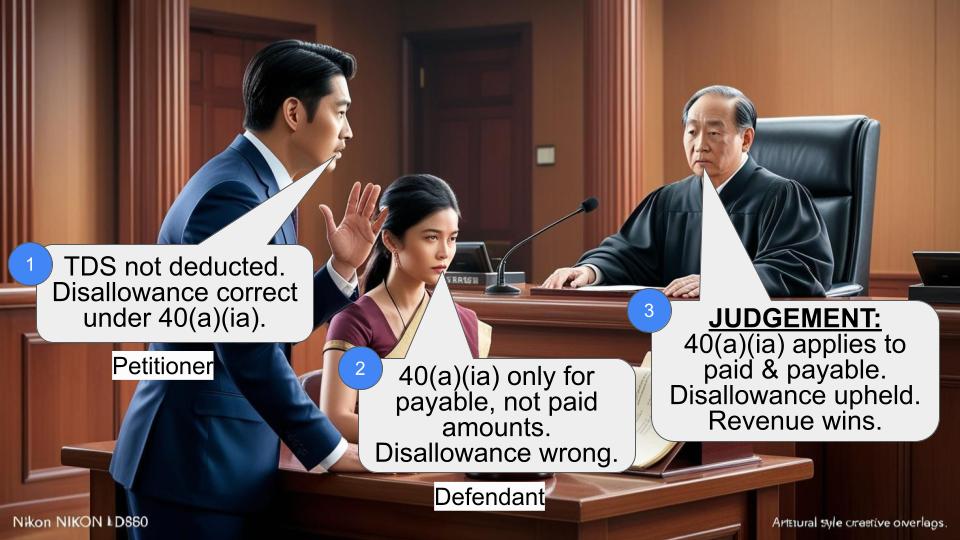
- Revenue:
Argued that the second proviso to Section 40(a)(ia) (of Income Tax Act, 1961) is prospective, effective from April 1, 2013, and should not apply to the assessment year 2012-13.
- Assessee:
Contended that the proviso is curative and should apply retrospectively, as it benefits the assessee and avoids undue hardship.
Key Legal Precedents
- CIT vs. Ansal Land Mark Township Private Limited (2015) 377 ITR 635 (Delhi):
Held that the second proviso to Section 40(a)(ia) (of Income Tax Act, 1961) is declaratory and curative, applying retrospectively from April 1, 2005.
- Rajiv Kumar Aggarwal vs. ACIT (ITA No. 337/Agra/2013):
Supported the retrospective application of the second proviso to Section 40(a)(ia) (of Income Tax Act, 1961).
Judgement
The High Court dismissed the revenue's appeal, confirming that the second proviso to Section 40(a)(ia) (of Income Tax Act, 1961) is declaratory and curative, applying retrospectively from April 1, 2005. The court upheld the ITAT's decision, which favored the assessee, Shivpal Singh Chaudhary.
FAQs
Q1. What is the second proviso to Section 40(a)(ia) (of Income Tax Act, 1961)?
A1. It states that an assessee who failed to deduct TDS will not be deemed in default if the payee has filed a return and paid taxes.
Q2. Does the second proviso apply retrospectively?
A2. Yes, the High Court confirmed it applies retrospectively from April 1, 2005.
Q3. What was the outcome of the case?
A3. The High Court ruled in favor of the assessee, dismissing the revenue's appeal.
Q4. What is the significance of this ruling?
A4. It clarifies that the second proviso to Section 40(a)(ia) (of Income Tax Act, 1961) benefits assessees retrospectively, reducing undue hardship.
Q5. Which courts' decisions were referenced?
A5. The High Court referenced decisions from the Delhi High Court and the Agra Bench of ITAT.

1. The appellant-revenue has filed the instant appeal under Section 260A (of Income Tax Act, 1961) (in short, “the Act”) against the order dated 26.05.2017, Annexure A.3, passed by the Income Tax Appellate Tribunal,Chandigarh (in short, “the Tribunal”) in I.T.A. No.224/Chd/2017, for the assessment year 2012-13, claiming following substantial question of law:-
“Whether on the facts and in the circumstances of the case and in law, the Hon’ble ITAT has erred in deleting the addition of 95,31,276/- made under Section 40(1)(ia) (of Income Tax Act, 1961) for non deduction of TDS on payment made for job works by holding that the second proviso to Section 40(a)(ia) (of Income Tax Act, 1961) has a retrospective effect and is applicable to the applicant for the relevant assessment year whereas the said provisions of Section 40(a)(ia) (of Income Tax Act, 1961) are prospective in operation w.e.f. 01.04.2013 as also held by the Hon’ble Kerala High Court in the case of Thomas George Muthoot Vs. CIT (ITA No. 278 of 2014)?”
2. A few facts relevant for the decision of the controversy involved as narrated in the appeal may be noticed. The assessee filed his return of income for the assessment year 2012-13 on 30.09.2012 declaring total income at 1,25,96,920/-. Assessment was completed under Section 143(3) (of Income Tax Act, 1961) on 27.02.2015 at income of ` 2,45,41,840/- by making following additions:-
(i) Addition of ` 1,90,626/- by invoking the provisions of Section 43B (of Income Tax Act, 1961);
(ii) Addition of ` 95,31,276/- under section 40(a)(ia) (of Income Tax Act, 1961) for non- deduction of TDS on payment made for job work;
(iii) Addition of ` 54,045/- under section 40(a)(ia) (of Income Tax Act, 1961) for non- deduction of TDS on professional charges paid to Sh. Manik Goyal;
(iv) Addition of ` 3,47,743/- and ` 21,313/- under section 40(a)(ia) (of Income Tax Act, 1961) for non-deduction of tax on interest paid to M/s L&T Finance Limited and M/s Tata Finance Ltd;
(v) Disallowance of interest of ` 17,98,420/- on the ground that the assessee had paid interest free loans;
(vi) Disallowance of ` 1,500/- being charity and donation expenses.
Aggrieved by the order, the assessee filed an appeal before the Commissionermof Income Tax (Appeals) [CIT(A)] on all the additions except addition mentioned at Sr. No. (vi). Vide order dated 10.11.2016, Annexure A.2, the CIT(A) partly allowed the appeal filed by the assessee. The addition mentioned at Sr. No. (ii) above was deleted whereas the additions mentioned at Sr. Nos.
(i) and (iii) to (v) were confirmed. Not satisfied with the order, the appellant-revenue filed an appeal before the Tribunal, with reference to the addition mentioned at Sr. No. (ii) above. Vide order dated 26.05.2017, Annexure A.3,the Tribunal dismissed the appeal filed by the revenue. Hence, the instant appeal by the appellant-revenue.
3. We have heard the learned counsel for the parties.
4. The issue raised by the revenue before the Tribunal pertained to the retrospectivity of the second proviso to Section 40(a)(ia) (of Income Tax Act, 1961). The said provision reads thus:-
“Provided further that where an assessee failed to deduct the whole or any part of tax in accordance with the provisions of Chapter XVII-B on any such sum but is not deemed to be assessee in default under the first proviso to sub-section (1) of section 201 (of Income Tax Act, 1961), then, for the purpose of this sub-clause, it shall be deemed that the asssessee has deducted and paid the tax on such sum on the date of furnishing of return of income by the resident payee referred to in the said proviso.”
Sub-clauses (i), (ia) and (ib) in Section 40(a) (of Income Tax Act, 1961) were substituted for clause (i) by the Finance (No.2) Act, 2004 with effect from 1.4.2005. The second Proviso to Section 40(a)(ia) (of Income Tax Act, 1961) was inserted by Finance Act, 2012 with effect from 1st April 2013. According to the aforesaid Proviso, a fiction has been introduced where an assessee who had failed to deduct tax in accordance with the provisions of Chapter XVII B of the Act, but is not deemed to be an assessee in default in terms of the first Proviso to sub section (1) of Section 201 (of Income Tax Act, 1961), then in such event, “it shall be deemed that the assessee has deducted and paid the tax on such sum on the date of furnishing of return of income by the resident/payee referred to in the said proviso.”
5. It would be expedient to reproduce first Proviso to Section 201(1) (of Income Tax Act, 1961), which was introduced with effect from Ist July 2012. It reads thus:-
"Provided that any person, including the principal officer of a company, who fails to deduct the whole or any part of the tax in accordance with the provisions of this Chapter on the sum paid to a resident or on the sum credited to the account of a resident shall not be deemed to be an assessee in default in respect of such tax if such resident-
(i) has furnished his return of income under section 139 (of Income Tax Act, 1961);
(ii) has taken into account such sum for computing income in such return of income; and
(iii) has paid the tax due on the income declared by him in such return of income;
And the person furnishes a certificate to this effect from an accountant in such form as may be prescribed.”
6. The purpose of insertion of the first Proviso to Section 201(1) (of Income Tax Act, 1961) is to benefit the assessee. It stipulates that where a person who has failed to deduct tax at source on the sum paid to a resident or on the sum credited to the account of the resident, such person shall not be deemed to be an assessee in default in respect of such tax, provided the resident has furnished the return of income under Section 139 (of Income Tax Act, 1961) and has taken into account such sum for computing income in the return of income and paid tax due on the income declared by him in such return of income.
7. Undoubtedly, a mandatory requirement exists under Chapter XVII B of the Act to deduct tax at source under certain eventualities. Consequences for failure to deduct or pay tax deducted at source within the time permissible under the statute have been spelt out in Section 201 (of Income Tax Act, 1961). However, under first Proviso to Section 201(1) (of Income Tax Act, 1961) inserted with effect from Ist July,2012, exception has been carved out which shows the intention of the legislature not to treat the assessee as a person in default subject to fulfillment of the conditions as stipulated thereunder. No different view can be taken regarding introduction of Second Proviso to Section 40(a)(ia) (of Income Tax Act, 1961) with effect from 01.4.2013. This Proviso is also intended to benefit the assessee by creating legal fiction in his favour and not to treat him in default of deducting tax at source under certain contingencies and that it shall be presumed that the assessee had deducted and paid tax on such sum on the date of furnishing of the return of income by the resident/payee.
8. From legal analysis of first Proviso to Section 201(1) (of Income Tax Act, 1961) and second Proviso to Section 40(a)(ia) (of Income Tax Act, 1961), it is discernible that according to both the provisos, where the payee/resident has filed its return of income disclosing the payment received by it or receivable by it, and has also paid tax on such income, the assessee would not be treated to be a person in default and presumption would arise in his favour as noted above.
9. Now the question that would require an answer is whether the insertion of Second Proviso to Section 40(a)(ia) (of Income Tax Act, 1961) with effect from Ist April 2013 will apply to assessment year 2012-13 being retrospective.
10. Similar issue regarding second Proviso to Section 40(a)(ia) (of Income Tax Act, 1961) is prospective or retrospective in nature, came up for consideration before Delhi high Court in CIT vs. Ansal Land Mark township Private Limited,(2015) 377 ITR 635(Delhi). The High Court approving the decision of the Agra Bench of ITAT in ITA No.337/Agra/2013 (Rajiv Kumar Aggarwal vs.ACIT) wherein it was held that the second proviso to Section 40(a)(ia) (of Income Tax Act, 1961) is declaratory and curative in nature and should be given retrospective effect from Ist April, 2005, in para 13, had recorded as under:-
“13. Turning to the decision of the Agra Bench of ITAT in Rajiv Kumar Agarwal v. ACIT (supra ) , the Court finds that it has undertaken a thorough analysis of the second proviso to Section 40(a)(ia) (of Income Tax Act, 1961) and also sought to explain the rationale behind its insertion. In particular, the Court would like to refer to para 9 of the said order which reads as under:
"On a conceptual note, primary justification for such a disallowance is that such a denial of deduction is to compensate for the loss of revenue by corresponding income not being taken into account in computation of taxable income in the hands of the recipients of the payments. Such a policy motivated deduction restrictions should, therefore, not come into play when an assessee is able to establish that there is no actual loss of revenue. This disallowance does deincentivize not deducting tax at source, when such tax deductions are due, but, so far as the legal framework is concerned, this provision is not for the purpose of penalizing for the tax deduction at source lapses. There are separate penal provisions to that effect. Deincentivizing a lapse and punishing a lapse are two different things and have distinctly different, and sometimes mutually exclusive, connotations.
When we appreciate the object of scheme of section 40(a)(ia) (of Income Tax Act, 1961), as on the statute, and to examine whether or not, on a "fair, just and equitable" interpretation of law- as is the guidance from Hon'ble Delhi High Court on interpretation of this legal provision, in our humble understanding, it could not be an "intended consequence" to disallow the expenditure, due to non deduction of tax at source, even in a situation in which corresponding income is brought to tax in the hands of the recipient. The scheme of Section 40(a)(ia) (of Income Tax Act, 1961), as we see it, is aimed at ensuring that an expenditure should not be allowed as deduction in the hands of an assessee in a situation in which income embedded in such expenditure has remained untaxed due to tax withholding lapses by the assessee. It is not, in our considered view, a penalty for tax withholding lapse but it is a sort of compensatory deduction restriction for an income going untaxed due to tax withholding lapse. The penalty for tax withholding lapse per se is separately provided for in Section 271 (of Income Tax Act, 1961) C, and, section 40(a)(ia) (of Income Tax Act, 1961) does not add to the same. The provisions of Section 40(a)(ia) (of Income Tax Act, 1961), as they existed prior to insertion of second proviso thereto, went much beyond the obvious intentions of the lawmakers and created undue hardships even in cases in which the assessee's tax withholding lapses did not result in any loss to the exchequer. Now that the legislature has been compassionate enough to cure these shortcomings of provision, and thus obviate the unintended hardships, such an amendment in law, in view of the well settled legal position to the effect that a curative amendment to avoid unintended consequences is to be treated as retrospective in nature even though it may not state so specifically, the insertion of second proviso must be given retrospective effect from the point of time when the related legal provision was introduced. In view of these discussions, as also for the detailed reasons set out earlier, we cannot subscribe to the view that it could have been an "intended consequence" to punish the assessees for non deduction of tax at source by declining the deduction in respect of related payments, even when the corresponding income is duly brought to tax. That will be going much beyond the obvious intention of the section. Accordingly, we hold that the insertion of second proviso to Section 40(a)(ia) (of Income Tax Act, 1961) is declaratory and curative in nature and it has retrospective effect from 1st April, 2005, being the date from which sub clause (ia) of section 40(a) (of Income Tax Act, 1961) was inserted by the Finance (No. 2) Act, 2004."
11. We are in agreement with the view of the Delhi High Court in Ansal Land Mark Township Pvt. Limited’s case (supra) approving the reasoning of the Agra Bench of the ITAT whereby holding the rationale behind the insertion of the second Proviso to Section 40(a)(ia) (of Income Tax Act, 1961) and that it is merely declaratory and curative and thus, applicable retrospectively with effect from Ist April, 2005.
12. Having crystallised the legal position, we proceed to examine the factual matrix. In the present case, the assessee during the year in question debited 98,99,141/- on account of job work, out of which ` 95,31,276/- was paid to M/s Jhandu Construction Company without deduction of tax. The Assessing Officer took the view that the said payment should have been made only after deduction of tax at source. As per the provisions of the relevant statute, in view of the assessee’s failure to deduct tax at source, the Assessing Officer disallowed payment in question under Section 40(a)(ia) (of Income Tax Act, 1961). The assessee filed an appeal before the CIT(A) pleading that in view of the second proviso to Section 40(a)(ia) (of Income Tax Act, 1961), payment should not have been disallowed. The CIT(A) after considering the submissions of the assessee and going through the evidence on record found that the assessee had filed confirmation from the party that the payment made by him to M/s Jhandu Construction Company had been reflected in its return of income. Thus, the CIT(A) rightly decided the issue in favour of the assessee which has been upheld by the Tribunal.
13. In all fairness to the learned counsel for the revenue, it needs to be noticed that she had relied upon two decisions of the Kerala High Court in Prudential Logistics and Transports vs. Income Tax Officer, (2014) 364 ITR 689 and Thomas George Muthoot vs. CIT, (2015) 32 RCR(Civil) 506,wherein it has been held that second Proviso to Section 40(a)(ia) (of Income Tax Act, 1961) with effect from 01.4.2013 was prospective and not retrospective. With respect, we are unable to subscribe to the aforesaid contrary view of the Kerala High Court in the aforesaid two decisions.
14. In view of the above, accordingly, substantial question of law as claimed stands answered against the revenue and in favour of the assessee.
Consequently, the appeal stands dismissed.
(Ajay Kumar Mittal)
Judge
July 05, 2018 (Avneesh Jhingan) ‘gs’ Judge
Whether speaking/reasoned Yes
Whether reportable Yes
×
Questions
Retrospective Application of Second Proviso to Section 40(a)(ia) (of Income Tax Act, 1961) Confirmed by High Court
Write your CommentSimilar Posts


Generic
- Reportdata/11109-HC-Punjab.pdf
