Full News

Invalid Reopening of Tax Assessment: Court Quashes Notice
Invalid Reopening of Tax Assessment: Court Quashes Notice
The case involves Sunbarg Tradlink § Ltd. challenging a notice issued by the Income Tax Officer to reopen its tax assessment for the year 2008-09. The court found the reasons for reopening the assessment to be invalid and quashed the notice, rendering the subsequent assessment order void.
Get the full picture - access the original judgement of the court order here
Case Name
Sunbarg Tradlink § Ltd. vs. Income Tax Officer (High Court of Gujarat)
Special Civil Application No. 4701 of 2016
Date: 7th September 2016
Key Takeaways
- The court emphasized that reopening a tax assessment requires a valid reason to believe that income has escaped assessment.
- A notice based on incorrect reasons or issued for the wrong assessment year is invalid.
- The decision reinforces the necessity for the Assessing Officer to have tangible material before reopening an assessment.
Issue
Was the notice for reopening the tax assessment for the year 2008-09 based on valid reasons?
Facts
- Sunbarg Tradlink § Ltd. filed its income tax return for the year 2008-09, which was accepted without scrutiny.
- The Income Tax Officer issued a notice to reopen the assessment, claiming the company received Rs. 20 lakhs in bogus share capital and share premium from entities managed by Shri Pratik R. Shah.
- The company contested this, stating it did not receive such funds from the mentioned entities and provided bank statements and share capital accounts as evidence.
Arguments
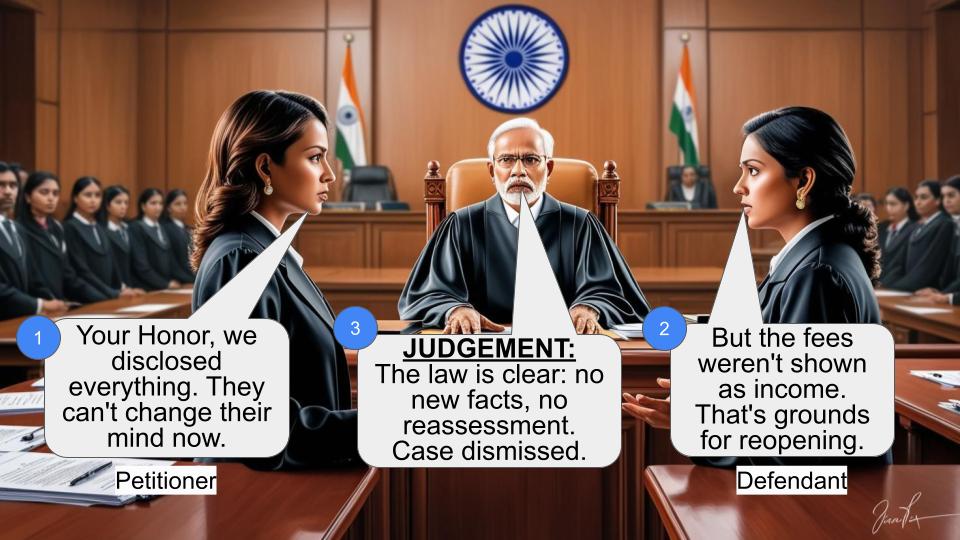
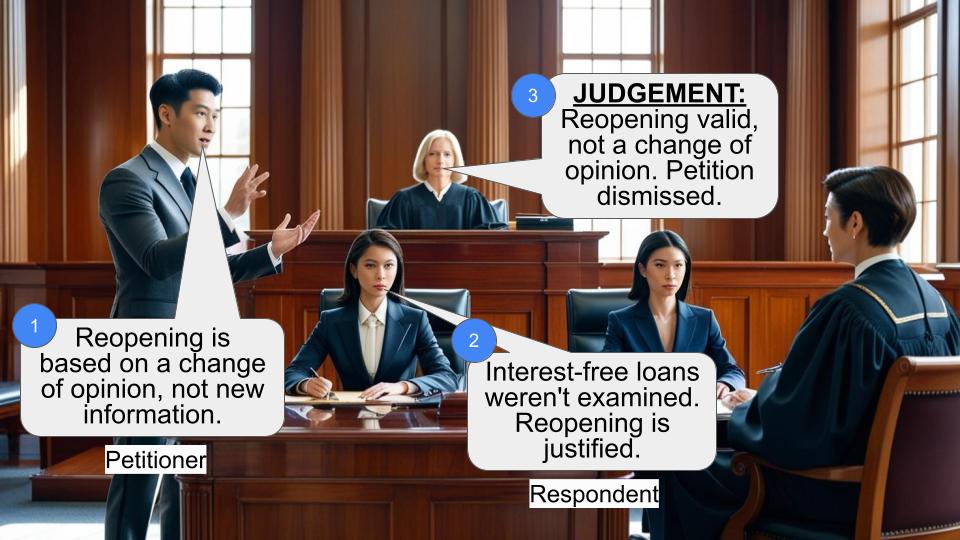
- Petitioner (Sunbarg Tradlink): Argued that the company did not receive the alleged share capital from the entities managed by Shri Pratik R. Shah and provided evidence to support this claim. They contended that the notice was based on incorrect information.
- Respondent (Income Tax Officer): Claimed there was sufficient material to justify the reopening of the assessment, although the notice was issued for the wrong assessment year due to a typographical error.
Key Legal Precedents
- The court referred to the case of Inductotherm (India) P. Ltd. v. M. Gopalan, Deputy Commissioner of Income-Tax, which established that the Assessing Officer must have a reasonable belief, based on tangible material, that income has escaped assessment before reopening an assessment under Section 147 (of Income Tax Act, 1961).
Judgement
The court quashed the notice for reopening the assessment, stating it was based on completely wrong reasons. Consequently, the assessment order passed pursuant to this notice was also invalidated. The court highlighted that the Assessing Officer lacked jurisdiction to frame the assessment without a valid reopening.
FAQs
Q: What does this judgment mean for Sunbarg Tradlink?
A: The judgment means that the notice to reopen their tax assessment was invalid, and any actions taken based on that notice are void.
Q: Why was the notice considered invalid?
A: The notice was based on incorrect reasons and was issued for the wrong assessment year, lacking the necessary tangible material to justify reopening the assessment.
Q: What is the significance of this case for future tax assessments?
A: This case underscores the importance of having valid and tangible reasons before reopening a tax assessment, ensuring that such actions are not based on incorrect or insufficient information.

1. The petitioner has challenged a notice dated 30.03.2015 issued by the respondent Assessing Officer, reopening the petitioner's assessment for the assessment year 2008-09. Brief facts are as under.
2. The petitioner is a company registered under the Companies Act. For the assessment year 2008-09, the petitioner had filed a return of income on 29.09.2008, declaring total income of Rs.15,94,430/. Such return was accepted under section 143(1) (of Income Tax Act, 1961) ('the Act' for short) without scrutiny. To reopen such assessment, the Assessing Officer issued impugned notice. In order to do so, he has recorded following reasons:
“ The assessee company had filed its return of income u/s. 139(1) (of Income Tax Act, 1961) on 29/09/2008 declaring total income of Rs.49,43,530/. The return was processed u/s 143(1) (of Income Tax Act, 1961) on 16/02/2010. The case was not selected for scrutiny. As per information of this office the assessee company has received share capital and share premium of Rs.20,00,000/ from the Entities which are managed and controlled by Shri Pratik R. Shah during the year under consideration. The share capital and share premium amounting to Rs.20,00,000/ received from various entities are accommodation entries in the form of share capital and share premium against the receipt of the cash from the assessee company. Therefore, in issue of bogus share capital and share premium is required to be verified. Therefore, the amount of Rs.20,00,000/ has escaped from the Taxation as per Income Tax Law.
In view of the above, I have reason to believe that the income of Rs.20,00,000/ has escaped assessment within the meaning of section 147 (of Income Tax Act, 1961). The case of the assessee company, therefore, is required to be reopened u/s. 147 (of Income Tax Act, 1961) by issue of notice u/s. 148 (of Income Tax Act, 1961).”
3. Upon being supplied with such reasons, the petitioner raised brief objections before the Assessing Officer under a letter written on or around 21.03.2016 conveying the following. “We would like to bring it to your kind attention that the assessee has not received any amount in relation to share capital from entites managed by Shri Pratik R. Shah. As a proof of the same we hereby attach all the bank statements of the assessee along with the Share Capital Account of the assessee. Major Share capital is received by the assessee from relatives or other companies. There is no receipt of Rs.20,00,000/ for Share Capital from entities managed by Shri Pratik R. Shah. Hence we request your honour to kindly drop the proceedings as the reasons recorded are incorrect.”
Alongwith such letter, the petitioner had also supplied a copy of its share capital account to demonstrate that the company had not received the amount of Rs.20 lakhs by way of share capital from any of the entities managed by Shri Pratik R. Shah as was referred to in the reasons recorded by the Assessing Officer.
4. Such objection however met with a reply from the Assessing Officer under letter dated 22.03.2016 conveying following.
“In response to your submission, it is to state that vide your above referred submission, you have submitted only Share Capital A/c and bank statement without any supportings. In absence of the supporting evidences, the legitimacy of the submission cannot be relied upon.”
5. Under yet another communication written on or around 23.03.2016, the petitioner requested the Assessing Officer to stay the assessment proceedings since the petitioner had already filed the petition before the High Court challenging the notice for reopening. The Assessing Officer however, proceeded to pass exparte assessment order on 23.03.2016. In addition to adding the said sum of Rs.20 lakhs towards bogus share application money, he made further substantial additions as unopposed. He eventually framed the assessment, assessing total income of the assessee at Rs.8.49 crores (rounded off).
6. Appearing for the petitioner, Shri Tushar Hemani took us through the materials on record and contended that the petitioner had not received any share money of Rs.20 lakhs from the companies controlled by Pratik R. Shah. This is clearly demonstrated from the share capital account which was produced before the Assessing Officer alongwith the objections. The Assessing Officer without considering such objections, promptly proceeded to pass exparte assessment order. In the order of assessment also, there is no link established by the Assessing Officer to show that the petitioner company had received such share capital from any other company managed by Shri Pratik R. Shah. He submitted that even in a case where the return has been accepted under section 143(1) (of Income Tax Act, 1961), in order to reopen the assessment, the Assessing Officer must have a reasonable belief that income chargeable to tax has escaped assessment, which can be formed on the basis of some tangible material having a live link with the formation of belief. Counsel lastly contended that merely because the assessment has already been framed, would not prevent this Court from striking down the very notice, since the Assessing Officer has no jurisdiction to frame the assessment, unless the reopening was validly done.
7. On the other hand, learned counsel Shri Mehta for the department submitted that the Assessing Officer had recorded reasons to reopen an assessment which was previously framed without scrutiny. To the question of the company having received share capital money of Rs.20 lakhs from Shri Pratik R. Shah managed or controlled companies, counsel stated under the instructions that there was sufficient material on record in the form of investigation report and other connected documents to establish this fact for the financial year 200809 i.e. the assessment year 200910. Apparently, due to oversight or a mistake which can be stated to be a typographical error, the notice for reopening came to be issued for the present assessment year 200809, instead of the assessment year relevant to the financial year 200809.
8. Having heard learned counsel for the parties and having perused documents on record, we may recall that the return filed by the petitioner was originally accepted without scrutiny. In that view of the matter, the Assessing Officer would have greater latitude to reopen the assessment since the principle of change of opinion would not apply. However, even in such a situation, the requirement of the Assessing Officer forming a belief that income chargeable to tax had escaped assessment, before assessment can be validly reopen, is not done away with.
9. This Court in case of Inductotherm (India) P. Ltd. v. M. Gopalan, Deputy Commissioner of Income- Tax reported in [2013] 356 ITR 481 (Guj) held and observed as under:
“13. Despite such difference in the scheme between a return which is accepted under section 143(1) (of Income Tax Act, 1961) as compared to a return of which scrutiny assessment under section 143(3) (of Income Tax Act, 1961) is framed, the basic requirement of section 147 (of Income Tax Act, 1961) that the Assessing Officer has reason to believe that income chargeable to tax has escaped assessment is not done away with. Section 147 (of Income Tax Act, 1961) permits the Assessing Officer to assess, reassess the income or recompute the loss or depreciation if he has reason to believe that any income chargeable to tax has escaped assessment for any assessment year. This power to reopen assessment is available in either case, namely, while a return has been either accepted under section 143(1) (of Income Tax Act, 1961) or a scrutiny assessment has been framed under section 143(3) (of Income Tax Act, 1961). A common requirement in both of cases is that the Assessing Officer should have reason to believe that any income chargeable to tax has escaped assessment.”
10. With this background, we may refer to the reasons recorded by the Assessing Officer and the petitioner's principle objection to the same. The reasons are brief and essentially convey that as per the information, the petitioner company had received share capital and share premium of Rs.20 lakhs from the entities managed and controlled by Shri Pratik R. Shah during the year under consideration. These were merely accommodation entries against cash receipts from the assessee company. This bogus share capital and share premium amount had therefore, in the opinion of the Assessing Officer, escaped assessment. In this respect, the stand of the petitioner from the outset has been that the petitioner company has not received any such share capital or share premium from any of the companies having any connection with Shri Pratik R. Shah. This was pointed out by the petitioner to the Assessing Officer under objection letter written on or around 21.03.2016, alongwith which, the share capital account of the company was also provided. Instead of examining such an objection, the Assessing Officer conveyed under letter dated 22.03.2016 that the company had submitted only share capital account and bank statement without any supporting documents. In absence of supporting evidence, the legitimacy of the submission cannot be accepted. Thus, though the Assessing Officer had an opportunity at this stage to verify the contention of the petitioner which went to the root of the matter, he skirted the issue by taking a stand that in absence of full evidences, it is not possible to accept such a contention at this stage. Had the Assessing Officer been more proactive, he would have realized that issuing notice for the assessment year 200809 was a sheer mistake. The department had its command material to reopen the assessment of the petitioner pertaining to the financial year 2008-09 and that therefore, notice for reopening should have been issued for the assessment year 2009
10. Instead, he adopted a rather rigid stand of not recalling a notice which was already issued, though, for the wrong year. Be that as it may, these aspects become further clear when we peruse the order of assessment, in which, after referring to the background of the case, and the reasons recorded for reopening the assessment, the Assessing Officer straightaway added a sum of Rs.20 lakhs to the total income of the assessee without even once pointing out the source for such addition. The Assessing Officer noted the contention of the petitioner that the company had received no such share capital or share premium amount from any of the companies managed or controlled by Shri Pratik R. Shah. In the order of assessment also, this aspect was not met with. Assessing Officer instead, went on general principles of taxing unaccounted receipts.
11. These aspects leave us with no doubt that the Assessing Officer had no material to suggest that the petitioner company had during the period relevant to the assessment year 200809, received any share capital or share premium money to the tune of Rs.20 lakhs or any other sum from the companies controlled and managed by Shri Pratik R. Shah. In fact, the order of assessment refers to 10 such companies so managed and controlled by Shri Pratik R. Shah, but does not refer to any of them from whom the petitioner had received any such amounts during the said period. The order of assessment itself thus, falsifies the ground on which the notice for reopening was issued.
12. Learned counsel for the Revenue however, made a last desperate attempt to save the proceedings by suggesting that the notice of reopening merely carried a reference to a wrong assessment year through a typographical error. On the basis of material pertaining to the financial year 200809 by error notice came to be issued for the assessment year 2008 09 instead of assessment year 200910. Had this been a mere typographical error so treated by the Assessing Officer, we would have considered the question whether a mere typographical error could invalidate otherwise valid proceedings. However, even the Assessing Officer has not treated the impugned notice as to referring to the assessment year 200910 wrongly typed as assessment year 2008-09. He has all along acted as if through the impugned notice, the assessment for the assessment year 200809 having been reopened. Whatever doubt one may have would disappear when one refers to multiple notices that the Assessing Officer issued to the assessee for supplying documents pertaining to the said assessment year and the final order of assessment that he passed. The Assessing Officer made multiple additions in the assessment order for the assessment year 200809 which obviously he could not have done had he treated the notice for reopening as relatable to the assessment year 200910.
13. Under the circumstances, inescapable conclusion that one would reach is that the notice for reopening the assessment for the assessment year 200809, was based on completely wrong reasons. In other words, reasons lacked validity. When the notice itself was thus, defective, it would have no effect of reopening on the assessment. Any action taken by the Assessing Officer subsequent to or in pursuance of such notice would also be invalidated.
14. In the result, impugned notice dated 30.03.2015 for reopening the assessment is set aside and as a result, the order of assessment dated 23.03.2016 framed by the Assessing Officer pursuant to such notice also stands invalidated.
15. Petition is disposed of accordingly.
(AKIL KURESHI, J.)
(A.J. SHASTRI, J.)
×