


Cessation of Liability Not Taxable Under Section 41(1) (of Income Tax Act, 1961…


Full News
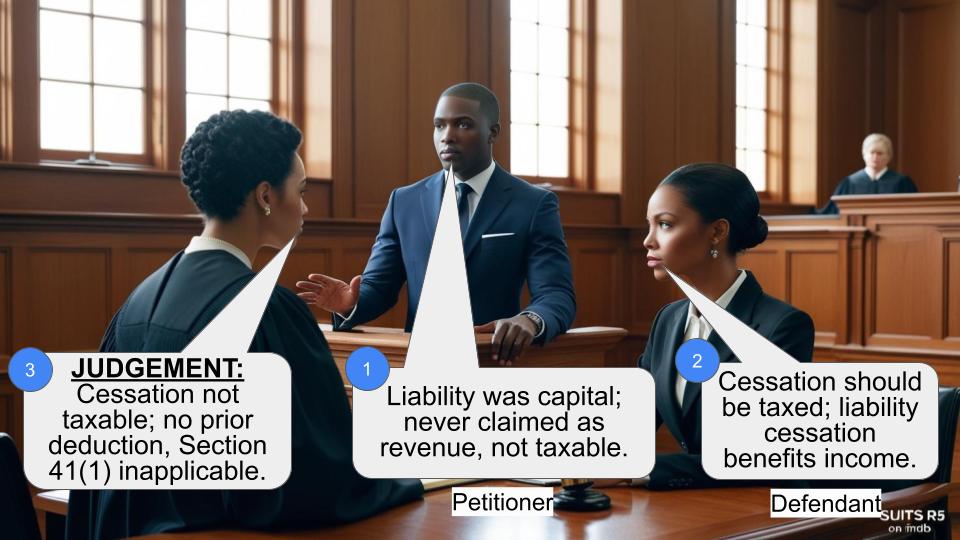
Cessation of Liability Not Taxable Under Section 41(1) (of Income Tax Act, 1961) Without Prior Deduction
Cessation of Liability Not Taxable Under Section 41(1) (of Income Tax Act, 1961) Without Prior Deduction
In the case of Principal Commissioner of Income Tax vs. Tinna Finex Ltd., the court addressed whether the cessation of a liability could be taxed under Section 41(1) (of Income Tax Act, 1961) when no prior deduction or allowance had been claimed. The court ruled in favor of Tinna Finex Ltd., stating that the cessation of liability was not taxable since it was not previously claimed as a revenue expenditure.
Get the full picture - access the original judgement of the court order here
Case Name:
Principal Commissioner of Income Tax vs. Tinna Finex Ltd.(High Court of Delhi)
ITA 113/2016
Date: 15th February 2016
Key Takeaways
- Section 41(1) (of Income Tax Act, 1961) Application: The court clarified that Section 41(1) (of Income Tax Act, 1961) does not apply if no deduction or allowance was made in respect of the liability in prior years.
- Capital vs. Revenue: The court emphasized the distinction between capital and revenue accounts, noting that the liability in question was on the capital account.
- Precedent Reliance: The decision relied on previous judgments, reinforcing the principle that cessation of liability is not taxable if it was never claimed as a deduction.
Issue
Can the cessation of a liability be taxed under Section 41(1) (of Income Tax Act, 1961) if no deduction or allowance was made in respect of that liability in prior years?
Facts
Tinna Finex Ltd. had a liability of Rs.5,64,85,956/- which was no longer required to be paid due to a family settlement. The Assessing Officer added this amount to the company's income under Section 41(1) (of Income Tax Act, 1961), but the company argued that this was incorrect as the liability was never claimed as a revenue expenditure.
Arguments
- Tinna Finex Ltd.: Argued that the liability was on the capital account and not claimed as a revenue expenditure, thus Section 41(1) (of Income Tax Act, 1961) should not apply.
- Revenue: Contended that the cessation of liability should be taxed under Section 41(1) (of Income Tax Act, 1961).
Key Legal Precedents
- CIT vs. Shivali Construction (P) Ltd.: Established that cessation of liability is not taxable if no prior deduction was claimed.
- CIT vs. Tosha International Ltd.: Reinforced the principle that capital account transactions are not subject to Section 41(1) (of Income Tax Act, 1961).
Judgement
The court upheld the decision of the Income Tax Appellate Tribunal, ruling in favor of Tinna Finex Ltd. The court found that the liability was on the capital account and not previously claimed as a deduction, thus Section 41(1) (of Income Tax Act, 1961) was not applicable.
FAQs
Q1: What is Section 41(1) (of Income Tax Act, 1961)?
A1: It is a provision that allows the taxation of any benefit received from the cessation of a liability if it was previously claimed as a deduction.
Q2: Why was the liability not taxable in this case?
A2: Because the liability was on the capital account and not claimed as a revenue expenditure in prior years.
Q3: What does this decision mean for other companies?
A3: It reinforces that liabilities not previously claimed as deductions cannot be taxed under Section 41(1) (of Income Tax Act, 1961) upon cessation.

1. This appeal has been preferred by the revenue against the order dated 26.06.2015 passed by the Income Tax Appellate Tribunal in ITA No. 3584/Del/2012 pertaining to the assessment year 2009-10. The revenue is aggrieved by the decision of the said Tribunal inasmuch as the Tribunal has dismissed the appeal filed by the revenue against the order of the Commissioner of Income Tax (Appeals) who had deleted the addition of Rs 5,64,85,956/- made by the Assessing Officer under Section 41(1) of the Income Tax Act, 1961, 1961.
2. The respondent company is engaged in the business of finance and export.In the year in question there was no business activity except for the receipt of interest and some hire charges. Against the gross receipts of Rs 6,54,900/- the respondent company claimed an expenditure of Rs 10,83,949/- resulting in a loss of Rs 4,29,049/-.
3. During the assessment proceedings the Assessing Officer noted that an amount of Rs 5,64,85,956/- shown as secured and unsecured loans as on 31.03.2008 in the balance sheet of the respondent company was reduced to Nil as on 31.03.2009. The assessee was asked to explain this change and in response the respondent / assessee indicated that this was based upon a family settlement between the group members. The respondent / assessee submitted that no trading transaction was involved in the writing off the said loans and, therefore, the provisions of Section 41(1) of the Income Tax Act, 1961 would not be attracted.
However, the Assessing Officer invoked the provisions of Section 41(1) of the Income Tax Act, 1961 and made an addition of Rs 5,64,85,956/- to the income of the assessee and completed the assessment under Section 143(3) of the Income Tax Act, 1961 by virtue of his order dated 28.12.2011.
4. As pointed out above, the Commissioner of Income Tax (Appeals) deleted the addition made by the Assessing Officer and found that Section 41(1) of the Income Tax Act, 1961 was not attracted. Against the said decision, the revenue filed an appeal before the Income Tax Appellate Tribunal which has been dismissed by the said Tribunal by virtue of the impugned order dated 26.06.2015. The Tribunal placed reliance on, inter alia, a decision of this court in Commissioner of Income-tax-III v. Shivali Construction (P) Ltd, 355 ITR 218. The Tribunal after examining the factual circumstances observed as under:
“8.3 After going through the provisions of section 41(1) of the Income Tax Act, 1961, we find that the same are not applicable to the facts of the assessee case. We also find that the AO has made the addition of Rs 5.64 crores by invoking provision of sec. 41(1) (of Income Tax Act, 1961) of the Income-tax without stating how the provision are applicable to the assessee’s case. Mere cessation of liability does not result into fit case of sec. 41(1) (of Income Tax Act, 1961) of the I.T Act. Assessee has submitted that assessee was not incurred any loss/expenditure/trading liability which is subsequently recovered by him is taxable as income in the year of recovery. We find that the assessee is squarely covered by the following judgments wherein it has been held that whenever, an amount is borrowed towards capital account and the loan is waived off, the same cannot be brought to tax net either in terms of sec-41(1) (of Income Tax Act, 1961) or 28(iv) of the Act. The same observation was mentioned by the Ld. CIT(A) in his impugned order at page no. 11 and Ld. CIT(A) also placed reliance on the following cases of this issue:
(i) CIT vs. Tosha International Ltd. (176 taxman 187) (Del.)
(ii) Govind Bhai C Patel vs. DCIT (ITA No. 1675/AHD/2009) dated 30.10.2009 (ITAT Ahmedabad)
(iii) CIT vs. Phool Chand Jiwan Ram (131 ITR 17) (Del.)
(iv) CIT vs. Compaq Electric Ltd. (ITA No. 172 of 2011 dated 18.10.2011) (Karnataka HC)
(v) CIT vs. Chetan Chemicals Pvt. Ltd. (267 ITR 770) (Guj.)
(vi) Mahindra & Mahindra Ltd. vs. CIT (261 ITR 501) (Bom.)
(vii) CIT-3 vs. M/s Cipla Investments Ltd. (ITA No. 6988 of 2012, dated 07.02.2012) (HC of Bombay)
8.4 We further note that it is well settled law that where no deduction / allowance has been made in respect of loss, exp/liability in the assessment year or in any earlier years, cessation of such liability cannot be taxed under section 41(1) (of Income Tax Act, 1961). To Support this finding, we place reliance on the following judgments:-
i. CIT-III vs. Shivali Constructions P. Ltd. 355 ITR 218 dated 01.05.2013, (Delhi High Court) ii.CIT-II vs. National Diary Development Board – Gujarat HC 49 Taxman.com 316 (ITA Appeal No. 195 of 2014) dated 06.05.2014.
8.5 In view of the above, we find that the AO has not disputed the facts brought on record by the assessee company. In our opinion, the liability of Rs 5,64,85,956/- as on 01.01.2009 in favour of M/s Tinna Overseas Ltd., was no longer required to be paid in view of the settlement. Similarly the assessee had foregone the investment in the shares and loan totalling to Rs. 1,08,41,345/- as per the terms of the settlement. The net gain to the assessee is Rs 4,56,44,611/-. The assessee has clearly established that the adjustments are on capital side and there is no case for invoking provisions of sec 41(1) (of Income Tax Act, 1961) since the liability waived by the creditor was never claimed as revenue expenditure.
8.6 Keeping in view of the facts and circumstances and the precedents, as explained aforesaid, we find considerable cogency in the finding of the ld. CIT(A) that the addition made by the AO cannot be sustained. Therefore, we do not see any reason to interfere with the finding of the Ld. CIT(A) on the issue in dispute, hence, we uphold the same.”
5. The Tribunal has, in our view, correctly followed the decision of this court in CIT v. Shivali Construction (supra). The loan transactions were on the capital account and the writing off the loan was also on capital account and did not find place in the Profit and Loss Account. Apart from this it has been found as a matter of fact that the respondent / assessee had not got the benefit of any allowance or deduction in the assessment for any prior year in respect of loss, expenditure or trading liability incurred by the respondent / assessee. Thus the cessation of the liability by itself would not lead to the attraction of the provisions of Section 41(1) (of Income Tax Act, 1961) in the subsequent year (i.e., the assessment year in question) when the liability ceased to exist.
6. The Tribunal having correctly applied the law and followed the decision in Shivali Construction (supra), cannot be faulted in its decision which is impugned before us. A similar decision of this court is also reported in Commissioner of Income-Tax v. Tosha International Ltd, (2011) 331 ITR 440. Since the issue on law already stands settled by the said decisions of this court, no substantial question of law arises for our consideration.
7. The appeal is dismissed.
BADAR DURREZ AHMED, J
FEBRUARY 15, 2016
R. K. GAUBA, J
×
Similar Ripples
Questions
Cessation of Liability Not Taxable Under Section 41(1) (of Income Tax Act, 1961) Without Prior Deduction
Write your CommentSimilar Posts


Generic
- Reportdata/3091.pdf
