


Court corrects Tribunal's misreading, restores CIT(A)'s decision on unexplained…


Full News

Court corrects Tribunal's misreading, restores CIT(A)'s decision on unexplained investment
Court corrects Tribunal's misreading, restores CIT(A)'s decision on unexplained investment
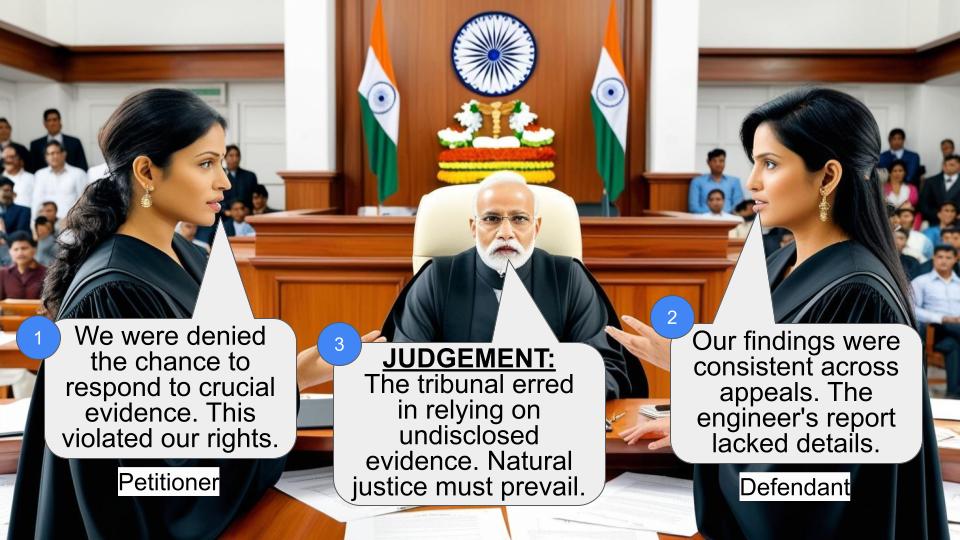
This case is about a guy named Hafiz Mohammed who was fighting the tax department over some money invested in a plot of land. The tax folks said it was his unexplained investment, but Hafiz said it was actually his son's. The case went through a few rounds of appeals, and finally, the High Court stepped in to clear up a misunderstanding about when some money was withdrawn from a bank account. In the end, they sided with Hafiz.
Get the full picture - access the original judgement of the court order here
Case Name:
Hafiz Mohammed Vs Assistant Commissioner of Income Tax (High Court of Rajasthan)
Income Tax Appeal No.69 of 2002
Date: 22nd November 2007
Key Takeaways:
1. The High Court can intervene when lower courts misread evidence.
2. Accurate interpretation of financial records is crucial in tax disputes.
3. The timing of financial transactions can make or break a case.
4. It's important to trace the source of funds in unexplained investment cases.
Issue:
The main question here was: Did the Income Tax Appellate Tribunal make a mistake by misreading the evidence about when money was withdrawn from a bank account, leading to an incorrect decision about unexplained investment?
Facts:
1. A plot of land was bought at an auction held by UIT (Urban Improvement Trust).
2. The receipt for the payment was in Hafiz Mohammed's name (our guy).
3. But the plot was supposedly bought by his son, Zakir Hussain.
4. Zakir's balance sheet from March 31, 1989, showed he bought the plot.
5. Zakir later sold the plot and declared the capital gain in his taxes.
6. There was a payment of Rs.68,400 made on March 31, 1989.
7. The big question was: Who actually made this payment? Hafiz or Zakir?
Arguments:
Tax Department's side:
- The receipt was in Hafiz's name, so it must be his investment.
- There's no proof that Zakir made the payment.
Hafiz's side:
- The plot was actually bought by his son, Zakir.
- Zakir's balance sheet shows the purchase.
- Zakir even paid taxes on the capital gain when he sold the plot.
- The money was withdrawn from Zakir's bank account.
Key Legal Precedents:
Interestingly, this case doesn't mention any specific legal precedents. It's more about correctly interpreting the evidence at hand.
Judgement:
So, here's what went down:
1. The Tribunal (ITAT) thought the money was withdrawn on March 8, 1990, which wouldn't make sense if it was paid on March 31, 1989.
2. But the High Court looked at the bank statement and found that the money was actually withdrawn on March 8, 1989, via a cheque dated March 6, 1989.
3. The Court said, "Oops! The Tribunal got this all wrong. They misread the date."
4. Because of this mix-up, the Court decided to throw out the Tribunal's decision and bring back the earlier decision by the CIT(A) that was in favor of Hafiz.
FAQs:
Q1: Why was this case so important?
A1: It shows how a simple misreading of a date can change the whole outcome of a tax case!
Q2: What does this mean for Hafiz Mohammed?
A2: Good news for him! The investment won't be treated as his unexplained income, saving him from potential extra taxes.
Q3: Could this have been avoided?
A3: Absolutely! If the Tribunal had double-checked the bank statement dates, they might have reached a different conclusion.
Q4: What's the lesson for taxpayers here?
A4: Keep good records! Being able to show exactly when and how money moved can make a huge difference in tax disputes.
Q5: Does this case set any new legal principles?
A5: Not really. It's more about the importance of correctly interpreting evidence in tax cases.

This appeal has been filed by the assessee against the impugned judgement of the Appellate Tribunal Annexure-1.
By Annexure-1 the learned Tribunal had decided two appeals being Appeal No. 663 and 664. Appeal No. 663 related to assessment year 1989-90, while Appeal No. 664 related to assessment year 1990-91. In the present appeal the findings arrived at by the learned Tribunal while deciding Appeal No. 663 only have been assailed, and that also with respect to ground no. 1 only whereby the Tribunal allowed the appeal of the Revenue, and set aside the deletion of the amount purportedly on account of unexplained investment on the plot bearing no. 27D.
The appeal came to be listed on 19.7.2002 on which date notice was ordered to be issued to show cause. Then, since nobody appeared on behalf of Revenue, on 28.8.2002 the appeal was admitted. However, in the order of admission no substantial question of law was formulated. Then, the matter came up on 25.9.2002. On that day it was noticed that the appeal has been admitted without formulating the substantial question of law. However, it was considered appropriate that the appeal itself be heard on priority basis, and therefore, the appeal was directed to be listed for hearing at admission stage. Thereafter, after various adjournments after adjournments, it has now come up before us.
The contention of the learned counsel for the appellant is that the finding of the learned Tribunal is based on misreading of the record, and is, therefore, liable to be set aside.
On the other hand, learned counsel for the Revenue submits that the finding recorded is a pure finding of fact, and does not involve any substantial question of law.
In our view, the present appeal does involve the substantial question of law being:-
“As to whether the finding recorded by the learned Tribunal in para-6 of the judgement is an out come of misreading of the record?”
We have considered the submissions, and perused the impugned judgement.
The relevant facts for appreciating the question formulated above is that the plot was purchased in auction conducted by the U.I.T. It appears that the receipt of the payment of the amount is issued in the name of assessee while the plot is said to have been purchased by his son Zakir Hussain. The balance sheet of Zakir Hussain as on 31.3.89 does show the purchase of this plot which was subsequently sold away by him, and he had declared capital gain derived from such sale which was assessed in the hands of Zakir Hussain. The learned Tribunal has found that the balance amount of Rs. 68,400/- was deposited vide receipt dt. 31.3.89 in the name of the assessee, and that there is no evidence/material on record to show that this payment of Rs. 68,400/- was made by Zakir Hussain, and that the entry of withdrawal of Rs. 68,400/- from the Bank by Zakir Hussain available at page-3 of the paper book of the Revenue relied upon by the assessee is dated 8.3.90, and therefore, this withdrawal obviously cannot relate back to the deposit made on 31.3.89, therefore, it was found that the assessing officer has rightly made this addition in the hands of the assessee, and the deletion was found to be uncalled for.
Learned counsel for the appellant made available for our perusal the photo stat copy of the bank statement of Account No. 745 of Zakir Hussain, and that shows that the amount of Rs. 68,400/- was withdrawn on 8.3.89 vide Cheque no. 453 dt. 6.3.89. In this sequence a look at the assessment order Annexure-5 shows that even therein it was found that as per the seized record payment of Rs. 68,400/- was made on 31.3.89, and the investment was found to be standing unexplained in the hands of the assessee while the learned Commissioner in appeal found that the investment duly reflected in the books of accounts of Zakir Hussain, and this was not the controversy gone into about amount having been drawn from the bank in the year 1990. Thus, it was never the question gone into as to whether the amount was drawn from the bank on 8.3.90, or 8.3.89, while the learned Tribunal has proceeded on the basis of the entry of withdrawal of Rs. 68,400/- from the Bank by Zakir Hussain assuming it to be dated 8.3.90. Thus, this much is not in controversy that the amount is 68,400/- does also not in controversy that the amount was drawn from the Bank of Zakir Hussain for being paid for purchase of the plot, and the question is only as to whether the amount was drawn on 8.3.89, or 8.3.90, obviously because if it was withdrawn on 8.3.90 it could not be paid on 31.3.89. What we find from the statement of account copy whereof is shown to us is that the amount was withdrawn by cheque issued in the name of U.I.T. itself being cheque no. 453 dt. 6.3.89, and does not appear to be a case of cash withdrawal by Zakir Hussain, and payment to U.I.T., and it appears that the cheque was given on 6.3.89 which was encashed on 8.3.89, and after encashment in due course the receipt was issued on 31.3.89. Thus, the whole edifice assumed by the learned Tribunal is clearly a misconception arising out of the misreading. Copy of the bank account is already there before the learned Tribunal.
Thus, the question is answered in favour of the assessee, and against the Revenue.
The appeal is accordingly allowed. The impugned judgement so far as it directs setting aside the deletion of amount made on account of unexplained investment as made by the Commissioner, Income Tax, is set aside, and the order of Commissioner, Income Tax is restored.
( MUNISHWAR NATH BHANDARI ),J. ( N P GUPTA ),J.
×
Similar Ripples
Questions
Court corrects Tribunal's misreading, restores CIT(A)'s decision on unexplained investment
Write your CommentSimilar Posts


Generic
- Reportdata/5158.pdf
