


Court Overturns Penalty on Company for Alleged Tax Inaccuracies, Citing Lack of…


Full News

Court Overturns Penalty on Company for Alleged Tax Inaccuracies, Citing Lack of Evidence
Court Overturns Penalty on Company for Alleged Tax Inaccuracies, Citing Lack of Evidence
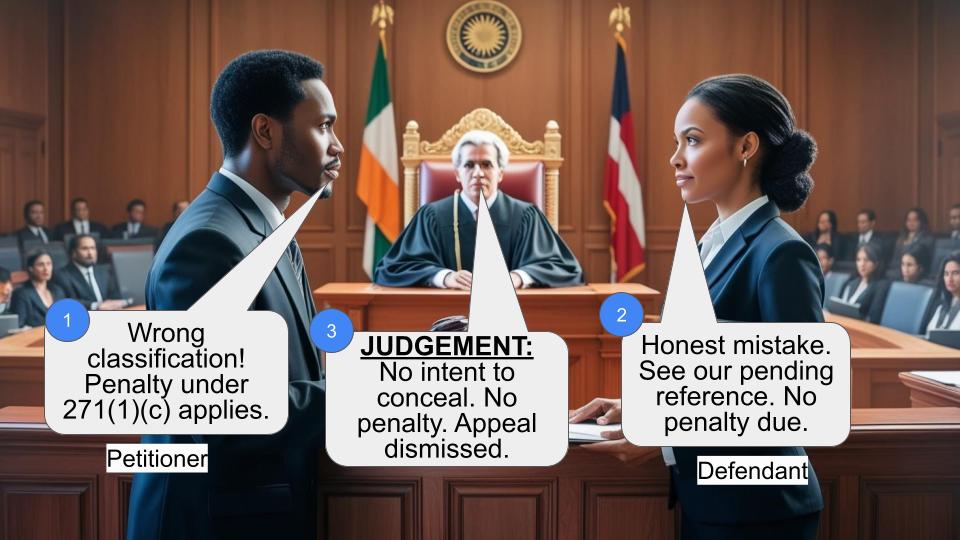
This case involves M/S. Vinay Autoparts P. Ltd. (the assessee) appealing against a penalty imposed by the Income Tax Department under Section 271(1)(c) (of Income Tax Act, 1961). The company had filed a nil income return but was later assessed for Minimum Alternate Tax (MAT) under Section 115JB (of Income Tax Act, 1961). The Income Tax Department imposed a penalty for allegedly furnishing inaccurate particulars. The High Court ultimately ruled in favor of the assessee, overturning the penalty.
Case Name**: M/S. Vinay Autoparts P. Ltd. vs Income Tax Officer
**Key Takeaways**:
1. Mere acceptance of a tax assessment doesn't automatically justify a penalty.
2. The tax department must prove concealment or inaccuracy of income particulars.
3. Lack of specific findings in the assessment order about inaccuracies can invalidate a penalty.
4. Honest mistakes or misinterpretation of law may not warrant penalties under Section 271(1)(c) (of Income Tax Act, 1961).
**Issue**:
Was the Income Tax Appellate Tribunal correct in confirming the levy of penalty under Section 271(1)(c) (of Income Tax Act, 1961) against the assessee?
**Facts**:
1. The assessee, a company, filed a nil income return for the assessment year 2009-10 on 28.09.2010.
2. The assessment was completed under Section 143(3) (of Income Tax Act, 1961), determining a loss of Rs.9,18,109 and book profits of Rs.28,69,799 under Section 115JB (of Income Tax Act, 1961).
3. The assessee accepted the assessment and paid taxes.
4. The Assessing Officer initiated penalty proceedings, citing that the assessee neither filed Form 29B nor paid taxes under Section 115JB (of Income Tax Act, 1961).
5. A penalty of Rs.2,95,589 was imposed under Section 271(1)(c) (of Income Tax Act, 1961).
6. The assessee appealed to the CIT(A) and then to the Tribunal, both of which upheld the penalty.
**Arguments**:
Assessee's arguments:
1. The mistake was due to wrong advice and there was no intention to conceal or furnish inaccurate particulars.
2. They were under the impression that as an STPI unit eligible for Section 10B (of Income Tax Act, 1961) benefits, there was no tax liability.
3. The tax demanded was immediately paid upon receipt of the assessment order.
Department's arguments:
1. The assessee furnished inaccurate particulars in the return of income.
2. The assessee was bound to declare income under both normal provisions and Section 115JB (of Income Tax Act, 1961).
**Key Legal Precedents**:
1. CIT vs. Reliance Petroproducts Pvt. Ltd., (2010) 322 ITR 158: Established that for Section 271(1)(c) (of Income Tax Act, 1961) to apply, there must be concealment of income particulars or furnishing of inaccurate particulars.
2. Sri Golulam Hotels India (P) Ltd. vs. ACIT, (2014) 49 taxmann.com 543 (Madras HC) and Terra Energy Ltd., 12 taxmann.com 405 (Chennai ITAT): Cited by CIT(A) to uphold the penalty.
3. CIT vs. Nalwa Sons Investments Ltd., (2010) 327 ITR 543 (Delhi): Cited by the assessee but found not applicable by the Tribunal.
**Judgement**:
The High Court allowed the appeal and answered the substantial question of law in favor of the assessee. Key points:
1. The Assessing Officer did not record any finding that the particulars given by the assessee were incorrect or inaccurate.
2. The assessment order was based on an interpretation of the legal position regarding tax under Section 115JB (of Income Tax Act, 1961).
3. The assessee's explanation about wrong advice and subsequent correction was found reasonable.
4. The court found the order imposing penalty to be perverse and interfered with the orders of the CIT(A) and Tribunal.
**FAQs**:
1. Q: What was the main reason for overturning the penalty?
A: The main reason was the lack of specific findings by the Assessing Officer that the assessee had furnished inaccurate particulars or concealed income.
2. Q: Does accepting a tax assessment automatically lead to penalties?
A: No, accepting a tax assessment doesn't automatically justify penalties. The department must prove concealment or inaccuracy of income particulars.
3. Q: What is the significance of Section 115JB (of Income Tax Act, 1961) in this case?
A: Section 115JB (of Income Tax Act, 1961) relates to Minimum Alternate Tax (MAT), which the assessee was found liable for but had not initially paid due to a misunderstanding.
4. Q: Can honest mistakes lead to penalties under Section 271(1)(c) (of Income Tax Act, 1961)?
A: Generally, honest mistakes or misinterpretation of law may not warrant penalties under Section 271(1)(c) (of Income Tax Act, 1961), as demonstrated in this case.
5. Q: What should taxpayers learn from this case?
A: Taxpayers should ensure accurate reporting but also know that they can contest penalties even if they've accepted the quantum assessment, provided they have a reasonable explanation for any discrepancies.

1. This appeal, filed by the appellant/assessee under Section 260A (of Income Tax Act, 1961) (hereinafter referred to as “the Act”), is directed against the order dated 10.05.2019, passed by the Income-tax Appellate Tribunal 'C' Bench, Chennai (for brevity, “the Tribunal”), in I.T.A.No.2384/Chny/2018 for the assessment year 2009-10.
2.The above appeal has been filed raising the following substantial question of law:-
“Whether on the facts and in the circumstances of case, the Tribunal was right in law in confirming the levy of penalty under Section 271(1)(c) (of Income Tax Act, 1961).”
3.The assessee, a company incorporated under the Companies Act, 1956, filed its return of income for the assessment year 2009-10, on 28.09.2010, admitting total income as Rs.NIL. The assessment was completed under Section 143(3) (of Income Tax Act, 1961), vide order dated 01.12.2011, determining the loss at Rs.9,18,109/- and book profits as determined under Section 115JB (of Income Tax Act, 1961) at Rs.28,69,799/-. The assessment order had become final, as the assessee accepted the assessment and paid taxes.
4.The Assessing Officer initiated penalty proceedings by issuing notice dated 01.12.2011. Though in the notice the exact allegations as regards furnishing inaccurate particulars or regarding concealment of particulars were not specifically mentioned, in the penalty order dated 27.06.2012, under Section 271(1)(c) (of Income Tax Act, 1961), the reason has been set out. The reason assigned by the Assessing Officer is that the assessee is liable for payment of Minimum Alternate Tax (MAT) under Section 115JB (of Income Tax Act, 1961). However, the assessee had neither filed Form 29B, nor paid taxes as required to be paid under Section 115JB (of Income Tax Act, 1961). Therefore, the Assessing Officer opined that penalty has to be imposed.
5.In reply to the show cause notice, the assessee stated that penalty can be imposed only when there is a conscious concealment or furnishing of inaccurate particulars and the mistake occurred at the time of filing the return was on account of wrong advice given to the assessee resulting in omission of the applicability of Section 115JB (of Income Tax Act, 1961). Further, the assessee stated that they were under the impression that since they are an STPI unit and eligible for the benefits under Section 10B (of Income Tax Act, 1961), there is no liability for tax. The assessee stated that it was their bona fide belief that there is no liability for tax and there is no intention to conceal or furnish inaccurate particulars and immediately, on receipt of the assessment order, the tax demanded to the tune of Rs.4,80,060/- was remitted by the assessee on 27.12.2012. Therefore, the assessee requested that the penalty proceedings be dropped. However, the Assessing Officer did not agree with the assessee and passed the order under Section 271(1)(c) (of Income Tax Act, 1961) dated 27.06.2012 and imposed minimum penalty of Rs.2,95,589/-.
6.Aggrieved by such order, the assessee preferred appeal before the Commissioner of Income-tax (Appeals)-11, Chennai (for brevity, “the CIT(A)”). In the appeal petition, apart from the grounds canvassed before the Assessing Officer, it was contended that penalty ought not to have been imposed without taking note of the representation given by the assessee that they were improperly advised. Further, it was contended that the tax paid under Section 115JB (of Income Tax Act, 1961) is only a presumptive tax and claimed credit in the subsequent assessment years as and when liability arises to the assessee.
7.Before the CIT(A), the Assessing Officer stated that the assessee had furnished inaccurate particulars in the return of income and hence, penalty under Section 271(1)(c) (of Income Tax Act, 1961) will be attracted. On the other hand, the assessee contended that the Assessing Officer has observed that the assessee has rightly claimed deduction under Section 10B (of Income Tax Act, 1961) and has declared NIL taxable income under the normal provisions of the Act.
8.Further, it was contended that the details relating to book profits were made available to the Assessing Officer at the time of assessment proceedings for his consideration regarding MAT. Further, the Assessing Officer, has not recorded any finding that the details provided by the assessee in its return of income were found to be incorrect or erroneous or false and in such circumstances, the question of levying penalty will not arise. Further, it was pointed out that the assessee has not provided any inaccurate particulars neither in the return of income, nor to the Assessing Officer while submitting the books of accounts.
9.The assessee placed reliance on the decision of the Hon'ble Supreme Court in CIT vs. Reliance Petroproducts Pvt. Ltd., (2010) 322 ITR 158. The CIT(A) held that the assessee was bound to have declared income under both the provisions as well as under Section 115JB (of Income Tax Act, 1961) and there can be no exception or lenience.
10.Referring to the decisions in the case of Sri Golulam Hotels India (P) Ltd. vs. ACIT, (2014) 49 taxmann.com 543 (Madras HC) and Terra Energy Ltd., 12 taxmann.com 405 (Chennai ITAT), the CIT(A) upheld the order of the Assessing Officer.
11.The assessee carried the matter by way of appeal to the Tribunal. Before the Tribunal, it was contended that the income was assessed under Section 115JB (of Income Tax Act, 1961) and not under normal provision and it is not denied that there is a concealment of income, but that had its repercussions only when the assessment was done under the normal procedure. Further, it was argued that the assessment as per normal procedure was, however, not acted upon. On the contrary, it is the deemed income assessed under Section 115JB (of Income Tax Act, 1961) and hence, when the computation was made under Section 115JB (of Income Tax Act, 1961), the concealment had no role to play and was totally irrelevant. Therefore, the concealment did not lead to tax evasion at all and hence, penalty should not be imposed under Section 271(1)(c) (of Income Tax Act, 1961).
12.In support of their contention, reliance was placed on the decision in CIT vs. Nalwa Sons Investments Ltd., (2010) 327 ITR 543 (Delhi). The Tribunal by the impugned order dismissed the appeal filed by the assessee holding that the explanation offered by the assessee, in response to the show cause notice issued under Section 271(1)(c) (of Income Tax Act, 1961), is not a plausible explanation and there is no material on record to establish as to why the assessee had entertained the belief that profit is exempt from tax under the provision of Section 10B (of Income Tax Act, 1961) and not liable to tax under Section 115JB (of Income Tax Act, 1961).
13.Further, the Tribunal pointed out that the explanation offered by the assessee was a bald explanation and cannot be a plausible explanation and levy of penalty was justified. The decision in the case of Nalwa Sons Investments Ltd. (supra) relied on by the assessee was held to be not applicable to the facts of the case. This is how the assessee is before us by way of this tax case appeal.
14.We have elaborately heard Mr.V.S.Jayakumar, learned counsel for the appellant/assessee; and Mr.M.Swaminathan, learned Senior Standing Counsel assisted by Ms.S.Premalatha, learned Standing Counsel appearing for the respondent/Revenue.
15.In order to levy penalty under Section 271(1)(c) (of Income Tax Act, 1961), the Assessing Officer should be satisfied that in the course of any proceedings under the Act, any person has concealed the particulars of his income or furnished inaccurate particulars of such income and if the Assessing Officer arrives at such satisfaction, it would be a case for imposition of penalty under the said Section. Therefore, it has to be seen as to why the Assessing Officer was satisfied in the assessee's case to levy penalty.
16.As pointed out by us, in the penalty notice dated 01.12.2011, it is not clearly indicated as to on what basis, the Assessing Officer was of the prima facie view that penalty is imposable. We find that irrelevant portions of the penalty notice have not been deleted and the space have been left blank except for the hearing date, which has been mentioned in the notice. However, the assessee has not raised such a plea before the Assessing Officer and therefore, at this juncture, we do not propose to invalidate the penalty proceedings on the ground that the penalty notice dated 01.12.2011 is devoid of material. The reason for imposition of penalty is on the ground that the assessee is liable for payment of MAT under Section 115JB (of Income Tax Act, 1961) and that the assessee had neither filed Form 29B, nor paid taxes as required to be paid under Section 115JB (of Income Tax Act, 1961).
17.The explanation given by the assessee is that, at the time of filing the e-return, they were advised by a Chartered Accountant, who had helped them to file the necessary details. Copy of the return of income dated 28.09.2009 has been filed by the assessee in the form of an additional paper book. From the return of income, we find that so far as the deduction under Section 10B (of Income Tax Act, 1961) is concerned, the assessee has mentioned the figure as Rs.3979312/-. With regard to the Minimum Alternate Tax, in column 5(b), relating to “deductions”, the assessee has shown the amount as Rs.39,79,312/-. So far as the MAT credit is concerned, in Column 1, referring to “tax under Section 115JB (of Income Tax Act, 1961)” of the Act, in the assessment year 2008-09, the assessee has shown Rs.“zero”.
18.According to the learned counsel for the assessee, along with the return of income, the statement of total of income was filed by the assessee which shows the computation as per Section 115JB (of Income Tax Act, 1961). It is the further case of the assessee that Form 29B was filed though not along with the e-return, but subsequently during the assessment proceedings.
19.The objection of Mr.M.Swaminathan, is that when the assessee has shown Rs.“zero” in the column “tax under Section 115JB (of Income Tax Act, 1961) in the assessment year 2008-09, it definitely amounts to furnishing inaccurate particulars or concealing the particulars of the assessee's income. Further, Mr.M.Swaminathan, would contend that the assessee is not an individual, but a private limited company and the plea raised by them is absolutely far fetched and the Assessing Officer and the CIT(A) and the Tribunal have concurrently held against the assessee and the finding of the Tribunal should not be disturbed.
20.It is true that when there are concurrent findings of fact, this Court exercising power under Section 260A (of Income Tax Act, 1961) will not interfere unless and until a case of perversity is established. It is a settled legal principle that merely because the assessee has accepted the quantum assessment as assessed by the Assessing Officer, based on the return of income and paid taxes, it will not automatically lead to levy of penalty and the assessee is entitled to contest the levy of penalty and the onus is on the Department to show that there has been concealment of particulars of income of the assessee or furnishing inaccurate particulars of income.
21.In the instant case, the penalty proceedings were initiated solely for the reason that the assessee had not filed Form No.29B, nor paid taxes as required to be paid under Section 115JB (of Income Tax Act, 1961). After the assessee filed e-return on 28.09.2009, the same was processed under Section 143(1) (of Income Tax Act, 1961) on 25.11.2010. Subsequently, the case was selected for scrutiny under CASS and notice under Section 143(2) (of Income Tax Act, 1961) was issued on 23.08.2010. In response to the said notice, the Chartered Accountant of the assessee appeared. The Assessing Officer from time to time called for details and the Assessing Officer accepts that those details were furnished by the assessee and the books of account and bank statement were produced and examined by the Assessing Officer.
22.At the time when the assessment proceedings were going on, it was pointed out by the Assessing Officer that the assessee had not filed Form 29B, nor paid taxes as required to be paid under Section 115JB (of Income Tax Act, 1961). The assessee's case was that the Chartered Accountant, whom they have engaged, had prepared form 29B on 01.09.2009, but the same was not filed along with the return, but subsequently, the Chartered Accountant passed away and they were advised in a particular manner to file the return of income and there is no intention to conceal particulars or furnish inaccurate particulars. The Assessing Officer notes that the authorised representative of the assessee during the assessment proceedings, when the Assessing Officer pointed out the omission, filed Form 29B. This was examined and tax was computed and the same has been remitted by the assessee along with interest levied under Section 234B (of Income Tax Act, 1961) and 243C of the Act.
23.The allegation against the assessee is that they had furnished inaccurate particulars, which would mean that the particulars are not accurate or not exact or not correct or it is untrue. However, on a reading of the assessment order dated 01.12.2011, we find that there is absolutely no finding rendered by the Assessing Officer that the assessee had furnished inaccurate or incorrect or untrue particulars or erroneous particulars in the return of income. In such circumstances, we are of the considered view that it is not a case where penalty could have been imposed on the assessee.
24.In Reliance Petroproducts Pvt. Ltd., (supra) the Hon'ble Supreme Court pointed out that for Section 271(1)(c) (of Income Tax Act, 1961) to be attracted, there has to be concealment of particulars of income of the assessee and secondly, the assessee must have furnished inaccurate particulars of his income. Admittedly, there is no allegation against the assessee before us that they had concealed particulars of their income.
However, the allegation is inaccurate particulars have been furnished. The Assessing Officer while completing the assessment vide order dated 01.12.2011, does not record any finding that the particulars given by the assessee in the return of income is incorrect or inaccurate, but the conclusion of the Assessing Officer is based upon an interpretation of the legal position and held that tax is payable under Section 115JB (of Income Tax Act, 1961).
25.The assessee's specific case was that they were advised to file the return of income in a particular fashion and prior to the assessment proceedings, their Chartered Accountant had passed away and this had led to the mistake, which the Assessing Officer pointed out during the assessment proceedings. Thus, in our considered view, the assessee's case is not a case where the provisions of Section 271(1)(c) (of Income Tax Act, 1961) could have been invoked, as there has been no finding recorded by the Assessing Officer that they have furnished inaccurate particulars or for concealing particulars. Therefore, we find that the order passed by the Assessing Officer imposing penalty vide order dated 27.06.2012 is perverse. Consequently, the orders passed by the CIT(A) and the Tribunal confirming such orders are liable to be interfered with.
26.For all the above reasons, the appeal filed by the assessee is allowed and the substantial question of law is answered in favour of the assessee.
(T.S.S., J.) (V.B.S., J.)
22.08.2019
Index : Yes/No
Speaking/Non-Speaking Order
To
1.The Income-tax Officer,
Company Ward 3(1),
121, Uttamar Gandhi Road,
Nungambakkam,
Chennai-600 006.
2.The Commissioner of Income-tax (Appeals)-11,
121, Mahatma Gandhi Road, Nungambakkam,
Chennai-600 034.
3.The Income-tax Appellate Tribunal 'C' Bench, Chennai.
T.S.Sivagnanam, J.
and
V.Bhavani Subbaroyan, J.
T.C.A.No.618 of 2019
22.08.2019
×
Similar Ripples
Questions
Court Overturns Penalty on Company for Alleged Tax Inaccuracies, Citing Lack of Evidence
Write your CommentSimilar Posts


Generic
- Reportdata/5939.pdf
