


Court Allows Reassessment, Directs Taxpayer to Prove Full Disclosure


Full News

Court Allows Reassessment, Directs Taxpayer to Prove Full Disclosure
Court Allows Reassessment, Directs Taxpayer to Prove Full Disclosure
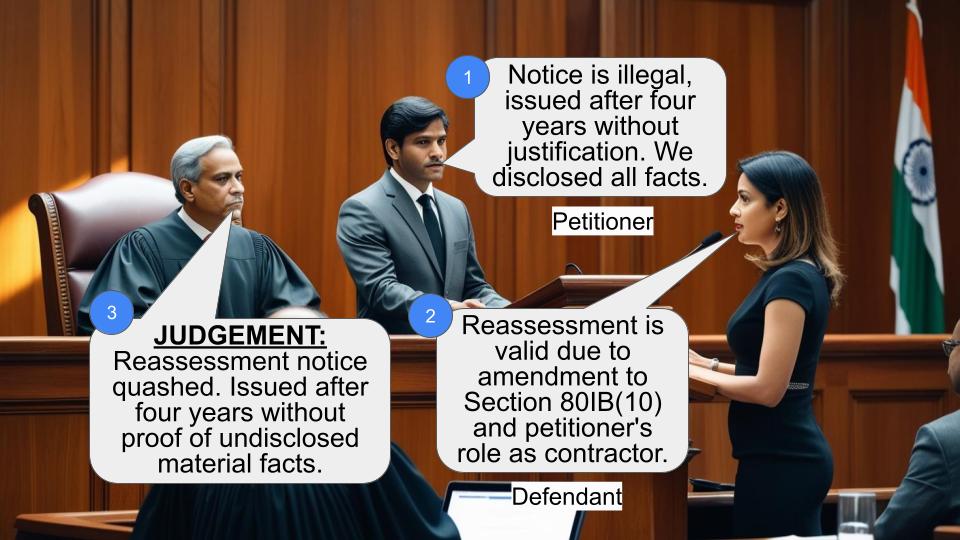
This case involves Seshasayee Paper and Boards Limited (the petitioner) challenging a notice issued by the Assistant Commissioner of Income Tax (the respondent) to reopen an assessment for the 2003-04 tax year. The court ultimately allowed the reassessment to proceed, directing the petitioner to participate in the proceedings and demonstrate that they had made a full and true disclosure of all material facts during the original assessment.
Get the full picture - access the original judgement of the court order here
Case Name:
Seshasayee Paper and Boards Limited Vs Assistant Commissioner of Income Tax (High Court of Madras)
W.P.No.23016 of 2011 and M.P.No.1 of 2011
Date: 19th May 2020
Key Takeaways:
1. The court emphasized the importance of "full and true disclosure" by taxpayers during assessments.
2. Mere submission of documents doesn't automatically constitute full disclosure.
3. The court reinforced that reassessments cannot be based on a mere "change of opinion" by tax authorities.
4. The judgment highlights the delicate balance between taxpayer rights and the tax department's power to reassess.
Issue:
Can the Income Tax Department reopen an assessment after four years from the end of the relevant assessment year, and what conditions must be met for such reopening to be valid?
Facts:
1. Seshasayee Paper and Boards Limited filed a tax return for the 2003-04 assessment year on 03.11.2003 .
2. A scrutiny assessment was completed, and an order was passed on 29.03.2006 under Section 143(3) (of Income Tax Act, 1961) .
3. Just before the six-year limitation period expired, the tax department issued a notice on 30.03.2010 under Section 148 (of Income Tax Act, 1961) to reopen the assessment .
4. The reasons for reopening included issues with provision for bad and doubtful debts and diminution in value under Section 115JB (of Income Tax Act, 1961) .
Arguments:
Petitioner's arguments:
1. The Assessing Officer relied on objections raised by the Internal Audit Party without forming an independent opinion .
2. No fresh material was brought to invoke Section 148 (of Income Tax Act, 1961), and the reopening was based on a mere change of opinion .
3. The provision for bad and doubtful debts was already disallowed, and there was no escapement of income .
4. Diminution in value didn't need to be added back under Section 115JB (of Income Tax Act, 1961) computation .
Respondent's arguments:
1. The petitioner should participate in the proceedings under Section 148 (of Income Tax Act, 1961) rather than challenging through a writ petition .
2. The petitioner can make all submissions on merits during the reassessment proceedings .
Key Legal Precedents:
1. Indian & Eastern Newspaper Society Vs. Commissioner of Income Tax, (1979) 119 ITR 996 (SC)
2. CIT Vs. Kelvinator of India Ltd., (2010) 320 ITR 561 (SC)
3. ITO Vs. Techspan India P. Ltd., (2018) 404 ITR 10 (SC)
4. Calcutta Discount Co. Ltd. V. Income Tax Officer, AIR 1961 SC 372
5. Jeans Knit P. Ltd. V. CIT, 2018(12) SCC 36
Judgement:
1. The court did not quash the reopening notice or the communication overruling the petitioner's objections .
2. The petitioner was directed to participate in the reassessment proceedings and file representations/objections within 30 days.
3. The tax department was ordered to pass orders on merits within 60 days of receiving the court order.
4. The court emphasized that if circumstances don't justify invoking the proviso to Section 147 (of Income Tax Act, 1961), the proceedings should be dropped.
FAQs:
Q1: What is the significance of the "full and true disclosure" requirement?
A1: It's crucial because if a taxpayer can prove they fully disclosed all material facts during the original assessment, it can prevent reassessment after four years.
Q2: Can the tax department reopen assessments based on a change of opinion?
A2: No, the court reinforced that mere change of opinion is not sufficient grounds for reopening an assessment.
Q3: What should taxpayers do if they receive a reassessment notice?
A3: They should participate in the proceedings and demonstrate that they made a full and true disclosure during the original assessment.
Q4: How long does the tax department have to complete the reassessment in this case?
A4: The court directed the tax department to pass appropriate orders within 60 days of receiving the court order.
Q5: What is the importance of Section 147 (of Income Tax Act, 1961) and its proviso in this case?
A5: Section 147 (of Income Tax Act, 1961) and its proviso set the conditions under which the tax department can reopen assessments, especially after four years from the end of the relevant assessment year.

In this Writ Petition, the petitioner has challenged the impugned communication dated 12.09.2011 overruling the objection of the petitioner against the re-opening of the assessment vide Notice dated 30.03.2010 under Section 148 (of Income Tax Act, 1961) for the Assessment Year 2003-04.
2. The said Notice has been issued on the last date of expiry of limitation (six years), under proviso to Section 147 (of Income Tax Act, 1961) seeking to re-open the assessment.
3. The brief facts of the present case are that the petitioner is engaged in manufacture and sale of paper and paper products. The petitioner had filed the return for the Assessment Year 2003-04 on 03.11.2003. Thereafter, a scrutiny assessment was completed and an assessment order was passed on 29.03.2006 under Section 143(3) (of Income Tax Act, 1961). Just before a lapse of six years limitation, the respondent issued a notice dated 30.03.2010 under Section 148 (of Income Tax Act, 1961) to re-open the aforesaid assessment.
4. Under these circumstances, the petitioner called upon the respondent to furnish the reason for re-opening of the assessment. By a communication dated 02.08.2010, the respondent has given the reasons for re-opening of the assessment, which reads as under:-
1.Provision for bad and doubtful debts of Rs.29,35,475/- under the head miscellaneous expenses. 2.Diminution in value has not been added back under the computation u/s. 115JB (of Income Tax Act, 1961), an amount of Rs.6,41,32,200/-.
5. It is the contention of the petitioner that the Assessing Authority while issuing notice under Section 148 (of Income Tax Act, 1961) has relied on the objections raised by the Internal Audit Party and has not independently formed an opinion on the objections raised. Therefore, this was contrary to the views of the Hon’ble Supreme Court in Indian & Eastern Newspaper Society Vs. Commissioner of Income Tax, (1979) 119 ITR 996 (SC) and the Bombay High Court in Hamilton Housewares (P.) Ltd. Vs. Deputy Commissioner of Income Tax, (2019) 104 taxmann.com 128 (Bombay).
6. It is further contended that no fresh material has brought to invoke Section 148 (of Income Tax Act, 1961) and that the failure in diminution value for computation under Section 115JB (of Income Tax Act, 1961) was merely based on the change of opinion and therefore, it was contrary to the decisions of the Hon’ble Supreme Court in CIT Vs. Kelvinator of India Ltd., (2010) 320 ITR 561 (SC) and in ITO Vs. Techspan India P. Ltd., (2018) 404 ITR 10 (SC).
7. It is further submitted that on merits the provision of bad and doubtful debts was disallowed as item not allowable by the petitioner itself and that the petitioner had not claimed any deduction in respect of provision for bad and doubtful debts and hence there is no escapement of income.
8. It is further submitted that the diminution in value would not enhancing the liability and hence, need not to be added back under the computation under Section 115JB (of Income Tax Act, 1961) for the purpose of memo altering the tax under reference was made to the decision of the Hon’ble Supreme Court in Commissioner of Income Tax Vs. HCL Comnet Systems & Services Ltd., (2008) 305 ITR 0409.
9. The learned counsel appearing for the petitioner relied on the following decisions:-
i. Calcutta Discount Co. Ltd. V. Income Tax Officer, AIR 1961 SC 372.
ii. Jeans Knit P. Ltd. V. CIT, 2018(12) SCC 36.
iii. The Income Tax Officer V. Lakhmani Mewal Das, 1976(3) SCC 757.
iv. Jindal Photo Films Ltd. V. The Deputy Commissioner of Income Tax, 1998 (46) DRJ (DB).
v. Income Tax Officer V. Techspan India P. Ltd., (2018) 6 SCC 685.
vi. CIT V. Kelvinator of India Ltd., (2010) 2 SCC 723.
vii.Deputy CIT V. Gay Travels (P) Ltd., in W.P.No.35606 and 35607 of 2002.
viii.CIT V.Usha International Ltd., (2012) 348 ITR 485.
ix. Asianet Star Communications Pvt. Ltd. V. Assistant Commissioner of Income Tax in reported judgment in W.P.Nos.25328 of 2018 etc.
10. The learned standing counsel for the respondent submits that the present Writ Petition is liable to be dismissed and the petitioner should be relegated to participate in the proceedings under Section 148 (of Income Tax Act, 1961). It is further submitted that it is not open for the petitioner to scuttle the proceedings by citing the decision and the very same decision can be cited before the Authority.
11. The learned standing counsel for the respondent submits that the impugned notice and the impugned communication overruling the objection cannot be interfered, inasmuch as it impedes with the re- assessment proceedings under Section 148 (of Income Tax Act, 1961).
It is submitted that it is open for the petitioner to make all its submissions on merits, which has been raised before this Court and in case, as has been contended by the petitioner that if there was a change of opinion and if the petitioner establishes that there was no failure on the part of the petitioner to fully and truly disclose all materials required for assessment, the officer would be obliged to drop the proceedings.
12. On the one hand, it is the contention of the learned counsel for the petitioner that the impugned proceedings are without jurisdiction and therefore the petitioner was entitled for the relief. On the other hand, it is the contention of the respondent that the present Writ Petition is liable to be dismissed.
13. I have considered the arguments advanced by the learned counsel for the petitioner and the learned standing counsel for the respondent.
14. The purpose of issuing notice under Section 148 (of Income Tax Act, 1961) is for passing an order of re-assessment under Section 147 (of Income Tax Act, 1961). However, Section 148 (of Income Tax Act, 1961) is not governed by the restrictions contained in Section 147 (of Income Tax Act, 1961).
15. For the aforesaid purpose, the Assessing Officer has to merely issue a notice within the time limit prescribed under Section 149 (of Income Tax Act, 1961). Before issuing notice, he has to record reason. In view of the decision of the Honourable Supreme Court in GKN Drive Shafts referred to supra, an assessee is now entitled to ask for the reasons for reopening of the assessment after filing the returns. The Assessing Officer has to merely communicate the reasons for reopening the assessment if desired by the assessee.
16. The communication of reasons for reopening of the assessment is merely to allow an assessee to participate in the re-assessment proceedings by giving effective reply. The overruling of the objection by the respondents through a speaking order is however not an order under Section 147 (of Income Tax Act, 1961).
17. Thus, for issuing a notice under Section 148 (of Income Tax Act, 1961) as it stands today, the Assessing Officer has to satisfy the requirements of Section 149 (of Income Tax Act, 1961).
18. However, while passing final order of re-assessment under Section 147 (of Income Tax Act, 1961), the Assessing Officer has to bear in mind the express language of the 1 st proviso to Section 147 (of Income Tax Act, 1961). As per the 1 st proviso to Section 147 (of Income Tax Act, 1961), no action shall be taken under the said Section after expiry of four years from the end of the relevant assessment year, unless income chargeable to tax has escaped assessment for such assessment year by reason of the failure on the part of the assessee to make a return under Section 139 (of Income Tax Act, 1961) or in response to a notice issued under sub-Section (1) of Section 142 (of Income Tax Act, 1961) or 148 or to disclose fully and truly all material facts necessary for that assessment year.
19. Whether the notice that has been issued to the petitioner was on account of change of opinion or on account of failure on the part of the petitioner to fully and truly disclose all material required for the assessment is to be determined by the Assessing Officer while passing order under Section 147 (of Income Tax Act, 1961). The present case involves questions relating to accounts which are better left to be decided by the original authority.
20. Though in a recent decision, the Honourable Supreme Court in Jeans Knit Private Limited Vs. Deputy Commissioner of Income Tax, (2018) 12 SCC 36 was cited, wherein it was observed that the Karnataka High Court had taken a view contrary to the law laid down by the Honourable Supreme Court in Calcutta Discount Co-Limited Vs. CIT referred to supra. The Hon’ble Supreme Court however refrained from making any observation on the merits and remitted the case back to the concerned High Court. Therefore, the said decision does not further the case of the petitioner. This is not a clear case to apply the principle laid down in the Calcutta Discount Co-Limited Vs. CIT referred to supra.
21. In Asianet Star Communications Pvt. Ltd. V. Assistant Commissioner of Income Tax, order dated 16.04.2019 passed by this Court in W.P.Nos.25328 of 2018 etc. referred by the learned counsel for the petitioner, the Court concluded that the responsibility was on the assessee to make true and full disclose and thereafter, mantle would shift on the Assessing Officer and is expected to complete the assessment. The Court there quashed the notice as all material was available to open sight.
22. In the facts of the case, though the petitioner had furnished certain details at the time of re-assessment, the question still remains to be answered is whether there was full and true disclosure by the petitioner as is contemplated under proviso to Section 147 (of Income Tax Act, 1961).
23. In this case, mere filing to the annexure by the petitioner in response to notice during scrutiny assessment by itself may or may not have been sufficient to come to the conclusion that there was full and true disclosure by the petitioner if the information furnished was neither complete nor true. Question is whether the information furnished were complete in all respect is to be decided only in a adjudicator mechanism.
24. It is therefore best left open for the petitioner to demonstrate before the respondent that the details furnished by the petitioner meets the requirements of full and true disclosure for the Assessing Officer to drop the proceedings in terms of 1 st proviso to Section 147 (of Income Tax Act, 1961).
25. In case there is a change of opinion, the respondent cannot proceed in the light of the decision of the Hon’ble Supreme Court in CIT Vs. Kelvinator of India Ltd., (2010) 2 SCC 723. The Hon’ble Supreme Court cautioned the Assessing Officers with the following observation:-
“On going through the changes, quoted above, made to Section 147 (of Income Tax Act, 1961), we find that, prior to Direct Tax Laws (Amendment) Act, 1987, re- opening could be done under above two conditions and fulfilment of the said conditions alone conferred jurisdiction on the Assessing Officer to make a back assessment, but in Section 147 (of Income Tax Act, 1961) (with effect from 1 st April, 1989), they are given a go-by and only one condition has remained, viz., that where the Assessing Officer has reason to believe that income has escaped assessment, confers jurisdiction to re- open the assessment. Therefore, post-1 st April, 1989, power to re-open is much wider. However, one needs to give a schematic interpretation to the words “reason to believe” failing which, we are afraid, Section 147 (of Income Tax Act, 1961) would give arbitrary powers to the Assessing Officer to re-open assessments on the basis of “mere change of opinion”, which cannot be per se reason to re-open. We must also keep in mind the conceptual difference between power to review and power to re-assess. The Assessing Officer has no power to review, he has the power to re-assess. But re-assessment has to be based on fulfilment of certain pre-condition and if the concept of “change of opinion” is removed, as contended on behalf of the Department, then, in the garb of re-opening the assessment, review would take place. One must treat the concept of “change of opinion” as an in-built test to check abuse of power by the Assessing Officer.”
26. In case indeed there is a mere change in opinion, the respondent will be obliged to drop the proceeding. However, to ascertain whether is a mere change of opinion or not first it has to be established that there was true and full disclosure by the petitioner.
27. As mentioned above, this can be demonstrated by the petitioner only before the respondent and not in a proceeding under Art.226 of the Constitution of India as scope of judicial review is very limited and it is not possible to conduct a roving enquiry on facts and accounts.
28. Under these circumstances, I do not find any merits in quashing the impugned notice dated 30.03.2010 and the communication dated 12.09.2011 overruling the objection of the petitioner.
29. In the light of the above observation, I relegate the petitioner to participate in the proceedings before the respondent by filing appropriate representations/objections within a period of thirty days from the date of receipt of a copy of this order. The espondent is obliged to pass orders on merits in accordance with law.
30. It is made clear that if the circumstance do not justify invocation of proviso to Section 147 (of Income Tax Act, 1961), the respondent shall drop the proceedings.
31. At the same time, while passing orders under Section 147 (of Income Tax Act, 1961), the respondent can pass assessment order as per Explanation 3 to Section 147 (of Income Tax Act, 1961).
32. Since the dispute pertains to the Assessment Year 2003-2004, the respondent is requested to pass appropriate order within a period of sixty days from date of receipt of a copy of this order.
33. The Writ Petition stands disposed of with the above observations. No costs. Consequently, connected Miscellaneous Petition is closed.
C.SARAVANAN, J.
×
Similar Ripples
Questions
Court Allows Reassessment, Directs Taxpayer to Prove Full Disclosure
Write your CommentSimilar Posts


Generic
- Reportdata/5965.pdf
