


Rule 8D (of Income Tax Rules, 1962) Not Applicable Retrospectively


Full News

Rule 8D (of Income Tax Rules, 1962) Not Applicable Retrospectively
Rule 8D (of Income Tax Rules, 1962) Not Applicable Retrospectively
The Income Tax Department (the Revenue) appealed against Spencer & Co. Ltd. (the Assessee) for the assessment year 2002-03. The main issue was about applying Rule 8D (of Income Tax Rules, 1962) retrospectively. Long story short, the court sided with the Assessee, saying this rule can't be applied to years before it was introduced. Let's break it down further.
Get the full picture - access the original judgement of the court order here
Case Name:
Commissioner of Income Tax vs. Spencer & Co. Ltd.(High Court of Madras)
Tax Case Appeal No.1038 of 2010
Date: 21st January 2020
Key Takeaways:
1. Rule 8D (of Income Tax Rules, 1962) can't be applied retrospectively.
2. This rule came into effect on March 24, 2008.
3. For assessment years before 2008-09, Rule 8D (of Income Tax Rules, 1962) doesn't apply.
4. The court emphasized the need for consistency in tax assessments.
5. The Supreme Court's previous decisions on similar cases were crucial in this judgment.
Issue:
The main question here was: Can Rule 8D (of Income Tax Rules, 1962), which deals with calculating expenses related to tax-free income, be applied to assessment years before it was introduced?
Facts:
- This case is about the assessment year 2002-03.
- The Income Tax Department wanted to apply Rule 8D (of Income Tax Rules, 1962) to calculate certain expenses.
- Rule 8D (of Income Tax Rules, 1962) was actually introduced on March 24, 2008, which is after the assessment year in question.
- The case made its way through various levels of appeal before reaching the High Court.
Arguments:
The Revenue (Income Tax Department) argued that they should be allowed to use Rule 8D (of Income Tax Rules, 1962) to recalculate some expenses for the 2002-03 assessment year. On the flip side, the Assessee (Spencer & Co. Ltd.) likely argued that this rule shouldn't apply to a time before it even existed.
Key Legal Precedents:
The court relied heavily on two previous Supreme Court decisions:
1. Commissioner of Income Tax vs. Essar Teleholdings Ltd. [(2018) 401 ITR 0445]
2. Godrej & Boyce Manufacturing Company Limited vs. Deputy Commissioner of Income Tax and another [(2017) 394 ITR 0449]
Both these cases established that Rule 8D (of Income Tax Rules, 1962) can't be applied retrospectively. The court quoted extensively from these judgments to support its decision.
Judgement:
The court dismissed the appeal filed by the Revenue. They agreed with the previous Supreme Court decisions that Rule 8D (of Income Tax Rules, 1962) cannot be applied retrospectively. The court emphasized that since Rule 8D (of Income Tax Rules, 1962) came into effect from March 24, 2008, it couldn't be applied to the assessment year 2002-03.
FAQs:
Q1: What is Rule 8D (of Income Tax Rules, 1962)?
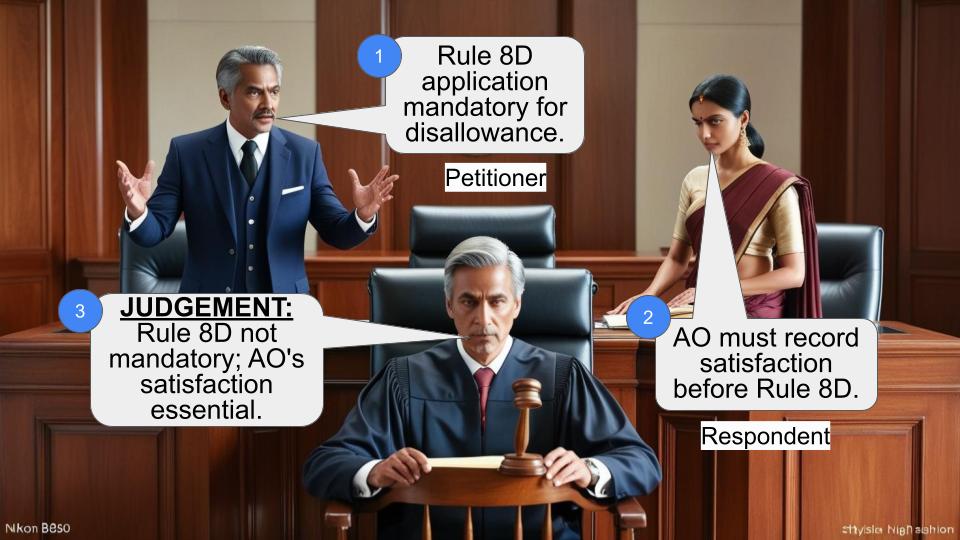
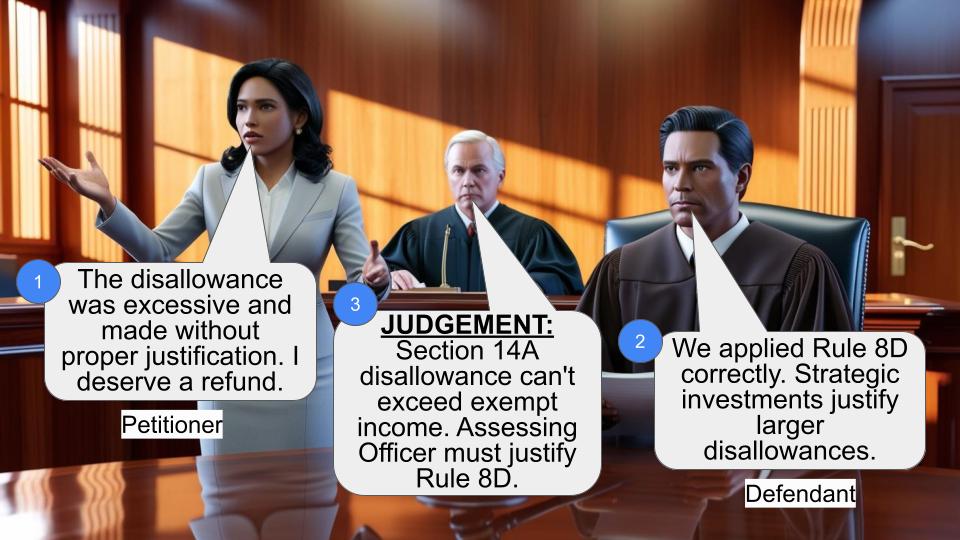
A1: Rule 8D (of Income Tax Rules, 1962) provides a formula for calculating expenses related to income that isn't part of total taxable income. It's used when the Assessing Officer isn't satisfied with the assessee's expense claims.
Q2: Why is the retrospective application of Rule 8D (of Income Tax Rules, 1962) important?
A2: Applying rules retrospectively can significantly impact past tax assessments and create uncertainty for taxpayers. The court's decision provides clarity and protects taxpayers from unexpected changes to past assessments.
Q3: Does this judgment apply to all cases before 2008?
A3: Yes, based on this judgment, Rule 8D (of Income Tax Rules, 1962) cannot be applied to any assessment year prior to 2008-09.
Q4: What does "res integra" mean in this context?
A4: "Res integra" is a legal term meaning an undecided question of law. Here, it's used to say that this issue has already been decided by previous Supreme Court judgments.
Q5: How does this judgment affect taxpayers?
A5: It provides certainty for taxpayers regarding how their pre-2008 assessments should be handled, potentially protecting them from additional tax liabilities based on later rules.

1. This Tax Case Appeal has been filed by the Revenue for Assessment Year 2002-03 raising the following substantial question of law arising from the order of the Income Tax Appellate Tribunal dated 18.12.2009.
"Whether on the facts and circumstances of the case, the Tribunal was right in upholding the CIT(A)'s deletion of 2.56 Cr. by invoking the provision of section 14A (of Income Tax Act, 1961) r/2 Rule 8D (of Income Tax Rules, 1962)?"
2.Both the learned counsels fairly submitted that the said issue is no longer res integra in view of the decisions of the Hon'ble Supreme Court in the case of Commissioner of Income Tax Vs. Essar Teleholdings Ltd. [(2018) 401 ITR 0445] and Godrej & Boyce Manufacturing Company Limited Vs. Deputy Commissioner of Income Tax and another [(2017) 394 ITR 0449], in which the Hon'ble Supreme Court has laid down the provisions of Rule 8D (of Income Tax Rules, 1962) cannot be applied retrospectively. The said Rules were introduced and brought on the Statute Book with effect from 24.03.2008 and the present assessment year involved in the present Appeal is Assessment Year 2002-03. The relevant observations from both the Judgments are quoted below for ready reference.
(i) Commissioner of Income Tax V. Essar Teleholdings Ltd. [(2018) 401 ITR 0445]:
"49. It is relevant to note that impugned judgment in this appeal relies on earlier judgment of Bombay High Court in Godrej and Boyce Manufacturing Company Limited versus Deputy Commissioner of Income Tax, Mumbai and Another, (2017) 7 SCC 421, where the Division Bench of the Bombay High court after elaborately considering the principles to determine the prospectivity or retrospectivity of the amendment has concluded that Rule 8D (of Income Tax Rules, 1962) is prospective in nature. Against the aforesaid judgment of the Bombay High court dated 12.08.2010 an appeal was filed in this court which has been decided by vide its judgment reported in Godrej and Boyce Manufacturing Company Limited Vs. Deputy Commissioner of Income Tax, Mumbai & Anr. (2017) 7 SCC 421. This Court, while deciding the above appeal repelled the challenge raised by the assessee regarding vires of Section 14A (of Income Tax Act, 1961). In para 36 of the judgment, this Court noticed that with regard to retrospectivity of provisions Revenue had filed appeal, hence the said question was not gone into the aforesaid appeal. In the above case, this Court specifically left the question of retrospectivity to be decided in other appeals filed by the Revenue. We thus have proceeded to decide the question of retrospectivity of Rule 8D (of Income Tax Rules, 1962) in these appeals.
50.In view of our opinion as expressed above, dismissal of the appeal by the Bombay High Court is fully sustainable. As held above, the Rule 8D (of Income Tax Rules, 1962) is prospective in operation and could not have been applied to any assessment year prior to Assessment Year 2008-09."
(ii) Godrej & Boyce Manufacturing Company Limited V. Deputy Commissioner of Income Tax and another [(2017) 394 ITR 0449]
"37. We do not see how in the aforesaid fact situation a different view could have been taken for the Assessment Year 2002-2003. Sub-sections (2) and (3) of Section 14A (of Income Tax Act, 1961) read with Rule 8D (of Income Tax Rules, 1962) merely prescribe a formula for determination of expenditure incurred in relation to income which does not form part of the total income under the Act in a situation where the Assessing Officer is not satisfied with the claim of the assessee. Whether such determination is to be made on application of the formula prescribed under Rule 8D (of Income Tax Rules, 1962) or in the best judgment of the Assessing Officer, what the law postulates is the requirement of a satisfaction in the Assessing Officer that having regard to the accounts of the assessee, as placed before him, it is not possible to generate the requisite satisfaction with regard to the correctness of the claim of the assessee. It is only thereafter that the provisions of Section 14A(2) (of Income Tax Act, 1961) and (3) read with Rule 8D (of Income Tax Rules, 1962) or a best judgment determination, as earlier prevailing, would become applicable.
38. In the present case, we do not find any mention of the reasons which had prevailed upon the Assessing Officer, while dealing with the Assessment Year 2002-2003, to hold that the claims of the Assessee that no expenditure was incurred to earn the dividend income cannot be accepted and why the orders of the Tribunal for the earlier Assessment Years were not acceptable to the Assessing Officer, particularly, in the absence of any new fact or change of circumstances. Neither any basis has been disclosed establishing a reasonable nexus between the expenditure disallowed and the dividend income received. That any part of the borrowings of the assessee had been diverted to earn tax free income despite the availability of surplus or interest free funds available (Rs. 270.51 crores as on 1.4.2001 and Rs. 280.64 crores as on 31.3.2002) remains unproved by any material whatsoever. While it is true that the principle of res judicata would not apply to assessment proceedings under the Act, the need for consistency and certainty and existence of strong and compelling reasons for a departure from a settled position has to be spelt out which conspicuously is absent in the present case. In this regard we may remind ourselves of what has been observed by this Court in Radhasoami Satsang vs. Commissioner of Income-Tax (1992) 193 ITR (SC) 321 [At Page 329].
“We are aware of the fact that strictly speaking res judicata does not apply to income tax proceedings. Again, each assessment year being a unit, what is decided in one year may not apply in the following year but where a fundamental aspect permeating through the different assessment years has been found as a fact one way or the other and parties have allowed that position to be sustained by not challenging the order, it would not be at all appropriate to allow the position to be changed in a subsequent year.”
39. In the above circumstances, we are of the view that the second question formulated must go in favour of the assessee and it must be held that for the Assessment Year in question i.e. 2002-2003, the assessee is entitled to the full benefit of the claim of dividend income without any deductions.
40. Consequently, the appeal is allowed and the order of the High Court is set aside subject to our conclusions, as above, on the applicability of Section 14A (of Income Tax Act, 1961) with regard to dividend income on which tax is paid under Section 115-O (of Income Tax Act, 1961)"
3.In view of the aforesaid submission, there is no merit in the present appeal filed by the Revenue and the question of law deserves to be answered against the Revenue and in favour of the Assessee. In view of the aforestated Supreme Court decisions, the Appeal is accordingly dismissed. No costs.
DR.VINEET KOTHARI, J.
And
R. SURESH KUMAR, J.
×
Questions
Rule 8D (of Income Tax Rules, 1962) Not Applicable Retrospectively
Write your CommentSimilar Posts

Generic
- Reportdata/6104.pdf
