


Court Upholds Disallowance of Business Expenses for Dress and Promotion


Full News
Court Upholds Disallowance of Business Expenses for Dress and Promotion
Court Upholds Disallowance of Business Expenses for Dress and Promotion
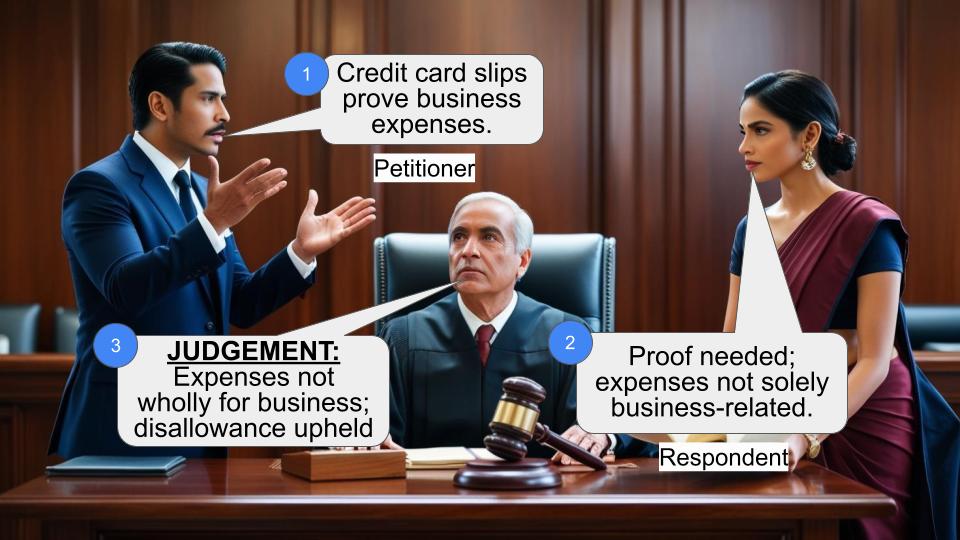
This case involves Sandeep Marwah, who appealed against the Income Tax Appellate Tribunal's decision to disallow certain business expenses. The High Court upheld the Tribunal's order, affirming that expenses for business promotion, dress, and costume were not wholly and exclusively for business purposes, and thus not fully deductible under Section 37 (of Income Tax Act, 1961).
Get the full picture - access the original judgement of the court order here
Case Name:
Sandeep Marwah & Anr. Vs Assistant Commissioner of Income Tax & Anr. (High Court of Delhi)
ITA 1249/2018
Date: 12th November 2018
Key Takeaways:
1. Expenses must be wholly and exclusively for business purposes to be deductible under Section 37 (of Income Tax Act, 1961).
2. Payments made through credit cards don't automatically qualify as business expenses.
3. The burden of proof for business expenses lies with the assessee.
4. Personal or private expenses are not deductible as business expenses.
Issue:
Whether expenses claimed for business promotion, dress, and costume are wholly and exclusively for business purposes and thus fully deductible under Section 37 (of Income Tax Act, 1961)?
Facts:
1. Sandeep Marwah claimed deductions for business promotion and dress/costume expenses for assessment years 2007-08 and 2008-09.
2. The expenses were paid through credit cards, but no bills or vouchers were provided.
3. The Assessing Officer disallowed 50% of these expenses for 2007-08 and a specific amount for 2008-09.
4. The Commissioner of Income Tax (Appeals) and the Income Tax Appellate Tribunal upheld these disallowances.
Arguments:
Appellant (Sandeep Marwah):
- The expenses were incurred through credit cards from leading showrooms.
- Credit card slips are sufficient evidence of the expenditure.
- The department could confirm the expenses directly with the bank.
Respondent (Income Tax Department):
- Mere payment through a bank doesn't qualify an expense under Section 37(1) (of Income Tax Act, 1961).
- The assessee failed to prove that the expenditure was wholly and exclusively for business purposes.
- The onus is on the assessee to provide necessary facts to support the claim for deduction.
Key Legal Precedents:
1. CIT v. Calcutta Agency Ltd. (1951) 19 ITR 191 (SC): The onus of providing necessary facts for deduction under Section 37(1) (of Income Tax Act, 1961) is on the assessee.
2. I.H. Sugar Factory & Oil Mills (Pvt.) Ltd. Vs. CIT (1980) 125 ITR, 293 (SC): The assessee must bring all material facts on record to substantiate their claim.
3. CIT v. Chandravilas Hotel (1987) 164 ITR 102 (Guj): Mere production of vouchers doesn't prove the claim for deduction.
4. Jaipur Electro (P) Ltd. V. CIT (1996) 134 CTR (Raj) 237: The assessing authority has the right to know whether an expense was incurred for business purposes.
Judgement:
The High Court dismissed the appeal and upheld the Tribunal's decision, stating:
1. The requirement of Section 37 (of Income Tax Act, 1961) is that expenditure should be wholly and exclusively for business purposes.
2. Payments through credit cards don't automatically qualify as business expenses.
3. The assessee failed to provide necessary documents to prove the business nature of the expenses.
4. The findings of the Assessing Officer were factual and not perverse.
FAQs:
1. Q: Does paying through a credit card automatically make an expense deductible?
A: No, the expense must still be proven to be wholly and exclusively for business purposes.
2. Q: Who bears the burden of proof for business expenses?
A: The assessee (taxpayer) bears the burden of proving that expenses are for business purposes.
3. Q: Can personal expenses be claimed as business expenses?
A: No, personal or private expenses are not deductible as business expenses.
4. Q: What does "wholly and exclusively" mean in the context of Section 37 (of Income Tax Act, 1961)?
A: "Wholly" refers to the quantum of expenditure, while "exclusively" refers to the motive, object, and purpose of the expenditure.
5. Q: Can the tax department independently verify expenses with banks?
A: While they may have the ability to do so, it's primarily the assessee's responsibility to provide evidence for claimed expenses.

These appeals filed by the appellant-Sandeep Marwah under Section 260A (of Income Tax Act, 1961) (in short ‘the Act’) relate to assessment years 2007-2008 and 2008-2009 and arise from a common order dated 25.05.2018 passed by the Income Tax Appellate Tribunal (hereinafter referred to as ‘the Tribunal’).
2. First grievance of the appellant is against 50% adhoc disallowance of Rs.8,20,927/-and Rs.2,17,605/- out of business promotion and dress and costume expenses for the assessment year 2007-08 and Rs. 1,56,513/-out of business promotion expenses for the assessment year 2008-09.
3. The reasoning regarding this disallowance vide the assessment order dated 11.12.2009 for assessment year 2007-08, reads as under:
“In the P&L A/c, the assesse has debited a sum of Rs.16,41,845/- under the head business promotion and Rs.4,35,210/- on account of dress and costume. While verifying the books of accounts, it was noticed that the expenses debited under the head business promotion and dress & costume has been paid through American Express/(S&C)/City Bank Credit card. However, there is not a single bill or voucher in respect of the expenses debited under these two heads. Vide Ordersheet entry dated 24.11.2009, the assessee was asked to furnish copy of account of business promotion an dressing costume along with bills and vouchers to verify the genuineness and also nature of expenses incurred/claimed under these two head . The books of accounts were again produced along with all bills and vouchers but thes was none in respect of the expenses incurred under these two heads. The expenses were supported by few credit card statement, but that does not clarify as to what was the expenditure. A show cause was also issued to assesse on the point to which the assessee vide his reply dated 10. 12.2009 submitted that:-
"these expenses have been incurred through credit from the leading showrooms whose identity cannot be challenged. Evidence of payment cannot be challenged. The slips of credit card is enough evidence for incurring this expenditure. We had already requested to the bank for proving copy of bills to us and department can also confirm directly from the bank.”
I am afraid that mere making payment through bank will entitle the assessee for claiming expenditure U/S 37(1) (of Income Tax Act, 1961). It is the first and foremost liability of assessee to prove that the expenditure incurred by him qualifies the necessary test of section 37(1) (of Income Tax Act, 1961). I find support in view from the case of CIT v.Calcutta Agency Ltd.(1951) 19 ITR 191 (SC), wherein the Hon’ble Supreme Court has held that the onus of providing necessary facts in order to avail the deduction under Section 37(1) (of Income Tax Act, 1961) is on the assessee. If, therefore, the assessee fails to establish the facts necessary to support his claim for deduction under Section 37(1) (of Income Tax Act, 1961), the claim for deduction of expenditure is not admissible. Further in the case of I.H. Sugar Factory & oil Mils (Pvt.) Ltd. Vs.CIT (1980) 125 ITR, 293 (SC) the Hon’ble Supreme Court has held that where an assesee claims a deduction the onus is on him to bring all material facts on record to substantiate his claim. The assesse did not furnish or produce any evidence as to what was the expenditure and why it was incurred. The assessee has thus failed to qualify the first test of Section 37(1) (of Income Tax Act, 1961). Mere claiming that the expenses were incurred through bank and evidence of payment is available with bank did not itself make the expenditure allowable in the case of assessee as something more is required to allow the deduction U/s 37(1) (of Income Tax Act, 1961). The assessee vide reply on the issue has claimed to have requested tobank for providing copy of bills to him. In this regard, I would like to put on record that whenever an expenditure is incurred or nay item is purchased through credit card, there is always a bill which is signed by the credit holder and the showroom/shopkeeper given a copy thereof to the person/buyer. In the case of CIT v. Chandravilas Hotel (1987) 164 ITR 102 (Guj), it was held that mere production of vouchers in support of the claim for deduction of expenditure would not prove the claim made by the assessee. It is has duty to prove payment especially when the ITO doubts the genuineness therefore. It appears that the assessee does not want to product such bill before the assessing authority knowing that the expenses incurred under these heads are of non-business nature. The assessee vide his reply has also contended that the department can also confirm directly from the bank. I would like to quote the case of Assam Pesticides &Agro Chemicals v.CIT (1977) 277 ITR 846 (Gau), wherein it was held that it cannot be said that even if the taxpayer does not produce any evidence in support of the claim for allowance, the ITO himself independently is to collect evidence and decide that the allowance claimed is baseless having regard to the legitimate business needs of the assessee. It is for the taxpayer to establish by evidence that a particular allowance is justified. The law does not prescribe any quantitative test to find out whether the onus in a particular case has been duly discharged. A decision of the final fact-finding authority is conclusive and binding. As already discussed and also settled by Hon’ble Apex Court that theonus is on the assessee to bring all material facts on record to substantiate him claim. I would also like to quote the case of Jaipur Electro (P) Ltd. V.CIT (1996) 134 CTR (Raj) 237, wherein it was held that the doctrine that the businessman is the best judge of business expediency does not affect the right, any duty, of the assessing authority to know whether it was incurred for business purpose and not for other extraneous considerations. It was the view of the various Courts that to be an allowable expenditure under Section 37(1) (of Income Tax Act, 1961), the money paid out or away must be (a) paid out wholly and exclusively for the purpose of business or profession; and further (b) must not be; (i) capital expenditure; (ii) personal expense; or (iii) an allowance of the character described in section 30 (of Income Tax Act, 1961) to 36 and section 80 (of Income Tax Act, 1961) VV. CIT V. India Molasses Co.(P) Ltd. [1970] 78 ITR 474 (SC)/ J.K .Cotton Mfrs. Ltd. V. CIT (1975) 101 ITR 221 (SC)/ Sasson J. David & co.(P) Ltd. V.CIT (1979) 118 ITR 261 (SC). In the case of CIT v. Shahibag entrepreneurs (P) Ltd. (1995) 215 ITR 810 (Guj), it was held that it cannot be disputed that before an assessee can become entitled to an allowance under Section 37(1) (of Income Tax Act, 1961), he must satisfy the department of the purpose for which the amount is spend. In view of this, the expenses claimed by assessee under the head business promotion and dress & costume are not allowable as such as claimed by assessee. I understand that for running every business, these nature of expenses are incurred and allowable. However, considering the facts of the assessee’s case and also material produced before me, I restrict the expenses to 50% of assessee’s claim and make a disallowance of Rs.8,20,927/- and Rs.2,17,605/- from business promotion and dress and costume respectively.”
4. The findings recorded by the Assessing Officer vide the assessment order dated 26.11.2011 for the assessment year 2008-2009 read as under: “During the course assessment proceedings it was noticed that the assessee has incurred an amount of Rs. 10,37,904/-towards business promotion. From the details filed by the assessee, it was noticed that the following expenditure were incurred under the head business promotion.
S. Entry date Credit card Particulars Credit cardAmount Date statement
1. 17.01.2008 17.01.2008 Expenses at AEB Credit 1.04.700 JW Mariot Card 3769108351 Hotel 63003
2. 17.01.2008 17.01.2008 Expenses at AEB Credit 2.4.31 Welcom Hotel Card 376910835163003
3. 18.07.2007 18.07.2008 Expresses at SCB Credit 49.382 Arbras Gallery Card
Total 1,56,513/-
8. The assessee clarified that the above expenditure was incurred in the interest of the business. However, the nature and purpose of the said expenditure and the manner in which the said expenditure is relatable to the business of the assessee was not clarified. Further, the assessee could not furnish necessary supporting documents to substantiate its claim of it being incurred for the purpose of the business of the assessee. Accordingly, an amount of Rs. 1,56,513/- is hereby added to the income of the assessee. Penalty proceedings U/s 271(1)(c) (of Income Tax Act, 1961) for concealment of income as aforesaid and furnishing inaccurate particulars within the meaning of explanation 1 to sub-section (1) of Section 271(1)(c) (of Income Tax Act, 1961) are initiated.
(Addition of Rs. 1,56,513/-) ”
5. This dis-allowance made by the Assessing officer was affirmed by the Commissioner of Income Tax (Appeals) vide order dated 27.10.2010 for assessment year 2007-08 and order dated 31.12.2013 for assessment year 2008-09 and has been sustained by the Tribunal.
6. Learned counsel for the appellant-assessee submits that 50% adhoc dis-allowance in the said two years is contrary to law, as the expenses as claimed should have been fully allowed or fully disallowed. He relies on an order of the Tribunal dated 25.02.2015 in ITA no.275/LKW/2010 in the case of Halwasiya Development Pvt.Ltd. vs. ACIT Range I Lucknow.
7. We do not agree. Requirement of Section 37 (of Income Tax Act, 1961) is that the expenditure should be wholly and exclusively laid out and expended for the purpose of business. Merely because payments were made through credit card would not show that the expenditure was wholly and fully for the purpose of business. This contention was rightly rejected by the assessing officer, as nature and object of the outgoing has to be also examined. Word ‘wholly’ refers to quantum of expenditure and word ‘exclusively’ refers to motive, object and purpose of the expenditure. Personal expenses or money spend for private purpose is not deductible. They fail the business expediency test.
Further, whether the expenditure was incurred wholly and fully for the purpose of business has to be established and proven by the assessee. These facts are within the exclusive knowledge of the assessee and therefore he is under an obligation to place all facts and circumstances before the authorities. Order for the assessment year 2007-08 refers to failure and non-furnishing details and particulars. Similarly order for the assessment year 2008-09 refers to the three expenditures totaling Rs.1,56,513/- regarding which particulars were not furnished. Accordingly, Rs.1,56,513/- was disallowed out of expenses of Rs.10,37,904/- claimed under the head business promotion. In the present case, the appellant-assessee had failed and did not produce material and documents to show that the expenditure under the aforesaid heads was incurred wholly exclusively for the purpose of business. The findings of the Assessing Officer affirmed in the appeals are factual. Nothing has been placed before us to show that these findings are perverse and contrary evidence and material on record. No substantial question of law therefore arises on account of ad-hoc disallowance of expenses under the head business promotion and dress and costume expenses.
8. The impugned order also affirms disallowance of expenses of Rs. 22,30,505/- and Rs. 16,35,049/- in the assessment years 2007-08 and 2008- 09, respectively, incurred on higher education of Akshay Marwah son the appellant-assessee at London School of Research in the subject/course Entrepreneur Management for Creative Arts. In the assessment year 2007- 08, the appellant assessee had also claimed deduction of expenses of Rs.1,94,414 incurred by Akshay Marwah on tour and travelling.
9. The assessing officer had disallowed the claims observing that the expenditure incurred was by the father for education of his son. It was not an expenditure wholly and exclusively for the purpose of business. Several factual findings were recorded by the assessing officer.
10. During the course of hearing, the learned counsel for the appellant- assessee had drawn our attention to an affidavit filed by Akshay Marwah (enclosed as Annexure to this appeal at page 168). However, it was accepted that this affidavit was not filed before the assessing officer or in the appellate proceedings before the Tribunal. This affidavit therefore cannot be taken into consideration by us.
11. Learned counsel for the appellant-assessee at this stage submits that the appellant-assessee had filed an application for production of additional documents on 15.05.2018 before the Tribunal in the two assessment years.The application was listed but was not disposed of and the additional documents have not been taken into consideration. These documents he states relate to the issue in question.
12. The learned counsel for the appellant-assessee states that the appellant-assessee would be filing an application under Section 254(2) (of Income Tax Act, 1961) before the Tribunal. He would accordingly not press this appeal on the said aspect at this stage. We have recorded the statement made by the appellant-assessee, without making any comments.
13. Accordingly, we dismiss the appeals as withdrawn, in respect of disallowance pertaining to higher education expenses and tour and travel expenses of Akshay Marwah. It will be open to the applicant to file an appeal challenging the impugned order in respect of this issue, if so advised,after disposal of the application under Section 254(2) (of Income Tax Act, 1961).
SANJIV KHANNA, J.
ANUP JAIRAM BHAMBHANI, J.
NOVEMBER 12, 2018
×
Similar Ripples
Questions
Court Upholds Disallowance of Business Expenses for Dress and Promotion
Write your CommentSimilar Posts


Generic
- Reportdata/1047_ffbA3Fg.pdf
