Tax Appeal Dismissed: Notice Issue and Merits Deletion Upheld by High Court


Full News
Tax Appeal Dismissed: Notice Issue and Merits Deletion Upheld by High Court
Tax Appeal Dismissed: Notice Issue and Merits Deletion Upheld by High Court
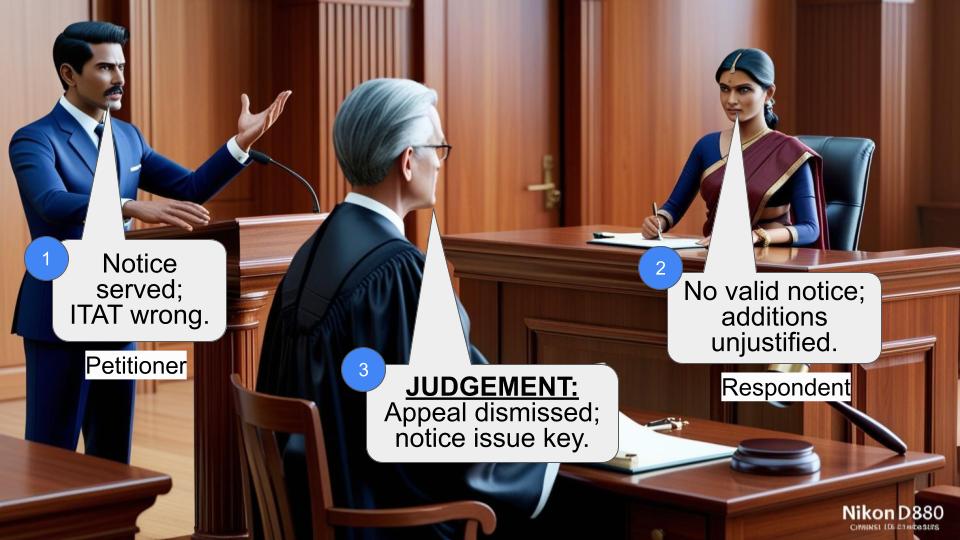
This case involves an appeal by the Principal Commissioner of Income Tax against Ravnet Solutions Pvt. Ltd. The High Court dismissed the Revenue's appeal, upholding the Income Tax Appellate Tribunal's (ITAT) decision regarding the issuance of notice under Section 143(2) (of Income Tax Act, 1961) and deletion of certain additions made by the Assessing Officer (AO) for the Assessment Year 2007-08.
Get the full picture - access the original judgement of the court order here
Case Name:
Principal Commissioner of Income Tax Vs Ravnet Solutions Pvt. Ltd. (High Court of Delhi)
ITA 1062/2017 & CM 43174/2017
Date: 28th November 2017
Key Takeaways:
1. The importance of proper notice issuance under Section 143(2) (of Income Tax Act, 1961).
2. The significance of maintaining accurate records of notice issuance and communication.
3. The court's reliance on precedent set by the Supreme Court in similar cases.
4. The High Court's reluctance to interfere with concurrent findings on merits by lower authorities.
Issue:
Was the ITAT correct in its findings regarding the issuance of notice under Section 143(2) (of Income Tax Act, 1961) and in upholding the deletion of additions made by the Assessing Officer?
Facts:
1. Ravnet Solutions Pvt. Ltd. filed its tax returns on 30.03.2007, declaring an income of Rs.36,609/- for AY 2007-08.
2. The case was initially processed under Section 143(1) (of Income Tax Act, 1961) but later put up for scrutiny.
3. The AO claimed to have issued notices under Section 143(2) (of Income Tax Act, 1961) and 142(1) (of Income Tax Act, 1961) on various dates.
4. The assessee allegedly did not respond to multiple notices.
5. The AO completed the assessment on 11.12.2009, making certain additions and assessing the total income at Rs.1,02,15,446/-.
Arguments:
Revenue's Arguments:
1. Notice under Section 143(2) (of Income Tax Act, 1961) was properly issued at the notified address.
2. Multiple attempts were made to secure the assessee's presence.
3. The assessee participated at a later stage in the proceedings.
4. The ITAT's decision to delete the additions was untenable.
Assessee's Arguments:
1. Proper notice under Section 143(2) (of Income Tax Act, 1961) was not issued.
2. The additions made by the AO were unjustified.
Key Legal Precedents:
The court relied on the Supreme Court's decision in "Additional Commissioner of Income Tax Vs. Hotel Blue Moon (2010) 321 ITR 362 (SC)" regarding the issuance of notice under Section 143(2) (of Income Tax Act, 1961).
Judgement:
1. The High Court found no reason to interfere with the ITAT's findings.
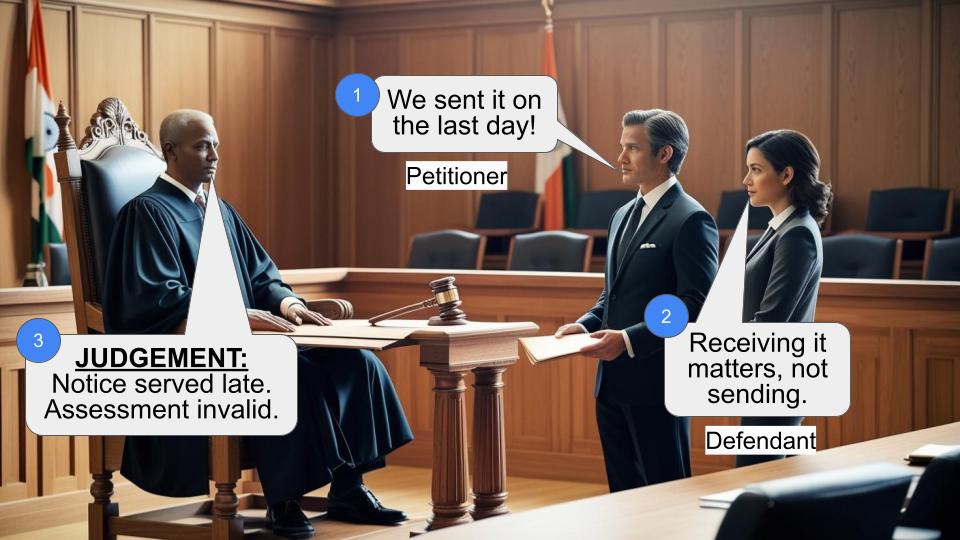
2. Regarding the notice under Section 143(2) (of Income Tax Act, 1961), the ITAT had considered the entire record and found no evidence of notice issuance on 15.09.2008.
3. The court agreed with the ITAT's application of the Supreme Court's reasoning in the Hotel Blue Moon case.
4. On the merits of deletion, the court noted that the findings were concurrent (agreed upon by lower authorities).
5. The High Court dismissed the appeal, stating that no substantial question of law arose.
FAQs:
Q1: What was the main issue in this case?
A1: The main issue was whether the ITAT was correct in its findings regarding the issuance of notice under Section 143(2) (of Income Tax Act, 1961) and in upholding the deletion of additions made by the Assessing Officer.
Q2: Why did the High Court dismiss the Revenue's appeal?
A2: The High Court found no reason to interfere with the ITAT's findings, as they were based on a thorough examination of the records and followed established legal precedents.
Q3: What was the significance of the notice under Section 143(2) (of Income Tax Act, 1961)?
A3: The notice under Section 143(2) (of Income Tax Act, 1961) is crucial for initiating scrutiny proceedings. Its proper issuance and documentation are essential for the validity of subsequent assessment proceedings.
Q4: How did the Supreme Court case of Hotel Blue Moon influence this decision?
A4: The ITAT applied the reasoning from the Hotel Blue Moon case regarding the importance of proper notice issuance under Section 143(2) (of Income Tax Act, 1961), which the High Court found appropriate in this case.
Q5: What does this judgment mean for taxpayers?
A5: This judgment emphasizes the importance of proper notice issuance by tax authorities and the potential for successful appeals if procedural requirements are not met.

1. The Revenue is aggrieved by the findings of the ITAT for AY 2007-08 which upheld the CIT(A)’s decision.
2. The facts of the case are that the assessee had filed its returns on 30.03.2007 declaring an income of Rs.36,609/-. It was initially processed under Section 143(1) (of Income Tax Act, 1961). The assessment, however, was completed on 11.12.2009 after the case was put up for scrutiny.
3. The assessment order recorded, inter-alia, that the notice under Section 143(2) (of Income Tax Act, 1961) was issued on 15.09.2008 and also sent through speed post subsequently at the address provided by the assessee, on 23.09.2008. The assessee was not represented and notice under Section 142(1) (of Income Tax Act, 1961) was issued – dated 20.01.2009. Apparently, a notice was again issued under the said provisions along with questionnaire through speed post on 18.02.2009, this too did not receive any response. A final notice on 18.03.2009 was issued. On the returnable day, the assessee’s representation contended and filed some details regarding the case, which was adjourned to 08.04.2009.
4. Subsequently, according to the assessment order, subsequent notice was issued and the matter was fixed for hearing on 12.11.2009. As the assessee was not represented on the date of hearing, the AO completed the assessment making certain additions – based upon disallowance in respect of salaries paid, web designing expenses, share application money and current liabilities. The total income was assessed was Rs. 1,02,15,446/-.
5. The assessee appealed to the CIT(A). Its contentions with respect to issuance of notice under Section 143(2) (of Income Tax Act, 1961), were rejected. However, the disallowance and other additions made by the AO were set aside. Upon appeal and cross appeal by the rival parties, the ITAT accepted the assessee’s contentions, after considering the record and also taking note of the remand report and comments received thereon.
6. The Revenue contends that the ITAT erroneously found that notice was not issued. It is highlighted that notice was, in fact, issued under Section 143(2) (of Income Tax Act, 1961) at the notified address. All attempts were made subsequently to secure the presence of the assessee. The record also revealed that the assessee did participate – at a later stage after its representations were obtained in the proceedings. In these circumstances, the deletion directed by the ITAT as was urged; is untenable.
7. The findings of the lower authorities especially ITAT, in the opinion of the Court, does not call for any interference. So far as the findings with respect to notice under Section 143(2) (of Income Tax Act, 1961) is concerned, the ITAT has considered the entire record afresh and clearly rendered a finding that on 15.09.2008, the assessment framed in this case, nowhere reflected that notice under Section 143(2) (of Income Tax Act, 1961) was issued. Para 10 of the impugned order, pointed out with respect to this aspect and having regard to all the factual material in these circumstances – compelled the ITAT to follow the reasoning of the Supreme Court in “Additional Commissioner of Income Tax Vs. Hotel Blue Moon (2010) 321 ITR 362 (SC)”. In this case, the impugned order does not call any interference. So far as the question with respect to deletion on merits is concerned, the findings are concurrent.
8. In view of the above, no substantial question of law arises. The appeals are, therefore, dismissed.
S. RAVINDRA BHAT
(JUDGE)
SANJEEV SACHDEVA
(JUDGE)
NOVEMBER 28, 2017
×