


Court Upholds ITAT's Decision on Transfer Pricing Method in Logistics Case


Full News
Court Upholds ITAT's Decision on Transfer Pricing Method in Logistics Case
Court Upholds ITAT's Decision on Transfer Pricing Method in Logistics Case
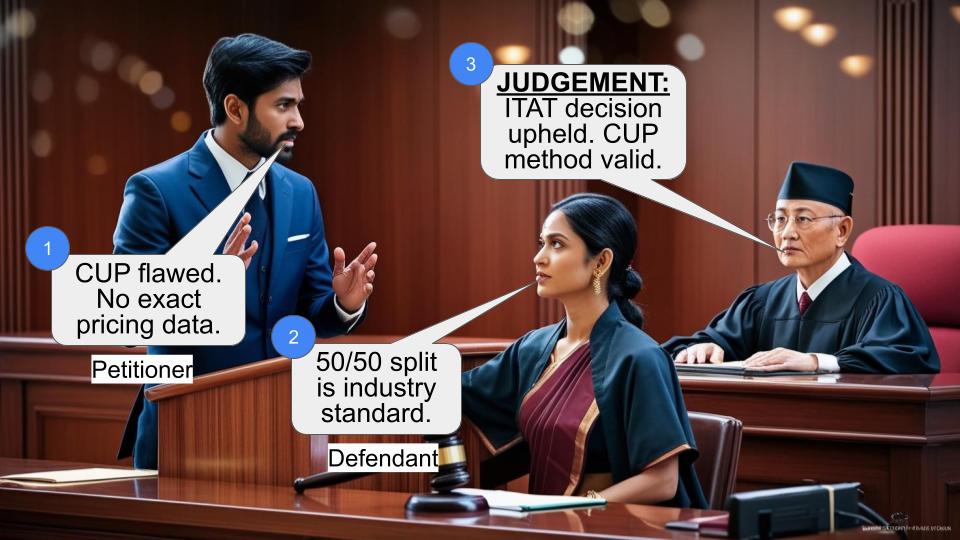
This case involves appeals by the Revenue against orders of the Income Tax Appellate Tribunal (ITAT) for Assessment Years 2006-07 and 2007-08. The dispute centered around the method used to determine the Arm's Length Price (ALP) for international transactions between a logistics service provider (the Assessee) and its Associated Enterprises (AEs). The ITAT's decision to accept the Comparable Uncontrolled Price (CUP) method over the Transactional Net Margin Method (TNMM) was upheld by the High Court.
Get the full picture - access the original judgement of the court order here
Case Name:
Pr. Commissioner of Income Tax & Ors. Vs Toll Global Forwarding India Pvt. Ltd & Ors. (High Court of Delhi)
ITA 374/2015
Date: 10th December 2015
Key Takeaways:
1. The CUP method can be appropriate even when exact pricing data isn't available if industry norms are well-established.
2. The 50:50 profit-sharing model is recognized as a standard practice in the logistics industry.
3. The court emphasized the importance of considering industry practices in transfer pricing cases.
Issue:
Was the ITAT correct in accepting the CUP method over the TNMM for determining the Arm's Length Price in the Assessee's international transactions with its Associated Enterprises?
Facts:
1. The Assessee is a logistics service provider offering international and domestic freight handling services.
2. The Assessee used the CUP method for benchmarking international transactions with its AEs, splitting residual profits 50:50.
3. The Transfer Pricing Officer (TPO) rejected the CUP method and adopted TNMM, leading to an addition to the Assessee's income.
4. The ITAT accepted the Assessee's use of the CUP method based on the industry-standard 50:50 profit-sharing model.
5. The Revenue appealed against the ITAT's orders for Assessment Years 2006-07 and 2007-08.
Arguments:
Assessee's Argument:
- The 50:50 profit-sharing model is an industry standard for both AEs and independent enterprises.
- This model justifies the use of the CUP method for determining ALP.
Revenue's Argument:
- The Assessee failed to provide exact pricing data for comparable uncontrolled transactions.
- TNMM should be used as the Assessee couldn't demonstrate that the exact amounts charged were the same for AEs and independent enterprises.
Key Legal Precedents:
The judgment doesn't explicitly mention any specific legal precedents. However, it refers to Rule 10B(1)(a) (of Income Tax Rules, 1962), which outlines the application of the CUP method.
Judgement:
1. The High Court dismissed the Revenue's appeals and upheld the ITAT's orders.
2. The Court found the ITAT's reasoning to be sound and well-researched.
3. It agreed that the CUP method could be appropriate even without exact pricing data, given the established industry norm of 50:50 profit sharing.
4. The Court left open the question of whether the matter should be sent back to the TPO for further examination, as this wasn't part of the original appeal.
FAQs:
1. Q: Why did the Court accept the CUP method despite the lack of exact pricing data?
A: The Court recognized the 50:50 profit-sharing model as an industry standard, which justified the use of CUP even without exact pricing data.
2. Q: What is the significance of this judgment for transfer pricing cases?
A: It highlights the importance of considering industry norms and practices when determining the most appropriate method for calculating ALP.
3. Q: Did the Court completely rule out the use of TNMM in such cases?
A: No, the Court didn't rule out TNMM entirely. It simply agreed with the ITAT that CUP was more appropriate in this specific case.
4. Q: What sections of the Income Tax Act were relevant in this case?
A: The judgment mentions Section 260A (of Income Tax Act, 1961), under which the Revenue filed the appeals, and Section 92CA(3) (of Income Tax Act, 1961), which relates to the determination of ALP by the TPO.
5. Q: Did the Court make any new legal interpretations in this judgment?
A: While the Court didn't make any groundbreaking new interpretations, it reinforced the idea that industry practices should be given weight in transfer pricing cases, even when they don't perfectly align with prescribed methods.

1. These are two appeals by the Revenue under Section 260A (of Income Tax Act, 1961).
2. ITA No. 374/2015 is directed against the impugned order dated 18th November, 2014 passed by the Income Tax Appellate Tribunal (‘ITAT’) in ITA No.5025/Del/2010 for Assessment Year (‘AY’) 2006-07. ITA No. 396/2015 is directed against the impugned order dated 18th November, 2014 passed by the ITAT in ITA No. 774/DEL/2012 for the AY 2007-08.
3. The Respondent Assessee is a logistics service provider, offering a bouquet of international and domestic freight handling services including time defined air and ocean transport and freight forwarding services. The Assessee has been using the Comparable Uncontrolled Price (‘CUP’) Method for benchmarking its international transactions with its Associated Enterprises (‘AEs’). The residual profits were split between the Assessee and the AEs in the ratio of 50:50.
4. A reference was made by the Assessing Officer (AO) to the Transfer Pricing Officer (‘TPO’) to determine the Arm’s Length Price (ALP) under Section 92CA(3) (of Income Tax Act, 1961) in respect of the international transactions entered into by the Assessee during the financial years in question. In the order 21st August,2009, the TPO observed that initially the Assessee only submitted its audited financials along with the auditor’s tax audit report, computation of total income and the previous assessment orders. Pursuant to notices issued by the TPO, a Transfer Pricing Study was also furnished by the Assessee. The TPO was not persuaded to adopt the CUP Method since according to the TPO the Assessee was required to “furnish the documents/vouchers related to third party for export and import transactions related to controlled and uncontrolled transactions.” The TPO, therefore, proceeded to adopt the Transactional Net Margin Method (‘TNMM’) and benchmarked the profitability of the Assessee with comparable companies engaged in a similar business by application of the TNMM at the entity level by using operating margin as the profit level indicator. On this methodology, the TPO determined that there was a difference of Rs.20,900,179/- between the booked value and the ALP and since the same was more than 5%, the said difference was added back to the income of the Assessee.
5. On the basis of the above order of the TPO for AY 2006-07 the AO passed a draft assessment order on 26th November, 2009 which was taken up before the Dispute Resolution Panel (DRP) by the Assessee unsuccessfully. Ultimately, the AO passed the final assessment order on 20th September, 2010 in line with the order of the TPO. A similar exercise was performed for AY 2007-08 and against both the orders of the AO appeals were filed before the ITAT.
6. The impugned order of the ITAT for AY 2006-07 noted at the outset in para 5 as under:
“We find that in the present case it is not really even in dispute that in this field of business activity, the 50:50 business model (i.e. the business model of sharing residual profits in equal ratio with the service provider at the other end of the transaction i.e. at the consignee’s end in the case of export transaction and at consigner’s end in the case of import transaction), is a standard practice. In other words, even with respect to the transaction with unrelated parties in this line of activity, it is admitted practice to share the residual profit in equal ratio and that is precisely the assessee claimed to have been adopted with the associated enterprise as well.”
7. The ITAT acknowledged that where a standard formula is adopted, the data regarding the precise amount charged or received for precisely the same services may not be available. Since the Assessee failed to furnish data to show that exactly the same amount was charged for the same service in the uncontrolled transactions, the TPO rejected the CUP method and instead adopted the TNMM, which is normally deployed as a method of last resort for computation of ALP.
8. The ITAT then proceeded to examine, in light of Rule 10B(1)(a) (of Income Tax Rules, 1962), the appropriateness of adopting the CUP Method in the present case notwithstanding that the Assessee “has not even made any efforts to demonstrate nor claimed that actual amount charged for comparable services rendered to, or received from, associated enterprise is the same as in the case of the independent enterprise.” What the Assessee fell back on, and was accepted by the ITAT as sufficient for arriving at the conclusion that the price charged was at arm’s length, was the fact that the profit sharing ratio of the transaction between the Assessee and the AEs was no different from that with a third party, viz., 50:50. In para 19 of the impugned order of the ITAT,it was observed as under:
“19. It is also important to bear in mind the fact that what we are dealing with at present is a classic case in which while there is no, and there cannot be any, dispute even at the assessment stage, that the terms at which the assessee has entered into the arrangements with the AEs are the same as the terms at which the assessee has entered into arrangements with the independent enterprise, there are still some procedural issues, with regard to application of methods of determining arm’s length price as set out in Rule 10B (of Income Tax Rules, 1962). Here is a case in which there is no dispute that the price determination for all business associates, whether associated enterprises or independent enterprises, is on the same terms and as per the same business model, which is admittedly unique to that line of business, but, owing to the limitations of the methods prescribed under Rule 10B(1)(a) (of Income Tax Rules, 1962) to (e), as the prescribed method of determining the arm’s length price existed at the relevant point of time, there are certain, what can at best be described as, unresolved procedural issues.”
9. The ITAT concluded in para 29 of the impugned order as under:
“We hold that the assessee’s contention to the effect that the arm’s length price of services rendered to, or received from, the associated enterprises, which was computed on the basis of the same 50:50 model as is the industry norm and as has been employed by the assessee for computing similar services to the independent enterprises, was at arm’s length. Accordingly, the impugned arm’s length price adjustment of Rs.2,09,00179/- stands deleted.”
10. Accordingly, the ALP adjustment for the AY 2006-07 was deleted. The same result followed in the Assessee's appeal AY 2007-08.
11. It was urged by Ms Suruchi Aggarwal, learned Senior Standing Counsel for the Revenue, that even if it is accepted that CUP is the most appropriate method to be adopted as per the prevailing industry norm, the matter should nevertheless be sent back to the TPO for the Assessee to furnish the relevant details which would help the TPO determine whether the price charged for the international transaction with the AE was an ALP.
12. The Court finds that in the present appeals the questions projected for the Court’s consideration by the Revenue are only regarding the appropriateness of adopting CUP method as against the TNMM for determination of the ALP. The question urged before the Court, not having been projected in the present appeals, is left open for consideration in an appropriate case where it is properly raised consideration in accordance with law.
13. As far as the present appeals are concerned, the Court finds the impugned order of the ITAT to be well reasoned and researched. The legal principles governing the determination of ALP in a TP adjustment exercise have been expounded lucidly by the ITAT in the impugned orders.
14. The Court does not find any substantial question of law arising from the impugned orders of the ITAT.
15. The appeals are accordingly dismissed.
S. MURALIDHAR, J
VIBHU BAKHRU, J
DECEMBER 10, 2015
×
Similar Ripples
Questions
Court Upholds ITAT's Decision on Transfer Pricing Method in Logistics Case
Write your CommentSimilar Posts



Generic
- Reportdata/3245.pdf
