Full News
Court Upholds Taxation of Property Owned by Real Estate Developer
Court Upholds Taxation of Property Owned by Real Estate Developer
This case involves the Commissioner of Income Tax (appellant) and Ansal Housing & Construction (respondent). The main dispute was about the taxation of properties owned by Ansal Housing, a real estate developer. The Delhi High Court ruled in favor of the Revenue department, affirming that the properties owned by the company should be taxed under the Income Tax Act, even if they're not actively rented out.
Get the full picture - access the original judgement of the court order here
Case Name:
Commissioner of Income Tax vs Ansal Housing & Construction (High Court of Delhi)
ITA 442/2003
Date: 26th July 2016
Key Takeaways:
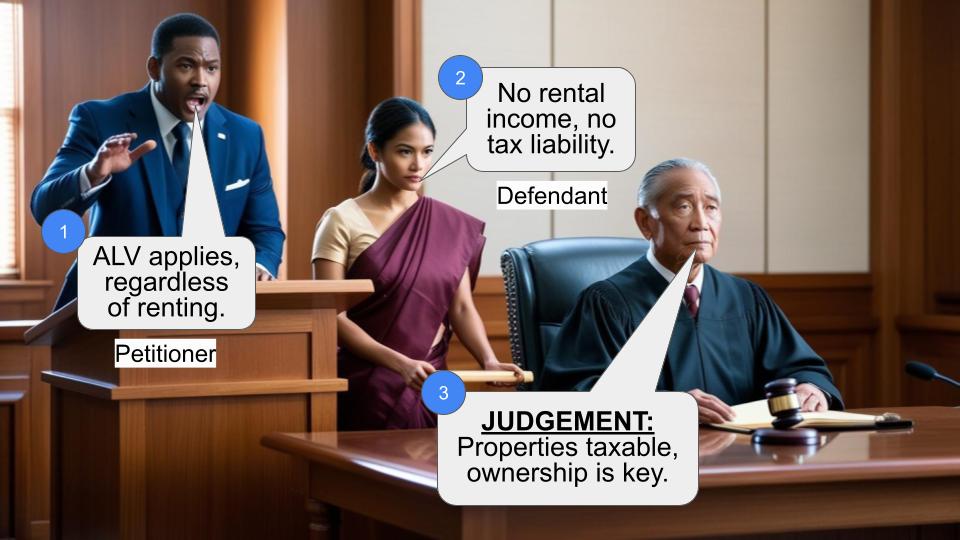
1. Properties owned by real estate developers can be taxed based on their Annual Letting Value (ALV), even if not actually rented out.
2. The court reaffirmed that taxation of house property is based on ownership, not on whether the owner is in the business of renting.
3. The decision in Chennai Properties & Investments Ltd v. CIT was distinguished from this case due to differences in the main objects of the companies involved.
Issue:
Was the Income Tax Appellate Tribunal (ITAT) justified in deleting the addition of Rs.80,49,504/- by holding that the provisions of Section 22 (of Income Tax Act, 1961) and 23 (of Income Tax Act, 1961) were not applicable to the properties owned by the Assessee (Ansal Housing & Construction)?
Facts:
- The case pertains to the Assessment Year 1994-95.
- Ansal Housing & Construction is a real estate developer.
- The company owned properties that were not actively rented out.
- The Income Tax department sought to tax these properties based on their Annual Letting Value.
- The ITAT had ruled in favor of Ansal Housing, deleting the addition of Rs.80,49,504/-.
- The Revenue department appealed this decision in the Delhi High Court.
Arguments:
Ansal Housing (Respondent):
1. Letting out properties was not part of their business objectives.
2. They didn't derive any actual income from letting out these properties.
3. The flats should not be taxed on notional ALV as they were occupied for business purposes.
Revenue Department (Appellant):
1. Taxation of house property is based on ownership, not on whether it's a business activity.
2. ALV is a valid method to calculate tax, even if no actual income is received.
3. The properties were not actively used for business purposes, just passively held.
Key Legal Precedents:
1. CIT v. Ansal Housing Finance & Leasing Co. Ltd. (2013) 354 ITR 180 (Del): This case established that taxation of house property is based on ownership, not on whether the owner is in the business of renting.
2. East India Housing & Land Development Trust v. CIT [1961] 42 ITR 49 SC and Sultan Bros. (P) Ltd. v. CIT [1964] 51 ITR 353 (SC): These cases were referenced in the Ansal Housing Finance decision.
3. Chennai Properties & Investments Ltd v. CIT 373 ITR 673 (SC): This case was distinguished from the current one due to differences in the main objects of the companies involved.
Judgement:
The Delhi High Court ruled in favor of the Revenue department. Key points of the judgment:
1. The court reaffirmed its earlier decision in CIT v. Ansal Housing Finance & Leasing Co. Ltd.
2. It held that the levy of income tax on house property is based on ownership, not on whether the owner is in the business of renting.
3. The use of Annual Letting Value (ALV) for tax calculation is valid, even if no actual income is received.
4. The court rejected the argument that the properties were occupied for business purposes, stating that active use, not mere possession, is required for such exemption.
5. The decision in Chennai Properties & Investments Ltd v. CIT was distinguished from this case.
FAQs:
1. Q: Does this mean all properties owned by real estate developers will be taxed, even if unsold?
A: Yes, if they're not actively used for business purposes, they can be taxed based on their Annual Letting Value.
2. Q: What is Annual Letting Value (ALV)?
A: ALV is a method to calculate the potential rental income a property could generate, used for tax purposes even if the property isn't actually rented out.
3. Q: How is this case different from Chennai Properties & Investments Ltd v. CIT?
A: In the Chennai Properties case, letting out properties was the main object of the company. In this case, it was not part of Ansal Housing's main business objectives.
4. Q: Does this decision apply to all types of businesses that own property?
A: While the principle could potentially apply broadly, each case would be judged on its specific facts and the nature of the business involved.
5. Q: Can companies avoid this tax by claiming they're using the properties for business purposes?
A: The court clarified that active use for business purposes, not mere possession, is required for such an exemption. So, simply claiming business use may not be sufficient.

1. By order dated 20th February 2004, this Court framed the following two questions for determination in this appeal by the Revenue which is directed against the order dated 24th March 2003 of the Income Tax Appellate Tribunal (ITAT) in ITA No. 945 (DEL)/98 for the Assessment Year (AY) 1994-95:
“A Whether on the facts and in the circumstances of the case the ITAT was justified in law in deleting of the addition of Rs.80,49,504/- by holding that the provision of Section 22 (of Income Tax Act, 1961) and 23 (of Income Tax Act, 1961) was not applicable to the properties owned by the Assessee?
B. Whether on the facts and in the circumstances of the case the ITAT was correct in law allowing depreciation at the rate of 100% on shuttering material and tabular scaffolding in spite of the fact that each shuttering was incapable of being used independently?”
2. As far as question B is concerned, it is not in dispute that it stands answered in favour of the Assessee and against the Revenue by the decision dated 31st October 2012 of this Court in ITA No. 56 of 2001 (Commissioner of Income Tax v. Ansal Properties & Indus. Ltd.) which in turn followed the judgment of the same date in Commissioner of Income Tax v. Ansal Housing Finance & Leasing Co. Ltd. (2013) 354 ITR 180 (Del).
3. As far as question A is concerned, an attempt has been made by learned counsel for the Assessee to urge that in view of the judgment of Supreme Court in Chennai Properties & Investments Ltd v. CIT 373 ITR 673 (SC), the decision of this Court in CIT v. Ansal Housing Finance & Leasing Co. Ltd. (supra) requires to be reconsidered.
4. In the first place it requires to be noticed that the same question squarely arose before this Court in CIT v. Ansal Housing Finance & Leasing Co.Ltd. (supra). In para 5 of the said judgment the Court noted the submissions of the learned counsel for the Assessee that “ letting out of vacant or other properties was not part of the business or objectives of the assessee, and its case stands on a better footing than the other judgments, because in fact the assessee did not derive an income as a result of letting out”.
5. The "other judgments" referred to in the above decision were East India Housing & Land Development Trust v. CIT [1961] 42 ITR 49 SC and Sultan Bros. (P) Ltd. v. CIT [1964] 51 ITR 353 (SC). The alternative submission was that the flats owned by the Assessee could not be taxed on the basis of their annual letting value („ALV‟) notionally because the owner is an occupant and “such occupation is in the course of, and for the purpose of business, as a builder”.
6. In CIT v. Ansal Housing Finance & Leasing Co. Ltd. (supra) this Court negatived both the above submissions of the Assessee. After discussing the decisions of the Supreme Court in Sultan Bros.(P) Ltd. v. CIT (supra) and Karan Pura Development Co. Ltd. v. CIT [1962] 44 ITR 362 (SC), this Court noted that the levy of income tax in the case of one holding house property is premised not on whether the Assessee carries on business as landlord, but on ownership. It was further observed as under:
“.....The capacity of being an owner was not diminished one whit, because the assessee carried on business of developing, building and selling flats in housing estates. The argument that income tax is levied not on the actual receipt (which never arose in this case) but on a notional basis, i.e. ALV and that it is therefore not sanctioned by law, in the opinion of the Court is meritless. ALV is a method to arrive at a figure on the basis of which the impost is to be effectuated. The existence of an artificial method itself would not mean that levy is impermissible. Parliament has resorted to several other presumptive methods, for the purpose of calculation of income and collection of tax. Furthermore, application of ALV to determine the tax is regardless of whether actual income is received; it is premised on what constitutes a reasonable letting value, if the property were to be leased out in the marketplace. If the assessee's contention were to be accepted, the levy of income tax on unoccupied houses and flats would be impermissible - which is clearly not the case.”
7. The Court in CIT v. Ansal Housing Finance & Leasing Co. Ltd. (supra) also rejected the alternative plea that the income from the property should in fact be treated as business income. The Court held in para 14 as under:
“As far as the alternative argument that the assessee itself is occupier, because it holds the property till it is sold, is concerned, the Court does not find any merit in this submission. While there can be no quarrel with the proposition that "occupation" can be synonymous with physical possession, in law, when Parliament intended a property occupied by one who is carrying on business, to be exempted from the levy of income tax was that such property should be used for the purpose of business. The intention of the lawmakers, in other words, was that occupation of one's own property, in the course of business, and for the purpose of business, i.e. an active use of the property, (instead of mere passive possession) qualifies as "own" occupation for business purpose. This contention is, therefore, rejected. Thus, this question is answered in favour of the revenue, and against the assessee.”
8. As far as the decision in Chennai Properties & Investments Ltd v.CIT (supra) is concerned, in para 5 the Supreme Court noted that the main object of the Appellant Assessee in that case was “to purchase or otherwise acquire and hold the properties known as “Chennai House” and to let out such properties and to make advances upon the security of lands or buildings or other property, or any interest therein”. What was emphasized was that holding the aforesaid properties and earning income by letting out properties was the “main object of the company”. The above facts in Chennai Properties & Investments Ltd (supra) clearly distinguishes it in its applicability to the facts of the present case where a categorical stand was recorded in para 5 of the judgment of CIT v. Ansal Housing Finance & Leasing Co. Ltd. (supra) that letting out of properties “was not part of business and object of the Assessee”.
9. Consequently, this Court is not persuaded to accept the plea of the Assessee that in view of the decision in Chennai Properties & Investments Ltd (supra) the Court should reconsider the correctness of its ruling in CIT v. Ansal HousingFinance & Leasing Co. Ltd. (supra).
10. Consequently, question A is answered in the negative, i.e., in favour of the Revenue and against the Assessee.
11. The appeal is accordingly disposed of.
S.MURALIDHAR, J
NAJMI WAZIRI, J
JULY 26, 2016
×