


“Appeals Court Upholds Admission of New Evidence in Tax Case”












Full News
“Appeals Court Upholds Admission of New Evidence in Tax Case”
“Appeals Court Upholds Admission of New Evidence in Tax Case”
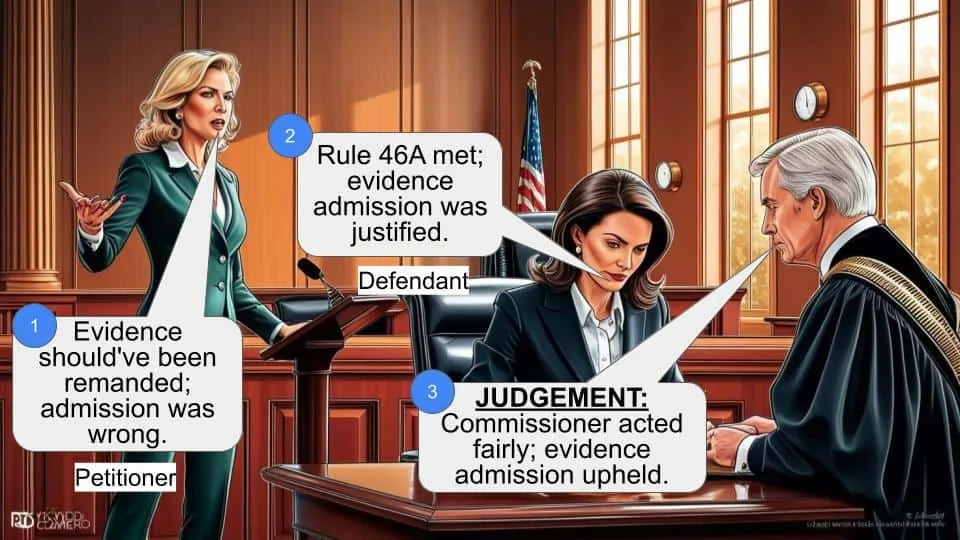
In the case of “Commissioner of Income Tax vs E.D. Benny,” the court addressed whether the Commissioner of Income Tax (Appeals) was correct in admitting additional evidence that was not presented during the initial assessment. The court upheld the decision of the Commissioner (Appeals) and the Tribunal, allowing the new evidence to be considered, despite objections from the Revenue.
Get the full picture - access the original judgement of the court order here
Case Name
Commissioner of Income Tax vs E.D. Benny (High Court of Kerala)
ITA. No. 84 of 2015
Date: 17th August 2015
Key Takeaways
- The court confirmed that the Commissioner (Appeals) has the discretion to admit additional evidence if the appellant was prevented by reasonable cause from presenting it earlier.
- Rule 46A (of Income Tax Rules, 1962), was central to the case, outlining when additional evidence can be admitted.
- The decision emphasized the importance of procedural fairness and the principles of natural justice in tax proceedings.
Issue
Was the Commissioner of Income Tax (Appeals) justified in admitting additional evidence that was not presented during the initial assessment proceedings?
Facts
The case involved a dispute over the admission of new evidence in a tax assessment appeal. The assessee, E.D. Benny, had not presented certain documents during the initial assessment by the Assessing Officer. These documents were later submitted to the Commissioner (Appeals), who admitted them, leading to a favorable decision for the assessee. The Revenue challenged this decision, arguing that the additional evidence should not have been considered.
Arguments
- Revenue’s Argument: The Revenue contended that the Commissioner (Appeals) should not have admitted the additional evidence without remanding the case back to the Assessing Officer for consideration. They relied on Rule 46A (of Income Tax Rules, 1962) and previous court decisions to support their position.
- Assessee’s Argument: The assessee argued that the conditions under Rule 46A (of Income Tax Rules, 1962) were met, as they were prevented by reasonable cause from presenting the evidence earlier. They also emphasized that the Commissioner (Appeals) had followed due process by allowing the Assessing Officer to review the new evidence.
Key Legal Precedents
- Commissioner of Income Tax v. McMillan & Co. [1958] 33 ITR 182: This case was cited by the Revenue to argue for remanding the case to the Assessing Officer. However, the court found it not directly applicable to the current procedural context.
- Smt. Prabhavati Shah v. CIT [1998] 231 ITR 1 (Bom.): This case clarified the powers of the Appellate Assistant Commissioner under Section 250 (of Income Tax Act, 1961) and Rule 46A (of Income Tax Rules, 1962), supporting the view that the Commissioner (Appeals) can admit additional evidence under certain conditions.
Judgement
The court upheld the decision of the Commissioner (Appeals) and the Tribunal, allowing the additional evidence to be considered. The court found that the Commissioner (Appeals) had acted within their powers under Rule 46A (of Income Tax Rules, 1962) and Section 250 (of Income Tax Act, 1961). The appeal by the Revenue was dismissed.
FAQs
Q: What is Rule 46A (of Income Tax Rules, 1962)?
A: Rule 46A (of Income Tax Rules, 1962), outlines the conditions under which an appellant can present additional evidence during an appeal, such as when they were prevented by sufficient cause from presenting it earlier.
Q: Why was the additional evidence admitted?
A: The court found that the assessee was prevented by reasonable cause from presenting the evidence during the initial assessment, satisfying the conditions of Rule 46A (of Income Tax Rules, 1962).
Q: Does this case set a precedent for future tax appeals?
A: Yes, it reinforces the discretion of the Commissioner (Appeals) to admit additional evidence under Rule 46A (of Income Tax Rules, 1962), provided the conditions are met and procedural fairness is maintained.
Q: What does this mean for the parties involved?
A: The decision is favorable for the assessee, as the additional evidence was considered, potentially impacting the outcome of their tax assessment. The Revenue’s appeal was dismissed, affirming the lower authorities’ decisions.

1. The issues raised in these appeals are connected. Therefore, these
appeals were heard together and are disposed of by this common judgment
treating, with the consent of the parties, ITA84/15 as the leading case.
2. ITA 84/15 is filed by the Revenue, challenging the order passed by
the Income Tax Appellate Tribunal, Cochin Bench in ITANo.612/2013. The
respondent assessee is a partner in various business concerns and the
other partners of these firms are the family members of the assessee. A
search under Section 132 (of Income Tax Act, 1961) (hereinafter referred as
'the Act') was conducted in the business premises of various firms and the
residences of the partners on 26.3.2008. During the course of the search, various incriminating documents were found and seized and statements
of the partners were also recorded. Consequent to the search, notices
under Section 153A (of Income Tax Act, 1961) were issued for the assessment years
2002-2003 to 2007-2008 and notice under Section 142(1) (of Income Tax Act, 1961)
was issued for the assessment year 2008-2009. In response to the
notice under Section 153A (of Income Tax Act, 1961), the assessee filed his returns of
income on 10.7.2009 and on 13.7.2009, filed his regular return of
income in response to the notice under Section 142(1) (of Income Tax Act, 1961), for the
assessment year 2008-2009.
3. The Assessing Officer completed assessment under Section
153A read with Section 144 (of Income Tax Act, 1961) vide his order dated 18.12.2009.
The assessment in respect of the assessment year 2008-2009 was also
completed under Section 143(3) (of Income Tax Act, 1961) read with Section 144 (of Income Tax Act, 1961) on
29.12.2009. The assessee filed appeals before the Commissioner of
Income Tax (Appeals). In the appeals, paper books containing detailed
written statements on various issues raised, cashflow statements filed
before the Assessing Officer, replies filed in response to various notices issued by the Assessing Officer and the evidences/workings in support
of various claims made in the appeals were also filed.
4. On the filing of the additional evidence before him, the
Commissioner of Income Tax (Appeals) forwarded the paper books
itself to the Assessing Officer and required the Assessing Officer to
examine the new evidences/details/submissions of the assessee and to
give a report. Accordingly, the Assessing Officer submitted his report, a
copy of which is Annexure C in this appeal. In this report, insofar as the
new evidences that were produced before the Commissioner of Income
Tax (Appeals) are concerned, the Assessing Officer has stated thus:
“20. The written submission filed by the assessee along
with 5 paper books the whole group of individual cases
and one paper book in the case of the assessee were
verified. These are fresh evidences filed by the assessee
before the Appellate Authority. None of them were filed
during the course of assessment proceedings. Detailed
investigations were made on the fresh evidences placed
by the assessee on record. They are summarized as
under:
21. AGRICULTURAL INCOME EARNED BY THE ASSESSEE:
The Inspector attached to this Circle was deputed to
inspect the various agricultural land holdings of the assessee and to verify the genuineness of the bills
produced as fresh evidences claimed by the assessee.
As per this report dated 23.2.2011 submitted by
the Inspector, he visited the agricultural lands held by
the assessee on 22.2.2011 and reported as under:
As per the direction of the Dy.CIT, Central Circle,
Thrissur, I had visited the agricultural lands of the
assessee situated in various villages and satisfied with
the documents produced by the assessee. The assessee
hold approximately 13.5 acres of cultivable land in
different villages in which 12 acres are paddy field. The
agricultural income claimed by the assessee as per
bills/vouchers produced as fresh evidences were verified
with the original bills/vouchers with dealers and the
genuineness was verified. I have verified the original
bills/vouchers from the following dealers for the period
from 2.4.2010 to 3.8.2010 and found genuine.
Sl.
No
Name of trader/dealer
Period
From To
1 KPK Oil Mills 2.4.2010 15.6.2010
2 Kottayam Rubbers 28.4.2010 19.7.2010
3 Anna Coconut Products 1.5.2010 3.6.2010
4 St.Joseph Oil Mills 2.5.2010 22.6.2010
5 Aloor Service Co.Op. Bank 1.6.2010 3.8.2010
6 Jeeva Bonemeal 21.7.2010 30.7.2010
It is pertinent to state that the agricultural income
claimed to have earned by the assessee is for the
assessment year 2010-2011 and not for the period under
the search assessment period.
22. Receipt from sale of trees:
The required particulars i.e. inflow in the cash flow
statement, details of sale of tree and agreement with
purchasers etc. were produced before the appellate
authority as fresh evidence. These were not produced at
the time of assessment proceedings.
23. Investment in immovable properties:
The investment in immovable property was ascertained
on the basis of seized documents. For the AY 2007-08,
the assessee had invested Rs.7,15,887/- in immovable
property for which he had shown only Rs.85,687/- in
cash flow statement. For the AY 2008-09, the assessee
had invested Rs.4,27,749/- in immovable property where
as the cash outflow as per cash flow statement is
Rs/5,00,558/-. This cash flow statement was produced
as a new evidence which was not produced at the time of
assessment. Hence, this claim of the assessee may be
rejected.
24. Investment in movable properties
The addition on investment in movable properties were
made on the basis of the sworn statement recorded from
the assessee on 26.3.2008. Now the assessee had filed
cash flow statements before the appellate authority to
prove his claim. This may be rejected on the ground that
this is a fresh evidence.
25. Opening Balance in the cash flow statement.
The opening cash balance of Rs.25,000/- shown by the
assessee in the cash flow statement can not be accepted
on the ground that the cash flow statement is a fresh
evidence filed before the CIT(A). He has not even
produced the copy of his balance sheet for the financial year ended 2001-2002 relevant to the AY 2002-03 for
verification. Hence, this can not be accepted as genuine.
26. In view of the observations it is prayed that all the
evidences now filed before the appellate authority are
fresh and not produced at the time of assessment
proceedings. They are prima facie inadmissible in view
of provisions of Rule 46A (of Income Tax Rules, 1962). Hence, they
may be rejected and assessment orders sustained.”
5. The Appellate Authority considered the matter in the light of
the provisions contained in Rule 46A (of Income Tax Rules, 1962)
(hereinafter referred to as 'the Rules') and passed Annexure B order, in
which after dealing with each of the justification offered by the
assessee, he concluded that:
“Considering these circumstances, I am of the opinion
that the appellant was prevented by reasonable and
sufficient causes from furnishing various
details/evidences at the assessment stage.
Therefore, considering the totality of the facts and
circumstances of the case, the additional
evidences/details filed by the appellant are admitted and
adjudicated in this appeal.”
6. Challenging Annexure B order,Revenue filed appeals before the
Tribunal. Cross Objections were also filed by the assessee impugning
Annexure B to the extent it was against him. By Annexure E common
order rendered on 10th October 2014, the appeal and Cross Objection
were dismissed by the Tribunal.
7. In its order, the Tribunal has stated that the first common
ground in all the appeals that were considered was with regard to the
admission of fresh/new evidences filed by the assessee before the
Commissioner of Income Tax (Appeals) without satisfying the
conditions laid down in Rule 46A (of Income Tax Rules, 1962). In paragraph 4 to 9 of its
order, the Tribunal dealt with the above contention in the light of the
provisions contained in Section 250 (of Income Tax Act, 1961) and Rule
46A of the Rules. In conclusion, the Tribunal held that it did not find
any merit in the contention urged by the Revenue and accordingly, the
contention was rejected. Thereafter, the Tribunal examined the other
contentions and, as already stated, dismissed the appeals and cross objections. It is aggrieved by these orders passed by the Tribunal that
the Revenue has filed this appeal.
8. We heard the Senior Standing Counsel appearing for the
Revenue and the learned Senior Counsel appearing for the respondent
assessee.
9. Although in the impugned order various issues were decided
by the Tribunal, when the appeals were heard, the sole contention
raised by the Senior Counsel for the Revenue was that the
Commissioner of Income Tax (Appeals), ought not have admitted
additional evidence that were produced by the assessee and that even if
it was decided to admit the additional evidence, the Commissioner of
Income Tax (Appeals) ought to have remanded the cases leaving to the
Assessing Officer, to consider the additional evidence produced and to
render his findings thereon. In support of this contention, learned
Senior Counsel for the Revenue relied on the provisions contained in
Section 250 (of Income Tax Act, 1961), Rule 46A (of Income Tax Rules, 1962), the decision of the Apex
Court in Commissioner of Income Tax v. McMillan & Co. [1958] 33 ITR 182, Sm t.Prabhavati Shah v. CIT [1998] 231 ITR 1 (Bom.) and
Commissioner of Income Tax v. United Towers (I.) P. Ltd. [2008] 296 ITR
106 (Delhi).
10. On the other hand, learned Senior Counsel appearing for the
assessee contended that this is a case in which the grounds provided
under Rule 46A (of Income Tax Rules, 1962) were established by the assessee and,
therefore, the First Appellate Authority was entitled to admit the
documents in evidence. He also pointed out that before deciding to
admit the additional documents and considering the same, the First
Appellate Authority had complied with the principles of natural justice.
Therefore, according to the learned counsel, no grounds have been
made out for interference with the orders impugned.
11. We have considered the submissions made. It is evident from
paragraph 3 of Annexure B order passed by the First Appellate
Authority itself that when the authorised representative of the assessee
appeared in response to the notice of hearing, he filed paper books
containing detailed written submissions on various issues raised in the appeal, cashflow statements filed before the Assessing Officer, reply
filed in response to various notices issued by the Assessing Officer and
evidences/working in support of various claims made in the appeal. On
production of these materials, admittedly, the First Appellate Authority
forwarded the paper books to the Assessing Officer and required the
Assessing Officer to examine the new evidences/details/submissions
and to give his report.
12. It was in response to that letter of the First Appellate
Authority that the Assessing Officer submitted Annexure C Remand
Report. Reading of this Report shows that in paragraphs 1 to 19, the
Assessing Officer has justified his conclusions in the assessment order.
Thereafter, from paragraph 20 onwards, extracted above, he dealt with
the additional materials that were produced by the assessee before the
First Appellate Authority. This report shows that insofar as the
agricultural income earned by the assessee, after stating that the
bills/vouchers produced by the assessee were found genuine, all that
the Assessing Officer has stated is that the period pertains to the assessment year 2010-2011 and not the period under the search
assessment. Insofar as the remaining issues are concerned, although
each one of them were separately dealt with, all that he has stated is
that the claim of the assessee may be rejected for the reason that the
materials mentioned were not produced at the time of assessment.
13. It was considering this report submitted by the Assessing
Officer that the First Appellate Authority passed Annexure B order. In
this order, the First Appellate Authority considered the circumstances
pleaded by the assessee and held that the assessee was prevented by
reasonable and sufficient causes from furnishing the details/ evidences
at the assessment stage. Based on that finding, the First Appellate
Authority admitted the evidence produced and adjudicated the appeal.
It is this order passed by the First Appellate Authority which was
confirmed by the Tribunal.
14. Rule 46A (of Income Tax Rules, 1962) read thus:
“(1) The appellant shall not be entitled to produce
before the [Deputy Commissioner (Appeals)] [or, as the
case may be, the Commissioner (Appeals), any evidence ,
whether oral or documentary, other than the evidence produced by him during the course of proceedings before
the [Assessing Officer] except in the following
circumstances, namely:-
(a) where the [Assessing Officer] has refused to
admit evidence which ought t have been admitted;
or
(b) where the appellant was prevented by
sufficient cause from producing the evidence
which he was called upon to produce by the
[Assessing Officer]; or
(c) where the appellant was prevented by
sufficient cause from producing before the
[Assessing Officer] any evidence which is relevant
to any ground of appeal; or
(d) where the [Assessing Officer] has made the
order appealed against without giving sufficient
opportunity to the appellant to adduce evidence
relevant to any ground of appeal.
(2) No evidence shall be admitted under sub-rule (1)
unless the [Deputy Commissioner (Appeals) [or, as the
case may be, the Commissioner (Appeals] records in
writing the reasons for its admission.
(3) The [Deputy Commissioner (Appeals)] [or, as the
case may be, the Commissioner (Appeals)] shall not take
into account any evidence produced under sub-rule (1)
unless the [Assessing Officer] has been allowed a
reasonable opportunity --
(a) to examine the evidence or document or to cross-
examine the witness produced by the appellant, or
(b) to produce any evidence or document or any witness
in rebuttal of the additional evidence produced by the
appellant.
(4) Nothing contained in this rule shall affect the power
of the [Deputy Commissioner (Appeals)] [or, as the case
may be, the Commissioner (Appeals)] to direct the
production of any document, or the examination of any
witness, to enable him to dispose of the appeal, or for
any other substantial cause including the enhancement
of the assessment or penalty (whether on his own
motion or on the request of the [Assessing Officer] under
clause (a) of sub-section (1) of section 251 (of Income Tax Act, 1961) or the
imposition of penalty under section 271 (of Income Tax Act, 1961).]”
15. Reading of this provision shows except on establishing the
circumstances enumerated in clauses (a) to (d) under sub rule 1 (of Income Tax Rules, 1962), an
appellant shall not be entitled to produce the Commissioner (Appeals)
any evidence whether oral or documentary. Sub rule 2 (of Income Tax Rules, 1962) mandates that
the Commissioner (Appeals) shall not admit any evidence, unless he
records in writing the reasons for its admission. Once the documents
are so admitted, sub rule 3 (of Income Tax Rules, 1962) comes into operation, which further
mandates that the Commissioner (Appeals) shall not take into account any evidence produced under sub rule 1 (of Income Tax Rules, 1962) unless the Assessing Officer
has been allowed a reasonable opportunity to examine the evidence or
document or to cross examine the witnesses produced by the appellant
or to produce any evidence in rebuttal of the additional evidence.
Insofar as this sub rule is concerned, as we have already seen, on
admission of the additional evidence, the Commissioner (Appeals)
forwarded the paper books itself to the Assessing Officer calling for his
report. It was in response to the letter calling for remand report that
the Assessing Officer submitted Annexure C report.
16. Therefore, this is a case where the Commissioner (Appeals)
has allowed the Assessing Officer adequate opportunity as provided
under sub rule 3 (of Income Tax Rules, 1962) to examine the evidence produced by the appellant. In
the remand report that he has furnished apart from requesting for its
rejection, the Assessing Officer did not, either dispute the genuineness
of the documents nor did he ask for cross examination of the witness, or
to adduce any evidence in rebuttal of the documents produced by the
appellant. In other words, sub rule 3 (of Income Tax Rules, 1962) has been fully complied with. It was thereafter, that the First Appellate Authority proceeded to
adjudicate the appeal, duly taking into account the additional evidence
produced by the appellant.
17. One of the contentions raised in these appeals is that having
admitted the additional evidence, the Commissioner (Appeals) should
have remanded the case to the Assessing Officer for his consideration.
In our view,this contention cannot be accepted in the light of sub rule 4 (of Income Tax Rules, 1962),
a reading of which shows that it was open to the Commissioner
(Appeals) to dispose of the appeal by himself or even to remit the
matter to the Assessing Officer. This power of the Appellate Authority is
also evident from Section 250 (of Income Tax Act, 1961), which reads thus:
“250. Procedure in appeal:
(1) The [Commissioner (Appeals)] shall fix a day and
place for the hearing of the appeal, and shall give notice
of the same to the appellant and to the [Assessing] Officer
against whose order the appeal is preferred.
(2) The following shall have the right to be heard at the
hearing of the appeal--
(a) the appellant, either in person or by an
authorised representative;
(b)the [Assessing] Officer, either in person or by a
representative.
(3) The [Commissioner (Appeals)] shall have the power to
adjourn the hearing of the appeal from time to time.
(4) The [Commissioner (Appeals)] may, before disposing
of any appeal, make such further inquiry as he thinks fit,
or may direct the [Assessing] Officer to make further
inquiry and report the result of the same to the
[Commissioner (Appeals)]
(5) The [Commissioner (Appeals)] may, at the hearing of
an appeal, allow the appellant to go into any ground of
appeal not specified in the grounds of appeal, if the
[Commissioner (Appeals)] is satisfied that the omission of
that ground from the form of appeal was not wilful or
unreasonable.
(6) The order of the [Commissioner (Appeals] disposing of
the appeal shall be in writing and shall state the points
for determination, the decision thereon and the reason for
the decision.
[(6A) In every appeal, the Commissioner (Appeals), where
it is possible, may hear and decide such appeal within a
period of one year from the end of the financial year in
which such appeal is filed before him under sub-section
(1) of section 246A (of Income Tax Act, 1961).]
(7) On the disposal of the appeal, the [Commissioner
(Appeals)] shall communicate the order passed by him to
the assessee and to the [Principal Chief Commissioner or] [Chief Commissioner or [Principal Commissioner or
Commissioner]”
18. Reading of sub section 4 (of Income Tax Act, 1961) shows that the Commissioner
(Appeals) may, before disposing of any appeal, make such further
inquiry as he thinks fit, or may direct the Assessing Officer to make
further inquiry and report the result of the same to the Commissioner
(Appeals). From the above provision, it is clear that neither the
admission of the additional materials nor the decision of the
Commissioner (Appeals) to adjudicate the appeals himself rather than
remanding the same to the Assessing Officer can be faulted.
19. Learned Senior Counsel for the Revenue relied on the
Supreme Court judgment in Commissioner of Income Tax v. McMillan &
Co. [1958] 33 ITR 182 to support his contention that when documents
are produced before the First Appellate Authority, the matter should
have been remanded to the Assessing Officer. In our view,this judgment
does not support the proposition canvassed by the learned Senior
Counsel. This judgment was rendered by the Apex Court in the background of the Income Tax Act,1922 and Income Tax Rules, 1922.
The facts of this case show that assessment was completed and appeal
was filed by the assessee. The Appellate Authority, after issuing notice
to the assessee, fixed the income of the assessee enhancing the tax
liability, presumably relying on the proviso to Section 13 (of Income Tax Act, 1961) and
Rule 33 (of Income Tax Rules, 1962). This was confirmed by the Tribunal and the High
Court. In the judgment, while interpreting the provisions of Section 13 (of Income Tax Act, 1961)
of the Act, the Apex Court has highlighted the requirement of
satisfaction by the Income Tax Officer. In our view, that finding of the
Apex Court does not suggest that in every case where additional
materials are produced before the First Appellate Authority, the
Appellate Authority is bound to remit the case to the Income Tax Officer
for fresh consideration. Therefore, this judgment does not support the
contention raised by the learned Senior Counsel for the Revenue.
20. Insofar as the Bombay High Court judgment in
Smt.Prabhavati Shah v. CIT [1998] 231 ITR 1 (Bom.) is concerned that
was a case where the provisions contained in Section 250 (of Income Tax Act, 1961) and Rule 46A (of Income Tax Rules, 1962) were dealt with. The relevant paragraphs of the
judgment reads thus:
“On a plain reading of rule 46A (of Income Tax Rules, 1962), it is clear that this
rule is intended to put fetters on the right of the appellant
to produce before the Appellate Assistant Commissioner
every evidence, whether oral or documentary, other than
the evidence produced by him during the course of the
proceedings before the Income-tax Officer, except in the
circumstances set out therein. It does not deal with the
powers of the Appellate Assistant Commissioner to make
further enquiry or to direct the Income tax officer to make
further enquiry and to report the result of the same to
him. This position has been made clear by sub rule (4)
which specifically provides that the restrictions placed on
the production of additional evidence by the appellant
would not affect the powers of the Appellate Assistant
Commissioner to call for the production of any document
or the examination of any witness to enable him to
dispose of the appeal. Under sub-section (4) of section
250 of the Act, the Appellate Assistant Commissioner is
empowered to make such further inquiry as he thinks fit
or to direct the Income tax officer to make further inquiry
and to report the result of the same to him. Sub-section
(5) of section 250 (of Income Tax Act, 1961) empowers the Appellate
Assistant Commissioner to allow the appellant, at the
hearing of the appeal, to go into any ground of appeal not
specified in the grounds of appeal, on his being satisfied
that the omission of the ground from the form of appeal
was not wilful. It is clear from the above provisions that
the powers of the Appellate Assistant Commissioner are
much wider than the powers of an ordinary court of appeal. The scope of his powers is coterminous with that
of the Income-tax Officer. He can do what the Income-tax
Officer can do. He can also direct the Income tax Officer
to do what he failed to do. The power conferred on the
Appellate Assistant Commissioner under sub-section (4)
of Section 250 (of Income Tax Act, 1961) being a quasi-judicial power, it is
incumbent on him to exercise the same if the facts and
circumstances justify. If the Appellate Assistant
Commissioner fails to exercise his discretion judicially,
and arbitrarily refuses to make enquiry in a case where
the facts and circumstances so demand, his action would
be open for correction by a higher authority.
On a conjoint reading of section 250 (of Income Tax Act, 1961) and
rule 46A (of Income Tax Rules, 1962), it is clear that the restrictions
placed on the appellant to produce evidence do not affect
the powers of the Appellate Assistant Commissioner under
sub-section (4) of Section 250 (of Income Tax Act, 1961). The purpose of
rule 46A (of Income Tax Rules, 1962) appears to be to ensure that evidence is
primarily led before the Income tax officer.”
21. This judgment also does not lead to the conclusion that in
every case where additional evidence are produced, the Appellate
Authority is bound to remand the case to the Assessing Officer.
22. However, in paragraph 9 of the order passed by the Tribunal it
has stated thus:
“In the instant case the entire additional evidence has
come on the record of the first appellate authority because the first appellate authority decided to examine
the facts of the case in depth and adjudicate upon the
matter on the basis of evidence and material thus
gathered. The learned CIT(A) was empowered to do so
under the provisions of Section 250(4) (of Income Tax Act, 1961). The results of
enquiry conducted by him could either go to further
cement the case made out by the assessing officer or to
help out the assessee against the findings of the assessing
officer. The mere fact that the results of the enquiries
thus conducted supported the case of the assessee and
not that of Revenue has no bearing on the jurisdiction
and powers of the learned CIT(A). The learned CIT(A)
has confronted the assessing officer with the evidence
thus received and the material thus gathered and allow
the assessing officer to have his say in the matter vide
remand report dated 29.4.2013 and being done so this
dispute have no merits. We do not see any requirement
in law that the first appellate authority should invariably
consult or confront the assessing officer every time an
additional evidence that was not filed before the
assessing officer comes on the record of the first appellate
authority. Where the additional evidence is obtained by
the first appellate authority on its own motion, there is
no requirement in law to consult/confront the assessing
officer with such additional evidence. There may be cases
where additional evidence is admitted by the first
appellate authority on a request or application being
made by the assessee. In such cases sub rule (2) of rule
46A requires the first appellate authority to allow the
assessing officer a further opportunity to rebut the fresh
evidence filed by the assessee. Even that requirement
cannot be said to be a rule of universal application. If the
additional evidence furnished by the assessee before the appellate authority is in the nature of clinching evidence
leaving no further room for any doubt or controversy in
such a case no useful purpose served on performing the
ritual of forwarding the evidence/material to the
assessing officer and obtain his report. In such
exceptional circumstances the requirement of sub-rule
(3) may be dispensed with.”
23. Reading of the aforesaid finding of the Tribunal would suggest
that according to it, if additional documents are summoned by the
Commissioner (Appeals) and produced or if the additional evidence
produced by the assessee are in the nature of clinching evidence leaving
no further room for any doubt or controversy, it is not necessary to give
an opportunity to the Assessing Officer to contradict the same. In other
words, the finding of the Tribunal would suggest that in cases where
documents are summoned by the Commissioner (Appeals) and in cases
where the documents produced are conclusive, the principles of natural
justice are excluded. We are unable to enclose these finding of the
Tribunal. As held by Delhi High Court in Commissioner of Income Tax v.
United Towers (I,) P. Ltd. [2008] 296 ITR 106 (Delhi), Rule 46A(4) (of Income Tax Rules, 1962) of the
Rules does not specifically exclude the principles of natural justice and, therefore, these principles are to be read into the Rules. Therefore, we
disprove the finding of the Tribunal as contained in paragraph 9 of the
order extracted above.
24. Having considered the sole contention urged, we do not find
any merit in these appeals. Appeal, therefore, fail and is accordingly
dismissed.
25. The issues involved in all other cases are similar. In view of
the dismissal of the leading case ITA 84/2015, all other appeals are also
dismissed.
All pending interlocutory applications in these cases stand closed.
SD/-
ANTONY DOMINIC
JUDGE
SD/-
SHAJI P. CHALY
JUDGE
×
Similar Ripples
Questions
“Appeals Court Upholds Admission of New Evidence in Tax Case”
Write your CommentSimilar Posts
Generic
- Reportdata/3516.pdf
