


Full News
Court Clarifies Tax Appeal Limits: Old Rules Apply to Pre-2014 Cases
Court Clarifies Tax Appeal Limits: Old Rules Apply to Pre-2014 Cases
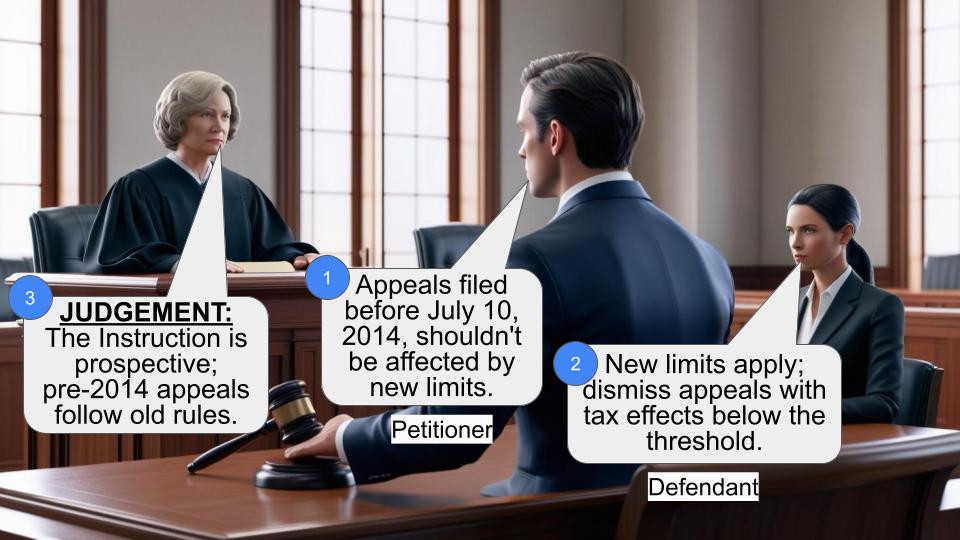
The case involves the Revenue's appeal against the Income Tax Appellate Tribunal's decision, which dismissed appeals concerning tax assessments for several years. The central issue was whether Instruction No.5/2014, which set new monetary limits for tax appeals, applied to cases filed before its issuance. The court decided that the Instruction is prospective and does not affect appeals filed before July 10, 2014.
Get the full picture - access the original judgement of the court order here
Case Name:
Commissioner of Income Tax vs. South Travancore Distilleries & Allied Products (High Court of Kerala)
ITA. No. 153 of 2001
Date: 30th July 2015
Key Takeaways
- Prospective Application: Instruction No.5/2014 applies only to appeals filed on or after July 10, 2014.
- Old Rules for Old Cases: Appeals filed before this date are governed by the instructions in effect at the time of filing.
- Legal Precedent: The court emphasized the importance of clear legislative language and its literal interpretation.
Issue
Does Instruction No.5/2014, which sets new monetary limits for filing tax appeals, apply to cases filed before its issuance on July 10, 2014?
Facts
The Revenue challenged the Tribunal's dismissal of appeals against the orders of the Commissioner of Income Tax. These orders set aside the Assessing Officer's disallowance of commissions paid by the assessee for selling liquor. The relevant assessment years were 1991-1992 to 2002-2003. The dispute centered on whether the new monetary limits for appeals applied retroactively.
Arguments
- Revenue's Argument: The Instruction should be judged based on the date of filing the appeals, not the assessment year. Therefore, it should not affect appeals filed before July 10, 2014.
- Assessee's Argument: The Instruction should apply, and since the tax effect was below the new limits, the appeals should be dismissed.
Key Legal Precedents
- Commissioner of Income Tax v. Camco Colour Co.: Highlighted the binding nature of CBDT instructions on the Revenue.
- Commissioner of Income Tax v. Surya Herbal Limited: Stated that courts could ignore circulars if substantial questions of law are involved.
Judgement
The court ruled in favor of the Revenue, stating that Instruction No.5/2014 is prospective and does not apply to appeals filed before July 10, 2014. The appeals were remanded to the Assessing Officer for reconsideration, following the precedent set in ITA Nos.95/10 and 168/10.
FAQs
Q1: What is Instruction No.5/2014?
A1: It's a directive from the Central Board of Direct Taxes setting monetary limits for filing tax appeals.
Q2: Why doesn't the Instruction apply to older cases?
A2: The court found the language of the Instruction clear and unambiguous, indicating it applies only to appeals filed after its issuance.
Q3: What happens to the appeals now?
A3: They are sent back to the Assessing Officer for a fresh decision, considering the merits of each case.

1. These appeals are filed by the Revenue challenging the orders of the Income Tax Appellate Tribunal dismissing the appeals filed against the orders of the Commissioner of Income Tax setting aside the orders of the Assessing Officer disallowing the commission paid by the assessee to the agents appointed by them for selling Indian Made Foreign Liquor manufactured by it to the Kerala State Beverages Corporation, a wholly owned Kerala Government Company. The assessment years which are relevant are 1991-1992, 1992-1993, 1994-1995, 1995-1996, 1996-1997 and 2002-2003.
2. When these appeals were taken up for consideration, learned Senior Counsel appearing for the Revenue brought to our notice the judgment dated 11th January 2011 rendered by this Court in ITA Nos.95 and 168 of 2010 passed in the case of the respondent assessee itself on the very same issue concerning the assessment years 2000-2001, 2001-2002 and contended that in those appeals filed by the Revenue, the orders passed by the Commissioner of Income Tax (Appeals) and the Tribunal were set aside and the matters were remitted to the Assessing Officer to decide the matter afresh. Therefore, he submitted that these appeals can also be disposed of with similar directions.
3. However, the learned Senior Counsel appearing for the respondent assessee brought to our notice Instruction No.5/2014 dated 10th July, 2014, issued by the Central Board of Direct Taxes fixing Rs.10,00,000/- as the monetary limit for maintaining an appeal under Section 260A (of Income Tax Act, 1961). According to him, in the light of the said Instruction and in view of the fact that the tax effect involved in these appeals is less than the limit prescribed in Instruction No.5/2014, they are not maintainable and therefore should be dismissed. In support of this plea, the learned Senior Counsel placed reliance on the judgments of the Bombay High Court in Commissioner of Income Tax v. Camco Colour Co. (2002) 254 ITR 565 (Bom), Commissioner of Income Tax v. Pithwa Engg. Works (2005) 276 ITR 519 (Bom) and Commissioner of Income Tax v. Madhukar K. Inamdar (HUF) (2009) 318 ITR 419 (Bom). Reference was also made on the judgments of the High Court of Punjab and Haryana in Commissioner of Income Tax v. Abhinash Gupta (2010) 327 ITR 619 and the judgment of the Madras High Court in Commissioner of Income Tax v. Nagaraja Rao and Others (2009) 318 ITR 422 (Mad). Counsel also brought to our notice the judgment of the Apex Court in State of Kerala and others v. Kurian Abraham Private Limited and Others (2008) 303 ITR 284 (SC) to contend that the Instructions are binding on all authorities of the Department.
4. On the other hand, learned Senior Counsel appearing for the Revenue contended that as is evident from the Instruction itself the applicability thereof should be judged with reference to the Instruction in force as on the date of filing of the appeals. According to him, therefore, Instruction No.5/2014 issued on the 10th of July 2014 cannot have any impact on these appeals which were filed in 2001, 2003 and 2006. Counsel also invited our attention to the principles laid by this Court in the judgment in Commissioner of Income Tax v. Smt. Pushpa Vijoy and Another (2012) 247 CTR 575.
5. The learned Senior Counsel for the assessee raised an alternative contention that even if it is assumed that the applicability of the Instruction has to be judged with reference to the date of filing of the appeal, ITA 50/02 filed on 9.10.2001 relating the assessment year 1992-1993 cannot be maintained as according to him, the tax effect is much less than Rs.2,00,000/- which was the then prevailing monetary limit prescribed in Instruction No.1979 dated 27th March 2000 for filing appeals under Section 260A (of Income Tax Act, 1961). This contention was resisted by the counsel for the Revenue by referring to us the principles laid down by the Apex Court in Commissioner of Income Tax v. Surya Herbal Limited (2011) 243 CTR 327 where it was held that the High Court can ignore the circulars and proceed to decide statutory appeals on merits, if the question involved is a substantial one.
6. Having thus set out the respective contentions by the counsel on both sides, we shall now examine whether there is any substance in the contention raised by counsel for the assessee that having regard to the Instruction No.5/2014 dated 10th July 2014, the appeals cannot be maintained.
7. Instruction No.5/2014, a copy of which was made available to us, was issued in supercession of Instruction No.3/2011 issued on 9.2.2011. Paragraphs 3 and 11 of the Instruction No.5/2014, being relevant for the purpose of this judgment, reads thus:
“3. Henceforth appeals shall not be filed in cases where the tax effect does not exceed the monetary limits given hereunder:
Sl. No.
Appeals in Income Tax matters
Monetary Limit (in Rs.)
1
Before Appellate Tribunal
4,00,000/-
2
U/s 260A (of Income Tax Act, 1961) before High Court
10,00,000/-
3
Before Supreme Court
25,00,000/-
It is clarified that an appeal should not be filed merely because the tax effect in a case exceeds the monetary limits prescribed above. Filing of appeal in such cases is to be decided on merits of the case.
11. This instruction will apply to appeals filed on or after 10 th July, 2014. However, the cases where appeals have been filed before 10 th July, 2014 will be governed by the instructions on this subject, operative at the time when such appeal was filed.”
8. Reading of paragraph 3 makes it explicitly clear that the direction of the Board is that “henceforth” appeal shall not be filed in cases where the tax effect does not exceed the monetary limits prescribed in the Instruction. Evidently, therefore, the operation of the Instruction is only prospective. This position is made further clear in Clause 11 of the Instruction which clarified that the Instruction will apply to appeals filed on or after 10th of July 2014 only. It is again clarified that the cases where appeals have been filed before 10th of July 2014 will be governed by the Instructions on this subject, operative at the time when such appeals were filed.
9. Even in respect of plenary law, it is trite that when the language used by the Legislature is clear and unambiguous courts are bound to literally interpret the same. We see no reason why that principle should not be imported for the interpretation of this Instruction as well. Thus seen, the language used by the Board in paragraphs 3 and 11 which are extracted above makes it clear that the Instruction cannot have any impact in respect of appeals which were filed before 10th July 2014 and in respect of appeals filed before 10.7.2014, the maintainability thereof will have to be judged in the light of the Instructions which were operative at the time when the appeals were filed.
10. Learned Senior counsel for the respondent placed reliance on three judgments of the Bombay High Court. First one is in the case of Commissioner of Income Tax v. Camco Colour Co. (2002) 254 ITR 565 (Bom). That case was rendered in the context of the assessment year 1990-1991 and the Instruction No.1979 dated 27th march 2000. In that judgment, the Bombay High Court has held in paragraph 5 thus: “It appears that despite about circular, the Revenue has chosen to file present appeal knowing fully well that the corridors of the Courts are flooded with pending litigations. The presentation of this appeal is quite contrary to the instruction issued in the circular which is binding on the Revenue.”
11. Reading of this paragraph would show that the Revenue had filed the appeal ignoring the Instruction and it was, therefore, that the Bombay High Court decided the issue in favour of the assessee. This view taken by the Bombay High Court, in our view, is consistent with the language and spirit of the Instruction making the same applicable with reference to the date of filing the appeal and not with reference to the assessment year in relation to which the appeal was filed.
12. Second judgment of the Bombay High Court in the case of Commissioner of Income Tax v. Pithwa Engg. Works (2005) 276 ITR 519 was also rendered in the context of Instruction No.1979 dated 27th March 2000. In that case, the contention raised by the Revenue was that the Instruction was not applicable to old referred cases. This contention of the Revenue was overruled by the Bombay High Court by holding thus:
“5. One fails to understand how the Revenue can contend that so far as new cases are concerned, the circular issued by the Board is binding on them and in compliance with the said instructions, they do not file references if the tax effect is less than Rs.2 lakhs. But the same approach is not adopted with respect to the old referred cases even if the tax effect is less than Rs.2 lakhs. In our view, there is no logic behind this approach.
6. This Court can very well take judicial notice of the fact that by passage of time, money value has gone down, the cost of litigation expenses has gone up, the assessees on the file of the Department have increased; consequently, the burden on the Department has also increased to a tremendous extent. The corridors of the superior Courts are choked with huge penalty of cases. In this view of the matter, the Board has rightly taken a decision not to file references if the tax effect is less than Rs.2 lakhs. The same policy for old matters need to be adopted by the Department. In our view, the Board's circular dated 27th March, 2000 is very much applicable even to the old references which are still undecided. The Department is not justified in proceeding with the old references wherein the tax impact is minimal. Thus, there is no justification to proceed with decades old references having negligible tax effect.”
13. In so far as the Instruction No.1979 dated 27th March 2000 is concerned, Clause 7 of the Instruction only provided that this Instruction will come into effect from 1 st April, 2000. Unlike in the case of Instruction No.5/2014, the language of the Instruction was not very clear about its prospective operation. It was in such circumstances that the Bombay High Court held it to be applicable even in respect of pending references. Therefore, that judgment cannot be any advantage to the assessee to substantiate its contentions with reference to Instruction Npo.5/2014 referred to above.
14. The third judgment of the Bombay High Court that was relied on by the learned counsel for the assessee is Commissioner of Income Tax v. Madhukar K Inamdar (HUF) (2009) 318 ITR 149 (Bom). That judgment was rendered in the context of Instruction No.5/2008 issued by the Central Board of Direct Taxes on 15 th June 2008. As in the case of Instruction No.5/2014, paragraphs 3 and 11 of the Instruction No.5/2008 provided thus:
“3. Appeals will henceforth be filed only in cases where the tax effect exceeds monetary limits given hereunder:
Sl.No.
Appeals in Income Tax matters
Monetary Limit (in Rs.)
1
Appeal before Appellate Tribunal
2,00,000/-
2
Appeal under Section 260A (of Income Tax Act, 1961) before High Court
4,00,000/-
3
Appeal before Supreme Court
10,00,000/-
11. This instruction will apply to appeals filed on or after 15th of May, 2008. However, the cases where appeals have been filed before 15th of May, 2008 will be governed by the instructions on this subject, operative at the time when such appeal was filed.”
15. The language of the Instruction, as we have already held in the context of Instruction No.5/2014, is plain and clear that it applied only to appeals filed on or after 15 th May 2008, when the circular was issued. Despite the clear language of the Instruction, Bombay High Court appears to have referred to Instruction issued by the Board on 5 th June, 2007 and held thus:
“7. One fails to understand how the Revenue, on the face of the above clear instructions of the CBDT, can contend that the circular dt. 15th May, 2008 issued by the CBDT is applicable to the cases filed after 15 th May, 2008 and in compliance thereof, they do not file appeals, if the tax effect is less than Rs.4 lakhs; but the said circular is not applicable to the cases filed prior to 15th May, 2008 i.e. to the old pending appeals, even if the tax effect is less than Rs.4 lakhs. In our view, there is no logic behind this belief entertained by the Revenue.
8. This Court can very well take judicial notice of the fact that by passage of time money value has gone down, the cost of litigation expenses has gone up, filing of cases at the instance of Revenue has increased; consequently, the burden on the Department has also increased to a tremendous extent. The corridors of the superior Courts are choked with huge pendency of cases. The litigation expenses have also increased manifold. In this view of the matter, the Board has rightly taken decision not to file appeals if the tax effect is less than Rs.4 lakhs so as to reduce burden of the Department as well as that of the Tribunals and Courts. The same policy for old matters needs to be adopted by the Department so as to achieve the object of the policy laid down by the CBDT.
9. It would be in the public interest if the Revenue concentrates on the cases wherein tax effect is substantially high rather than running after the assessees wherein the tax impact is less than Rs.4 lakhs considering the cost of litigation and other administrative cost which may be much more than the tax recovery.
10. At this juncture, it will be relevant to note that the CBDT has also issued a circular on 5 th June, 2007 directing the Department to examine all appeals pending before this Court on case to case basis with further direction to withdraw cases wherein the criteria of monetary limits as per the prevailing instruction is not satisfied, unless the question of law involved or raised in appeal or referred to the High Court for opinion is of a recurring nature required to be settled by the higher Court.
11. The aforesaid circular makes it clear that on the date of issuance of circular, prevailing instructions fixing monetary limit will hold good even for pending cases. Adopting the same approach, we are of the considered view that the CBDT circular dt. 15th May, 2008 would be very much applicable to the pending cases requiring Department to withdraw cases wherein the tax effect is less than the prescribed monetary limits. ”
16. In our view, the reliance placed by the learned counsel on the Instruction issued on 5 th June 2007 which had relevance only in respect of the Instruction No.2/05 dated 24th October 2005 which held the field till 15 th May 2008 when Instruction No.5/08 was issued, was erroneous. Even otherwise, the interpretation given by the Bombay High Court, to our mind, is plainly against the terms of the Instruction itself.
17. The Senior counsel also placed reliance on the judgment of the Punjab and Hariyana High Court in Commissioner of Income Tax v. Abhinash Gupta (2010) 327 ITR 619 rendered in the context of the assessment year 2000-2001 and the judgment of the Madras High Court in Commissioner of Income Tax v. Nagaraja Rao and Others (2009) 318 ITR 422 (Mad), rendered in the context of the assessment year 1991- 1992 and Instruction No.1979 dated 27th March 2000. These judgments were rendered basically following the earlier judgments of the Bombay High Court which, as we have already held, cannot be followed.
18. Sum and substance of the above discussion is that Instruction No.5/2014 issued on 10th July 2014, cannot be pressed into service in respect of appeals filed prior to 10th July 2014 and such appeals are governed by instructions on this subject operative at the time when the appeals were filed.
19. Having thus seen the effect of the Instruction No.5/2014 that are discussed above, we will have to see the appeals when these appeals were filed. We find that ITA 153/2001 and 50/2002 concerning the assessment years 1991-1992 and 1992-1993 were filed on 9.10.2001. ITA 171/2001 concerning the assessment year 1994-95 was filed on 10.10.2001. ITA 30/07 concerning the assessment year 2002-2003 was filed on 14.12.2006. ITA Nos.172/08 and 5/09 concerning the assessment years 1995-1996 and 1996-97 were filed on 4.9.2003. This, therefore, means that Instruction 5/2014 dated 10th July 2014, which have come into effect from the date of its issue, has no relevance in so far as these appeals are concerned. Therefore, the contentions raised by the learned counsel for the respondent assessee is only to be rejected and we do so.
20. The alternative contention raised by learned Senior Counsel for the assessee was that in ITA 50/02 concerning the assessment year 1992-1993, even if the Instruction 1979 dated 27th March 2000 is applied the tax effect is much less than the prescribed minimum and, therefore, the appeal cannot be maintained. It was in answer to this plea that the learned Senior Counsel for the Revenue referred us to the Apex Court judgment in Commissioner of Income Tax v. Surya Herbal Limited (2011) 243 CTR 327 where it was held that the High Court can ignore the circulars and proceed to decide the statutory appeals on merits, if the question involved is a substantial one. This judgment has been followed by a Division Bench of this Court in Commissioner of Income Tax v. Smt. Pushpa Vijoy and Another (2012) 247 CTR 575.
21. As we have already stated, the Senior Counsel for the Revenue relied on the orders passed by this Court in ITA 95/2010 and 168/2010, filed by the Revenue against the assessee herein concerning the assessment years 2000-2001 and 2001-2002. By the common judgment rendered on 11 th January 2001, this Court set aside the order passed by the Commissioner (Appeals) and the Tribunal and remitted the matter back to the Assessing Officer for reconsideration of the matter as directed therein. In that case also, the issues involved were similar. This, therefore, means that this Court has already accepted the case of the Revenue that the appeal filed involved substantial question of law. It was therefore, this Court set aside the orders. In such a case, going by the principles laid down by the Apex Court, the circular should be ignored and the cases should be decided on merits. Therefore, the monetary limit prescribed in Circular No.1979 dated 27th March, 2000 cannot be applied in respect of the order passed for the assessment year 1992-1993 which is the subject matter of ITA 50/02 cannot be accepted. We, therefore, reject that contention of the learned Senior Counsel for the assessee.
22. Having thus cleared the ground, we shall now deal with the merits of the matter. It is seen that the very same issue is held in favour of the Revenue in the judgment ITANos.95 & 168/2010. That judgment reads thus:
“The question raised is whether the Tribunal was justified in confirming the order of the first appellate authority holding that the respondent assessee is eligible for deduction of commission paid to agents for sale of liquor to Kerala State Beverages Corporation Ltd. We have heard standing counsel for the Revenue which filed the appeals and also Adv.Sri.T.M.Sreedharan counsel for the respondent assessee.
2. Standing counsel has relied on a Division Bench judgment of this Court reported in Commissioner of Income Tax v. Premier Breweries Ltd. (Ker.) [2005] 279 ITR 51 (Ker)] wherein this Court held that the Tribunal should allow the claim only on being satisfied about the genuineness of the claim and the purpose for which commission was paid. The contention of the Revenue is that liquor distribution in the State is the monopoly of the sole marketing agency, which is the KSBC, a wholly owned Kerala Government company. Accordingly, there is no scope for paying any commission for the sale of liquor to a Government company. We find force in this contention because, collection of commission or incentive if any by a Government company or its employees would amount to a corrupt practice. There is prohibition against advertisements of liquor for sales promotion. Therefore, it is essentially a matter of selection of manufacturers and brands which should not involve any payment of commission because the sole purchaser in Kerala happens to be a Government company. The Tribunal allowed the appeals following the orders of earlier years, which, though was challenged in this Court was not considered on merits for the reason that the department did not press the appeals. We do not think the claim can be allowed on a regular basis merely because it was allowed in one year or for several years. If a mistake has happened, it can always be corrected in a subsequent assessment. Therefore, we feel matters require critical examination by the assessing officer. The assessee should be given full opportunity to give the entire details of the expenditure claimed under commission payments or if marketing expenses incurred are claimed as commission, the details thereof. We, therefore, allow the appeals by setting aside the orders of the Tribunal and that of the 1st appellate authority and remand the matter to the assessing officer to decide the matter afresh after giving opportunity to the assessee and if necessary, after calling for particulars or clarification from KSBC Ltd.”
23. Since the question raised in these appeals are exactly similar, following the precedent in ITA Nos.95/10 and 168/10, the orders passed by the Commissioner (Appeals) and the Tribunal for the assessment years 1991-1992, 1992-1993, 1994-1995, 1995-1996, 1996-1997 and 2002-2003 are set aside and the matters will stand remitted to the Assessing Officer to decide the matters afresh in the manner as directed in the judgment in ITA Nos.95/10 and 168/10, after giving opportunity to the assessee and if necessary, after calling for particulars or clarification from the Kerala State Beverages Corporation Limited. Appeals are disposed of accordingly.
SD/-
ANTONY DOMINIC
JUDGE
SD/-
SHAJI P.CHALY
JUDGE
×
Similar Ripples
Questions
Court Clarifies Tax Appeal Limits: Old Rules Apply to Pre-2014 Cases
Write your CommentSimilar Posts
Generic
- Reportdata/3572.pdf
