


Court Dismisses Penalty on Taxpayer for Honest Mistake in Deduction Claim



Full News
Court Dismisses Penalty on Taxpayer for Honest Mistake in Deduction Claim
Court Dismisses Penalty on Taxpayer for Honest Mistake in Deduction Claim
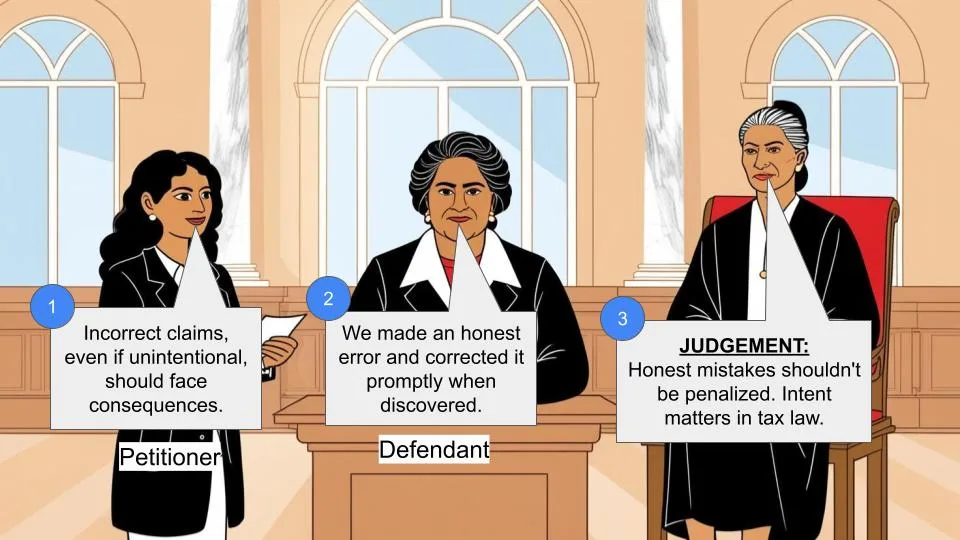
This case involves a dispute between the Commissioner of Income Tax and Himachal Agro Foods Ltd. The main issue was whether a penalty under Section 271(1)(c) (of Income Tax Act, 1961) should be imposed on the company for claiming an incorrect deduction under Section 80-IB (of Income Tax Act, 1961). The court ruled in favor of the assessee (Himachal Agro Foods Ltd.), dismissing the penalty on the grounds that the mistake was not deliberate concealment or furnishing of inaccurate income particulars.
Case Name**: COMMISSIONER OF INCOME TAX VS HIMACHAL AGRO FOODS LTD. **Key Takeaways**: 1. Honest mistakes in tax calculations, even if they result in incorrect claims, may not warrant penalties under Section 271(1)(c) (of Income Tax Act, 1961). 2. The court emphasized the importance of distinguishing between deliberate concealment and bona fide errors. 3. The burden is on the Revenue to prove deliberate concealment or inaccuracy in income reporting. **Issue**: Was the Income Tax Appellate Tribunal (ITAT) justified in deleting the penalty imposed under Section 271(1)(c) (of Income Tax Act, 1961), when the assessee company had furnished inaccurate particulars of its income in the original return and admitted the mistake by filing a revised return only after the defect was pointed out by the department? **Facts**: 1. Himachal Agro Foods Ltd. filed a return for the assessment year 2003-04 on 1.12.2003, declaring NIL income. 2. The company claimed 100% deduction under Section 80-IB (of Income Tax Act, 1961) in the original return, whereas it was only entitled to 30% deduction. 3. The mistake was discovered during scrutiny, and the assessee revised the return on 24.3.2005, declaring an income of Rs. 10,04,200/- and claiming Rs. 4,30,371/- as deduction under Section 80-IB (of Income Tax Act, 1961). 4. The Assessing Officer initiated penalty proceedings under Section 271(1)(c) (of Income Tax Act, 1961) for furnishing inaccurate particulars of income. 5. The Commissioner of Income Tax (Appeals) accepted the assessee's appeal and deleted the penalty. **Arguments**: Revenue's Argument: - The assessee deliberately concealed income particulars by claiming wrong deductions. Assessee's Argument: - The mistake was bona fide and resulted from a misunderstanding of which five years the company was entitled to deduction under Section 80-IB (of Income Tax Act, 1961). **Key Legal Precedents**: 1. Hindustan Steel Ltd. vs. State of Orissa (1972) 83 ITR 26 (SC): The Supreme Court held that penalty is not imposable if there is no conscious breach of law. **Judgement**: The High Court dismissed the Revenue's appeal and upheld the ITAT's decision to delete the penalty. The court reasoned that: 1. The main dispute was about the calculation of the number of years for deduction, which doesn't indicate deliberate concealment. 2. Even if the assessee's counsel made a bona fide mistake in calculations, it doesn't warrant a penalty. 3. The Tribunal found that the Revenue failed to pinpoint any specific defect in the CIT(A)'s conclusions. **FAQs**: 1. Q: What was the main issue in this case? A: The main issue was whether a penalty should be imposed on the assessee for claiming an incorrect deduction under Section 80-IB (of Income Tax Act, 1961). 2. Q: Why did the court rule in favor of the assessee? A: The court found that the mistake in calculation was not a deliberate attempt to conceal income, but rather a bona fide error. 3. Q: What is the significance of this judgment for taxpayers? A: This judgment suggests that honest mistakes in tax filings, especially in complex matters like deduction calculations, may not result in penalties if the taxpayer can demonstrate the error was not intentional. 4. Q: Does this mean all mistakes in tax filings will be excused? A: No, the judgment doesn't provide blanket protection for all errors. Each case would be evaluated on its merits, considering factors like the nature of the mistake and the taxpayer's conduct. 5. Q: What should taxpayers learn from this case? A: While honest mistakes may be forgiven, it's crucial to be diligent in tax filings and promptly correct any errors discovered, as the assessee did in this case by filing a revised return.

1. The Revenue has filed the present Appeal under Section 260A (of Income Tax Act, 1961)(for short ‘the Act’) against the order of the Income Tax Appellate Tribunal, Chandigarh , Bench ‘B’ Chandigarh (for short ‘the Tribunal’), dated 30.7.2007 passed in ITA No.245/CHANDI/2007 for the Assessment Year 2003-04 raising the following substantial question of law: -
“Whether on the facts and in the circumstances of the case, the Hon'ble ITAT is justified in law in deleting the penalty imposed u/s 271(1)(c) (of Income Tax Act, 1961), when the assessee company had deliberately furnished inaccurate particulars of its income in the original return and had admitted the mistake by filing the revised return only after the defect was pointed out by the department ?
The assessee-company filed its return of income for the assessment year 2003-04 on 1.12.2003 declaring NIL income which was processed under Section 143(1)(a) (of Income Tax Act, 1961) on 11.3.2004. Thereafter, the case was selected for scrutiny. It was found that the assessee had claimed 100 % deduction under Section 80 (of Income Tax Act, 1961) IB of the Act in the original return, whereas the company was entitled to only 30 % deduction as per the said provisions. It was admitted by the assessee that the deduction under Section 80 (of Income Tax Act, 1961) IB of the Act was being claimed wrongly by mistake. Thereafter, the assessee revised the return on 24.3.2005 declaring income of Rs.10,04,200/- and claimed Rs.4,30,371/- as deduction under Section 80 (of Income Tax Act, 1961) IB and thereafter the assessment was completed. The Assessing Officer also initiated penalty proceedings under Section 274 (of Income Tax Act, 1961) read with Section 271(1)(c) (of Income Tax Act, 1961) against the assessee. Vide order dated 28.9.2006, the Income Tax Officer, Ward-1(2) Chandigarh imposed the penalty under Section 271(1)(c) (of Income Tax Act, 1961) for furnishing inaccurate and concealing particulars of income. The said order of penalty was challenged by the assessee by filing appeal before the Commissioner of Income Tax (Appeals), Chandigarh(for short the “CIT(A)”) on the ground that the mistake committed by the assessee was bonafide and therefore, the assessee cannot be penalized under the provisions of Section 271(1)(c) (of Income Tax Act, 1961). The CIT(A) vide his order dated 18.12.2006 accepted the appeal and deleted the penalty.
Aggrieved against the said order, the Revenue filed the appeal before the Tribunal raising the plea that the assessee had deliberately concealed the particulars of income as the assessee had claimed wrong deduction and therefore, the penalty proceedings were rightly initiated against the assessee. However, the appeal of the Revenue was dismissed by the Tribunal holding that no definite finding has been recorded by the Assessing Officer that there is a concealment of income by the assessee and it was merely a case of a wrong claim under mistaken belief as to which five years, the assessee was entitled to deduction under Section 80 (of Income Tax Act, 1961) IB of the Act and it was a debatable issue. We have heard Shri S.K.Garg Narwana, Advocate, learned counsel for the Revenue. The facts of the case are not in dispute. The assessee was entitled to 100 % deduction under section 80 (of Income Tax Act, 1961) IB of the Act for five assessment years beginning with the initial assessment year of the profits and gains derived from such an industrial undertaking. As per certificate No.1978 dated 6.3.2002 issued by the District Industries Centre, Solan, which was attached with the return of income, the unit commenced manufacturing of the goods w.e.f. 28.3.1998 i.e., 3 days of the Financial Year 1997-98(Assessment Year 1998-99) and the assessee has taken deduction under Section 80 (of Income Tax Act, 1961) IB inadvertently taking the first assessment year of exemption starting from 1999-2000 and the said mistake was a bonafide mistake committed by the Chartered Accountant of the assessee who has duly audited the return. The scope of reasonable cause/bonafide mistake has been debated upon in a catena of judgments. The Hon'ble Apex Court in the case of M/s Hindustan Steel Ltd. Vs. State of Orissa (1972) 83 ITR 26 (SC) has categorically held that penalty is not imposable if there is no conscious breach of law. In the present case, since the main dispute was for calculation of number of years, it cannot be said that the assessee deliberately concealed the particulars of income or furnished inaccurate particulars of income and even if it is presumed that the counsel for the assessee made a bonafide mistake in calculation of such assessment years, still it can be said that no penalty should be imposed upon the assessee for the mistake of his counsel. Even otherwise, the Tribunal has given a specific finding that the Revenue has failed to pin point any specific defect in the conclusions of the CIT(A).
Thus, in view of the aforesaid finding of facts given by the Tribunal, we are not inclined to interfere in the order of the Tribunal. No question of law arises in the appeal and the same is hereby dismissed.
(RAKESH KUMAR GARG)
JUDGE
April 3,2008 (SATISH KUMAR MITTAL)
JUDGE
×
Questions
Court Dismisses Penalty on Taxpayer for Honest Mistake in Deduction Claim
Write your CommentSimilar Posts

Generic
- Reportdata/4705.pdf
