


Court Dismisses Writ Petition; Assessee Must Explain Tax Disallowance







Full News
Court Dismisses Writ Petition; Assessee Must Explain Tax Disallowance
Court Dismisses Writ Petition; Assessee Must Explain Tax Disallowance
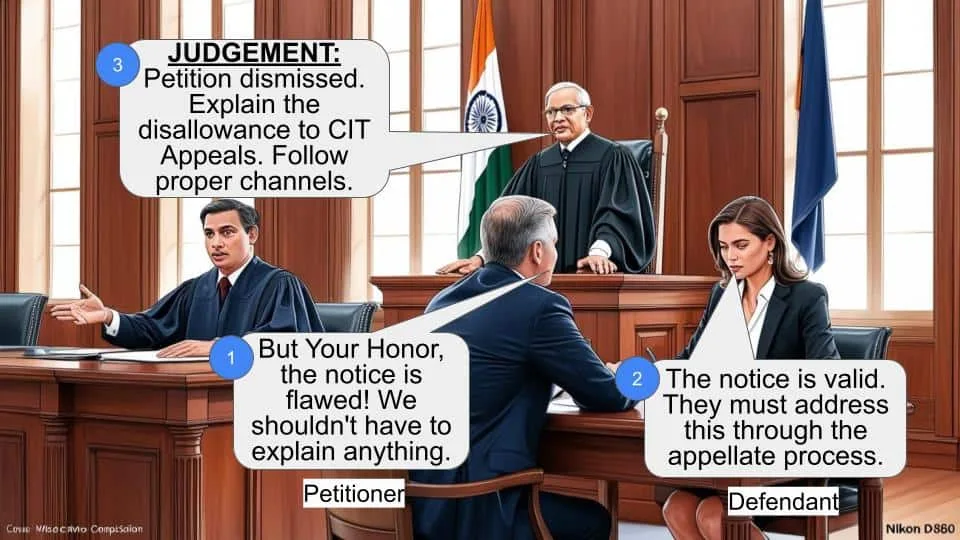
In the case of Megatrends Inc vs. Commissioner of Income Tax, the High Court dismissed a writ petition challenging a show cause notice for tax assessment enhancement. The court ruled that the assessee should present their explanation to the Commissioner of Income Tax (Appeals) regarding the disallowance of a specific expenditure amount from their taxable income.
Get the full picture - access the original judgement of the court order here
Case Name
Megatrends Inc vs. Commissioner of Income Tax (High Court of Madras)
W.P.No.37072 of 2015 and M.P.No.1 of 2015
Date: 11th February 2016
Key Takeaways
- The court emphasized the importance of addressing tax disputes through the appropriate appellate channels rather than through writ petitions.
- The decision reinforces the powers of the Commissioner of Income Tax (Appeals) to assess and decide on tax matters.
- The case highlights procedural adherence in tax assessments and the necessity for the assessee to provide explanations for disallowed expenditures.
Issue
Should the writ petition challenging the show cause notice for tax assessment enhancement be dismissed, requiring the assessee to explain the disallowed expenditure to the CIT (Appeals)?
Facts
- Megatrends Inc, a partnership firm, filed a return for the Assessment Year 2012-2013, which was processed and selected for scrutiny.
- The firm was issued a show cause notice to explain why an amount of Rs. 96,60,000 should not be disallowed as an expenditure and added back to their taxable income.
- The firm filed a writ petition to quash this notice, arguing procedural issues and questioning the validity of the notice.
Arguments
- Petitioner (Megatrends Inc): Argued that the show cause notice was procedurally flawed and sought to quash it through a writ petition.
- Respondent (Commissioner of Income Tax): Maintained that the notice was valid and within legal bounds, urging the petitioner to address the issue through the appellate process.
Key Legal Precedents
- The court referenced the powers under Section 251(1)(a) (of Income Tax Act, 1961) of the Income Tax Act, which allows the appellate authority to enhance assessments.
- The case of Dulichand Laxminarayan vs. Commissioner of Income Tax (1956) 29 ITR 535 (SC) was cited regarding the validity of partnership firms and the number of partners.
Judgement
The High Court dismissed the writ petition, stating that the petitioner should submit their explanation to the CIT (Appeals) and contest the disallowance on its merits. The court found no merit in the writ petition and emphasized the proper procedural route through the appellate process.
FAQs
Q: Why was the writ petition dismissed?
A: The court found that the petitioner should address the issue through the appellate process rather than a writ petition, which is not the appropriate channel for such disputes.
Q: What does this mean for Megatrends Inc?
A: Megatrends Inc must now provide an explanation to the CIT (Appeals) regarding the disallowed expenditure and contest the issue on its merits.
Q: What is the significance of Section 251(1)(a) (of Income Tax Act, 1961) in this case?
A: Section 251(1)(a) (of Income Tax Act, 1961) grants the appellate authority the power to enhance assessments, which was a key point in the court’s decision to dismiss the writ petition.

1. The petitioner has filed the above writ petition to issue a Writ of Certiorari to call for the records and quash the impugned show cause notice for enhancement of assessment issued by the first respondent in ITA No.83/2015-16 (wrongly mentioined as ITA No.85/2015-16) dated 6.11.2015 for the assessment year 2012-13.
2. According to the petitioner, it is a Partnership Firm trading in stocks, shares, debentures, manufacturing, buying, selling and transporting of various consumer and industrial commodities. The petitioner filed its Return for Assessment Year 2012-2013 on 29.09.2012, admitting a total income of Rs.1,74,36,050. The Reutrn of Income was processed under Sec.143(1) (of Income Tax Act, 1961), 1961 and selected for scrutiny. Many details were called for and after considering the details, submitted and explanations given, the Assessment Order under Sec.143(3) (of Income Tax Act, 1961), was passed on 30.03.2015 by the second respondent. The second respondent disallowed donations made under Section 35(1)(ii) (of Income Tax Act, 1961) to the tune of Rs.2,62,50,000/- and asessed the income of the assessee at Rs.4,36,86,050/-. Aggrieved over the Order passed by the second respondent, they preferred an appeal against the Order passed by the second respondent before the first respondent on 5.5.2015.
3. On 26.10.2015, the first respondent issued a Notice posting the appeal for hearing on 29.10.2015. This Notice was received by the petitioner on 28.10.2015. The petitioner sought time till the fourth week of November 2015 for submitting the reply and other submissions. However, the first respondent rejected the request on 3.11.2015 and posted the hearinig again on 6.11.2015. Again, this Notice was received by the petitioner only on 5.11.2015. The petitioner again submitted that the appeal be posted for hearing in the fourth week of November 2015.
4. The first respondent again rejected the request of the petitioner and issued the impugned Notice on 6.11.2015, posting the appeal for hearing on 18.11.2015. The Notice was received by the petitioner only on 14.11.2015. In the impugned notice, the first respondent has also required the petitioiner to show cause why the assessment of the petitioner should not be enhanced, pointing out that a partnership firm could not be a partner in a firm, as indicated in the case of the petitioner and hence the petitioner was to be assessed as an AOP and not a firm.
5. According to the petitioner, in the parptnership deed, the two individuals are partners on behalf of the smaller firms, which is an accepted practice in law. The petitionier has quantified the investment and the remuneration, to be received by each of the partners in the Annexure to the Partnership Deed dated 1.4.2011. Further, according to the petitioner, the perusal of the assessment orders of the petitioner in the previous years will show that the respondents have accepted the constitution of the firm.
6. According to the first respondent, under Sec.11(2) of the Companies Act, 1956, no Company, Association or Partnership consisting of more than twenty persons shall be formed for the purpose of carrying on any other business that has for its object the acquisition of gain by the company, assocaition or partnership or by the individual members thereof, unless it is registered as a company under this Act, or is formed in pursuance of some other Indian law. Further, the first respondent contended that on verification of the records, it was found that two firms viz., M/s Krupa Trading Co, having six partners and M/s DCP Trading Co., also having six partners were the 14th and 15th partners in the petitioner firm, consisting of 16 partners. The first respondent further submitted that since all the partners in both the above firms were not representing in the petitioner firm and only one of the partners each represented their respective firm, and therefore, the petitioner cannot be considered to be a valid partnership firm, as per the law laid down by the Hon'ble Supreme Court of India in the case of Dulichand Laxminarayan vs Commissioner of Income-Tax (1956) 29 ITR 535 (SC). Therefore, according to the first respondent, the partnership deed of the two firms shows that they are having six partners each and therefore, as per the law, the total number of partners in the present case exceeds twenty, which is beyond the maximum number of partners presecribed and therefore, the petitioner firm is not a valid partnership firm under the eyes of law.
7. The first respondent also contended that the impugned show cause notices were issued under Sec.251(1)(a) (of Income Tax Act, 1961) and Sec.251(1)(a) (of Income Tax Act, 1961) sets out various powers, which can be exercised by the appellate authority in appeal against different orders. Under the said section, the appellate authority while deciding an appeal, is clothed with very wide power so as to do justice to the assessee and also in the interest of the Revenue. Further, according to the first respondent, the impugned notices are well within the four corners of law and therefore are valid. 8. Ms. T.C.A. Sangeetha, learned counsel appearing for the petitioner, in support of her contention, relied upon an unreported judgment of the Jharkhand High Court in W.P.(T) No.1293 of 2013 etc batch (M/s Central Coalfields Limited vs Commissioner of Income Tax (Appeals), Ranchi, wherein the Division Bench of Jharkhand High Court held as follows:
"13. By perusal of the above, it appears that the CIT (Appeals) has not only expressed the doubt regarding the status of the petitioner-company but also expressed the view that the petitioner is not a company and the petitioner has been incorrectly and unlawfully assessed in the status of a company. We are of the view that the CIT (Appeals), by expressing the reasoning, indicates that CIT (Appeals) has predetermined the matter that the petitioner-CCL is not a company, had committed a serious error and exceeded jurisdiction in upsetting the settled status of the petitioner- company."
9. Mr.T. Pramod Kumar Chopda, learned counsel appearing for the first respondent, in support of his contention relied upon a judgment of the Full Bench of this Court reported in 51 STC 381 (State of Tamil Nadu vs Arulmurugan and Company), wherein, the Full Bench of this Court held as follows:
We accept the contention of the learned Government Pleader that the assessing authority, as the prescribed authority, has the power to allow further time to file C forms under the proviso to section 8(4) of the Central Sales Tax Act. Likewise, we accept the position that under the proviso to rule 12(7) of the Central Sales Tax (Registration and Turnover) Rules, 1957, the first assessing authority is invested with the power to allow further time for filing C forms. We do not, however, accept the implication in the Government Pleader's further contention that an appellate authority cannot be brought within the meaning of the expression "assessing authority". In one sense, an appeal may be different from an assessment. But the difference lies only in the particular stage of the proceeding and in the particular authority having jurisdiction in the two stages. Basically, an appeal does not differ from an assessment. Just as is the case with any other appeal under our legal system, an appeal from a sales tax assessment is only a rehearing or a retrial. In the absence of any statutory inhibitions or restrictions, an appellate authority has precisely the same powers, exercisable or in the same manner and to the same extent, as the assessing authority has, in the first instance. If this were not the position, no appellate authority can effectively function while hearing and determining an appeal from an assessment. Under the scheme of section 9 of the Central Sales Tax Act, appeals from Central sales tax assessments will have to be dealt with in the same manner and under the same procedure as provided for under the general sales tax law of the concerned State. The jurisdiction of an appellate authority under the Tamil Nadu General Sales Tax Act, 1959, includes the power to confirm, reduce, enhance, or annual, the assessment. It also includes the power to set aside the assessment with a direction to the assessing authority to make a fresh assessment, and also to pass any other order which the appellate authority may think fit.
These powers, which are of the widest amplitude, are expressly conferred both on the Appellate Assistant Commissioner and on the Appellate Tribunal, vide sections 31 and 36 of the Tamil Nadu General Sales Tax Act, 1959. The provisions show clearly that the power of the appellate authority concerning an assessment under appeal is no different, and not less wide, than the power of the assessing authority to make the assessment in the first instance. Besides, such power as the appellate authority is empowered to exercise in relation to an assessment under appeal, has got to be exercised only in the same manner and subject to the same conditions, if any, which govern the exercise of the power of assessment by the assessing authority in the first instance. It follows, therefore, that whatever discretion is conferred on the assessing authority for purposes of assessment must so be regarded, as a matter of statutory construction, to have been conferred on the appellate authority even without the concerned statutory provision expressly naming the appellate authority in that behalf. It goes without saying that an appellate authority, engaged as it is in precisely the same task under the fiscal statute as that of the assessing authority must also be possessed to like powers as those of the assessing authority. It is implicit in the very nature of the appellate jurisdiction, as well as the purposes for which that jurisdiction is created by the statute, that the appellate authority will have to function, in the very image of the assessing authority. Appellate proceedings are often truly described as an extension of the assessment proceedings, or as a continuation of the assessment proceedings. In this context, therefore, it does not matter that a power is conferred, by any provision in the taxing statute or in the statutory rules, eo nomine on the assessing authority, and is silent about the appellate authority or any other authority under the Act. Since the enabling section, or the rule, as the case may be, expressly refers to the assessing authority, as the repository of the power, it is elementary construction to hold that such power can be, and is intended to be, exercised by the assessing authority named in the particular provision concerned. But, it does not mean that the appellate authority and any other fiscal authority who are in seisin of the assessment, either in appeal, or in revision or in any other proceeding, cannot exercise a like power. The fact that the appellate authority is not expressly mentioned in the provision conferring the enabling power, does not mean that the legislature intended to exclude that authority from the purview of the provision.
10. In the judgment relied upon by the learned counsel for the petitioner, the Commissioner of Income Tax (Appeals) directed the petitioner Company therein to show cause as to why the provisions of Sec.251(1)(a) (of Income Tax Act, 1961) should not be invoked for the Assessment Years 2002-03, 2003-04, 2004-05, 2005-06, 2006-07, 2007-08, 2008-09, 2009-10 and the income liable to tax should not be enhanced and why the books of accounts of the petitioner Company should not be rejected and also directed the petitioner Company to show the status of the petitioner as a Company. When the petitioner Company therein were enjoying the status of the Company over several decades, on such circumstances, the Jharkhand High Court held that the CIT (Appeals) is not justified in raising doubt about the status of the petitioner Company and the respondent therein cannot contend that the show cause notice has been issued as only for verification exercise.
11. Since the CIT (Appeals) has expressed the doubts that the petitioner is not a Company and is seeking to reopen assessment of the petitioner company over the years, the Division Bench were of the view that the impugned show cause notices are in excess of jurisdiction and are liable to be quashed. However, the Jharkhand High Court gave liberty to to the CIT (Appeals) to issue a fresh show cause notice in accordance with law.
12. In the case on hand, the Notice under Sec.2561(1) (of Income Tax Act, 1961), issued to the petitioner on 6.11.2015 is in respect of the pending appellate proceedings for the Assessment Year 2012-13 and therefore, the judgment, relied upon by the learned counsel for the petitioner is not applicable to the present case.
13. In the show cause notice dated 6.11.2015, the respondent had called upon the petitioner to show cause as to why the amount of Rs.96,60,000/- may not be disallowed as expenditure and added back to the petitioner's taxable income for the relevant year, which is under consideration. By the impugned show cause notice, the respondent had called upon the petitioner to submit his explanation on or before 18.11.2015. Since the petitioner have to explain as to why the said amount may not be disallowed as expenditure and added back to the taxable income of the petitioiner, they can very well submit their explanation and contest the same, on merits and in accordance with law befoer the CIT (Appeals).
14. In these circumstances, I do not find merits in the writ petition, which is liable to be dismised. However, I give liberty to the petitioner to submit their explanation before CIT (Appeals) and make their submissions with regard to the query, raised in the impugned show cause notice dated 06.11.2015. After receiving the explanation and hearing the submissions on behalf of the petitioner, the CIT (Appeals) is directed to pass orders, on merits and in accordance with law.
15. With these observations, the writ petition is dismissed. No costs. Consequently, connected MP is closed.
-s/d-
Assistant Registrar
Sub-Assistant Registrar https://hcservices.ecourts.gov.in/hcservices/
To
1. The Commissioner of Income Tax, Appeals-4 121, Mahatma Gandhi Road, Chennai – 600 034
2. The Assistant Commissoner of Income Tax, Non Corporate Circle 3, 121, Mahatma Gandhi Road, Chennai-600 034
×
Similar Ripples
Questions
Court Dismisses Writ Petition; Assessee Must Explain Tax Disallowance
Write your CommentSimilar Posts
Generic
- Reportdata/3102.pdf
