


Court Limits Tax Reassessment Power: "Tangible Material" Required for Reopening…



Full News
Court Limits Tax Reassessment Power: "Tangible Material" Required for Reopening Beyond 4 Years
Court Limits Tax Reassessment Power: "Tangible Material" Required for Reopening Beyond 4 Years
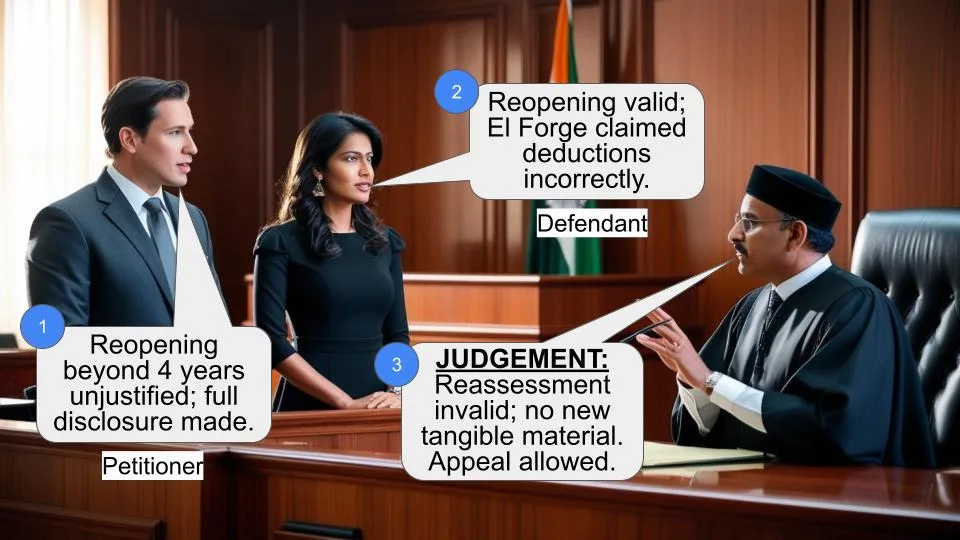
A company called El Forge Ltd. challenged the Income Tax Department's decision to reopen their tax assessment from way back in 1989-90. The tax folks tried to reassess after more than four years, which is usually a no-go. The court ended up siding with El Forge, saying the tax department didn't have good enough reasons to reopen such an old case.
Get the full picture - access the original judgement of the court order here
Case Name:
El Forge Ltd. vs Deputy Commissioner of Income Tax (High Court of Madras)
Tax Case (Appeal) No.2147 of 2006
Date: 1st October 2012
Key Takeaways:
1. Tax authorities can't just reopen old assessments on a whim - they need solid, "tangible material" to do so.
2. There's a 4-year time limit on reopening assessments, which can only be extended if the taxpayer didn't fully disclose all necessary info.
3. The concept of "change of opinion" is an important check on the tax department's power to prevent abuse.
4. Taxpayers who've been honest and thorough in their disclosures have some protection against old cases being dug up.
Issue:
The main question here was: Can the Assessing Officer (AO) reopen a tax assessment beyond the 4-year limit when the taxpayer had already disclosed all necessary information?
Facts:
1. El Forge Ltd. filed their taxes for the 1989-90 assessment year.
2. The AO initially assessed their taxes under Section 143(1)(a) (of Income Tax Act, 1961) on December 31, 1991.
3. Later, the AO noticed that El Forge had claimed some deductions (under Sections 80HH (of Income Tax Act, 1961) and 80I) before setting off previous losses.
4. The AO decided this wasn't correct and wanted to reopen the assessment.
5. They issued a notice under Section 148 (of Income Tax Act, 1961) to reopen the case on December 15, 1997 - more than 4 years after the original assessment.
6. El Forge said, "Hold up, you can't do that after 4 years!" but the tax department disagreed.
7. The case went through appeals, with lower authorities siding with the tax department, before reaching the High Court.
Arguments:
El Forge's side:
- "We disclosed everything back then. You can't reopen after 4 years just because you changed your mind!"
- "There's no new information here. You had all the facts when you first assessed us."
Tax Department's side:
- "El Forge didn't disclose everything fully and truly. We have the right to reassess."
- "They claimed deductions incorrectly, so we need to fix this."
Key Legal Precedents:
The big one here is Commissioner of Income Tax v. Kelvinator of India Ltd. (2010) 320 ITR 561. This case is super important because:
1. It said the AO needs "tangible material" to reopen an assessment after April 1, 1989.
2. It emphasized that "change of opinion" shouldn't be a reason to reopen old cases.
3. It highlighted that the words "reason to believe" in Section 147 (of Income Tax Act, 1961) are crucial to prevent arbitrary reopening of assessments.
The court also mentioned Circular No. 549 dated October 31, 1989, which explains why the phrase "reason to believe" was reintroduced into the law.
Judgement:
Good news for El Forge! The High Court said:
1. The AO didn't have good enough reasons to reopen the assessment after 4 years.
2. El Forge had disclosed all the necessary info in their original assessment.
3. The tax department couldn't prove that El Forge failed to disclose any material facts.
4. Even if El Forge might have made a mistake in their deductions, that alone isn't enough to reopen such an old case.
5. The court set aside the earlier decisions and allowed El Forge's appeal.
FAQs:
1. Q: Does this mean tax assessments can never be reopened after 4 years?
A: Not exactly. They can be reopened if there's solid proof the taxpayer hid information.
2. Q: What's this "tangible material" the court talks about?
A: It's concrete evidence or information, not just a change in how the tax officer interprets the same old facts.
3. Q: Does this apply to all tax years or just old ones?
A: This principle applies to all cases, but the 4-year limit is especially important for older assessments.
4. Q: What should taxpayers learn from this?
A: Always disclose everything fully and keep good records. It can protect you from reassessments years down the line.
5. Q: Can the tax department appeal this decision?
A: Potentially, yes. They could try to take it to the Supreme Court if they believe there's an important legal question to be resolved.

1. The assessee is on appeal in respect of the assessment year 1989-90. The following are the substantial questions of law raised for consideration at the time of admission of this Tax Case Appeal:
1. Whether on the facts and circumstances of the case the Appellate Tribunal was right in law in holding that reopening of assessment u/s 147 (of Income Tax Act, 1961) beyond 4 years is valid?
2. Whether the Appellate Tribunal was right in law in holding that assessee failed to disclose fully and truly all material facts when the original assessment was made u/s. 143(3) (of Income Tax Act, 1961) after making all relevant and detailed inquiries?
3. Whether the Appellate Tribunal was right in law in holding that Explanation 1 to Section 147 (of Income Tax Act, 1961) are attracted in the present case?
4. Whether the Appellate Tribunal was right in law in holding that deduction under Chapter VI-A has to be allowed on the profits of eligible units after deducting therefrom the losses of other eligible units?
2. The Assessing Officer made an order of assessment under Section 143(1)(a) (of Income Tax Act, 1961) on 31.12.1991. Thereafter, he noticed that the assessee had claimed deduction under Section 80HH (of Income Tax Act, 1961) and 80I of the Income Tax Act on the total income before first setting off the unabsorbed losses of the earlier years. Therefore, according to the Assessing Officer, as the assessee was not entitled to deduction under Chapter VIA of the Income Tax Act, the assessment was reopened under Section 147 (of Income Tax Act, 1961) by issuance of notice under Section 148 (of Income Tax Act, 1961). The assessee objected to the reopening of the assessment by contending that as the said reopening was made after the lapse of four years from the date of assessment under Section 143(3) (of Income Tax Act, 1961), the reopening was not valid and there was no failure on the part of the assessee to disclose all material facts necessary for making the assessment. Therefore, the said reopening of assessment was challenged by the assessee before the First Appellate Authority.
3. The First Appellate Authority rejected the claim of the assessee and consequently dismissed the appeal by holding that the reopening of the assessment by the Assessing Authority was perfectly in order, against which, the assessee filed an appeal before the Income Tax Appellate Tribunal.
4. The Tribunal, after holding that the assessee did not disclose fully and truly all material facts, concurred with the finding of the Assessing Officer as well as the First Appellate Authority and consequently justified the reopening of assessment. Thus the Tribunal viewed that the reopening of the assessment was well within the period as provided for under the proviso to Section 147 (of Income Tax Act, 1961). Aggrieved by this, the assessee has come on appeal before us.
5. A perusal of the notice issued under Section 147 (of Income Tax Act, 1961) dated 15.12.1997 shows that there were no independent reasons disclosed therein for assessment under Section 147 (of Income Tax Act, 1961). In the course of the proceedings before the Assessing Officer, the assessee objected to the proceedings of reopening. The order dated 16.04.1998, passed under Section 148 (of Income Tax Act, 1961), shows that the assessee claimed deduction under Section 80HH (of Income Tax Act, 1961) and 80I on the total income before set off of unabsorbed losses of the earlier years. It is not denied by the assessee that the income was negative and the resultant on the above setting off of the unabsorbed loss is the negative figure. It is no doubt true that the assessee would not be entitled to deduction under Chapter VIC. However, as rightly pointed out by the learned counsel appearing for the assessee, with no reasons disclosed on the reopening of the assessment and that there is no denial of the fact that the details of the income computation being very much before the Assessing Officer, the assessee took the plea of reopening of the assessment not disclosing the materials as contemplated under Section 147(1) (of Income Tax Act, 1961). The time limit for invoking the jurisdiction under Section 147 (of Income Tax Act, 1961) being four years, the proceedings were time barred.
6. In the decision reported in [2010] 320 ITR 561 (Commissioner of Income Tax Vs. Kelvinator of India Ltd.), the Apex Court considered the scheme of Section 147 (of Income Tax Act, 1961) both before and after amendment in 1987. On a reading of the provisions, the Apex Court observed that the expression "reason to believe" as appearing in Section 147 (of Income Tax Act, 1961) must be given a schematic interpretation, failing which, Section 147 (of Income Tax Act, 1961) would give arbitrary powers to the Assessing Officer to reopen the assessment on the basis of mere change of opinion. Pointing out that the Assessing Officer has no power to review, the Supreme Court observed as follows:
" The Assessing Officer has no power to review; he has the power to re-assess. But re-assessment has to be based on fulfillment of certain pre-condition and if the concept of "change of opinion" is removed, as contended on behalf of the Department, then, in the garb of re-opening the assessment, review would take place. One must treat the concept of "change of opinion" as an in-built test to check abuse of power by the Assessing Officer. Hence, after 1st April, 1989, Assessing Officer has power to re-open, provided there is "tangible material" to come to the conclusion that there is escapement of income from assessment. Reasons must have a live link with the formation of the belief. Our view gets support from the changes made to Section 147 (of Income Tax Act, 1961), as quoted hereinabove. Under the Direct Tax Laws (Amendment) Act, 1987, Parliament not only deleted the words "reason to believe" but also inserted the word "opinion" in Section 147 (of Income Tax Act, 1961). However, on receipt of representations from the Companies against omission of the words "reason to believe", Parliament re-introduced the said expression and deleted the word "opinion" on the ground that it would vest arbitrary powers in the Assessing Officer. We quote herein below the relevant portion of Circular No.549 dated 31st October, 1989, which reads as follows:
7.2 Amendment made by the Amending Act, 1989, to reintroduce the expression `reason to believe' in Section 147 (of Income Tax Act, 1961).--A number of representations were received against the omission of the words `reason to believe' from Section 147 (of Income Tax Act, 1961) and their substitution by the `opinion' of the Assessing Officer. It was pointed out that the meaning of the expression, `reason to believe' had been explained in a number of court rulings in the past and was well settled and its omission from Section 147 (of Income Tax Act, 1961) would give arbitrary powers to the Assessing Officer to reopen past assessments on mere change of opinion. To allay these fears, the Amending Act, 1989, has again amended Section 147 (of Income Tax Act, 1961) to reintroduce the expression `has reason to believe' in place of the words `for reasons to be recorded by him in writing, is of the opinion'. Other provisions of the new Section 147 (of Income Tax Act, 1961), however, remain the same. "
7. The facts of the case show that there was no denial of the fact that the assessee had disclosed the details as regards the carry forward of the losses as well as the income computed and all these details were very much there before the Assessing Officer; that there is no denial of the fact that there was no failure on the part of the assessee in disclosing the facts necessary for assessment and that there is no such allegation that the escapement of income was on account of the failure of the assessee in not disclosing fully and truly all material facts. In the circumstances, applying the Supreme Court decision referred to above, we have no hesitation in accepting the plea of the assessee that the assumption of the jurisdiction beyond four years is hit by limitation as provided under Section 147 (of Income Tax Act, 1961) proviso. Even though, on the merits of the assessment, the assessee's case has to fail, yet, on the limited question as regards the jurisdictional time limit as provided for under Section 147 (of Income Tax Act, 1961), the assessee is entitled to succeed. Since limitation is the fundamental aspect of the assessment, we have no hesitation in setting aside the order of the Tribunal, thereby allowing the appeal.
In the light of the above, the appeal is decided in favour of the assessee and the Tax Case Appeal stands allowed. No costs
×
Questions
Court Limits Tax Reassessment Power: "Tangible Material" Required for Reopening Beyond 4 Years
Write your CommentSimilar Posts
Generic
- Reportdata/5393.pdf
