


Full News

Court Upholds Investor Status: Share Sale Gains Treated as Capital Gains, Not Business Income
Court Upholds Investor Status: Share Sale Gains Treated as Capital Gains, Not Business Income
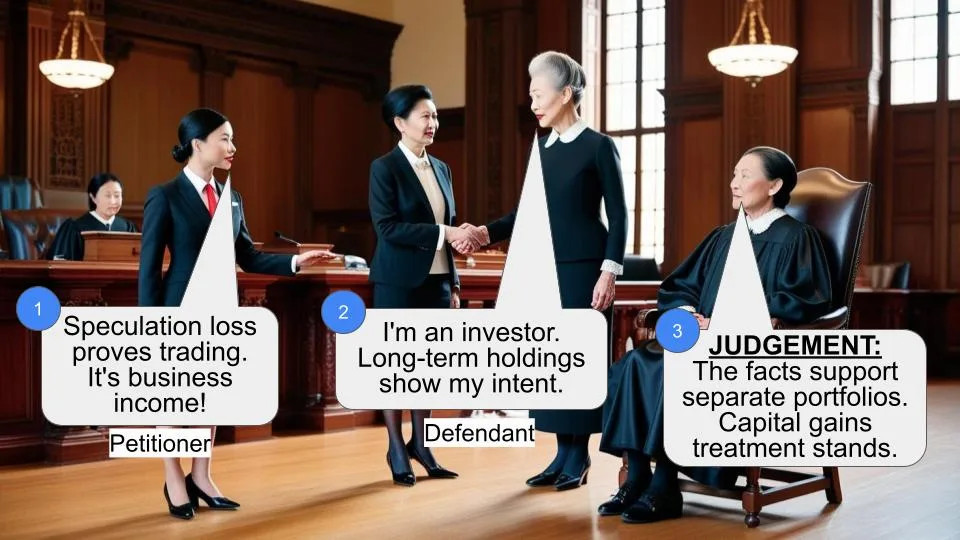
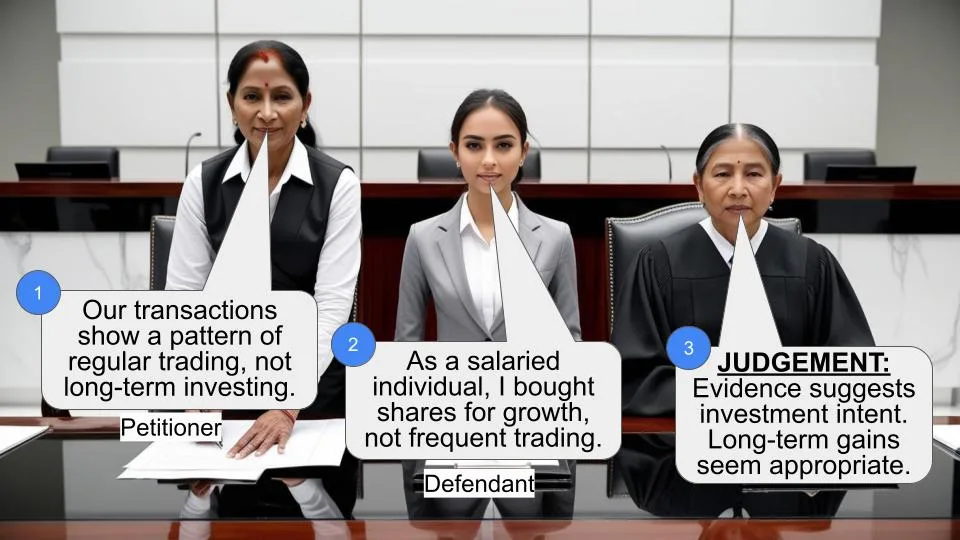
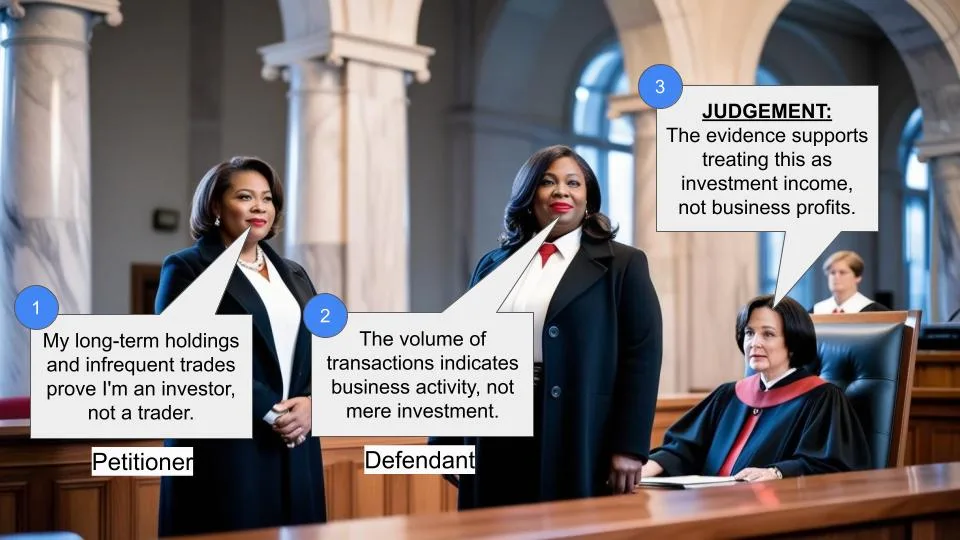
This case involves a dispute between the Revenue Department and an assessee (taxpayer) regarding the classification of income from the sale of shares. The Revenue Department argued that the gains should be treated as business income, while the assessee claimed it was capital gains. The Income Tax Appellate Tribunal (ITAT) ruled in favor of the assessee, and the High Court upheld this decision, dismissing the Revenue's appeal.
Case Name**: COMMISSIONER OF INCOME TAX VS MANISH NATHULAL LAVTI
**Key Takeaways**:
1. The intention of the assessee at the time of share purchase is crucial in determining whether it's an investment or trading activity.
2. Factors such as shareholding amount, volume, and frequency of transactions are considered when classifying income from share sales.
3. It's possible for a taxpayer to have both investment and trading portfolios, requiring separate tax treatment.
4. The CBDT circular No. 4/2007 dated 15-06-2007 provides guidance on distinguishing between investment and trading in shares.
**Issue**:
Was the Income Tax Appellate Tribunal correct in treating the gains from the sale of shares as long-term capital gains instead of business income as assessed by the Assessing Officer?
**Facts**:
1. The case pertains to the assessment year 2006-07.
2. The assessee, a salaried individual, filed a tax return showing:
- Gross total income of Rs. 3,95,001/- (including salary and Rs. 83,712/- from share trading)
- Exempt income of Rs. 53,96,468/- as long-term capital gains from share sales
3. The Assessing Officer treated the entire Rs. 53,96,468/- as business income.
4. The assessee appealed, and both the Commissioner (Appeals) and the ITAT ruled in favor of the assessee.
**Arguments**:
Revenue's Argument:
- The assessee was engaged in the business of trading shares, so the gains should be taxed as business income.
Assessee's Argument:
- The shares were held as investments, not for trading purposes.
- The majority of shares were held for a long period, resulting in long-term capital gains.
- Only a small portion (Rs. 83,712/-) was from short-term transactions.
**Key Legal Precedents**:
The judgment refers to a CBDT circular No. 4/2007 dated 15-06-2007, which examined this issue after referring to Supreme Court judgments. The circular instructs tax officers to consider the possibility of taxpayers having two portfolios: an investment portfolio and a trading portfolio.
**Judgement**:
1. The High Court dismissed the Revenue's appeal, upholding the ITAT's decision.
2. The Court agreed that the assessee's intention was to invest, not trade in shares.
3. The Court noted that only Rs. 83,712/- worth of shares were sold in the short term, while the bulk (Rs. 53,84,239/-) were held long-term.
4. The gains were correctly classified as capital gains (both short-term and long-term) rather than business income.
**FAQs**:
Q1: What's the main difference between capital gains and business income in this context?
A1: Capital gains result from the sale of investments held for a longer period, while business income comes from frequent trading activities. The tax treatment and rates can differ significantly between the two.
Q2: Why is the assessee's intention important in this case?
A2: The intention at the time of purchasing shares helps determine whether they were bought for investment (capital gains) or trading (business income) purposes. This affects how the income is classified and taxed.
Q3: Can a person have both investment and trading portfolios?
A3: Yes, according to the CBDT circular mentioned in the judgment, it's possible for a taxpayer to have both investment and trading portfolios, which would be taxed differently.
Q4: What factors did the court consider in making its decision?
A4: The court considered factors such as the assessee's status as a salaried individual, the volume and frequency of share transactions, the holding period of shares, and the proportion of short-term vs. long-term gains.
Q5: Does this judgment set a precedent for similar cases?
A5: While each case is unique, this judgment reinforces the importance of considering the taxpayer's intention and the pattern of share transactions when determining the nature of income from share sales.

1. Revenue is in appeal against the judgment of the Income Tax Appellate Tribunal ('the Tribunal', for short) dated 27-5-2011. For the assessment year 2006-07, the following questions have been presented for our consideration:-
A. Whether in the facts and circumstances of the case and in law the Ld. ITAT is right in treating the gain on sale of shares amounting to Rs.68,81,901/- as long- term Capital Gain as against business income treated by the AO?
B. Whether in the facts and circumstances of the case and in law the Ld. ITAT has erred in holding the assessee as 'Investor' and not as a 'Trader' in shares and thereby treating the resultant gain on sale of shares as 'Long Term Capital Gain?
2. The questions pertain to the issue whether the respondent assessee can be stated to be engaged in the business of trading in shares. In case of an assessee belonging to the same family, under very similar circumstances, we had upheld the Tribunal's judgment making following observations:-
“The assessee as a salaried class person had filed a return of income in which he had shown the gross total income of Rs.3,95,001/- which included his income from salary as well as a sum of Rs.83,712/- towards receipt from share trading. The assessee had also claimed as exempt income of Rs.53,96,468/- towards long term capital gain out of sale of shares. The Assessing Officer, however, held that the assessee was trading in shares and accordingly taxed the entire income of Rs.53,96,468/- as the income from profit and gains of business and profession.
The assessee carried the matter in appeal. The appellate authority took note of the circular of CBDT clarifying the position with respect to share trading/investment in shares and concluded that the Assessing Officer failed to take into account such clarification as well as the decisions of the Apex Court. He was of the opinion that looking to the material on record, it cannot be stated that the assessee was in the business of trading in shares.
Revenue, aggrieved by the decision of the Commissioner (Appeals), carried the matter before the Tribunal. The Tribunal upheld the Commissioner's view making following observations:-
“4. We have considered the rival submissions on either side and have also perused the material available on record. For the purpose of finding out the nature of transaction as to whether it is an investment or adventure in the nature of trade, one has to see the intention of the assessee at the time of purchase of the shares. The assessee is only an employee having salary income. In the return of income as seen from the assessment order, the assessee has claimed Rs.83,712 from share trading and another sum of Rs.53,84,239 as exempt income on sale of certain sales. This Rs.53,84,239 was treated by the assessing officer as business income on sale of shares. We find that the CBDT in its circular No.4/2007 dated 15-06-2007 examined this issue and after referring to the judgment of the apex court, instructed all its officers that it is possible for the taxpayer to have two portfolios, i/e/ investment portfolio. When the assessee has two portfolios, the income has to be assessed both under the head “capital gains” as well as “business income”. In this case, the assessee is a salaried employee. Therefore, the question of maintaining two portfolio does not arise for consideration. The assessee invested his funds as investment and whenever it was convenient, it was sold. The intention of the assessee at the time of purchase is very clear that it is an investment and not to trade in shares. Merely because, on one or two occasions there was also purchase and sale of shares, we cannot say that the assessee is trading in shares. The transaction as extracted by the assessing officer in the assessment order shows that the assessee never intended to trade in shares and being salaried person intended to investor. Therefore, the profit on sale shares has to be classified as capital gain either as short term capital gain or long term capital gain depending upon the period holding. Since the CIT(A) has directed the assessing officer to treat the same as capital gain we do not find any infirmity in the order of lower authority. Accordingly the same is confirmed.”
Having heard learned counsel for the revenue and having perused the documents on record, we are of the opinion that the Commissioner as well as the Tribunal concurrently found as a matter of fact that looking to the relevant factors including the amount of share holding of the assessee, the volume and the frequency of the purchase and sale of shares etc., it cannot be stated that the assessee was in the business of trading of shares. More significantly, we find that the assessee had sold shares only worth Rs.83,712/- during the year under consideration inviting short term capital gain. As against that, bulk of the shares were held by the assessee for a long period of time inviting long term capital gain for a total sum of Rs.53,84,239/-. Totality of the facts and circumstances of the case would lead to an inescapable conclusion that CIT (Appeals) as well as the Tribunal correctly applied the factual and legal position. No question of law arises. Resultantly, the tax appeal is dismissed.”
3. In the result, the tax appeal is dismissed.
( Akil Kureshi, J. ) ( Harsha Devani, J. )
×
Similar Ripples
Questions
Court Upholds Investor Status: Share Sale Gains Treated as Capital Gains, Not Business Income
Write your CommentSimilar Posts
Generic
- Reportdata/5390.pdf
