


Court Upholds Investor's Share Income as Capital Gains, Not Business Income



Full News
Court Upholds Investor's Share Income as Capital Gains, Not Business Income
Court Upholds Investor's Share Income as Capital Gains, Not Business Income
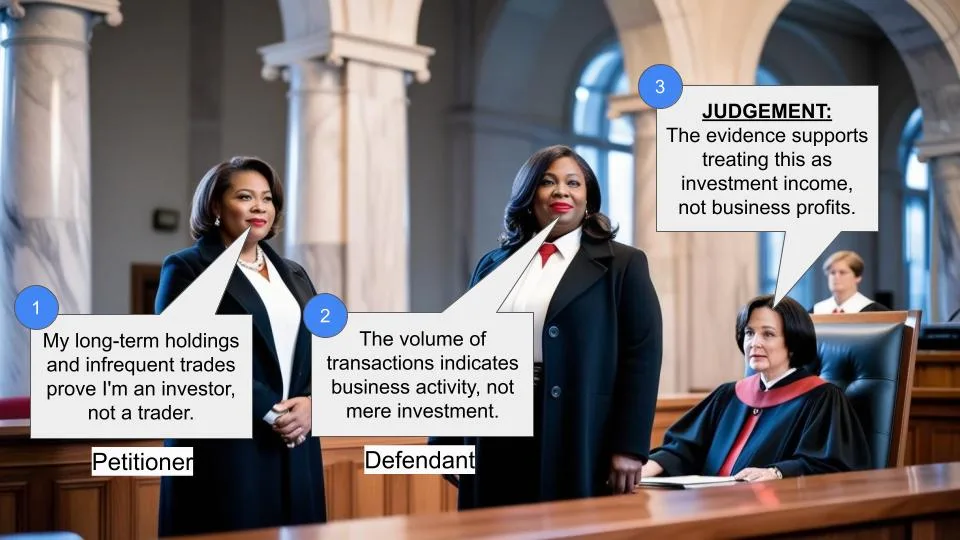
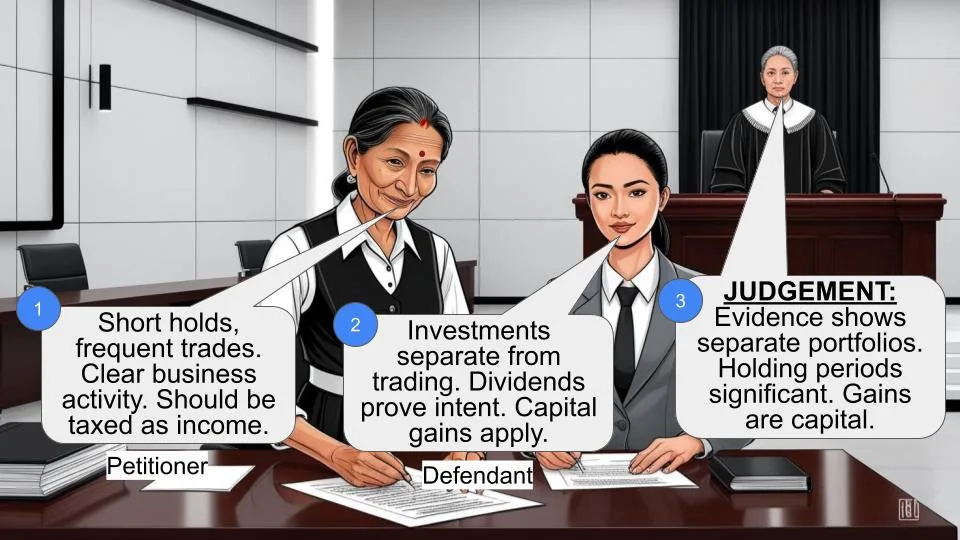
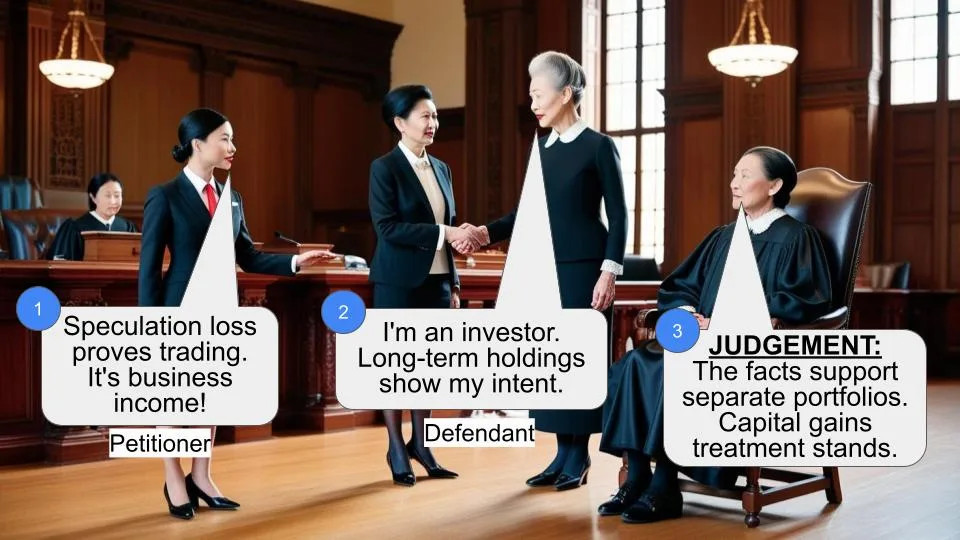
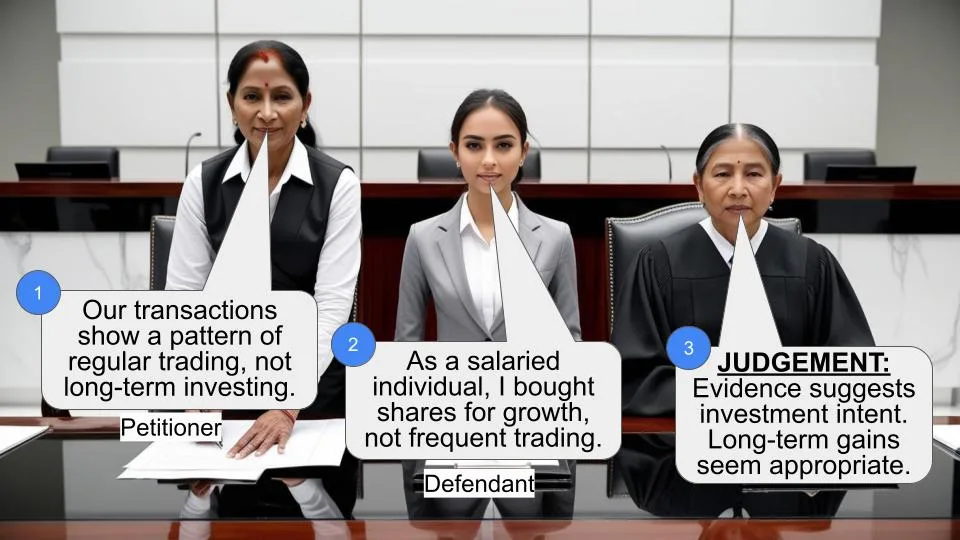
Hey there! So, we've got an interesting case here. The Income Tax Department (the Revenue) appealed against an order by the Income Tax Appellate Tribunal. The Tribunal had agreed with the taxpayer (the assessee) that their income from selling shares should be treated as capital gains, not business income. The High Court sided with the taxpayer, dismissing the Revenue's appeal. Pretty big win for the investor!
Case Name**: COMMISSIONER OF INCOME TAX VS R.F. DADABHOY **Key Takeaways**: 1. The court emphasized the importance of considering the taxpayer's intention and conduct when determining the nature of income from share transactions. 2. Long-term holding of shares and the absence of frequent trading were seen as indicators of investment rather than business activity. 3. The court highlighted that using personal funds for share purchases, rather than borrowed money, supports the classification as investment. 4. This case reinforces the principle that consistent treatment of income in previous years should be considered by tax authorities. **Issue**: The main question here was: Should the income from the sale of shares be assessed as capital gains (as claimed by the assessee) or as business income (as determined by the Assessing Officer)? **Facts**: Alright, let's break this down: 1. The assessee (our taxpayer) had been investing in shares for many years. 2. They consistently reported income from share sales under the "Capital Gains" category in previous years. 3. The assessee isn't a registered share broker and doesn't trade on any stock exchange. 4. Some shares were held for more than 5 years. 5. The assessee used their own funds to buy shares, not borrowed money. 6. They received and reported substantial dividend income from these shares. **Arguments**: The Revenue (tax department) argued: - The income should be treated as business income due to the volume of transactions. The Assessee (taxpayer) contended: - They're an investor, not a trader in shares. - The transactions were always reported as capital gains in previous years. - The shares were held for long periods, some over 5 years. - They used personal funds, not borrowed money, for investments. - Substantial dividend income was received and reported. **Key Legal Precedents**: The judgment mentions the case of Gopal Purohit Vs. JCIT 122 TTJ 87. This case emphasized the principle of consistency in tax treatment, especially considering the introduction of Securities Transaction Tax. The court noted that if the nature and method of share transactions haven't changed, the tax treatment shouldn't change either just because of new tax advantages. **Judgement**: The High Court agreed with the Income Tax Appellate Tribunal and dismissed the Revenue's appeal. Here's why: 1. They found the assessee to be an investor, not a share trader. 2. The long-term holding of shares (some for over 5 years) indicated investment intent. 3. The assessee wasn't a registered share broker and didn't engage in frequent trading. 4. The use of personal funds, not borrowed money, for share purchases supported the investment classification. 5. The court noted the lack of evidence from the Revenue to counter these points. Based on these factors, the court concluded that the income should be treated as capital gains, not business income. **FAQs**: 1. Q: What's the main difference between capital gains and business income? A: Capital gains typically come from selling investments held for a longer term, while business income comes from regular trading activities. 2. Q: Why is this decision important for investors? A: It provides clarity on how tax authorities should classify income from share transactions, potentially leading to more favorable tax treatment for long-term investors. 3. Q: Does this mean all share sales will be treated as capital gains? A: Not necessarily. The court looked at specific factors like holding period, frequency of trades, and use of personal funds. Each case would be judged on its own merits. 4. Q: What role did the Securities Transaction Tax play in this case? A: The introduction of this tax was seen as a factor supporting consistent tax treatment of share transactions, rather than changing their classification. 5. Q: How might this affect future tax assessments? A: Tax authorities may need to consider factors like holding period, investment patterns, and source of funds more carefully when determining the nature of income from share transactions.

1. The Revenue has filed this appeal calling in question the order of the Income Tax Appellate Tribunal 'C' Bench, Chennai, dated 7.2.2013 made in I.T.A.No.1029/Mds/2011 for the assessment year 2006-2007, by raising the following questions of law:
“Whether under the facts and circumstances of the case, the Tribunal was right in holding that the income of the assessee from sale of shares should be assessed under the head capital gains and not under the head business income as has been done by the Assessing Officer?
2. In a nutshell, the department is aggrieved by the order of the Tribunal confirming the order of the Commissioner of Income Tax (Appeals),who held that the income of the respondent/assessee from sale of shares should be brought under the head “capital gains” and not under the head “business” .
3. There is not much of fact to be added than what has been recorded by the Commissioner of Income Tax (Appeals) and extracted by the Tribunal in paragraph (5) of its order. We set out the same hereunder for better clarity:
“5. We have heard both sides. Perused the orders of the authorities below. The Commissioner of Income Tax (Appeals), in his order has dealt with this issue elaborately and came to the conclusion that the assessee who is working as Director in a company is only an investor and not a trader. The Commissioner of Income Tax (Appeals), while holding so, observed as under:-
'5. I have carefully considered the facts as well as the arguments of the learned Authorised Representative. have also given serious consideration to all the precedents relied on by the learned Authorised Representative. The main thrust of the argument is that the appellant has been only an investor all along and the transactions in such investments have been shown under capital gains in all the earlier years the magnitude of the transactions are not voluminous and even if they are, the same cannot be a ground for treating the activity as business in the place of investment, the transactions are delivery based transaction and no borrowed funds were used for making such investments and the plethora of decisions quoted support his plea that the income from the Long Term Capital Gains/Short Term Capital Gains should be taxed under these heads only and not treated as business income.
5.1 There is no dispute about the fact the appellant is indeed dealing in investment in shares in the past for many years and offered the same under the head Capital Gains. It is also true that the Finance Act 2004 imposed Securities Transaction Tax on sale and purchase of shares whether the assessee earns profit or not or suffers a loss and simultaneously the legislature exempted Long Term Capital Gains u/s 10(38) (of Income Tax Act, 1961) from the levy of tax and subjected to tax @ 10% on Short Term Capital Gains provided Securities Transaction Tax has been passed on such transactions. In this context the Hon'ble ITAT in the case of Gopal Purohit Vs. JCIT 122 TTJ 87 held as under in para 8.1.
5.2. 'In our view, the legislative change of this nature, whereby no change has been made in respect of nature and modus operandi of such share transactions, resulting into any advantage cannot be taken away by the Revenue Authorities in this manner and in these circumstances, we are of the view that, principle of consistency, though it is an exception to the principle res judicata must be applied here. It is further so because the payment of Securities Transaction Tax is mandatory i.e. whether an assessee earns the profit or not or suffers a loss and by imposition of such tax, the Legislature has not given any benefit to individual(s) entering into these transactions. Thus, in our view, in the facts and circumstances of the case, on the basis of principle of consistency alone, the action of the Revenue Authorities is liable to be quashed'.
Another important aspect to be considered here is that the appellant is not a share broker nor he is having a registration with any Stock Exchange. More over some of the scripts have been held for more than 5 years and it is not the case of the assessing officer that there were any derivative transactions by the appellant nor it is the case of the assessing officer that there were transactions without any delivery. The intention of the appellant cannot be read from his mind but it reflects in his conduct, the way he treats the transactions. The appellant has not borrowed any money for investing in shares and used his own surplus funds and these facts are borne out on record. Yet another aspect, as rightly stressed by the learned Authorised Representative is the fact that the appellant has received substantial dividend and that is also disclosed in the return of income filed. After considering the totality of the facts, I hold that the transaction of purchase and sale of shares by the appellant cannot be treated in the line of trading in shares nor can be treated as an adventure in the nature of trade. For the reasons given above, I hold that the entire income from the sale and purchase of shares it to be assessed under the head "Capital Gains" as rightly declared by the appellant either as Long Term Capital Gains (LTCG) or Short Term Capital Gains (LTCG) depending upon the period of holding. I therefore direct the assessing officer to accept the capital gain declared by the appellant from the sale of shares and delete the addition made treating the Long Term Capital Gains as business Income.'”
4. We are in agreement with the reasoning of the Commissioner of Income Tax (Appeals), which found favour with the Tribunal, that the assessee is only an investor in shares and he is not engaged in the activity of trading in shares. The Commissioner of Income Tax (Appeals) has gone at length into the manner in which the shares were held by the assessee for long number of years and opined that there was no indication to show that he was engaged in the activity of trading in shares as a share broker or trader. Moreover, the Department has not produced any material evidence to rebut the findings rendered by the Commissioner of Income Tax (Appeals) and the Tribunal. The fact that there was no borrowal of funds by the assessee and shares were purchased out of his own funds is borne out by records and, therefore, in our considered opinion, the Commissioner of Income Tax (Appeals) and the Tribunal were right in treating the income from sale of shares as “capital gains”.
We find, on facts, that there is no reason to interfere with the order of the Tribunal confirming the order of the Commissioner of Income Tax (Appeals). In such view of the matter, we do not find any question of law,much less substantial question of law, for consideration in this appeal and accordingly, the same is dismissed. No costs.
(R.S.J.) (R.K.J.)
29.10.2014
Index : Yes
Internet : Yes
To:
1. The Assistant Registrar, Income Tax Appellate Tribunal Chennai Bench "C", Chennai.
2. The Secretary, Central Board of Direct Taxes, New Delhi.
3. The Commissioner of Income Tax (Appeals) - V Chennai.
4. The Assistant Commissioner of Income Tax Company Circle VI(4), Chennai.
R.SUDHAKAR,J.
and
R.KARUPPIAH,J.
×
Similar Ripples
Questions
Court Upholds Investor's Share Income as Capital Gains, Not Business Income
Write your CommentSimilar Posts
Generic
- Reportdata/4455.pdf
