


Court Upholds Taxation of Industrial Shed Leases on Yearly Instalment Basis



Full News
Court Upholds Taxation of Industrial Shed Leases on Yearly Instalment Basis
Court Upholds Taxation of Industrial Shed Leases on Yearly Instalment Basis
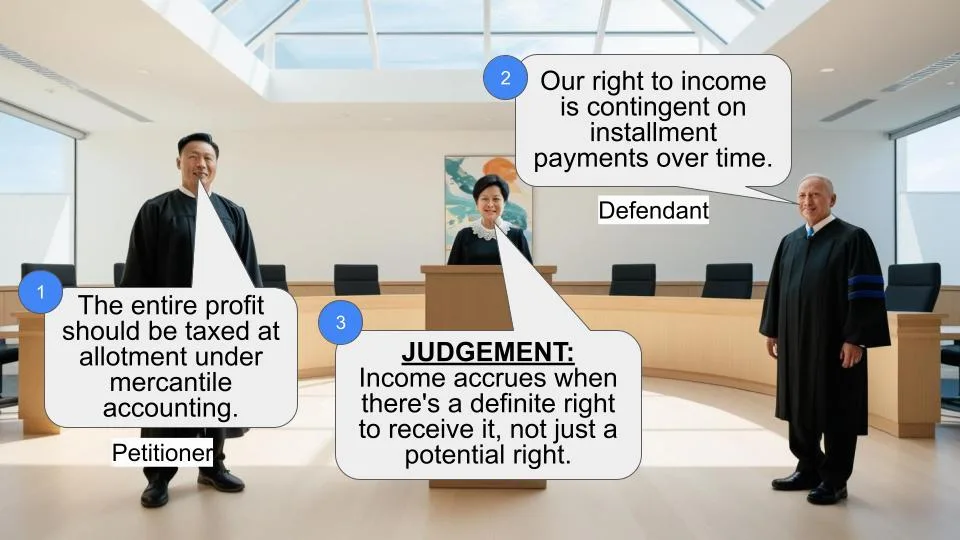
This case involves a dispute between the Commissioner of Income Tax and Chandigarh Industrial & General Development Corporation Ltd. The main issue was whether the income from leasing industrial sheds should be taxed on an accrual basis or a receipt basis. The court ruled in favor of the assessee (the Corporation), allowing income to be taxed on a receipt basis, despite the assessee following a mercantile system of accounting.
Get the full picture - access the original judgement of the court order here
Case Name:
Commissioner of Income Tax Vs Chandigarh Industrial & General Development Corporation Ltd (High Court of Punjab & Haryana)
I.T.R. No. 349 of 1995
Date: 1st November 2007
Key Takeaways:
1. Income from long-term lease agreements can be taxed on a receipt basis, even if the company follows a mercantile accounting system.
2. The court emphasized the importance of considering the actual transfer of rights and the contingent nature of payments in determining when income accrues.
3. This decision reinforces the principle that income accrues only when there is a definite right to receive it, not just a potential or contingent right.
Issue:
Whether the Income Tax Appellate Tribunal (ITAT) was correct in law in allowing the income of the assessee to be taxed on a receipt basis and not on an accrual basis, even though the assessee was following a mercantile system of accountancy.
Facts:
1. The assessee-corporation is engaged in the business of development and sale of industrial sheds.
2. They allotted industrial sheds on a 99-year lease, with 25% of the price paid at allotment and 75% payable in ten annual installments.
3. Leasehold rights were to be finally transferred after 15 years from the date of allotment.
4. The assessee declared profit on the allotment money received, while the Assessing Officer calculated profit on the entire allotment amount.
5. The Commissioner of Income Tax (Appeals) and the Tribunal ruled in favor of the assessee, leading to this case.
Arguments:
Revenue's Argument:
- The entire 15% profit on the gross capital cost of the industrial sheds should be treated as income in the year of allotment, as the assessee follows a mercantile system of accounting.
Assessee's Argument:
- The sale of industrial sheds was not complete at the time of allotment due to the terms and conditions.
- In case of default, the sheds could be resumed by the assessee.
- The right in the land was not transferred finally until the last installment was paid.
- The assessee had consistently followed this method since 1979, which had been accepted by the department.
Key Legal Precedents:
1. CIT vs. Ashokbhai Chimanbhai (1965) 56 ITR 42 (SC):
Defined when income is said to accrue or arise.
2. Municipal Corporation of Hyderabad vs. P.N. Murthy & Ors. (1987) 167 ITR 204 (SC):
Held that title passes when payment of the installment of sale price is paid by the allottee/lessee.
3. CIT vs. Hindustan Housing & Land Development Trust Ltd. (1986) 161 ITR 524 (SC):
Held that an inchoate right to receive income does not result in taxable income.
4. Smt. Rama Bai vs. CIT (1990) 181 ITR 400 (SC):
Held that interest accruing on compensation should be spread over the number of years to which it relates.
5. CIT vs. Ace Builders (P) Ltd. (1993) 202 ITR 324 (Bom):
Held that income accrues only when the assessee acquires a right to receive that income.
Judgement:
The court ruled in favor of the assessee, holding that:
1. The income would accrue on receipt of installments on a year-to-year basis, not on the allotment of land or industrial sheds.
2. The right to receive premium accrues in favor of the assessee on a yearly basis until the payment of the final installment is made.
3. The Tribunal's approach was correct in holding that even under the mercantile system of accounting, income would accrue on receipt of installments.
FAQs:
Q1: Why did the court rule against the Revenue's argument for taxing the entire profit at once?
A1: The court considered that the assessee's right to receive the full payment was contingent on the allottees paying all installments, making it an inchoate right until full payment.
Q2: Does this judgment apply to all businesses using the mercantile system of accounting?
A2: Not necessarily. This judgment is specific to cases where the right to receive full payment is contingent on future events or installments.
Q3: How does this judgment impact the taxation of long-term lease agreements?
A3: It suggests that income from such agreements can be taxed on a receipt basis, even if the company follows a mercantile accounting system, provided the right to receive full payment is contingent.
Q4: What is the significance of the court mentioning the assessee's consistent practice since 1979?
A4: It highlights the importance of consistent accounting practices and the principle that tax authorities should have good reason to deviate from long-accepted methods.

At the instance of revenue, the Income Tax Appellate Tribunal, Chandigarh Bench, Chandigarh (for brevity “the Tribunal”) vide its order dated 23.7.1993 in ITA No. 207/Chandi/88 has referred the following question of law to this Court for its opinion under Section 256(1) (of Income Tax Act, 1961), 1961 (for short “the Act”) for the assessment year 1983-84:-
“Whether, on the facts and in the circumstances of the case, the I.T.A.T. was right in law in allowing the income of the assessee to be taxed on receipt basis and not on accrual basis even though the assessee was following mercantile system of accountancy?”
The facts as narrated in the statement of the case are that the assessee-corporation is engaged in the business of development and sale of industrial sheds. The assessee raised certain construction in the form of industrial sheds on the land provided by the State of Punjab and made allotments to the entrepreneurs. As per the conditions of the allotment, 25% of the price was to be paid by the allottees at the time of allotment and remaining 75% was payable in ten annual instalments and the land was to be allotted for 99 years on lease. The lease hold rights were to be finally transferred after 15 years from the date of allotment. During the assessment year under consideration, the assessee allotted 49 industrial sheds measuring 5 marlas and an equal number of sheds measuring 15 marlas. The assessee declared 15% profit on the allotment money received. The assessee claimed that the income on receipt basis must be assessed and not on accrual basis and the assessee declared profit at Rs.1,16,987/- but it was calculated at Rs.4,85,100/- in respect of industrial sheds measuring 5 marlas. Similarly, the profit declared by the assessee to the tune of Rs.3,99,091/- in respect of industrial sheds measuring 15 marlas but was determined by the Assessing Officer at Rs.14,04,188/-. The assessee took the matter in appeal and the CIT (A) accepted the appeal and held that the income on receipt basis must be brought to tax in view of the nature of transactions. Feeling dissatisfied, the revenue filed appeal before the Tribunal and the Tribunal upholding the view of the CIT (A) dismissed the appeal vide its order dated 23.7.1993.
We have heard learned counsel for the parties. According to the learned counsel for the revenue, the 15% profit on the gross capital cost of the industrial sheds and not on the instalment money actually received by the assessee was to be treated as income of the assessee as it was following mercantile system of accounting. Learned counsel argued that it is the accrued income which is exigible to tax under mercantile system of accounting and the actual receipt is of no consequence.
Learned counsel for the assessee very vehemently controverted the submission of the revenue and argued that gross capital cost of the land was realized in a period of ten years in equated annual instalments and the assessee did not receive the entire price of industrial sheds and in that eventuality it was not exigible to tax in this year. Elaborating further, it was contended that the sale of the industrial sheds was not complete at the time of allotment in view of the terms and conditions and in case any person defaulted in making payment of the annual instalments or violated any terms and conditions, the industrial sheds were liable to be resumed by the assessee and, therefore, the right in the land did not stand transferred to the allottees finally till the last instalment was paid. Further, the allottees were not permitted to transfer the industrial sheds without the permission of the assessee and they had only right of possession. Learned counsel relied upon the Chandigarh Industrial and General Development Corporation Ltd.-
Allotment of Industrial Shed Rules, 1977 (for short, “Allotment Rules”) in support of her submission. It was further submitted that according to the consistent method adopted by the assessee since 1979, the profits accruing on the allotment of industrial shed have been accepted by the department on the basis of accrual of profits from year to year till the final instalment is paid.
After giving our thoughtful consideration to the respective submissions, we have not felt impressed by the submission of learned counsel for the revenue.
Before proceeding further, it would be apposite to view the relevant allotment rules which are material for adjudication of controversy involved in the present case.
Rule 5 of the Allotment Rules provides for allotment of industrial sheds. Rule 5(ii)(b) (of Income Tax Rules, 1962) which is relevant for the present purposes reads thus:-
“5 (ii)(b) Lease hold rights in the industrial sheds of the Corporation shall be transferred in favour of the lessee after the expiry of 15 years from the date of allotment provided there are no arrears against the lessee on account of premium interest or ground rent. Even after the transfer of land in favour of the lessee, he shall be liable to pay ground rent at the prescribed rate.”
Further, Clause (e) of Rule 5(ii) (of Income Tax Rules, 1962) stipulates that in the event of failure on the part of the allottee/lessee in making payment of instalment, the Managing Director of the assessee- Corporation shall be entitled to resume the plot. However, an option has been given to the allottee/lessee to make the payment of the premium along with interest. The said rule is reproduced for ready reference:-
“5 (ii) (e) In the event of non-payment of any instalment of premium, interest due thereon or annual ground rent, it shall be lawful for the Managing Director of the Chandigarh Industrial & General Development Corporation Limited, Chandigarh notwithstanding the waiver of any previous cause or right for re-entry thereon or any part thereof and to repossess, retain and enjoy the same as to his former estate and lessee will not be entitled to refund of premium or any part thereof or to any compensation whatsoever on account of such resumption.”
After careful analysis of the aforesaid rules, it emerges that the transfer of rights in favour of the allottee are not complete till the payment of the last instalment and in the event of default on his part, the assessee could not recover the balance amount forcibly though it had right to cancel the allotment and resume the land or industrial shed. This clearly shows that the right transferred to the allottees were not absolute right in respect of land or industrial sheds till the payment of the final instalment.
The assessee is following mercantile system of accountancy. Under mercantile system of accounting, the assessee is liable to pay tax on the income that 'accrues' or 'arises' during the year of accounting. The Apex Court in Commissioner of Income Tax Gujarat v. Ashokbhai Chimanbhai, (1965) 56 ITR 42 while considering the scope of 'accrue' or 'arise' held that the words 'accrue' or 'arise' are used to contradistinguish the word 'receive'. Income is said to be received when it reaches the assessee; when the right to receive the income becomes vested in the assessee, it is said to accrue or arise. The Apex Court further held as under:-
“Income becomes taxable on the footing of accrual only after the right of the taxpayer to the income accrues or arises, and in the case of an agreement which makes profits receivable at or on the happening of a contingency, the fact that the profits are the result of transactions spread over a period which covers a period preceding the happening of that contingency would not make the receipt liable to be paid to persons other than those who are entitled to receive it on the date on which it is actually received or became receivable. It was also observed thus:-
“In the gross receipts of a business day after day or from transaction to transaction lies embedded or dormant profit or loss. On such dormant profit or loss undoubtedly taxable profits, if any, of the business will be computed, but dormant profits cannot be equated to profits charged to tax under sections 3 (of Income Tax Act, 1961) and 4 (of Income Tax Act, 1961) the Indian Income-tax Act. The concept of accrual of profits of a business involves their determination by the method of accounting at the end of the accounting year or any shorter period determined by law.”
In Municipal Corporation of Hyderabad v. P.N. Murthy and others, (1987) 167 ITR 204 the Hon'ble Supreme Court on the issue as to what point of time the property passes to an allottee in case of payment by instalment held that the title passes when payment of the instalment of sale price is paid by the allottee/lessee. The relevant observations of the Apex Court reads thus:-
“It is no doubt true that until all the instalments under the hire purchase agreement were paid, the allottees would not become the owners of the houses for the title would vest unto them only upon the payment of all the instalments as per the stipulations contained in the agreement. At the relevant point of time, the instalments had not yet been fully paid. The title in regard to the houses, therefore, continued to vest unto the Municipal Corporation at the relevant time.”
In Commissioner of Income Tax West Bengal-II v. Hindustan Housing and Land Development Trust Ltd., (1986) 161 ITR 524 while analysing the scope of accrual of income, the Hon'ble Supreme Court categorically held that in case of an inchoate right to receive income, it does not result in taxable income. Similar view had been expressed in Rama Bai v. Commissioner of Income Tax Andhra Pradesh, (1990) 181 ITR 400 wherein the Apex Court went on to hold that interest which accrues on compensation as a result of acquisition of land by virtue of court order is to be spread over number of years to which it relates.
A Division Bench of Bombay High Court in Commissioner of Income Tax v. Ace Builders Pvt. Ltd., (1993) 202 ITR 324 while considering the similar situation as in the present case held as under:-
“From a plain reading of this clause it is clear that it was the total guaranteed profit that was determined at Rs.8 lakhs. From the agreement it is also evident that the work in connection with which the guaranteed profits were to be given to the assessee was not expected to be completed immediately on execution of the agreement or within the previous year during which the agreement was executed. It was to take a number of years. It is in this context that the profits were bifurcated and different dates were fixed when the amounts became payable. A sum of Rs.85,000 was paid before execution of the agreement. A sum of Rs.1,00,000 was to be paid before April 1, 1971. A further amount of Rs.1,50,000 was to be paid before May 1, 1971. Another amount of Rs.3,50,000 was to be paid before May 1, 1972. Thereafter other amounts mentioned in the said clause were payable before the dates mentioned therein. There is no doubt that the entire amount did not become due to the assessee on the execution of the agreement. The assessee had no right to claim the amount from the builders or to enforce the claim before the date specified in the agreement. In such a situation it is difficult to accept the submission of the Revenue that the entire amount of Rs.8 lakhs accrued to the assessee immediately on execution of the agreement. The principles to determine as to when the income is said to have accrued or arisen are already well-settled by a catena of decisions of the Supreme Court and need no reiteration. It is well- settled that the income is held to accrue only when the assessee acquires a right to receive that income. In other words, or to say it differently, income can be said to accrue on a date when the debt becomes due. As observed by the Supreme Court in CIT v. Ashokbhai Chimanbhai [1965] 56 ITR 42, unless the right to profits comes into existence there is no accrual of profits. In the instant case, in the face of the clear agreement between the parties contained in clause 9 of the agreement, it cannot be said that the entire amount of Rs.8 lakhs accrued to the assessee on the date of the agreement.”
Applying the aforesaid principles to the facts of the present case, it is undisputed that the assessee allots an industrial shed on lease hold basis in which premium is required to be paid over 10 years period and the rights are transferred in favour of the allottee/lessee on the payment of final instalment. Further, till the assessee received payment of annual instalment during the year, it is an inchoate right in favour of the assessee as in the event of failure on the part of the allottee/lessee, the Managing Director of the Corporation has only right to resume but cannot enforce the payment of the balance amount. Still further, the revenue since 1979 had been treating the accrual of profits on yearly basis on instalments due till the payment of last instalment was made and there is no justification for the revenue in deviating from the said approach which is in conformity with law. Viewed from this, the approach of the Tribunal was correct and it had rightly held that even under mercantile system of accounting, the income would accrue on receipt of instalment on year to year basis and not on the allotment of land or industrial sheds.
In all fairness to the learned counsel for the revenue, we make a reference to the decisions relied upon by him viz. State Bank of Travancore v. Commissioner of Income-Tax, Kerala, (1986) 158 ITR 102, Bison Field A Estate v. Inspecting Assistant Commissioner and others, (2001) 248 ITR 341 and Commissioner of Income-Tax v. Ram Chand Kanshi Ram, (1989) 180 ITR 114. In the aforesaid judgments, it has been held that that under the mercantile system of accountancy, it is the income which accrues or arises to an assessee which is liable to income tax. The said principle is well recognized. However, as observed earlier, in the present case the right to receive premium accrues or arises in favour of the assessee on yearly basis till the payment of the final instalment is made and, therefore, the aforesaid decisions do not advance the case of the revenue.
Accordingly, the question posed is answered in favour of the assessee and against the revenue. No costs.
(AJAY KUMAR MITTAL) JUDGE November 01, 2007 ( M.M. KUMAR )
×
Similar Ripples
Questions
Court Upholds Taxation of Industrial Shed Leases on Yearly Instalment Basis
Write your CommentSimilar Posts
Generic
- Reportdata/5205.pdf
