


High Court Dismisses Revenue's Appeal in Hindustan Construction Co. Ltd. Case




Full News
High Court Dismisses Revenue's Appeal in Hindustan Construction Co. Ltd. Case
High Court Dismisses Revenue's Appeal in Hindustan Construction Co. Ltd. Case
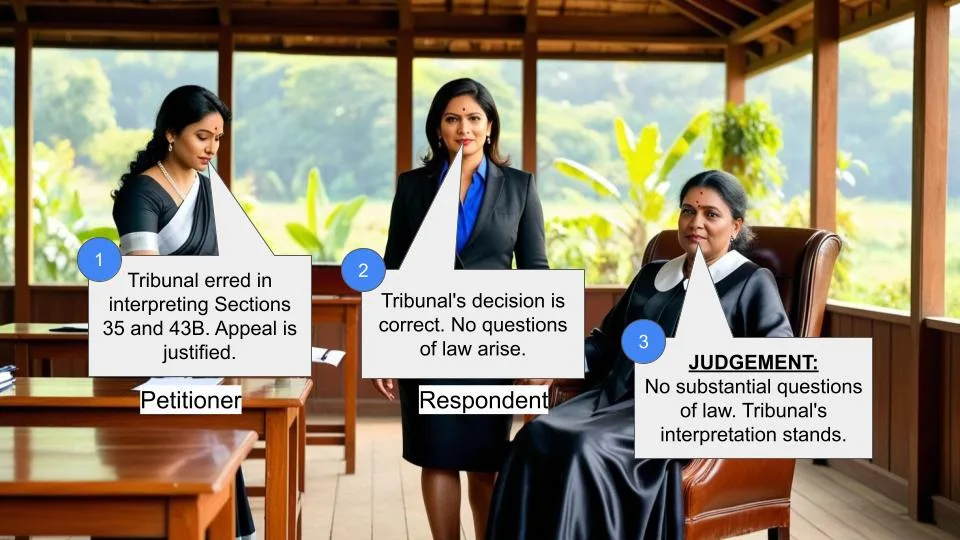
The High Court dismissed the Revenue's appeal against the Income Tax Appellate Tribunal's order favoring Hindustan Construction Co. Ltd. The court found no substantial questions of law in the Revenue's arguments, affirming the Tribunal's interpretation of Section 35 (of Income Tax Act, 1961) and Section 43B (of Income Tax Act, 1961).
Get the full picture - access the original judgement of the court order here.
Case Name:
Commissioner of Income Tax vs. Hindustan Construction Co. Ltd. (High Court of Bombay)
Income Tax Appeal No. 1140 of 2013
Key Takeaways
- The High Court upheld the Tribunal's decision, which favored Hindustan Construction Co. Ltd.
- The court found that the Revenue failed to raise substantial questions of law.
- The Tribunal's interpretation of Section 35 (of Income Tax Act, 1961) and Section 43B (of Income Tax Act, 1961), was affirmed.
- The appeal was dismissed with no order as to costs.
Issue
Did the Revenue raise substantial questions of law in its appeal against the Income Tax Appellate Tribunal's order favoring Hindustan Construction Co. Ltd.?
Facts
- The Revenue appealed against the Income Tax Appellate Tribunal's order dated 28th September 2012, concerning assessment years 2003-04 and 2006-07.
- The Tribunal had ruled in favor of Hindustan Construction Co. Ltd., allowing certain deductions under Section 35 (of Income Tax Act, 1961) and Section 43B (of Income Tax Act, 1961).
- The Revenue argued that the Tribunal's decision raised substantial questions of law.
Arguments
- Revenue's Arguments:
The Revenue, represented by Mr. Arvind Pinto, argued that the Tribunal's decision raised substantial questions of law, particularly concerning the interpretation of Section 35 (of Income Tax Act, 1961) and Section 43B (of Income Tax Act, 1961).
- Assessee's Arguments:
The assessee, represented by Mr. Sanjiv M. Shah, contended that the Tribunal's decision was based on a correct interpretation of the law and factual findings.
Key Legal Precedents
- Commissioner of Income Tax vs. Ghatge Patil Transports Limited (2014) 368 ITR 749:
This case was cited to argue that the questions raised were already covered by existing judgments.
- Godrej & Boyce Manufacturing Company Limited vs. Deputy Commissioner of Income Tax 328 ITR 81:
This case was cited to support the Tribunal's interpretation of the law, particularly regarding Section 35 (of Income Tax Act, 1961).
Judgement
The High Court dismissed the Revenue's appeal, stating that no substantial questions of law were raised. The court affirmed the Tribunal's interpretation of Section 35 (of Income Tax Act, 1961) and Section 43B (of Income Tax Act, 1961), and found that the Tribunal's conclusions were neither perverse nor vitiated by any error of law. The appeal was dismissed with no order as to costs.
FAQs
Q1: What was the main issue in this case?
A1: The main issue was whether the Revenue raised substantial questions of law in its appeal against the Tribunal's order favoring Hindustan Construction Co. Ltd.
Q2: What sections of the Income Tax Act, 1961, were in question?
A2: Sections 35 and 43B of the Income Tax Act, 1961, were in question.
Q3: What was the court's decision?
A3: The court dismissed the Revenue's appeal, finding no substantial questions of law.
Q4: Were there any costs awarded?
A4: No, the court dismissed the appeal with no order as to costs.
Q5: What legal precedents were cited?
A5: The cases of Commissioner of Income Tax vs. Ghatge Patil Transports Limited (2014) 368 ITR 749 and Godrej & Boyce Manufacturing Company Limited vs. Deputy Commissioner of Income Tax 328 ITR 81 were cited.

1. Parties concede that question No.6.1 in this appeal is covered by a judgment of this Court in the case of Commissioner of Income Tax vs. Ghatge Patil Transports Limited (2014) 368 ITR 749.
2. Having heard both sides and finding that this appeal by the Revenue against the order passed by the Income Tax Appellate Tribunal, dated 28th September, 2012, for assessment years 2003-04, 2006-07, we cannot accede to the submissions of Mr. Pinto that it should be admitted simply because assessee's appeals from that order and impugning a part of it has been admitted. The Revenue has to independently satisfy us that this appeal raises substantial questions of law.
3. Mr. Pinto would submit that the same indeed raises substantial questions of law. In that he projects the questions at pages 5 (6.1, 6.2 and 6.3).
4. However, in relation to para 6.3 he concedes that a judgment of a Division Bench of this Court in the case of Godrej & Boyce Manufacturing Company Limited vs. Deputy Commissioner of Income Tax 328 ITR 81 covers the controversy against the Revenue and in favour of the assessee. Following that, we do not think that question 6.3 is a substantial question of law. We hold the same opinion on questions 6.1 and 6.2 as well.
5. Mr. Pinto could not satisfy us on a plain reading of section 35 (of Income Tax Act, 1961), that there was no requirement of any project being completed or the entire amount capitalised in the books of account as reported by the auditors. The Tribunal found that the understanding of the Assessing Officer was completely faulty. The Assessing Officer had not referred to the plain language of section 35 (of Income Tax Act, 1961). There, the amount which has been incurred for research and particularly scientific research can be claimed. In relation to that at page 80 of the paper-book and from paragraph 11.1 onwards, the Tribunal found that the assessee had incurred expenses on scientific research development which has been recognised by the appropriate authorities. He has shown the expenditure in the books of account as on 31st March, 2003, waiting capitalisation. The Assessing Officer found that this claim cannot be granted as the expenditure has not been capitalised in the books of account but shown as waiting as such.
6. However, the assessee's representative pointed out to the Tribunal the undisputed position that an expenditure of Rs.27,25,243/- was indeed incurred on research which is duly approved by the competent authority being the Ministry of Science and Technology, Government of India and a letter dated 4th December, 2002, was produced. For that provision to apply, it is sufficient that the assessee incurs the expenditure of a capital nature on scientific research and there is no requirement that such an expenditure should be capitalised in the books of account. The Tribunal found that once there is no dispute that such expenditure is incurred and the legal provision not warranting any further capitalisation of the amont and in the books of account, the Assessing Officer and the Commissioner erroneously rejected this claim. The reasoning in paragraph 13 of the Tribunal's order is not only in consonance with the factual position, but the plain language of section 35 (of Income Tax Act, 1961). The Tribunal has also taken care to observe that when the Assessing Officer found that the expenditure on research and development is eligible for deduction under the same provision in the subsequent year then the view taken by the Assessing Officer all the more cannot be sustained.
7. Such a conclusion of the Tribunal does not raise any substantial question of law.
8. In relation to question 6.2, the Tribunal found that there was no question of section 43B (of Income Tax Act, 1961) being invoked and at the stage when the interest was not payable. The loan itself was availed of on 26th December, 2002, and for one year. It was payable with interest. However, the interest had not become payable and hence the question of relying on section 43B (of Income Tax Act, 1961) to disallow the claim does not arise. By the plain language of this provision and given the factual and admitted position, we do not think that the Tribunal erred in the view that it has taken and hence even with regard to this question, we do not agree that the Tribunal's conclusion as reached in paragraph 9.2 of the impugned order raises any substantial question of law. The view taken is neither perverse nor vitiated by any error of law apparent on the face of the record.
9. The appeal is thus devoid of merits. Hence it is dismissed. There shall be no order as to costs.
A.K. MENON, J. S.C. DHARMADHIKARI , J.
×
Similar Ripples
Questions
High Court Dismisses Revenue's Appeal in Hindustan Construction Co. Ltd. Case
Write your CommentSimilar Posts

Generic
- Reportdata/3868.pdf
