Full News

High Court Must Formulate Law Questions Before Appeals
High Court Must Formulate Law Questions Before Appeals
The case revolves around the necessity for High Courts to first identify and formulate substantial questions of law before proceeding with appeals under Section 260-A (of Income Tax Act, 1961). The Supreme Court emphasized this requirement, impacting how appeals are handled in tax-related cases.
Get the full picture - access the original judgement of the court order here
Case Name:
Nagarbail Salt Pwners Co-operative Society Limited Vs Commissioner of Income Tax (High Court of Karnataka)
R.P.No.100037-42 of 2016 IN I.T.A 100067-73 of 2015
Date: 6th September 2016
Key Takeaways:
- The High Court must formulate substantial questions of law before deciding on appeals under Section 260-A (of Income Tax Act, 1961).
- This requirement ensures that appeals are not decided on equitable grounds but strictly on legal questions.
- The case reinforces the procedural rigor required in appellate tax litigation.
Issue
Is it mandatory for the High Court to formulate substantial questions of law before proceeding with appeals under Section 260-A (of Income Tax Act, 1961)?
Facts
The case involves the petitioner-assessee challenging the High Court's decision to proceed with appeals without first formulating substantial questions of law. The appeals were related to tax assessments, and the petitioner argued that the High Court's approach was contrary to the procedural requirements under Section 260-A (of Income Tax Act, 1961).
Arguments
- Petitioner: Argued that the High Court must first identify substantial questions of law before hearing appeals, as mandated by Section 260-A (of Income Tax Act, 1961). They cited previous judgments, including "M.Janardhana Rao vs. Joint Commissioner of Income-Tax" and "Commissioner of Income Tax vs. Meghalaya Steels Ltd."
- Revenue: Contended that the High Court had indeed referred to substantial questions of law and addressed them, arguing there was no error in the process.
Key Legal Precedents
- M.Janardhana Rao vs. Joint Commissioner of Income-Tax: The Supreme Court held that formulating substantial questions of law is essential before proceeding with appeals under Section 260-A (of Income Tax Act, 1961).
- Commissioner of Income Tax vs. Meghalaya Steels Ltd.: Reinforced the necessity of adhering to procedural requirements in tax appeals.
Judgement
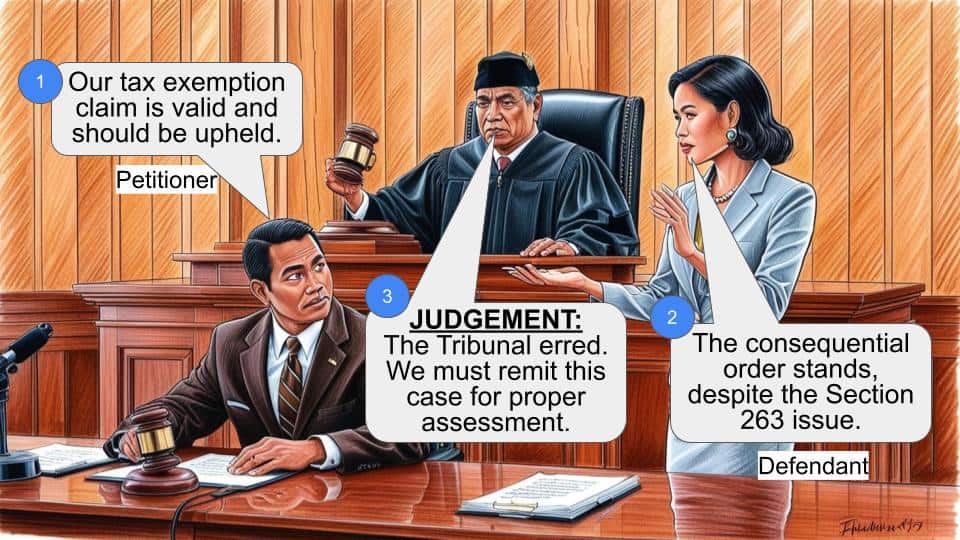
The court set aside the High Court's judgment, emphasizing the need to formulate substantial questions of law at the admission stage of appeals. The case was remitted back to the High Court for reconsideration, adhering to the procedural requirements of Section 260-A (of Income Tax Act, 1961).
FAQs
Q1: Why is it important to formulate questions of law before an appeal?
A1: It ensures that the appeal is decided based on legal principles rather than equitable grounds, maintaining the integrity of the judicial process.
Q2: What happens if a High Court fails to formulate these questions?
A2: The appeal process may be deemed procedurally flawed, potentially leading to the setting aside of the judgment and a remand for proper consideration.
Q3: How does this case impact future tax litigation?
A3: It underscores the importance of procedural compliance in tax appeals, potentially influencing how courts handle similar cases in the future.

This breakdown should help you understand the court's decision and its implications in a more digestible format. If you have any more questions or need further clarification, feel free to ask!
1. In all these review petitions, petitioner-assessee has raised a common question with regard to formulation of a substantial question of law before deciding the appeals on merits.
2. Heard Shri Ashok A. Kulkarni, learned Counsel appearing for the petitioner and Shri Y.V. Raviraj, learned standing Counsel appearing for the Revenue.
3. Shri Ashok Kulkarni, adverting to Section 260A(5) (of Income Tax Act, 1961), contended that before taking up an appeal filed under Section 260-A (of Income Tax Act, 1961) for hearing, it is mandatory for the High Court to frame a question of law and call upon the parties to address their arguments. Adverting to the facts of orders under appeal, he submitted that all these appeals were filed by the Revenue under Section 260-A (of Income Tax Act, 1961) and they were listed for admission. Both the learned Counsel for the Revenue as well as Assessee addressed elaborate arguments on the merits of the case. However, he fairly conceded that Counsel on both sides did not raise any objection to hear the appeals for final disposal. Further, they did not bring to the notice of this Court the provision with regard to framing of question/s of law by the Court.
4. He placed reliance on the following judgments of the Hon’ble Supreme Court in support of his contention and prayed for allowing these review petitions.
1. M.Janardhan Rao vs. Joint Commissioner of Income-Tax reported in (2005) 273 ITR 56 (SC): (2005) 2 SCC 324;
2. Commissioner of Income Tax vs. Meghalaya Steels Ltd. reported in (2015) 377 ITR 112 (SC)
5. Per contra, Shri Y.V.Raviraj, learned standing Counsel for the Revenue submitted that this Court has indeed referred to a substantial question of law raised by the Revenue and answered the same in its favour after adverting to various judgments. He further submitted that there is no error apparent on the face of the record warranting interference in these review petitions. Accordingly, he prayed for dismissal of these petitions.
6. We have given our careful and anxious consideration to the submissions of the learned Counsel for the parties and perused the judgments relied upon by the learned Counsel for the petitioner.
7. In the case of M.Janardhana Rao supra, the Hon’ble Supreme Court has held that it is essential for the High Court to first formulate the question/s of law and thereafter to proceed further in the matter. Following the said judgment, the Hon’ble High Court of Gauhati has allowed review petitions in the case of Meghalaya Steels Ltd. and others vs. Commissioner of Income Tax. The said orders of the Hon’ble Gauhati High Court were unsuccessfully challenged before the Hon’ble Supreme Court of India in the case of Commissioner of Income Tax v. Meghalaya Steels Ltd. supra.
8. In the case of M.Janardhana Rao, the Hon’ble Supreme Court has held has follows:
14. Without insisting on the statement of substantial question of law in the memorandum of appeal and formulating the same at the time of admission, the High Court is not empowered to generally decide the appeal under Section 260-A (of Income Tax Act, 1961) without adhering to the procedure prescribed under Section 260-A (of Income Tax Act, 1961). Further, the High Court must make every effort to distinguish between a question of law and a substantial question of law. In exercise of powers under Section 260-A (of Income Tax Act, 1961), the findings of fact of the Tribunal cannot be disturbed. It has to be kept in mind that the right of appeal is neither a natural nor an inherent right attached to the litigation. Being a substantive statutory right, it has to be regulated in accordance with law in force at the relevant time. The conditions mentioned in Section 260-A (of Income Tax Act, 1961) must be strictly fulfilled before an appeal can be maintained under Section 260-A (of Income Tax Act, 1961). Such appeal cannot be decided on merely equitable grounds.
15. An appeal under Section 260-A (of Income Tax Act, 1961) can only be in respect of a “substantial question of law”. The expression “substantial question of law” has not been defined anywhere in the statute. But it has acquired a definite connotation through various judicial pronouncements. In Sir Chunilal V. Mehta & Sons Ltd. v. Century Spg. & Mfg. Co. Ltd. [1962 Supp (3) SCR 549 : AIR 1962 SC 1314] this Court laid down the following tests to determine whether a substantial question of law is involved. The tests are: (1) whether directly or indirectly it affects substantial rights of the parties, or (2) the question is of general public importance, or (3) whether it is an open question in the sense that the issue is not settled by pronouncement of this Court or Privy Council or by the Federal Court, or (4) the issue is not free from difficulty, and (5) it calls for a discussion for alternative view. There is no scope for interference by the High Court with a finding recorded when such finding could be treated to be a finding of fact.
16. On reading of the impugned judgment of the High Court it is clear that no substantial question of law was formulated at the time of admission of the appeal. Obviously, the High Court has formulated questions subsequently after conclusion of arguments for the purpose of adjudication. That is clearly against the scheme of Section 260-A (of Income Tax Act, 1961). Additionally, grievance that certain points which were urged have not been dealt with by the High Court appears to be correct.
17. In the aforesaid background, the impugned judgment of the High Court is set aside. The matter is remitted to the High Court which shall deal with the matter afresh keeping in view the prescriptions of Section 260-A (of Income Tax Act, 1961). We make it clear that we have not expressed any opinion on the merits of the case.
18. For a period of three months the interim protection given by this Court in the matter of recovery of tax shall be operative. It shall be open to the parties to move the High Court for such interim protection as the facts of the case warrant till disposal of the appeals.
Thus, respectfully following the pronouncements of the Hon’ble Supreme Court in both the cases cited before us, we are of the considered view that these review petitions merit consideration.
9. The Hon’ble High Court of Gauhati, while allowing the review petition has adverted to various judgments. We feel it appropriate to extract the following observations of Jackson J. in the case of Massachusetts vs. United States reported in (1948) 333 US 611 referred by the Hon’ble High Court of Gauhati and the same reads as follows:
“I see no reason why should be consciously wrong today, because I was unconsciously wrong yesterday. Even Lord Denning expressed similar views when he observed in Ostime (Inspector of Taxes vs. Australian Mutual Provident Society reported in (1960) AC 459, ‘the doctrine of precedent does not compel your lordships to follow the wrong path until you fall over the edge of the cliff.”
10. We also would like to extract another passage by P.N.Bhagawati J. (as His Lordship then was) in the case of Distributors (Baroda) P. Ltd. v. Union of India, reported in (1985) 155 ITR 120 (SC) referred by Hon’ble High Court of Gauhati and the same reads as follows:
“It is almost as important that the law should be settled permanently as that it should be settled correctly. But there may be circumstances, where the public interests demands that the previous decision be reviewed and reconsidered. The doctrine of stare decisis should not deter the court from overruling an earlier decision, if it is satisfied that such decision is manifestly wrong or proceeds upon a mistaken assumption in regard to the existence of continuance of a statutory provision or is contrary to another decision of the Court.”
11. In premise, we hold that these review petitions deserve to be allowed. Hence, the following order:
1. Review petitions are allowed;
2. Order dated 26.02.2016 passed in
I.T.A No. 100069/2015, I.T.A No.100067/2015,
I.T.A No.100070/2015, I.T.A No.100071/2015,
I.T.A No.100072/2015 and I.T.A No.100073/2015 are set aside;
3. Registry to list the appeals for admission. A copy of this order shall be placed in all connected review petitions. No costs.
Sd/-
JUDGE
Sd/-
JUDGE
These petitions were heard at length and reserved for orders. Whilst orders were being pronounced today, it is brought to our notice by the learned counsel for revenue that the petitioner herein has challenged the impugned orders in all these review petitions in SLP No.23881/2016 and connected petitions before the Hon’ble Supreme Court. He submitted that the said SLPs were pending on the date on which these review petitions were argued before this Court. Learned counsel for the petitioner does not dispute the said submission. We express our displeasure on the fact that the petitioner was pursuing parallel remedy and did not bring it to the notice of this Court while these review petitions were being heard.
Sd/-
JUDGE
Sd/-
JUDGE
×