


Interest on Land Acquisition Compensation Taxable as "Income from Other Sources"













Full News

Interest on Land Acquisition Compensation Taxable as "Income from Other Sources"
Interest on Land Acquisition Compensation Taxable as "Income from Other Sources"
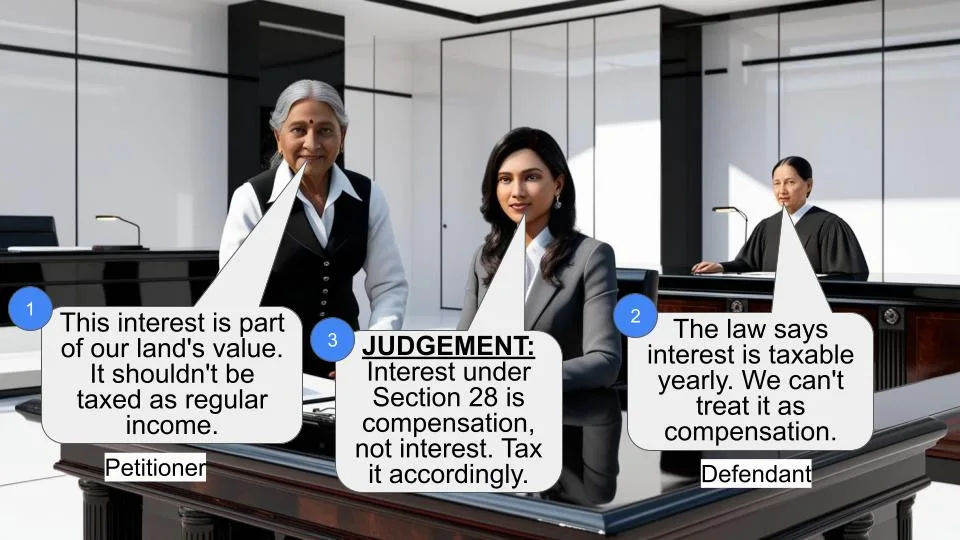
A landowner, Mahender Pal Narang, challenged how the interest on his land acquisition compensation was being taxed. The Central Board of Direct Taxes (CBDT) had classified it as "Income from Other Sources," but Narang thought it should be treated as part of the compensation itself and taxed under "Capital Gains." Unfortunately for Narang, the High Court didn't agree with him and dismissed his petition.
Get the full picture - access the original judgement of the court order here
Case Name:
Mahender Pal Narang vs Central Board of Direct Taxes, New Delhi and Others (High Court of Punjab & Haryana)
CWP No. 17971 of 2019
Date: 19th February 2020
Key Takeaways:
1. Interest on land acquisition compensation is now taxable as "Income from Other Sources."
2. The 2010 amendments to the Income Tax Act have significantly changed how this interest is treated for tax purposes.
3. The court emphasized that when statutory language is clear, it should be interpreted strictly, regardless of legislative intent.
Issue:
The main question here was: After the introduction of Sections 56(2)(viii) and 57(iv) of the Income Tax Act in 2010, can interest received under Section 28 of the Land Acquisition Act, 1894 be considered part of the compensation and taxed under "Capital Gains" instead of "Income from Other Sources"?
Facts:
1. Mahender Pal Narang's land was acquired in the assessment years 2007-08 and 2008-09.
2. He received enhanced compensation on March 21, 2016.
3. For the 2016-17 assessment year, Narang filed his tax return treating the interest as "Income from Other Sources" and claimed a 50% deduction as per Section 57(iv) (of Income Tax Act, 1961).
4. Later, Narang realized he might have made a mistake and filed for a revision under Section 264 (of Income Tax Act, 1961), arguing that the interest should be treated as part of the compensation.
5. The revision was rejected on January 30, 2019, leading to this court case.
Arguments:
Narang's side argued:
1. The nature of interest under Section 28 of the Land Acquisition Act should remain that of compensation, despite the new tax provisions.
2. They cited a Supreme Court decision (Ghanshyam (HUF) case) to support their view that such interest is akin to compensation.
3. They also referred to a CBDT Circular to argue that the 2010 amendments were meant to address a different issue.
The tax authorities' side likely argued (though not explicitly stated):
1. The new provisions clearly classify such interest as "Income from Other Sources."
2. The language of the new sections is unambiguous and should be interpreted strictly.
Key Legal Precedents:
1. Commissioner of Income-tax v. Ghanshyam (HUF), (2009) 315 ITR 1:
This Supreme Court case held that interest under Section 28 of the Land Acquisition Act should be treated as compensation.
2. Rama Bai v. Commissioner of Income Tax, (1990) 181 ITR 400:
This case led to hardships that the 2010 amendments aimed to address.
3. Movaliya Bhikhubhai Balabhai v. Income Tax Officer (TDS) (2016) 388 ITR 343:
A Gujarat High Court decision that the current court respectfully disagreed with.
4. M/s I.T.C. Ltd. v. Commissioner of Central Excise, New Delhi and another, 2004(7) SCC 591:
This case emphasized strict interpretation of unambiguous statutory language.
Judgement:
The court dismissed Narang's petition, ruling that:
1. The 2010 amendments to the Income Tax Act have changed how interest on compensation is treated.
2. Such interest should now be classified as "Income from Other Sources," not "Capital Gains."
3. The language of the new provisions is clear and unambiguous, leaving no room for interpretation based on legislative intent.
FAQs:
Q1: Does this ruling apply to all types of land acquisition compensation?
A1: Yes, it applies to interest received on any compensation or enhanced compensation under the Land Acquisition Act.
Q2: Can taxpayers still claim any deduction on this interest income?
A2: Yes, Section 57(iv) (of Income Tax Act, 1961) allows a 50% deduction on such interest income.
Q3: How does this ruling affect past cases where interest was treated as part of compensation?
A3: This ruling applies from the 2010-11 assessment year onwards, when the new provisions came into effect.
Q4: Could this decision be appealed to the Supreme Court?
A4: Potentially, yes. However, given the clear language of the statute, a successful appeal might be challenging.
Q5: Does this ruling create any conflict with previous Supreme Court decisions?
A5: While it differs from some previous interpretations, the court argues that the new statutory provisions have changed the legal landscape, making some older precedents less relevant.

Aggrieved of the order dated 30.1.2019 dismissing the revision under Section 264 (of Income Tax Act, 1961) (for short, 'the 1961 Act'), the present petition is filed.
The issue involved in narrow circumference is “whether after the insertion of Sections 56(2)(viii) and 57(iv) of the Act w.e.f. 1.4.2010, can the assessee claim that interest received under Section 28 of the Land Acquisition Act, 1894 (for short, 'the 1894 Act') will part take the character of the compensation and would fall under the head “Capital gains” and not “Income from other sources”?” The relevant facts are that the land of the petitioner was acquired in the assessment years 2007-08 and 2008-09. The enhanced compensation was received on 21.3.2016. The petitioner filed income tax return for the assessment year 2016-17 treating the interest received under Section 28 of the 1894 Act as income from other sources and claimed deduction for 50% as per Section 57(iv) of the Income Tax Act, 1961. The return was processed under Section 143(1) of the Income Tax Act, 1961. An application under Section 264 of the Income Tax Act, 1961 was made claiming that by mistake the petitioner treated the interest income as income from other sources whereas the same is part of enhanced compensation. The revisional authority rejected the application on 30.1.219.
The relevant provisions are quoted below:
“Section 10(37) of the Income Tax Act, 1961
Incomes are not included in total income.
10. (37) in the case of an assessee, being an individual or a Hindu undivided family, any income chargeable under the head “Capital gains” arising from the transfer of agricultural land, where--
(i) such land is situate in any area referred to in item (a) or item (b) of sub-clause (iii) of clause (14) of section 2 (of Income Tax Act, 1961);
(ii) such land, during the period of two years immediately preceding the date of transfer, was being used for agricultural purposes by such Hindu undivided family or individual or a parent of his;
(iii) such transfer is by way of compulsory acquisition under any law, or a transfer the consideration for which is determined or approved by the Central Government or the Reserve Bank of India;
(iv) such income has arisen from the compensation or consideration for such transfer received by such assessee on or after the 1st day of April, 2004.
Section 56(2)(viii) (of Income Tax Act, 1961) (inserted by Finance (No.2) Act 2009 w.e.f. 1.4.2010.
Income from other sources.
56(2) In particular, and without prejudice to the generality of the provisions of sub-section (1), the following incomes, shall be chargeable to income-tax under the head “Income from other sources”, namely:-- xx xx xx
(viii) income by way of interest received on compensation or on enhanced compensation referred to in clause (b) of Section 145A (of Income Tax Act, 1961).
Section 57(iv) of the Income Tax Act, 1961 Deductions.
57. The income chargeable under the head “Income from other sources” shall be computed after making the following deductions, namely:-
(iv) in the case of income of the nature referred to in clause (viii) of sub-section (2) of Section 56 (of Income Tax Act, 1961), a deduction of a sum equal to fifty per cent of such income and no deduction shall be allowed under any other clause of this section. Section 145A(b) (of Income Tax Act, 1961) (inserted by the Finance (No. 2) Act 2009 w.e.f. 1.4.2010.
Method of accounting in certain cases.
145A. Notwithstanding anything to the contrary contained in section 145 (of Income Tax Act, 1961),--
(b) interest received by an assessee on compensation or on enhanced compensation, as the case may be, shall be deemed to be the income of the year in which it is received.”
Section 10 (of Income Tax Act, 1961) deals with the incomes not to be included in the total income. Sub-section (37) to Section 10 (of Income Tax Act, 1961) provides for deduction from capital gain arising from the transfer of agricultural land. Sub-clause (iii) deals with transfer by way of compulsory acquisition. Sub-clause (iv) deals with the income arising from the compensation or consideration for transfer.
Section 56(2)(viii) (of Income Tax Act, 1961) provides that interest received on compensation or enhanced compensation referred to in clause (b) of Section 145A (of Income Tax Act, 1961) would be chargeable under “income from other sources”. Section 57 (of Income Tax Act, 1961) provides for deduction of income chargeable under the head “Income from other sources” and clause (iv) provides that for income referred to in clause (viii) of sub-section (2) of section 56 (of Income Tax Act, 1961), there would be deduction of fifty per cent.
Section 145 (of Income Tax Act, 1961) provides for accounting method. Clause (b) of Section 145A (of Income Tax Act, 1961) provides that interest received on compensation or enhanced compensation shall be deemed to be income for the year in which it is received.
Learned counsel for the petitioner argued that there is no amendment in Section 10(37) of the Income Tax Act, 1961 and by insertion of Sections 56(2)(viii) and 57(iv), the nature of interest under Section 28 (of Income Tax Act, 1961) of the 1894 Act will remain that of compensation. To fortify the submission, he relies upon the decision of the Supreme Court in Commissioner of Income-tax v. Ghanshyam (HUF), (2009) 315 ITR 1. The contention is that as per the decision of the Apex Court, the interest under Section 28 of the 1894 Act is not compensatory for delay but would be treated akin to compensation. He buttresses his contention by relying upon Central Board of Direct Taxes Circular No. 5 of 2010 to contend that the amendment brought in 2010 was to remove the hardships created by the decision of the Supreme Court in Rama Bai v. Commissioner of Income Tax, (1990) 181 ITR 400. Reliance is placed upon the decision of Gujarat High Court in Movaliya Bhikhubhai Balabhai v. Income Tax Officer (TDS) (2016) 388 ITR 343.
Before dealing with the contentions, relevant portion of the circular is quoted below:
“46. Rationalizing the provisions of taxation of interest received on delayed compensation or on enhanced compensation.
46.1 The existing provisions of Income Tax Act provide that income chargeable under the head “Profits and gains of business or profession” or “Income from other sources”, shall be computed in accordance with either cash or mercantile system of accounting regularly employed by the assessee. Further, the Hon'ble Supreme Court in the case of Rama Bai vs. CIT (181 ITR 400) has held that arrears of interest computed on delayed or enhanced compensation shall be taxable on accrual basis. This has caused undue hardship to the taxpayers.
46.2 With a view to mitigate the hardship, section 145A (of Income Tax Act, 1961) is amended to provide that the interest received by an assessee on compensation or enhanced compensation shall be deemed to be his income for the year in which it was received, irrespective of the method of accounting followed by the assessee.
46.3 Further, clause (viii) is inserted in the sub-section (2) of the section 56 (of Income Tax Act, 1961) so as to provide that income by way of interest received on compensation or on enhanced compensation referred to in clause (b) of section 145A (of Income Tax Act, 1961) shall be assessed as “income from other sources” in the year in which it is received.
46.4 Applicability- This amendment has been made applicable with effect from 1st April, 2010, and will accordingly apply in relation to assessment year 2010-11 and subsequent assessment years.”
Section 45 of the Income Tax Act, 1961 deals with capital gains. By Finance Act, 1987, sub-section (5) was inserted in Section 45 (of Income Tax Act, 1961) and as per its clause (b), the enhanced compensation shall be chargeable under the head “Capital gains” of the previous year in which the amount is received by the assessee. This issue came up before Apex Court in Ghanshyam's case (supra). Considering Sections 45(5) and 155(16) of the 1961 Act, it was held that enhanced compensation received under the 1894 Act may be received in multiple stages but the same is to be treated as “deemed income” at the time when it is received and is to be taxed on receipt basis. It was further held, the fact that enhanced compensation is in dispute and the withdrawal is conditional will not make a difference. While dealing with the said issue, it was held that interest on enhanced value of land forms part of compensation and is exigible to tax in the year of receipt whereas interest on delayed payment of enhanced compensation is income in a different nature.
The scheme with regard to chargeability of interest received on compensation and enhanced compensation has undergone a sea change with the insertion of Sections 56(2)(viii) and 57(iv) of the 1961 Act. Section 56 (of Income Tax Act, 1961) deals with income from other sources and a specific provision has been inserted by way of sub-section 2(viii) (of Income Tax Act, 1961), whereby the interest received on compensation or enhanced compensation, as referred to in clause (b) to Section 145A (of Income Tax Act, 1961) has been included under the head 'Income from other sources'. In clause (iv) to Section 57 (of Income Tax Act, 1961), deduction of fifty per cent is provided on interest received on compensation or enhanced compensation.
In view of the amendments, the decision of Apex Court in Ghanshyam's case (supra) does not come to the rescue of the petitioner to claim that interest received under Section 28 of the 1894 Act is to be treated as compensation and to be dealt with under “Capital gains”. The fact that there is no amendment carried out under Section 10(37) of the Income Tax Act, 1961 will not change the position. Section 10 (of Income Tax Act, 1961) deals with deductions and sub- section (37) thereof deals with capital gains arising from transfer of agricultural land, it no where provides as to what is to be included under the head “Capital gains”. The argument raised is not well founded.
Learned counsel has relied on Circular No. 5 of 2010 by merely reading clause 46.1. The said clause talks about undue hardship being caused as arrears of interest being taxable on accrual basis. Clause
46.2 states that Section 145A (of Income Tax Act, 1961) is amended to overcome the difficulty, by deeming the income for the year in which it is received. Clause 46.3 has been ignored in which Section 56(2)(viii) (of Income Tax Act, 1961) is dealt with that interest on compensation or on enhanced compensation referred to in clause (b) of Section 145A (of Income Tax Act, 1961) shall be assessed as “income from other sources”.
Gujarat High Court in Movaliya Bhikhubhai Balabhai's case (supra) while dealing with deduction of tax at source relying upon Circular No. 5 of 2010 held that amendment to the provisions of the 1961 Act by Finance Act, 2010 Act was not in connection with the decision of Supreme Court in Ghanshyam's case (supra) but to mitigate the hardship caused by the decision of Supreme Court in Rama Bai's case (supra). It was held that interest under Section 28 of the 1894 Act continues to part take the character of compensation and will not fall within the ambit of expression “interest”. In view of discussion above, we with utmost respect are not in agreement with the view taken by Gujarat High Court. There is another aspect, i.e. the language of Sections 56(2)(viii) and 57(iv) of the 1961 Act is plain, simple and unambiguous. There is no scope of taking outside aid for giving an interpretation to newly inserted sub-sections and clauses. Supreme Court in M/s I.T.C. Ltd. v. Commissioner of Central Excise, New Delhi and another, 2004(7) SCC 591 held as under:
“23. ........ These decisions exemplify the general rule of statutory construction that words have to be construed strictly according to their ordinary and natural meaning, particularly when the statute is a fiscal one irrespective of the object with which the provision was introduced. Of course if there is ambiguity in the statutory language, reference may be made to the legislative intent to resolve the ambiguity. But if the statutory language is unambiguous then that must be given effect to. The legislature is deemed to intend and mean what it says. The need for interpretation arises only when the words used in the statute are, on their own terms ambivalent and do not manifest the intention of the legislature.”
In view of the above, it is held that the interest received on compensation or enhanced compensation is to be treated as “income from other sources” and not under the head “Capital gains”.
The writ petition is dismissed.
(AVNEESH JHINGAN) (AJAY TEWARI)
JUDGE JUDGE
×
Similar Ripples
Questions
Interest on Land Acquisition Compensation Taxable as "Income from Other Sources"
Write your CommentSimilar Posts


Generic
- Reportdata/6033.pdf
