Settlement Commissioner to Consider All Grounds, Including Department's Objecti…



Full News
Settlement Commissioner to Consider All Grounds, Including Department's Objections
Settlement Commissioner to Consider All Grounds, Including Department's Objections
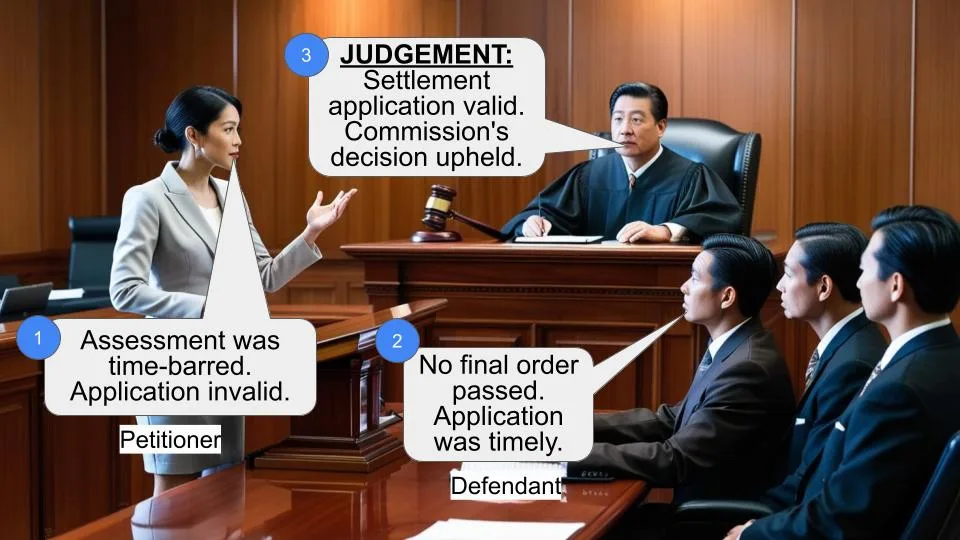
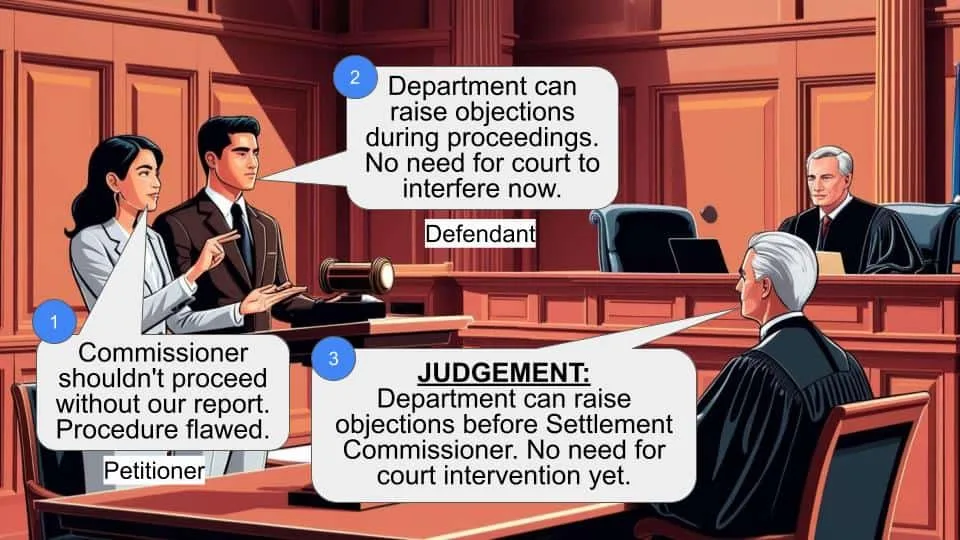
This case involves the Principal Commissioner of Income Tax challenging the Income Tax Settlement Commissioner's decision to proceed with a settlement application without considering the Department's report. The High Court dismissed the petition, allowing the Department to raise objections before the Settlement Commissioner.
Get the full picture - access the original judgement of the court order here
Case Name:
Principal Commissioner of Income Tax vs. Seema Suryavanshi & Anr. (High Court of Madhya Pradesh)
Writ Petition No. 20817, 20818 and 20892 of 2015
Date: 27th July 2016
Key Takeaways
1. The court upheld the Settlement Commissioner's authority to proceed with settlement applications.
2. The Department can raise objections during ongoing settlement proceedings.
3. Premature interference by courts in settlement processes is discouraged.
Issue
Should the High Court interfere with the Income Tax Settlement Commissioner's decision to proceed with a settlement application without considering the Department's report under section 245-D(2) (of Income Tax Act, 1961), 1961?
Facts
1. Search and seizure operations were conducted on the assessee's (Seema Suryavanshi) establishment.
2. While assessment proceedings were pending, the assessee filed an application under section 245-C(1) (of Income Tax Act, 1961), 1961 before the Income Tax Settlement Commissioner.
3. The Settlement Commissioner allowed the application to proceed on 24.3.2015 under section 245-D(1) (of Income Tax Act, 1961).
4. The Department was asked to submit a report under section 245-D(2B) (of Income Tax Act, 1961), which they did on 28.4.2015.
5. The Settlement Commissioner proceeded with the matter without considering the Department's report and objections.
6. The Principal Commissioner of Income Tax filed a writ petition challenging this decision.
Arguments
Petitioner (Department):
- The procedure followed by the Settlement Commissioner is unsustainable.
- The order passed under section 245D(2C) (of Income Tax Act, 1961) without considering the Department's report is invalid.
- Cited cases from Bombay and Delhi High Courts to support their position.
Respondent:
- Interference at this stage is not necessary as proceedings are still pending.
- The Department can raise all questions before the Settlement Commissioner.
- Cited Supreme Court and Madhya Pradesh High Court judgments supporting non-interference.
Key Legal Precedents
1. Commissioner of Income Tax vs. K. Jayaprakash Narayanan, (2009) 184 TAXMAN 85 (SC)
2. Commissioner of Income Tax, Indore vs. Asian Natural Resources India Limited, (2015) 63 taxman.com 169 (MP)
3. Commissioner of Income Tax (Central) vs. Income Tax Settlement Commissioner (ITSC), (2014) 267 CTR 0007 (BOM)
4. Marc Bathing Luxuries Limited vs. Income Tax Settlement Commission and Another, (2013) 94 DTR 0241 (DEL)
Judgment
The High Court dismissed the writ petitions, finding no grounds for interference. Key points:
1. The court allowed the Department to raise objections before the Settlement Commissioner.
2. The Settlement Commissioner was directed to consider these objections and proceed according to law.
3. The court followed the principle set by the Supreme Court in K. Jayaprakash Narayanan and the Madhya Pradesh High Court in Asian Natural Resources India Limited.
FAQs
1. Q: Why did the court refuse to interfere with the Settlement Commissioner's decision?
A: The court believed that since the matter was still pending before the Settlement Commissioner, it was premature to interfere. The Department could raise all objections during the ongoing proceedings.
2. Q: Can the Department still present its objections?
A: Yes, the court explicitly granted liberty to the Department to raise all grounds and objections before the Settlement Commissioner.
3. Q: What is the significance of this judgment for future cases?
A: This judgment emphasizes the importance of allowing settlement proceedings to run their course without premature judicial interference, while ensuring that all parties have the opportunity to present their case before the Settlement Commissioner.
4. Q: How does this judgment affect the Income Tax Settlement process?
A: It reinforces the Settlement Commissioner's authority to proceed with applications while also ensuring that the Department's objections are considered during the settlement process.
5. Q: What should taxpayers take away from this case?
A: Taxpayers should be aware that while they can apply for settlement, the Department still has the right to raise objections throughout the settlement process, which the Settlement Commissioner must consider.

1- As common questions of law and fact are involved in all these three writ petitions filed by the Principal Commissioner of Income Tax (Central) MP, Bhopal , they are being heard analogously. For the sake of convenience, pleadings and documents available in the record of Writ Petition No.20817/2015 are being referred to in this order.
2- Search and seizure operations were carried out in the establishment of respondent No.1/assessee. Based on the same and the material collected in the search and seizure operation, Department proceeded for assessment and when the assessment proceedings were pending, the respondent/assessee preferred an application under section 245-C(1) (of Income Tax Act, 1961), 1961 before the Income Tax Settlement Commissioner – namely respondent No.2, for the purposes of settling the issue with the Income Tax Department. It is said that after the applications were filed under section 245-C (of Income Tax Act, 1961) on 12.3.2015, the Settlement Commissioner passed an order under section 254-D(1) (of Income Tax Act, 1961) on 24.3.2015 allowed the application to be proceeded with. After the application was so allowed, notices were issued to the petitioner/Department for submitting their report under section 245 (of Income Tax Act, 1961)- D(2B) vide Annexure P/2 on 24.3.2013. The Report as required was submitted by the Department on 28.4.2015 vide Annexure P/3, but thereafter without taking note of the Report and the objections as the matter is being proceeded with vide order-dated 13.5.2015 – Annexure P/5, this writ petition has been filed by the petitioner and it is the case of the petitioner in the writ petition that the order passed for proceeding with the matter for settlement under section 245-D(2)(3) (of Income Tax Act, 1961) is unsustainable.
3- Various grounds are raised in the writ petition to say that the procedure followed by the Department is unsustainable and in support thereof reliance is placed on the cases of Bombay High Court and Delhi Court: Commissioner of Income Tax (Central) Vs. Income Tax Settlement Commissioner (ITSC), (2014) 267 CTR 0007 (BOM); and, Marc Bathing Luxuries Limited Vs. Income Tax Settlement Commission and Another, (2013) 94 DTR 0241 (DEL), to say that the order passed under section 245-D(2C) (of Income Tax Act, 1961) without taking note of the Report of the Department is unsustainable and the prayer made is that the matter be remanded back and proceeded with.
4- Refuting the aforesaid Shri Sumit Nema, learned counsel for the respondent, invites our attention to an order passed by the Supreme Court in the case of Commissioner of Income Tax Vs. K. Jayaprakash Narayanan, (2009) 184 TAXMAN 85 (SC), to say that interference at this stage is not called for. The proceedings are still pending before the Settlement Commissioner and, therefore, the Department can raise all such question before the Settlement Commissioner, where the matter is pending and the Settlement Commissioner can still take note of the same.
5- Further reliance is placed on a Division Bench Judgment of this Court in the case of Commissioner of Income Tax, Indore Vs. Asian Natural Resources India Limited, (2015) 63 taxman.com 169 (MP), wherein similar question was considered and an order was passed admitted an application under section 245-D(1) (of Income Tax Act, 1961), challenge to which made by the Department, was disposed of with liberty to the Department to raise the grounds before the Settlement Commissioner, who was directed to consider the same.
6- We have heard learned counsel for the parties at length and perused the records.
7- We find that merely because the application filed under section 245-D(1) (of Income Tax Act, 1961) has been admitted and the Report of the Department under section 245-D(2) (of Income Tax Act, 1961) has not been considered, no case is made out for interference. The matter is still pending before the Settlement Commissioner, the petitioner can raise all the grounds before the Settlement Commissioner, including the objection as are raised in the writ petition, and it is for the Settlement Commissioner to look into this aspect of the matter and proceed in accordance with law. This is the principle which we find from the order passed by the Supreme Court in the case of K. Jayaprakash Narayanan (supra) and the law laid down by a Coordinate Bench of this Court, in the case of Asian Natural Resources India Limited (supra).
8- The judgments cited by the Revenue based on the decision rendered by the Bombay High Court and the Delhi High Court, in the cases of Commissioner of Income Tax (Central) [supra) and Marc Bathing Luxuries Limited (supra) need not be considered at this stage, when a Coordinate Bench of this Court under similar circumstances in the case of Asian Natural Resources India Limited (supra) has refused to interfere and has relegated the Department to raise the objections before the Settlement Commissioner, who has been directed to proceed in the matter in accordance with law.
9- Accordingly, finding no ground to interfere in the matter, we dispose of the writ petitions with liberty to the petitioner/Revenue to raise the grounds before the Settlement Commissioner, who shall before deciding the matter consider and proceed in accordance with law.
10- Accordingly, with the aforesaid observations0, the three writ petitions stand disposed of.
( RAJENDRA MENON ) ( ANURAG SHRIVASTAVA )
ACTING CHIEF JUSTICE J U D G E
×