


Supreme Court Upholds Tax Deduction for Delayed PF Contributions




Full News

Supreme Court Upholds Tax Deduction for Delayed PF Contributions
Supreme Court Upholds Tax Deduction for Delayed PF Contributions
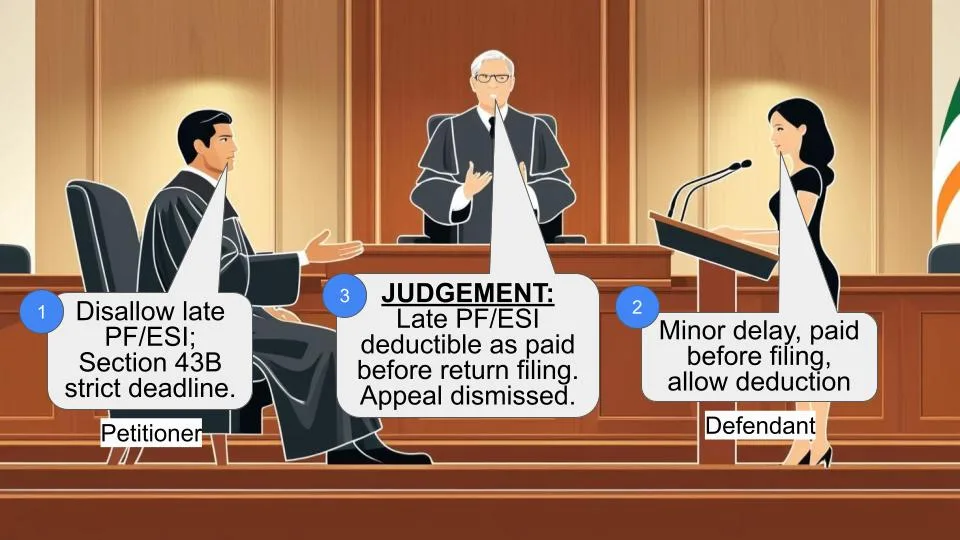
this case is all about a dairy company that got into a bit of a tax tangle with the Income Tax Department. The company, Udaipur Dugdh Utpadak Sahakari Sangh Limited, made some late payments to their employees' provident fund (PF) and ESI accounts. The tax folks weren't happy about this and tried to add that money back to the company's taxable income. But guess what? The company fought back and won! The court said that as long as they paid up before filing their tax return, it's all good. Pretty neat, right?
Case Name**: Commissioner of Income Tax, Udaipur Vs. M/s. Udaipur Dugdh Utpadak Sahakari Sangh Limited, Udaipur
**Key Takeaways**:
1. Late payments to PF and ESI are deductible if made before filing the tax return.
2. The Supreme Court's decision in CIT v. Vinay Cement Ltd. set a precedent for this interpretation.
3. This ruling provides some flexibility for businesses in managing their tax deductions.
**Issue**:
The main question here was: Can a company claim tax deductions for PF and ESI contributions that were paid after the due date but before filing the tax return?
**Facts**:
Alright, let's break this down:
1. Our dairy company, Udaipur Dugdh Utpadak Sahakari Sangh Limited, filed their tax return for 2006-07 on October 30, 2006.
2. They had made some PF and ESI payments late - after the 15th of the following month, which was the due date.
3. The Assessing Officer wasn't happy about this and added Rs. 14,60,412 (PF) and Rs. 973 (ESI) back to the company's taxable income.
4. The company appealed, and both the Commissioner of Income Tax (Appeals) and the Income Tax Appellate Tribunal sided with the company.
5. The tax department wasn't ready to give up and took the case to the High Court.
**Arguments**:
The tax department argued:
1. The law changed in 2003, and now employee contributions should be treated differently from employer contributions.
2. Late payments shouldn't be allowed as deductions under Section 36(1)(va) (of Income Tax Act, 1961).
The company's stance:
1. They made the payments before filing the tax return, so it should be allowed as a deduction.
2. Previous court decisions support their position.
**Key Legal Precedents**:
1. CIT v. Vinay Cement Ltd. (2009) 313 ITR (St.) 1: The Supreme Court said that if you contribute to the provident fund before filing your return, you can claim the benefit under section 43B (of Income Tax Act, 1961).
2. Commissioner of Income Tax v. Alom Extrusions Ltd. (2009) 319 ITR 306: The Supreme Court explained the history and purpose of section 43B (of Income Tax Act, 1961).
3. Commissioner of Income-Tax v. AIMIL Ltd (2010) 321 ITR 508 (Delhi): The Delhi High Court agreed that if payments are made before filing the return, the benefit can be claimed.
**Judgement**:
The High Court dismissed the tax department's appeal. They said:
1. The Supreme Court has already settled this issue in the Vinay Cement case.
2. As long as the company pays the PF and ESI contributions before filing their tax return, they can claim the deduction.
3. The company won, and they get to keep their tax deduction!
**FAQs**:
1. Q: Does this mean companies can always pay PF late without consequences?
A: Not exactly. They might still face penalties under PF and ESI laws, but for income tax purposes, they can claim the deduction if paid before filing the return.
2. Q: What if a company pays after filing the tax return?
A: In that case, they probably couldn't claim the deduction. The key is paying before filing the return.
3. Q: Does this apply to all types of statutory payments?
A: This case specifically dealt with PF and ESI contributions. Other types of payments might have different rules.
4. Q: How does this help businesses?
A: It gives them a bit more flexibility in managing their cash flow, as long as they make the payments before their tax filing deadline.

The defect pointed out by the office is over ruled.
This appeal has been filed by the Revenue aggrieved by the order dated 16.12.2011 passed by the Income Tax Appellate Tribunal, Jodhpur Bench, Jodhpur ('ITAT') in ITA No.351/JU./2010 for the assessment year 2006-07, whereby, the appeal filed by it against the order dated 15.03.2010 passed by the Commissioner of Income Tax (Appeals), Udaipur ['CIT (A)') has been dismissed.
The facts in brief are that the assessee is engaged in the business of dairy product, processing and marketing of milk and milk product and cattle feed etc. It filed its return of income for the assessment year 2006-07 on 30.10.2006 declaring total D.B. INCOME TAX APPEAL NO.48/2012 Commissioner of Income Tax, Udaipur Vs. M/s. Udaipur Dugdh Utpadak Sahakari Sangh Limited, Udaipur.
income of Rs.9,80,723/-. While completing the assessment under Section 143(3) (of Income Tax Act, 1961) ('the Act') vide its order dated 26.12.2008 the Assessing Officer (AO) noticed that the assessee had deposited payment of Rs.14,60,412/- in the PF fund and Rs.973/- in the ESI fund with delay that is the said payments were deposited after the due dates i.e. after 15th next month and, therefore, added the said amount to the income of the assessee as per the provisions of Section 36(1)(va) (of Income Tax Act, 1961) read with Section 2(24)(x) (of Income Tax Act, 1961). Aggrieved by the assessment order dated 26.12.2008, the assessee filed an appeal before the CIT(A), who, vide its appellate order dated 15.03.2010 after noticing certain judgments came to the conclusion that it is a settled position of law that where payments on account of contribution to the PF, ESI etc. are made within the due date of filing the return, such deductions are allowable. It was further noticed that it was not in dispute that the PF contribution and ESI was deposited by the appellant before the due date of filing the return and, consequently, the CIT(A) deleted the dis-allowance made by the AO and granted a relief of Rs.14,61,385/-.
The order dated 15.03.2010 passed by the CIT(A) was questioned by the Revenue before the ITAT and, the ITAT by its order dated 16.12.2011 upheld the order passed by the CIT(A) on the said issue, inter alia, holding that the employees' contribution is allowable, if the same is paid before the due date of return.
D.B. INCOME TAX APPEAL NO.48/2012 Commissioner of Income Tax, Udaipur Vs.M/s. Udaipur Dugdh Utpadak Sahakari Sangh Limited, Udaipur.
It was contended by learned counsel for the Revenue that the CIT(A) and ITAT fell in error in deleting the addition made under Section 36(1)(va) (of Income Tax Act, 1961) read with Section 2(24)(x) (of Income Tax Act, 1961) without considering the facts and legal aspect involved therein.
It was submitted with reference to Section 43B (of Income Tax Act, 1961) that the deletion of second proviso therein, after the amendment by the Finance Act, 2003; the contribution of the employer is governed by provisions of Section 43B (of Income Tax Act, 1961), whereas, employees' contribution continues to be governed by provision of Section 36(1)(va) (of Income Tax Act, 1961) read with Section 2(24)(x) (of Income Tax Act, 1961) and, therefore, the ITAT fell in error in upholding the order passed by the CIT(A). The effect of deletion of second proviso to Section 43B (of Income Tax Act, 1961) was considered by Hon'ble Supreme Court in Commissioner of Income Tax v. Alom Extrusions Ltd. : (2009) 319 ITR 306 and it was observed at page 314 of the report as under:-
“.......section 43B (of Income Tax Act, 1961) (main section), which stood inserted by the Finance Act, 1983, with effect from April 1, 1984, expressly commences with a non obstante clause, the underlying object being to disallow deductions claimed merely by making a book entry based on the mercantile system of accounting. At the same time, section 43B (of Income Tax Act, 1961) (main section) made it mandatory for the Department to grant deduction in computing the income under section 28 (of Income Tax Act, 1961) in the year in which tax, duty, cess, etc., is actually paid. However, Parliament took cognizance of the fact that the accounting year of a company did not always tally with the due dates under the Provident Fund Act, Municipal Corporation Act (octroi) and other tax laws.
Therefore, by way of the first proviso, an incentive/relaxation was sought to be given in respect of tax, duty, cess or fee by explicitly stating that if such tax, duty, cess or fee is paid before the date of filing of the return under the Income-tax Act (due date), the assessee(s) then would be entitled to deduction.
However, this relaxation/incentive was restricted only to
D.B. INCOME TAX APPEAL NO.48/2012 Commissioner of Income Tax, Udaipur Vs. M/s. Udaipur Dugdh Utpadak Sahakari Sangh Limited, Udaipur.
tax, duty, cess and fee. It did not apply to contributions to labour welfare funds. The reason appears to be that the employer(s) should not sit on the collected contributions and deprive the workmen of the rightful benefits under social welfare legislations by delaying payment of contributions to the welfare funds. However, as stated above, the second proviso resulted in implementation problems, which have been mentioned hereinabove, and which resulted in the enactment of the Finance Act, 2003, deleting the second proviso and brining about uniformity in the first proviso by equating tax, duty, cess, and fee with contributions to welfare funds.”
Further the Hon'ble Supreme Court in CIT v. Vinay Cement Ltd. : (2009) 313 ITR (St.) 1 while dismissing the Special Leave Petition preferred by the Revenue against the judgment of the Guwahati High Court observed as under:-
“In the present case we are concerned with the law as it stood prior to the amendment of section 43B (of Income Tax Act, 1961). In the circumstances the assessee was
entitled to claim the benefit in section 43B (of Income Tax Act, 1961) for that period particularly in view of the fact that he has contributed to provident fund before filing of the return.”
Following the observations of Hon'ble Supreme Court in Vinay Cement (supra), the Delhi High Court in Commissioner of Income-Tax v. AIMIL Ltd : (2010) 321 ITR 508 (Delhi) held at page 518 as under:-
“We may only add that if the employees' contribution is not deposited by the due date prescribed under the relevant Acts and is deposited late, the employer not only pays interest on delayed payment but can incur penalties also, for which specific provisions are made in the Provident Fund Act as well as the ESI Act. Therefore, the Act permits the employer to make the deposit with some delays, subject to the aforesaid consequences. In so far as the Income-tax Act is concerned, the assessee can get the benefit if the actual payment is made before the return is filed, as per the principle laid down by the Supreme Court in Vinay Cement (2009) 313 ITR (St.) 1.”
D.B. INCOME TAX APPEAL NO.48/2012 Commissioner of Income Tax, Udaipur Vs. M/s. Udaipur Dugdh Utpadak Sahakari Sangh Limited, Udaipur.
In view of the settled legal position, the appeal preferred by the Revenue has no substance and the same is, therefore, dismissed. No costs.
(ARUN BHANSALI),J. (NARENDRA KUMAR JAIN),J.
×
Similar Ripples
Questions
Supreme Court Upholds Tax Deduction for Delayed PF Contributions
Write your CommentSimilar Posts


Generic
- Reportdata/5849.pdf
