


Tax Deduction Upheld for Mineral Processing in Special Economic Zone





Full News
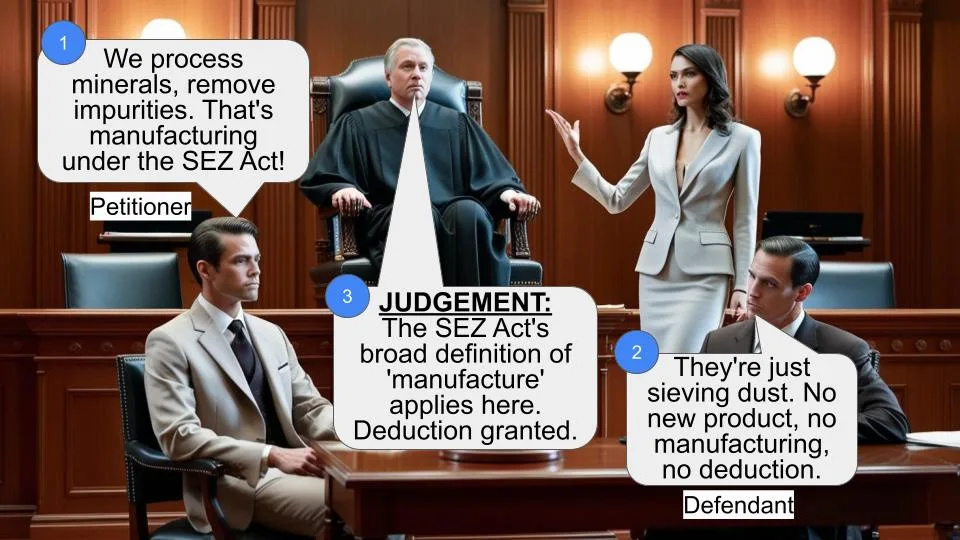
Tax Deduction Upheld for Mineral Processing in Special Economic Zone
Tax Deduction Upheld for Mineral Processing in Special Economic Zone
It's about a company called M/s. Vetrivel Minerals that was denied a tax deduction by the Income Tax Department. The company claimed they were doing manufacturing in a Special Economic Zone (SEZ), but the tax folks disagreed. Long story short, the company won their appeal, and the High Court agreed with them. Let's break it down, shall we.
Get the full picture - access the original judgement of the court order here
Case Name:
Commissioner of Income Tax Circle Vs M/s Vetrivel Minerals (High Court of Madras)
Tax Case Appeal No.605 of 2018
Date: 21st July 2020
Key Takeaways:
1. The definition of "manufacture" in the Special Economic Zone Act, 2005 is pretty broad.
2. Even processes that don't create entirely new products can qualify as manufacturing.
3. Tax authorities should consider all evidence, not just superficial documents like gate passes.
4. The courts will look at the actual processes involved, not just the names of products.
Issue:
The main question here was: Is M/s. Vetrivel Minerals eligible for a tax deduction under Section 10AA (of Income Tax Act, 1961), for their activities in a Special Economic Zone, even if they're not creating an entirely new product?
Facts:
1. M/s. Vetrivel Minerals filed their tax return for 2013-14, claiming a total income of Rs.3,16,61,350/-.
2. They claimed a deduction under Section 10AA (of Income Tax Act, 1961) for their SEZ unit.
3. The Income Tax Department said, "Hold up! You're not really manufacturing anything new here."
4. The company said they were processing minerals, removing impurities, and creating a marketable product.
5. The case went through several rounds of appeals before landing in the High Court.
Arguments:
The tax folks said:
- The raw material and finished product are basically the same thing.
- The company is just doing some minor sieving to remove dust particles.
- That's not manufacturing, so no tax deduction for you!
The company argued:
- Hey, we're doing more than just sieving!
- We're taking semi-finished materials that aren't marketable and turning them into something useful.
- We're removing silicon, sand, and waste - that's manufacturing according to the SEZ Act.
Key Legal Precedents:
Interestingly, this case didn't rely heavily on previous court decisions. Instead, it focused on interpreting the definition of "manufacture" in Section 2(r) of the Special Economic Zone Act, 2005. This definition is pretty broad and includes processes that result in a new product with a different name, character, or use.
Judgement:
The High Court sided with M/s. Vetrivel Minerals. Here's why:
1. The court said the tax department got hung up on the name used in the gate pass and ignored other evidence.
2. They accepted that the company was indeed processing the minerals and removing 10-20% impurities.
3. The court noted that the semi-finished product the company bought wasn't marketable without further processing.
4. They also considered a certificate from the Assistant Development Officer confirming the company's production activities.
5. In the end, the court said this qualifies as 'manufacture' under the SEZ Act, so the company gets their tax deduction.
FAQs:
1. Q: Does this mean any process in an SEZ can qualify for tax deductions?
A: Not exactly. The process still needs to result in a product with a different name, character, or use. But the bar for "manufacturing" might be lower than some people thought.
2. Q: Why did the initial tax assessment go against the company?
A: It looks like the tax officer relied too heavily on the gate pass description and didn't consider all the evidence about the actual processes involved.
3. Q: Could this decision affect other companies in Special Economic Zones?
A: Potentially, yes. It might encourage companies doing similar processing activities in SEZs to claim tax deductions under Section 10AA (of Income Tax Act, 1961).
4. Q: What's the takeaway for tax authorities from this case?
A: They should look beyond surface-level descriptions and consider the actual processes and value addition happening in SEZ units.
5. Q: Does this mean the definition of "manufacturing" is the same for all tax purposes?
A: Not necessarily. This case specifically dealt with the definition under the Special Economic Zone Act, which might be broader than in other contexts.

This appeal by the revenue filed under Section 260A (of Income Tax Act, 1961) (the 'Act' for brevity), is directed against the order dated 20.09.2017 in ITA No.706/Mds/2017 on the file of the Income Tax Appellate Tribunal, Chennai, 'A' Bench, for the Assessment Year 2013-14.
2. The Tax Case Appeal was admitted on 24.08.2018 on the following Substantial Questions of Law.
"(a) Whether the Tribunal was right in holding that the assessee is eligible for deduction U/s.10AA (of Income Tax Act, 1961), even though the assessee is not carrying on any manufacturing at its SEZ Unit?
(b) Whether the Tribunal was right in holding that the assessee is carrying on manufacturing activity even though a new product having a distinctive name, character or use was not brought into existence at its SEZ Unit by the assessee as per Special Economic Zone Act 2005?"
3. We have heard Mrs.Premalatha, learned standing counsel for the appellant/revenue and Mr.S.Raj Makesh, learned counsel appearing for the respondent / assessee.
4. The assessee filed their return of income for the Assessment Year under consideration 2013-14 on 27.09.2013, admitting total income of Rs.3,16,61,350/-. The assessment was selected for scrutiny by issuance of notice under Section 143 (of Income Tax Act, 1961)[2] dated 02.09.2014 and the Assessing Officer rejected the claim of the assessee, who claimed deduction under Section 10AA (of Income Tax Act, 1961), on the ground that the raw material and the finished product are one and the same and there was no manufacturing activity having taken place in the SEZ unit of the assessee.
5. The assessee filed an appeal before the Commissioner of Income Tax (Appeals)-III, Madurai, (the CIT(A), for brevity). The appeal was allowed by an order dated 07.12.2016, alleging that the processes carried out by the assessee in their SEZ unit, results in a new product having a different name, character or use, as per the definition of "manufacture", as defined under Section 2(r) of the Special Economic Zone Act, 2005[the 'SEZ Act', for brevity].
6. The revenue filed an appeal before the tribunal and by the impugned order, the appeal was dismissed.
7. After elaborately hearing the learned counsels for the parties, we find that the entire issue involved in the instant case is fully factual and in our considered view, no question of Law much less any Substantial Question of Law, arises for consideration. We support such conclusion with the following reasons.
8. The Assessing Officer denied the benefit of the deduction claimed by the assessee on the grounds that what was imported by the assessee and what was exported are the same product and therefore, there was no manufacturing activity done by the assessee to be eligible to claim deduction. In fact, an Inspector from the department had visited the factory to acquaint himself with the process adopted by the assessee in their SEZ Unit. This fact has been recorded by the Assessing Officer in the order of assessment dated 30.03.2016. But, the Assessing Officer, chose to refer to the 'Gate Pass' issued by the Government wherein the description of the goods, is shown as 'Tailings rich in ilemnite'. Further the Assessing Officer opined that a minor activity of sieving to separate dust particles only is carried out in the SEZ units and hence, it does not amount to manufacturing.
9. Before the CIT(A), the assessee had explained in detail about the process adopted by them. A certificate has been given by the Assistant Development Officer dated 28.03.2013, certifying that the assessee's unit has commenced production on 29.02.2012. Further, the assessee has stated that the export invoice was submitted to the Assessing Officer during the assessment procedure. However, the same was ignored and was not taken into consideration.
10. The CIT(A) after considering the factual position accepted the submission of the assessee that the semi finished material purchased by the assessee is not marketable and usable in the industry, as what is purchased by the assessee includes silicon, sand and waste, which cannot be marketed as such, unless the waste materials are removed. The flow chart, which was produced by the assessee before the Assessing Officer, was referred to CIT(A) and he came to the conclusion that the Assessing Officer was himself mislead by the nomenclature used in the Gate Pass. After considering the factual materials, the CIT(A) concluded that the process done by the assessee would qualify as 'manufacture', under the SEZ Act.
11. The Revenue carried the matter by way of appeal to the tribunal and the tribunal once again re-appreciated the factual position and found that there is a process of 'manufacture' as defined under the SEZ Act,which takes place in the SEZ unit and also pointed out that the Assessing Officer himself has accepted that the assessee's unit, processed the raw materials by removing 10 to 20% impurities. Cost comparison of the semi finished product with that of the raw material was also referred to and it was also pointed out that the Assessing Officer could not establish that the assessee has suppressed the purchase cost of semi-finished goods in order to claim higher deduction under Section 10AA (of Income Tax Act, 1961).
Furthermore, the certificate issued by the Assistant Development Officer was accepted on the ground that the revenue could not prove the same to be not genuine. Therefore, the tribunal sustained the factual finding recorded by the CIT(A).
12. Thus, in our considered view, the entire factual matrix has not only been analyzed by the CIT(A), but, also by the tribunal. Therefore, we are convinced to observe that no question of Law much less any Substantial Question of Law arises for consideration in this appeal.
Accordingly the Tax Case Appeal fails and the same is dismissed. No Costs.
T.S.SIVAGNANAM, J.
AND
V.BHAVANI SUBBAROYAN, J.
×
Similar Ripples
Questions
Tax Deduction Upheld for Mineral Processing in Special Economic Zone
Write your CommentSimilar Posts

Generic
- Reportdata/6216.pdf
