


Full News
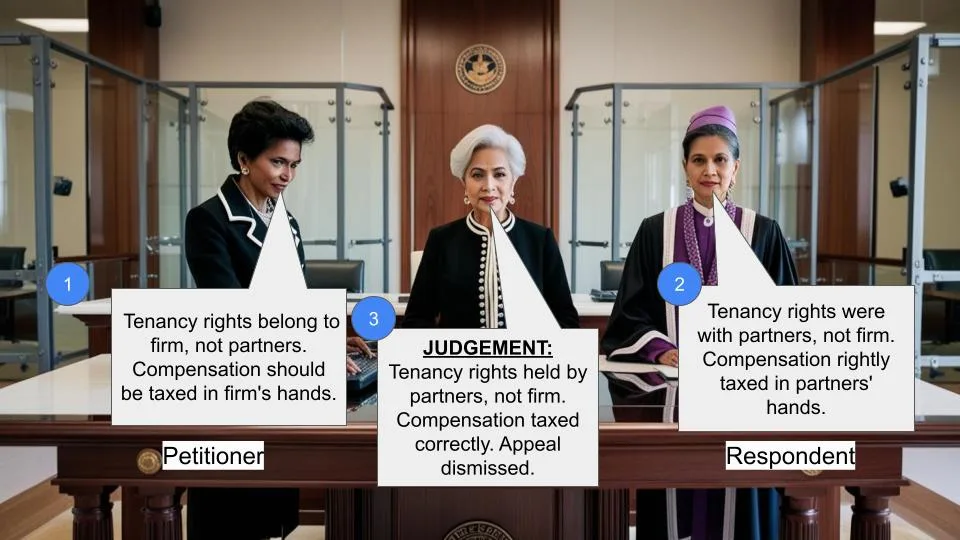
Tenancy Rights Belong to Individual Partners, Not Firm, Rules Court
Tenancy Rights Belong to Individual Partners, Not Firm, Rules Court
The case involves the Commissioner of Income Tax and Bombay Electric Laundry, where the main issue was whether the tenancy rights of a rental property belonged to the firm or its individual partners. The court ruled that the tenancy rights were held by the individual partners, and thus, the compensation received for surrendering these rights should be taxed in their hands, not the firm's.
Get the full picture - access the original judgement of the court order here.
Case Name:
Commissioner of Income Tax vs. Bombay Electric Laundry (High Court of Bombay)
Income Tax Appeal No. 56 of 2013
Key Takeaways
- The court confirmed that the tenancy rights of the rental premises were held by the individual partners, not the firm.
- Compensation received for surrendering tenancy rights was correctly shown in the individual partners' tax returns.
- The court upheld the decisions of the CIT(A) and the Tribunal, which had both ruled in favor of the individual partners.
- The appeal by the Revenue was dismissed as no substantial question of law was found.
Issue
Whether the tenancy rights were vested in the Respondent-Assessee (the firm) or in its individual partners for the purpose of determining who is liable to pay tax on the compensation received for surrendering the tenancy rights?
Facts
- The Respondent-Assessee was operating from a rental property owned by Mr. V. Shantaram.
- During an assessment, an agreement was found indicating the surrender of tenancy by the firm to a builder for Rs.2.50 Crores.
- The firm claimed that the tenancy rights were held by the individual partners, not the firm.
- The partners had disclosed the compensation in their individual tax returns and claimed benefits under Section 54EC (of Income Tax Act, 1961).
- The Assessing Officer taxed the compensation in the hands of the firm, which was contested by the firm.
Arguments
- Revenue's Argument:
The tenancy rights belonged to the firm as the rent was paid by the firm and the Tripartite Agreement did not mention the individual partners.
- Respondent-Assessee's Argument:
The tenancy rights were originally allotted to the partners' predecessors, and the firm was included in the agreement at the builder's insistence. The compensation was received by the partners, not the firm.
Key Legal Precedents
- The court referred to the findings of the CIT(A) and the Tribunal, which were based on the examination of documents, including a letter from the Deputy Custodian of Evacuee Property and the Partnership Deed. These documents supported the claim that the tenancy rights were held by the individual partners.
Judgement
The court dismissed the appeal by the Revenue, confirming that the tenancy rights were held by the individual partners and not the firm. The compensation received for surrendering these rights was correctly taxed in the hands of the individual partners. The court found no substantial question of law to entertain the appeal.
FAQs
Q1: Why was the firm included in the Tripartite Agreement?
A1: The firm was included at the builder's insistence to ensure a clear title to the property.
Q2: Who received the compensation for surrendering the tenancy rights?
A2: The individual partners received the compensation, not the firm.
Q3: What was the court's final decision?
A3: The court upheld the decisions of the CIT(A) and the Tribunal, ruling that the tenancy rights belonged to the individual partners and dismissing the Revenue's appeal.
Q4: What is Section 54EC (of Income Tax Act, 1961)?
A4: Section 54EC (of Income Tax Act, 1961) provides for exemption from capital gains tax if the gains are invested in specified bonds, such as those issued by NABARD.
Q5: Did the court find any substantial question of law in this case?
A5: No, the court did not find any substantial question of law and thus dismissed the appeal.

1. This Appeal under Section 260A (of Income Tax Act, 1961) (the Act), challenges the order dated 13th June, 2012 passed by Income Tax Appellate Tribunal (the Tribunal) .
2. The Assessment Year (A. Y.) involved is A. Y. 2006-07.
3. The following question of law has been formulated by the Revenue for our consideration:
“ Whether on the facts and in the circumstances of the case and in law, the Tribunal was justified in sustaining the order of the CIT(A) and thereby deleting the additions made by the A. O. at Rs.2.50 Crores on account of compensation received on surrender of tenancy rights?”
4. The basic issue which arises in this Appeal is whether tenancy rights are vested in the RespondentAssessee or in its individual partners for purposes of determining who is liable to pay tax on the compensation received on surrender of tenancy.
5. The RespondentAssessee was carrying on business from a rental premises owned by one Mr. V. Shantaram. During the course of assessment proceeding, the Assessing Officer consequent to a survey discovered an Agreement indicating surrender of tenancy by the Respondentfirm in favour of builder–M/s. Veera & Gala Developers. The above agreement provided for a compensation of Rs.2.50 Crores as a consideration for surrender of tenancy by the RespondentAssessee. During assessment proceedings, the RespondentAssessee submitted that the tenancy of the premises was in the name of the partners individually and not in the name of the firm. The Respondent- Assessee pointed out that the rented premises was alloted to Mr. Ratwani and Mrs. Ratwani who had migrated from Pakistan as is evident from the communication of the Deputy Custodian of Evacuee Property to the landlord – Mr. V. Shantaram dated 21st December, 1959, directing the landlord to treat Mr. Ratwani and Mrs. Ratwani as his direct tenants. The present partners of the RespondentFirm are legal heirs of Ratwani's to whom the tenancy was originally allotted. It was brought to the notice of the Assessing Officer that the RespondentAssessee was made a party to the Agreement at the instance of the builder to ensure a title free of any doubt. The payment was made to the partners and not to Respondent- Assessee by the builder. Further, the partners on receipt of the consideration of Rs.2.50 Crores from the developer had invested the same in NABARD bond for the purpose of exemption under Section 54EC (of Income Tax Act, 1961). As an alternative, it was submitted that the benefits claimed on exemption under Section 54EC (of Income Tax Act, 1961) be extended to the Respondent- firm. The Assessing Officer did not accept either of the two submissions and brought to tax an amount of Rs.2.50 Crores in the hands of the RespondentAssessee.
6 In Appeal, the Commissioner of Income Tax (Appeals) [CIT(A)] by order dated 25th March, 2009 set aside the order of the Assessing Officer. This was on examination of all documents beginning with the letter dated 21st December, 1959 – wherein the landlord was directed by the Deputy Custodian of Evacuee Property to treat the Ratwani's in there individual capacity as a tenants. The Partnership Deed constituting the RespondentAssessee was also examined to conclude that the tenancy rights in respect of the rental premises did not belong to the RespondentAssessee but to its partners to their individual capacity.
Accordingly, appeal of the RespondentAssessee was allowed.
7. The Revenue carried the issue in further Appeal to the Tribunal. By the impugned order, the Tribunal upheld the findings of the CIT(A) and held that the tenancy rights of the rental premises/ properties was always held by the partners and never by the firm. In view of the above, Appeal filed by the Revenue was dismissed by the impugned order dated 13th June, 2012.
8. Mr. Malhotra, learned Counsel appearing for the Revenue submits that the Tripartite Agreement found during the course of survey was entered into between landlord, RespondentAssessee and the builder. The individual partners who claim to be tenants of the said premises do not find any mention therein. Besides, the rent in respect of the office premises were always paid by the firm. Both these factors would indicate that the tenancy of the rental premise belonged to the firm and not to the individual partners.
9. We find that the RespondentAssessee had in fact before Assessing Officer pointed out that the Tripartite Agreement was entered into, making RespondentAssessee party thereto was on the insistence of the builders so as to take care of builders apprehension in respect of the said property. It was also pointed out that sale consideration was received by the individual partners and not by the firm from the builders. So far as payment of the rent by the firm is concerned, it was a normal allowable business expenditure of the firm. Thus, both the CIT(A) and the Tribunal have come to a concurrent finding of the fact on examination of evidence that the tenancy of the rental premises belonged to the individual partners and not to the RespondentAssessee. It is also noticed that the amounts received by the partners in the individual capacity, was disclosed in their return of income claiming the benefit of Section 54EC (of Income Tax Act, 1961).
10. We find that as conclusion is based on concurrent finding of fact, no substantial question of law arises for us to entertain the present Appeal.
11 Accordingly, Appeal is dismissed. No order as to costs.
(G.S.KULKARNI,J.) (M.S.SANKLECHA,J.)
×
Similar Ripples
Questions
Tenancy Rights Belong to Individual Partners, Not Firm, Rules Court
Write your CommentSimilar Posts



Generic
- Reportdata/4135.pdf
