


Full News

Court remands income tax case for fresh adjudication on mixed questions of law and fact.
Court remands income tax case for fresh adjudication on mixed questions of law and fact.
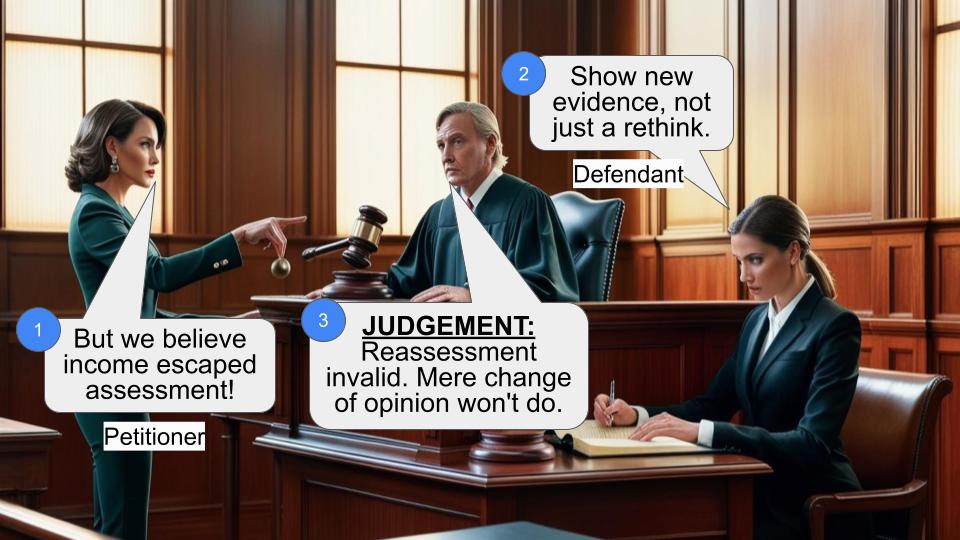
This case involves Raj Kumar Tewatia challenging the Income Tax Appellate Tribunal's decision regarding the validity of an income tax assessment notice and the status under which his income was assessed. The High Court set aside the Tribunal's order and remanded the case for fresh adjudication.
Get the full picture - access the original judgement of the court order here.
Case Name:
Raj Kumar Tewatia vs Commissioner of Income Tax (High Court of Punjab and Harayana)
ITA No. 305 of 2009
Key Takeaways
- The High Court found that the case raised mixed questions of law and fact, necessitating a fresh adjudication by the Tribunal.
- The Tribunal's decision to assess the appellant's income in the status of 'individual' was contested, given that previous assessments were made in the status of 'HUF' (Hindu Undivided Family).
- The case highlights the importance of proper notice and the correct status of assessment in income tax proceedings.
Issue
Whether the Tribunal was correct in its decision to assess the appellant's income in the status of 'individual' and whether the notice issued under Section 143(2) (of Income Tax Act, 1961) was valid.
Facts
- Raj Kumar Tewatia received enhanced compensation and interest from the Haryana Urban Development Authority (HUDA) for acquired agricultural lands.
- The appellant filed returns in the status of 'individual' for the assessment year 2000-01 but later contested this status, arguing it should be 'HUF'.
- The Assessing Officer issued a notice under Section 143(2) (of Income Tax Act, 1961) in the status of 'individual', which the appellant claimed was time-barred and invalid.
- The Tribunal initially set aside the assessment and remanded the case, but the revenue's appeal led to further legal proceedings.
Arguments
- Appellant's Arguments:
The appellant argued that the assessment in the status of 'individual' was null and void, citing the Supreme Court's decision in Assistant Commissioner of Income-tax v. Hotel Blue Moon. They also contended that the enhanced compensation was not taxable as it was under dispute.
- Respondent's Arguments:
The revenue relied on Section 292BB (of Income Tax Act, 1961) and the judgment in CIT v. Panchvati Motors (P) Ltd., arguing that the notice and assessment were valid.
Key Legal Precedents
- Assistant Commissioner of Income-tax v. Hotel Blue Moon:
This case was cited by the appellant to argue that the assessment in the status of 'individual' was invalid.
- CIT v. Panchvati Motors (P) Ltd.:
The revenue cited this case to support the validity of the notice and assessment.
Judgement
The High Court set aside the Tribunal's order dated 12.12.2008 and remanded the case for fresh adjudication. The Tribunal was instructed to hear the parties again and pass a speaking order in accordance with the law.
FAQs
Q1: What was the main issue in this case?
A1: The main issue was whether the Tribunal was correct in assessing the appellant's income in the status of 'individual' and whether the notice issued under Section 143(2) (of Income Tax Act, 1961) was valid.
Q2: What did the High Court decide?
A2: The High Court set aside the Tribunal's order and remanded the case for fresh adjudication, citing mixed questions of law and fact.
Q3: What legal precedents were cited?
A3: The appellant cited Assistant Commissioner of Income-tax v. Hotel Blue Moon, while the revenue cited CIT v. Panchvati Motors (P) Ltd.
Q4: What is the significance of this case?
A4: The case underscores the importance of proper notice and the correct status of assessment in income tax proceedings, as well as the need for thorough judicial review when mixed questions of law and fact are involved.

1. This appeal has been preferred by the assessee under Section 260A (of Income Tax Act, 1961) (in short “the Act”) against the order dated 12.12.2008 (Annexure A-11) passed by the Income Tax Appellate Tribunal, Delhi Bench “G”, New Delhi (hereinafter referred to as “the Tribunal”) in ITA No. 1956/Del/2007 for the assessment year 2000-01, claiming the following substantial questions of law:-
(i) Whether on the facts and circumstances of the case the Tribunal was legally correct in taking the view that the CIT(A) was not justified in entertaining the grounds regarding validity of notice under Section 143(2) (of Income Tax Act, 1961) issued to the appellant herein being time barred and the assessment framed in the status of 'Individual' being null and void as per law as the same had not been challenged either before the CIT(A) or before the ITAT before the remand order was passed by the latter?
(ii) Whether on the facts and circumstances of the case the Tribunal is legally correct in holding that the CIT(A) should have declined to admit additional grounds, even when the assessment framed in the status of 'Individual' is null and void as per law?
(iii) Whether the Tribunal was legally correct in ignoring the judgment of a coordinate Bench in the case of the appellant for assessment year 2001-02 admitting the ground/plea with regard to assessment having been framed in wrong status affecting the jurisdiction of the Assessing Officer going to the root of the matter, admittedly not requiring any investigation into the facts and thereby being void?
(iv) Whether the Tribunal was legally correct in reversing the order of the CIT(A) even when the order of assessment passed under Section 143(3) (of Income Tax Act, 1961) was bad in law on account of notice under Section 143(2) (of Income Tax Act, 1961) issued to the appellant herein being time barred in view of the express provisions of Section 143(2) (of Income Tax Act, 1961)?
(v) Whether the Tribunal misdirected itself in law as well as on facts in recording its conclusion based on irrelevant findings while reversing the order of the CIT(A)?
(vi) Whether the impugned order passed by the Tribunal is perverse, contrary to judicial discipline and institutional integrity and as a result of non application of correct principles of law to factual position emerging from the material on record?
2. The facts, in short, necessary for adjudication of the instant appeal as narrated therein are that consequent to the acquisition of agricultural lands acquired by the Haryana Urban Development Authority (HUDA), the appellant received enhanced compensation and interest during the financial years 1999-2000, 2000-01 and 2001-02 relevant to the assessment years 2000-01, 2001-02 and 2002-03 on furnishing of security as the enhanced compensation was being challenged by the HUDA in this Court. As the income of the assessee in the status of HUF was not liable to be subjected to income-tax, return of income was not filed. However, the return of income in the status of individual was filed by the assessee for the assessment year 2000-01 on 14.6.2000 under Section 139(1) (of Income Tax Act, 1961). The Assessing Officer issued a notice dated 7.2.2002 under Section 142(1) (of Income Tax Act, 1961) to the effect that since the appellant had received the enhanced compensation from HUDA, he should file return of income for the assessment year 2000-01 which the assessee did on 25.2.2002. In the computation of income, it was stated that since the Land Acquisition Collector and the assessee are in appeal before this Court, therefore, the enhanced compensation of ` 28,37,047/- received during the year under consideration was not taxable. The Assessing Officer issued notice dated 26.9.2002 to the assessee under Section 143(2) (of Income Tax Act, 1961) in the status of individual. However, on the basis of the return filed by the appellant and in compliance thereto, the assessee submitted a letter dated 15.11.2002 stating therein that the award of enhanced compensation is disputed in appeal before this Court. The Assessing Officer vide assessment order dated 23.12.2002 (Annexure A-1) assessed the enhanced compensation of 28,37,047/- for the assessment year 2000-01 in the status of individual. Feeling aggrieved, the assessee filed an appeal before the Commissioner of Income Tax (Appeals) [for brevity “the CIT(A)”]. The CIT(A) dismissed the appeal of the assessee against which the assessee filed an appeal before the Tribunal. The Tribunal vide order dated 13.7.2004 (Annexure A-2) set aside the assessment order (Annexure A-1) and remanded the matter back to the Assessing Officer for deciding the question in the light of the decision of the Karnataka High Court in Chief Commissioner of Income-Tax and aother v. Smt. Shantavva (2004) 267 ITR 67 (Kar.). Being dissatisfied, the revenue filed an appeal bearing ITA No. 108 of 2005 in this Court against the order dated 13.7.2004 (Annexure A-2) which is still pending adjudication.
The assessee had also filed returns of income for the assessment year 2001-02 on 25.2.2002 under Section 139(4) (of Income Tax Act, 1961) and for assessment year 2002-03 in compliance with the notice under Section 148 (of Income Tax Act, 1961) in the status of HUF. The Assessing Officer made the assessment for the assessment year 2001-02 on 23.12.2002 (Annexure A-3) in the status of 'individual' and for the assessment year 2002-03 on 27.12.2004 (Annexure A-4) in the status of 'HUF' and assessed the enhanced compensation and interest in the year of receipt. Feeling aggrieved, the assessee filed appeals before the CIT(A) who vide orders dated 9.11.2004 and 29.3.2005 (Annexures A-5 and A-6, respectively) allowed the appeals by holding that the enhanced compensation and interest received was not taxable as the HUDA had challenged the compensation before this Court and, therefore, the right to receive had not crystallized and become final. Against the order of the CIT(A) for the assessment year 2001-02, the revenue filed an appeal before the Tribunal whereas the assessee filed cross-objections challenging the assessment in the status of 'individual' on the plea that the Assessing Officer had accepted the status of 'HUF' for the assessment year 2002- 03. The Tribunal vide order dated 11.1.2007 (Annexure A-7) restored the matter to the CIT(A) for the assessment year 2001-02 for adjudication in accordance with law. In pursuance thereto, the CIT(A) vide order dated 5.2.2008 (Annexure A-8) allowed the appeal and annulled the assessment against which the revenue filed an appeal before the Tribunal which is pending adjudication. The Income Tax Officer made re-assessment for the assessment year 2000-01 vide order dated 14.2.2006 (Annexure A-9) on being set aside by the Tribunal and assessed the enhanced compensation of ` 28,37,047/- again in the status of 'individual' even when the return was filed in the status of 'HUF'. The said order was challenged before the CIT(A) who vide order dated 8.2.2007 (Annexure A-10) annulled the assessment made in the status of 'individual'. The revenue took the matter in appeal before the Tribunal. The Tribunal vide order dated 12.12.2008 (Annexure A-11) allowed the appeal and sent the matter back to the CIT(A) to decide the issue on merits. Hence, the present appeal.
3. We have heard learned counsel for the parties.
4. Learned counsel for the assessee relying upon the judgment of the Apex Court in Assistant Commissioner of Income-tax v. Hotel Blue Moon, (2010) 188 Taxman 113 (SC), urged that no assessment could be framed in the status of 'individual'. It was further submitted that for the assessment years 2001-02 and 2002-03, the income from the acquired land was assessed in the status of 'HUF' which had attained finality. It was argued that the order of the Tribunal is unsustainable in view of subsequent decision of the Apex Court in Hotel Blue Moon's case (supra) .
5. Learned counsel for the revenue relied upon the provisions of Section 292BB (of Income Tax Act, 1961) inserted w.e.f. 1.4.2008 and also judgment of this Court in CIT v. Panchvati Motors (P) Ltd. (2011) 243 CTR 189. It was contended that in such circumstances, the reliance on Hotel Blue Moon's case (supra) was of no assistance to the assessee.
6. After hearing learned counsel for the parties, we find that the issue arising in this appeal raises mixed question of law and fact and, therefore, it is required to be remanded to the Tribunal to decide afresh in view of the submissions made hereinbefore. Accordingly, the impugned order dated 12.12.2008 (Annexure A-11) passed by the Tribunal is set aside and the matter is remitted to the Tribunal to adjudicate the same afresh after hearing learned counsel for the parties and by passing a speaking order in accordance with law. The appeal stands disposed of.
(AJAY KUMAR MITTAL)
JUDGE
September 1, 2015 (RAMENDRA JAIN)
gbs JUDGE
×
Similar Ripples
Questions
Court remands income tax case for fresh adjudication on mixed questions of law and fact.
Write your CommentSimilar Posts


Generic
- Reportdata/3484.pdf
