


"Capital Gains or Business Income? Court Rules in Favor of Long-Term Capital Ga…




Full News
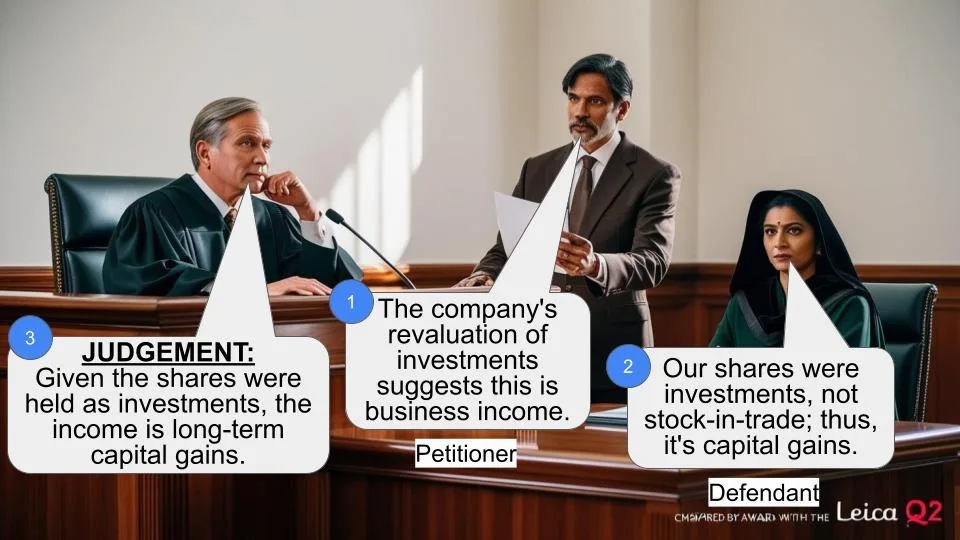
"Capital Gains or Business Income? Court Rules in Favor of Long-Term Capital Gains"
"Capital Gains or Business Income? Court Rules in Favor of Long-Term Capital Gains"
This case involves a dispute between the Commissioner of Income Tax and HMA Data Systems (P) Ltd. The main issue was whether the income from the sale of shares should be taxed as capital gains or business income. The court ruled in favor of treating the income as long-term capital gains, affirming the decision of the lower appellate authorities.
Get the full picture - access the original judgement of the court order here
Case Name:
Commissioner of Income Tax vs. HMA Data Systems (P) Ltd. (High Court of Karnataka)
ITA No. 700 of 2009 C/w ITA No. 684 of 2009
Date: 26th June 2015
Key Takeaways:
- The court affirmed that the income from the sale of shares should be treated as long-term capital gains, not business income.
- The decision highlights the importance of how investments are recorded and treated in financial statements.
- The ruling also addressed the treatment of professional charges and travel expenses related to the sale of shares.
Issue
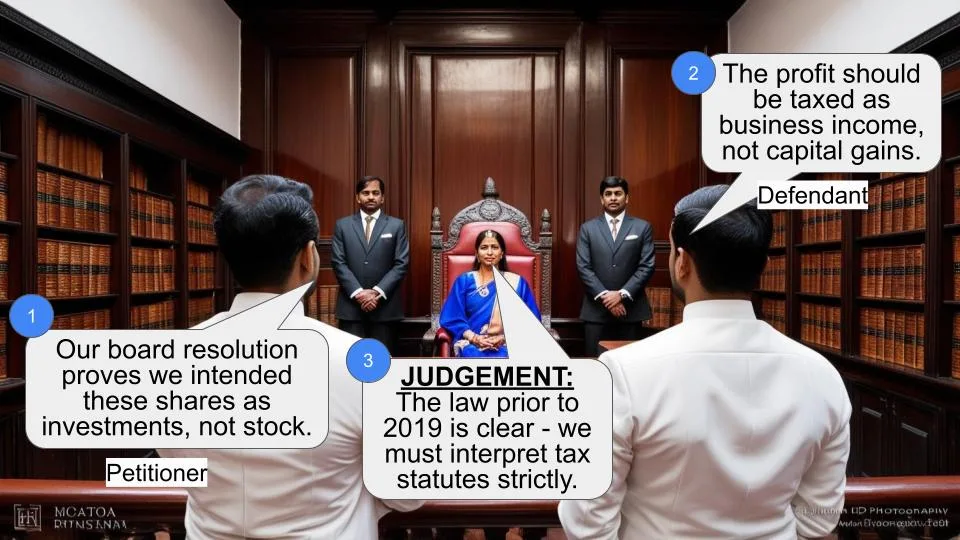
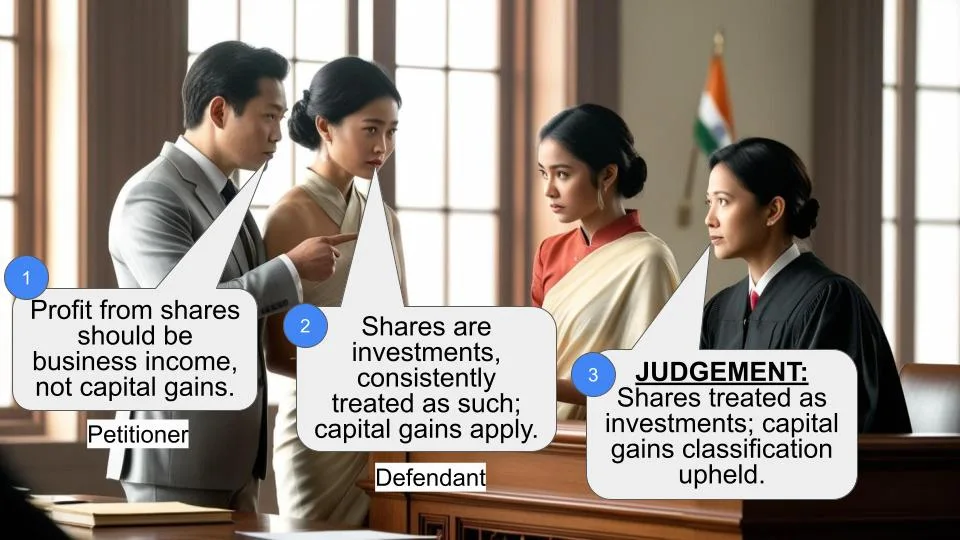
Should the income from the sale of 50,000 shares be taxed as long-term capital gains or as business income?
Facts
- HMA Data Systems (P) Ltd. sold 50,000 shares of Diebold HMA Pvt. Ltd. for a significant profit.
- The company declared this profit as long-term capital gains in its tax return.
- The Assessing Officer disagreed, treating the income as business income due to the company's history of revaluing investments.
- The case was appealed, and the appellate authorities ruled in favor of the company, treating the income as capital gains.
Arguments
- For the Revenue: The income should be treated as business income because the company regularly revalued its investments, indicating a business activity.
- For the Assessee: The income should be treated as capital gains because the shares were held as investments, not as stock-in-trade.
Key Legal Precedents
The judgment did not explicitly cite specific past cases but focused on the interpretation of tax laws regarding the classification of income from the sale of shares.
Judgement
The court ruled in favor of HMA Data Systems (P) Ltd., affirming the decision of the lower appellate authorities. The income from the sale of shares was to be treated as long-term capital gains. The court also upheld the allowance of professional charges related to the sale of shares as part of the capital gains computation.
FAQs
Q1: Why was the income treated as capital gains and not business income?
A1: The court found that the shares were held as investments, not as part of a business activity, which justified treating the income as capital gains.
Q2: What was the significance of the professional charges in this case?
A2: The professional charges were related to the sale of shares and were allowed as deductions in computing the capital gains, not as business expenses.
Q3: How does this case impact future tax assessments?
A3: This case reinforces the importance of how companies classify and report their investments and related income, impacting how such income is taxed.

1. These two appeals have been preferred by the Revenue and the assessee respectively being aggrieved by the order passed by Income Tax Appellate Tribunal, Bangalore Bench in ITA No.1154/Bang/2009 dated 29.05.2009 whereunder the Tribunal has held:
(i) income earned on the sale of 50,000 equity shares of M/s.Diebold HMA Pvt. Ltd., was liable to be brought to tax under the head “Capital gains” and not as “income from business” as held by the assessing officer;
(ii) travel expenditure, professional charges and other expenses in connection with sale of said shares had nexus to such sale; and
(iii) amount paid towards legal charges in respect of such sale was allowed by the CIT(A) was correct.
2. This Court has admitted both the appeals on 24.09.2010 and 27.10.2009 respectively to consider the following substantial questions of law:
1. ITA 700/2009:
(i) “Whether the Appellate Authorities
were correct in holding that the
income of Rs.21,55,47,800/- earned
on the sale of 50,000 equity shares
of M/s.Diebold HMA P. Ltd., was
liable to be brought to tax under the
head “capital gains” and not “income
from business” as held by the
Assessing Officer despite the
assessee increasing the profit and
loss account in respect of the value
of the shares for each assessment
year from the date of purchase i.e.,
assessment year 1992-93?
(ii) Whether the Appellate Authorities
were correct in not taking into
consideration the fact that the
assessee had claimed travel
expenditure, professional charges
and other expenses in connection
with sale of M/s.Diebold HMA P.
Ltd., shares and especially when the
assessee had no other business
income during the current
assessment year?
(iii) Whether the sum of Rs.24,93,800/-
paid to M/s.Amarchand Mangaldas
towards legal charges in respect of
sale of M/s.Diebold HMA P. Ltd.,
shares is liable to be deducted from
the sale value when computing
capital gains tax when the actual
payment accrued and was paid in
the earlier assessment year 2003-04
and allowing the claim during the
current assessment year would
distort the profits of the current
year?”
2. ITA 684/2009:
(i) “Whether the Tribunal was justified
in law in holding that the appellant
is not entitled to the deduction on
account of technical support charges
on the facts and circumstance of the
case?
(ii) Whether the Tribunal was justified in
law disallowing the expenditure
relating to Travel by the executive for
the purpose of business on the facts
and circumstance of the case?
(iii) Whether the Tribunal was justified in
holding that accrual of income is the
precondition for allowing expenditure
on the facts and circumstances of
the case?”
3. Facts in brief which has led to filing of these appeals are as under:
Assessee is a private limited company
engaged in the development of software as well as
manufacture and sale of equipments and maintenance.
For the assessment year 2004-05 return of income
came to be filed declaring its total income at
`3,70,66,590/-. The assessing officer after issuing
notice under section 143(2) (of Income Tax Act, 1961) after selecting the return for
scrutiny has proceeded to frame the assessment order
under Section 143(3) (of Income Tax Act, 1961) by order dated 22.12.2006,
whereunder disallowances to the tune of `2,67,85,610/-
was made. During the previous year relevant to the
assessment year, assessee sold 50,000 shares of
M/s.Diebold HMA Pvt. Ltd., said to have been acquired
by it during the year 1992-93 for a total consideration of
`21,55,47,800/- and declared a long term capital gain
of `20,51,66,634/- in its return of income. However,
the assessee was denied the benefit of long term capital
gain arising from such sale of shares on the ground that
the assessee had been debiting its profit and loss
account with decrease or increase in the value of
investments and as such it should be treated as `income
from business’. It was also noticed by the assessing
officer that professional charges of `1,19,09,768/-
debited to profit and loss account is to be disallowed to
an extent of `24,93,800/- on the ground that such
professional charges related to sale of shares and the
payment relating to this expenditure had been made in
the year 2002-03 but accounted to in the assessment
year 2004-05. Hence, assessing officer came to a
conclusion that payment was made outside the books of
accounts and accordingly disallowed the claim for
deduction to the extent indicated hereinabove.
However, CIT (A) held such payment had been reflected
as advance (pre-paid professional-charges) in that year
and it cannot be allowed while computing business
income, but it has to be allowed in computing the long
term capital gains, since assessee had incurred
expenditure in sale of Diebold HMA shares and same is
to be allowed in computing long term capital gains as
claimed by assessee and his finding came to be affirmed
by Tribunal. Further, assessing officer also disallowed a
sum of ` 18,55,756/- claimed by the assessee as
expenditure relating to abroad travel by the company’s
Managing Director and his wife on the ground that there
was no business activity justifying their foreign travel
for business purposes. A sum of ` 94,74,184/- claimed
by the appellant as `technical support charges’ paid
towards promotion of products and services in North
America was also disallowed on the ground that the
agreement relating to this activity had not been put into
practice which came to be affirmed by CIT (A) and
Tribunal.
4. Thus, revenue being aggrieved by the order
of the Tribunal which affirmed the finding of CIT(A)
insofar as treating the receipt of the amount by the
assessee insofar as sale of shares as ‘capital asset’ and
allowance of the legal fee paid by the assessee as
professional fee to be allowed while computing the long
term capital gains as claimed by the assessee which
finding has been affirmed by the Tribunal has been
questioned by the revenue in ITA No.700/2009. The
assessee being aggrieved by the finding of the assessing
officer who disallowed the expenditure relating to
foreign travel by the Managing Director and his wife and
disallowing the amount paid by the assessee as
‘technical support charges’ to professionals on the
ground that such activity had not been put into practice
came to be affirmed both by the CIT (A) as well as
Tribunal and as such, the assessee has preferred ITA
No.684/2009.
5. We have heard the learned advocates
appearing for the parties and perused the orders passed
by the Tribunal, CIT(A) and the assessing officer.
6. It is the contention of Sri K.V.Aravind,
learned Advocate appearing for the revenue that the
appellate authorities committed an error in holding that
income earned by the assessee on sale of 50,000 equity
shares to be brought under the head “Capital Gains”
and not “Income from Business” though assessee had
increased the profit and loss account in respect of the
value of shares for each assessment year from the date
of purchase of shares namely, from 1992-93. He would
also contend that the amount paid towards legal
charges was liable to be deducted from the sale value
when computing capital gains tax when the actual
payment accrued and was paid in the earlier
assessment year 2003-04 and allowing the claim during
current assessment year would distort the profits of the
current year and contends non-consideration of this
aspect by the appellate authorities have resulted in
erroneous order being passed. Hence, he prays for
answering the substantial questions of law in favour of
the revenue.
7. Per contra, Sri A.Shankar, learned Advocate
appearing on behalf of assessee would support the order
of the Tribunal insofar as it has rejected the claim of the
revenue and he would contend that the authorities
erred in disallowing the traveling expenses incurred by
the assessee and merely because there was no business
activity, per se would not indicate that there was no
business activity by the assessee. He would also
elaborate his submission by contending that
professional charges paid to H.M.A.S., an American
based company was on the basis of contract entered
into by the assessee with the said Firm to render
professional services in the form of market input and
other issues as detailed in the contract and accordingly,
as per the contractual term, a sum of $1,00,000 was to
be paid as upfront amount and accordingly, it was paid.
Non-consideration of said plea of the assessee in this
perspective has resulted in great injustice to the
assessee and hence, he prays for substantial questions
of law being answered in favour of the assessee as
formulated in ITA No.684/2009 and he would also pray
for dismissal of the appeal filed by the revenue.
8. RE: FINDING ON SUBSTANTIAL QUESTION OF LAW NO.(1) FORMULATED IN ITA
NO.700/2009.
At the cost of repetition, it is noticed that assessee
had purchased 50,000/- shares of M/s.Diebold HMA
Private Limited during the year 1992-93 and sold the
same during the previous year relevant to the
assessment year 2004-05 for a total consideration of
`21,55,47,800/- and declared a long term capital gain
of `20,51,66,634/- in its return of income. The
assessing Officer denied the benefit of long term capital
gains and held that it should be treated as ‘income from
business’. The CIT(A) has noticed that the balance
sheet along with its enclosures of the earlier 2-3 years,
assessee has been showing the value of the shares of
Diebold HMA Private Limited at Rs.50,00,000/- and has
never claimed diminution. It is also noticed by the CIT
(A) that claim for diminution/increase in valuation in
respect of other shares had not been allowed by the
assessing Officer and the assessee had accepted the
same. It has been held that observation made by the
assessing Officer to the effect “assessee has been in the
business of purchase and sale of investments year after
year and has been debiting the P & L A/c with increase
or decrease in the value of investments under the head
‘revaluation of investments’ , is far from the facts. In
that view of the matter, we are not inclined to accept the
contention of the revenue and we are of the considered
view that the finding recorded by the CIT (A) which has
since been affirmed is a question of fact. Hence,
substantial question of law No.(1) is answered in the
affirmative.
9. RE: SUBSTANTIAL QUESTION OF LAW NO.(2) IN ITA No.700/2009 AND SUBSTANTIAL
QUESTIONS OF LAW NOS.(1) AND (2) IN ITA NO.684/2009:
The assessee had claimed a sum of `33,86,284/-
as expenditure relating to travel abroad by the
company’s Managing Director (Sri Harish K Murthy) and
his wife (Smt.Asha Murthy). A sum of `18,55,756/-
came to be disallowed by the assessing Officer on the
ground that there was no business activities in these
years and no explanation was forthcoming to establish
the nexus of travel to that of business purpose.
Undisputedly, before the assessing Officer as well as
before the CIT(A), assessee could not substantiate the
claim by producing cogent evidence with regard to
expenditure incurred towards the Director’s foreign
travel to the extent of disallowance made by the
assessing Officer. The assessee had not discharged the
burden cast on it by furnishing the details like the
business visa, at whose invitation the business trip was
held, proof of any meetings abroad and the details alike.
In that view of the matter, the order of assessing Officer
as affirmed by the lower appellate authorities cannot be
found fault with. In that view of the matter, we are of
the considered view that disallowance made by the
assessing Officer insofar as foreign travel expenditure is
concerned, requires to be affirmed by holding that the
appellate authorities were correct in affirming the
findings of the assessing Officer.
10. The assessing Officer disallowed a sum of Rs.94,74,184/- claimed by the assessee as technical support charges towards promotion of products and
services in North America on the ground that there was no business activities and the agreement on which the assessee based its claim was an agreement which was not put into practice. This finding of the assessing
Officer came to be affirmed by CIT(A) as well as by the Tribunal. The assessee made payment of $1,00,000 on 14.07.2003 and $1,06,000 on 02.12.2003 based on an agreement dated 01.07.2003 contending interalia that such payment was made as per Clause (6) of the agreement and the recipient namely, HMAS was required to render professional services in the form of
furnishing market input and other issues as detailed in
the contract. Undisputedly, assessee did not place any
material to show as to the actual implementation of the
contract and the report which the consultant HMAS had
to furnish to the assessee and as such, in the absence
of any commercial expediency of incurring such
expenditure, the disallowance was sustained by both
the appellate authorities. It cannot be gainsaid by the
assessee that even in the absence of any evidence, the
claim ought to have been allowed. The mere existence
of a technical agreement with HMAS was not sufficient
and there being no business activity in the year under
consideration, the burden was on the assessee to prove
the business expediency to claim expenditure. Hence,
all the authorities were justified in disallowing the claim
or holding that the assessee is not entitled to the
deduction. Accordingly, the questions of law are
answered in the affirmative.
11. RE: SUBSTANTIAL QUESTION OF LAW
NO.(3) IN ITA NO.700/2009 AND ITA NO.684/2009
The assessee also claimed expenditure of
`1,19,09,768/- towards professional charges. Out of
this, the assessing Officer disallowed the assessee’s
claim for deduction of payment of `24,93,800/- and
same was set aside by the CIT(A) on the ground that
there was misinterpretation by the assessing Officer in
respect of payment of professional fees to the legal
advisers and the assessee who had made the payment
in financial year 2002-03, it has been reflected as
advance (pre-paid professional charges). Hence, same
was ordered to be allowed in its entirety namely, to the
extent claimed by the assessee.
12. The Tribunal has rightly noticed that the
exercise undertaken by the assessee in the book is to
transfer the same from pre-paid professional charges to
professional charges account and held that in the year
under consideration, expenditure took place and
accounted for in the books. Hence, the Tribunal found
that the allowance made by the CIT(A) was in
connection with the transfer of shares and hence, it is
to be computed in the income from the long term capital
gains and cannot be allowed while computing the
business income. The said finding of fact by the
authorities does not give rise to the substantial question
of law for being answered in favour of the assessee. As
such, the same is answered in the affirmative.
13. For the reasons aforestated, we proceed to
pass the following:
ORDER
(I) ITA No.700/2009 and ITA No.684/2009 are
hereby dismissed.
(II) Order dated 29.05.2009 passed by Income
Tax Appellate Tribunal, Bangalore Bench in
ITA No.1154/Bang/2009 is hereby affirmed.
(III) The substantial questions of law are
answered as indicated hereinabove.
(IV) No order as to costs.
Sd/-
JUDGE
Sd/-
JUDGE
×
Similar Ripples
Questions
"Capital Gains or Business Income? Court Rules in Favor of Long-Term Capital Gains"
Write your CommentSimilar Posts

Generic
- Reportdata/3670.pdf
