


Court Affirms Assessee's Right to Choose Depreciation Claims






Full News

Court Affirms Assessee's Right to Choose Depreciation Claims
Court Affirms Assessee's Right to Choose Depreciation Claims
The Gujarat High Court dismissed an appeal by the Revenue challenging the Income Tax Appellate Tribunal's decision. The court upheld the Tribunal's ruling allowing deductions under sections 80HHC (of Income Tax Act, 1961) and 80IA on gross total income, including income from other sources. It also affirmed that depreciation not claimed by the assessee cannot be forcibly allowed as a deduction.
Get the full picture - access the original judgement of the court order here.
Case Name:
Deputy Commissioner of Income Tax Vs Sun Pharmaceuticals India Ltd. (High Court of Gujarat)
Tax Appeal No. 93 of 2000
Date: 17th December 2014
Key Takeaways:
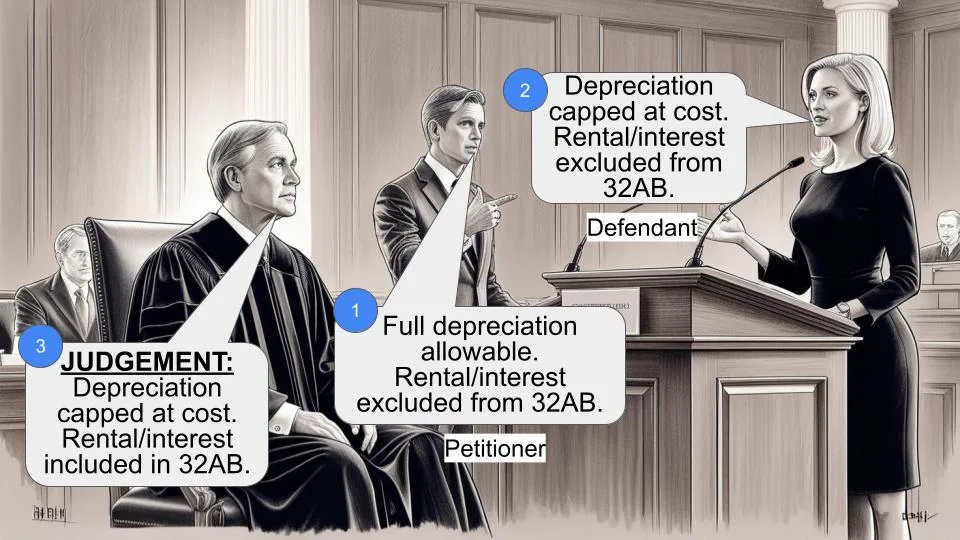
1. Deductions under sections 80HHC (of Income Tax Act, 1961) and 80IA can be claimed on gross total income, including income from other sources.
2. Depreciation is optional for the assessee, and the Assessing Officer cannot allow it if not claimed by the assessee.
3. The concept of block assets doesn't change the optional nature of depreciation claims.
4. The court relied on previous judgments, particularly CIT v. Mahendra Mills, to support its decision.
Issue:
1. Whether the Appellate Tribunal is right in law and on facts in allowing the deduction under sections 80HHC (of Income Tax Act, 1961) and 80IA on gross total income inclusive of income from other sources?
2. Whether the Appellate Tribunal is right in law and on facts in holding that depreciation not claimed by the assessee cannot be allowed as a deduction despite the introduction of the concept of block assets?
Facts:
- The case involves Sun Pharmaceuticals Ind. Ltd. for the Assessment Year 1996-97.
- The assessee received income from lease rent and interest, which was taxed as income from other sources.
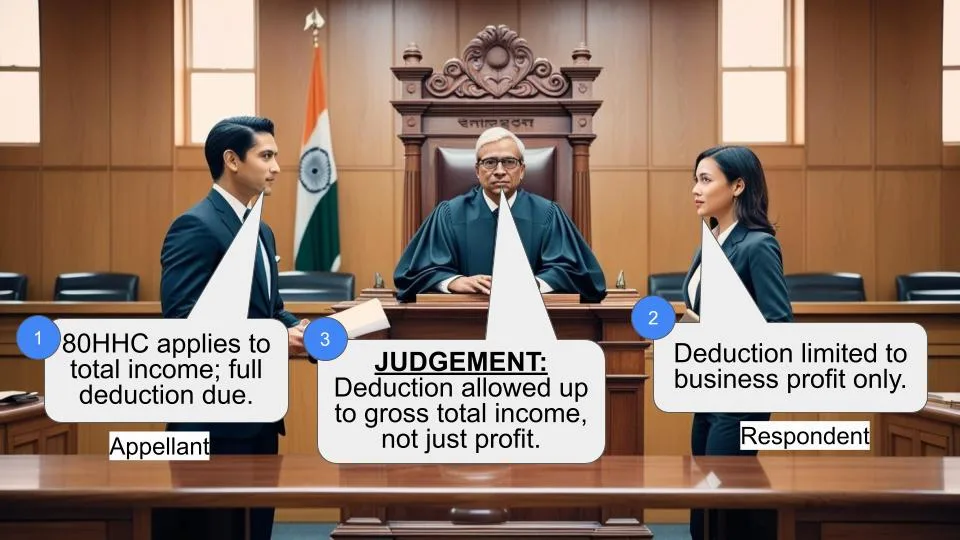
- The assessee claimed deductions under sections 80HHC (of Income Tax Act, 1961) and 80IA on their gross total income, including this income from other sources.
- The assessee chose not to claim depreciation on certain assets.
Arguments:
Revenue's Arguments:
1. Income from other sources should not be included in income eligible for deduction under sections 80HHC (of Income Tax Act, 1961) and 80IA.
2. Depreciation should be mandatorily allowed, even if not claimed by the assessee, due to the concept of block assets.
Assessee's Arguments:
1. Deductions under sections 80HHC (of Income Tax Act, 1961) and 80IA should be allowed on gross total income, including income from other sources.
2. Depreciation is optional, and the assessee has the right to choose whether to claim it or not.
Key Legal Precedents:
1. CIT v. Mahendra Mills (2000) 243 ITR 56:
This Supreme Court decision was relied upon to support the Tribunal's view.
2. CIT v. Arun Textiles 192 ITR 700:
The Gujarat High Court held that depreciation is optional for the assessee.
3. JOINT COMMISSIONER OF INCOME TAX v. MANDIDEEP ENG. AND PKG.IND. P. LTD. (2007) 292 ITR 1 (SC):
This case was cited regarding the independence of deductions under different sections.
Judgement:
The High Court dismissed the appeal and ruled in favor of the assessee, holding that:
1. The Appellate Tribunal was correct in allowing deductions under sections 80HHC (of Income Tax Act, 1961) and 80IA on gross total income, including income from other sources.
2. The Appellate Tribunal was right in holding that depreciation not claimed by the assessee cannot be forcibly allowed as a deduction, even with the introduction of the concept of block assets.
FAQs:
Q1: Can an assessee choose not to claim depreciation on certain assets?
A1: Yes, the court affirmed that depreciation is optional for the assessee, and they can choose not to claim it on certain assets.
Q2: Does the concept of block assets make depreciation mandatory?
A2: No, the court ruled that the concept of block assets doesn't change the optional nature of depreciation claims.
Q3: Can deductions under sections 80HHC (of Income Tax Act, 1961) and 80IA be claimed on income from other sources?
A3: Yes, the court upheld that these deductions can be claimed on gross total income, including income from other sources.
Q4: What was the significance of the CIT v. Mahendra Mills case in this judgment?
A4: The CIT v. Mahendra Mills case was a key precedent that supported the Tribunal's view and influenced the High Court's decision.
Q5: Can the Assessing Officer allow depreciation if it's not claimed by the assessee?
A5: No, the court ruled that if the assessee chooses not to claim depreciation, the Assessing Officer cannot allow it while computing the income.

1. By way of this appeal, the Revenue has challenged the judgment and order dated 6.3.2000 passed by the Income Tax Appellate Tribunal, Ahmedabad Bench “C” in ITA No. 1261/Ahd/1999 for AY 1996-97.
2. At the out-set, it is to be noted that when
the present appeal was preferred by the Revenue,
the Revenue felt that the challenge should be
only to the effect as to whether the Tribunal is
right in law and on facts in allowing the
deduction u/s. 80HHC (of Income Tax Act, 1961) and 80IA on gross total
income inclusive of income from other sources as
per the provisions of sec. 80AB (of Income Tax Act, 1961). According to the
Revenue, other sources could not be included in
the income eligible for deduction under sec.
80HHC and 80IA. It is an admitted position by and
between the parties that the assessee received
income from lease rent and interest which has
been taxed, according to the AO as income from
other sources.
3. The CIT(Appeals), on appeal preferred by the
assessee, the present respondent herein, held
that the claim for deduction under sec. 80HHC (of Income Tax Act, 1961) and
80IA was allowable. This aspect has aggrieved the
Revenue and following question was posed for
consideration of this Court:
“Whether the Appellate Tribunal is right
in law and on facts in allowing the
deduction u/s. 80HHC (of Income Tax Act, 1961) and 80IA on gross
total income inclusive of income from
other sources ?”
4. This Court in the case of Jt. Commissioner of
Income Tax v. United Phosphorous Ltd. in Tax
Appeal No. 2 of 2002, has held as follows:
“7. Similarly, in Tax Appeal No.175/2001
disposed of by the coordinate Bench, the
following observations are relevant for
our purpose;
“We have heard the learned advocates
at length and have also perused the
order of the Tribunal and judgment
delivered in the case of CIT v.
Mahendra Mills, 243 ITR 56. In our
opinion, no substantial question of
law arises in this appeal as the
Tribunal has rightly decided the
appeal in view of the ratio laid
down by the Hon'ble Supreme Court in
the case of Mahendra Mills (supra).
It is also pertinent to note that
the Tribunal had taken similar view
in the case of Sun Pharmaceutical
Industries v. Deputy Commissioner of
Income tax (Assessment) in I.T.A.
Nos. 2355/A/98, 1261 and 1190/A/89
for the Assessment Years 199596 and
199697 and against the said view
taken by the Tribunal in the case of
Sun Pharmaceutical Industries
(supra), the revenue had not filed
an appeal though an appeal has been
filed by the revenue in the said
case on other points. It has been
submitted by learned advocate Shri
Qureshi that the revenue proposes to
amend the appeal memo filed in the
case of Sun Pharmaceutical
Industries, but as on today, the
fact remains that the issue
regarding claim of depreciation in
the case of Sun Pharmaceutical
Industries decided by the Tribunal
has not been challenged by the
revenue.
Looking to the view expressed by
the Supreme Court in the case of
Mahendra Mills (supra), in our
opinion, the Tribunal was justified
in taking the view with regard to
the depreciation in the instant case
and, therefore, we do not find any
substantial question of law involved
in this appeal and, therefore, the
appeal is dismissed.
8. In view of the above, the question
of law raised in this appeal is answered
in favour of the assessee and against
the Revenue.”
5. Even Tax Appeal No. 175/2001 has been
disposed off by the co-ordinate Bench of this
Court relying on the decision of the Apex Court
in the case of CIT V. Mahendra Mills, reported in
243 ITR 56.
6. The learned counsel for the appellant felt
that as the aforesaid question was not raised in
this appeal should be raised in this appeal
afresh after many years that the issue involved
in the present case, requires re-consideration,
and therefore, Civil Application being OJ CA No.
546 of 2010 was filed after Tax Appeal No. 2/2002
was decided, and pursuant to the order passed in
OJCA No. 546 of 2010, vide order dated
26.11.2014, the following substantial question of
law has been framed by this Court, which reads
as under:
“Whether, the Appellate Tribunal is
right in law and on facts in holding
that depreciation not claimed for by the
assessee, cannot be allowed as a
deduction despite the introduction of
the concept of block assets ?”
6. We have heard the learned counsels appearing
for the parties and considered the submissions.
Mr. Soparkar learned counsel at the out set
submitted that the question no. 2 cannot be re-
agitated as it is covered by the decision of this
Court in Tax Appeal No. 175 of 2001 as well as
Tax Appeal No. 2/2002 decided on 17.11.2014.
However, Mr. Parikh learned counsel for Revenue
submitted that the question of law as raised in
this case was never decided in those matters,
and therefore, he requested that the question of
law be decided afresh. As both the questions of
law are inter connected are decided together.
7. We have heard the learned counsel appearing
for the parties at length. According to the
learned counsel Mr. Parikh, the decision of the
Full Bench of the Bombay High Court in the case
of Plastiblends India Limited v. Additional
Commissioner of Income-tax & Ors., reported in
[2009] 318 ITR (Bom)[FB] will have to be applied
to the facts of this case. Ld. Counsel has relied
on the grounds of challenge raised in this appeal
as it original was and amended.
8. In contra, learned counsel Mr. Soparkar for
revenue has drawn our attention to the decision
of the Hon’ble Supreme Court in the case of
Commissioner of Income Tax v. Mahendra Mills,
reported in [2000] 243 ITR 56 and the decision of
this Court in Tax Appeal 2/2002 and Tax Appeal
No. 175/2001. It is submitted that the questions
of law are concluded, but no elaborate reasons
are to be given in view of the finding of fact
and the question also having been answered in the
case of Manehdra Mills (supra), and therefore,
the decision of the Hon’ble Supreme Court will
enure for the benefit of the present assessee as
the amendment is after 2000 and not prior
thereto.
9. The decision cited by the learned counsel for
the Revenue of the Bombay High Court (supra)
cannot be applied in the facts of this case and
as far as this question of law is concerned.
10. This takes us to the original first question
wherein also the learned counsel for the
appellant has placed reliance on the decision of
the Full Bench of Bombay High Court Plastiblends
India Limited v. Additional Commissioner of
Income-tax & Ors., reported in [2009] 318 ITR
(Bom)[FB] and submitted that this appeal should
be allowed.
11. As far as this aspect is concerned, the
finding of fact recorded by the CIT(Appeals)
which reads as under:
“3. The contentions of the appellant and
the reasons given by the Assessing
Officer in allowing full depreciation
are considered. The decision of CIT v.
Mother India Refrigeration (P) Ltd.
(supra) relied on by the assessing
Officer is not applicable in the instant
case as the issue as to whether
depreciation is optional or not was
never before the Supreme Court. The
second decision of Madras High Court in
the case of Dasa Prakash Bottling Co. v.
CIT (supra) will also not be applicable
as the Gujarat High Court,which is
jurisdictional High Court in the case of
CIT v. Arun Textiles 192 ITR 700 did not
agree with this decision. In the case of
Arun Textiles (supra), the Gujarat High
Court held that there is nothing in the
provisions of section 32(1) (of Income Tax Act, 1961) read with
section 29 (of Income Tax Act, 1961),
to indicate that even when no claim is
made for allowing deduction in respect
of the depreciation under section 32(1) (of Income Tax Act, 1961),
the Income-tax Officer is bound to allow
a deduction. Under the scheme of the
Act, income is to be charged regardless
of depreciation on the value of the
assets and it is only by way on an
exception that section 32(1) (of Income Tax Act, 1961) grants an
allowance in respect of depreciation on
the value of the capital assets
enumerated therein. There is intrinsic
evidence under section 43(6)(b) (of Income Tax Act, 1961) of the
Act in the expression “less all
depreciation actually allowed” to show
that it is not as if all allowable
deductions are to be granted by the
Income-tax Officer even when the
assessee does not want the same. Sub-
section (2)(a) of Section 143(3) (of Income Tax Act, 1961) of the
Act provides that an assessee can object
to such deduction made under section
143(1). Therefore, the assessee can
come forward in such a case and make
clear its intention that it does not
want to compute depreciation on the
assets and wants no benefit of claiming
any depreciation in respect thereof. The
Circular of CBDT 29 D (XIX-4) of 1965
(F. No. 45/239/65-ITJ), dated 31.8.1996)
directed that, “where the required
particulars have not been furnished by
the assessee and no claim for
depreciation has been made in the
return, the Income-Tax Officer should
estimate the income without allowing
depreciation allowance.” Respectfully
following the decision of the Gujarat
High Court, I hold that the depreciation
is optional to the assessee and once he
chooses not to claim it, the Assessing
Officer cannot allow it while computing
the income. Further, once the
depreciation is option, applying the
same ratio of Gujarat High Court and
other Courts, it will be optional for
block of assets also. It is not
necessary that the depreciation is
allowable not allowable as a whole. The
assessee can claim it partly also in
respect of certain block of assets and
not claim in respect of other block of
assets. I, therefore, direct the
Assessing Officer to withdraw
depreciation allowance of Rs.
85,24,227/- not claimed by the
appellant.”
12. The Tribunal has upheld the well reasoned
finding of CIT(Appeals) in computing and
analyzing the gross business profit. The
provisions of section. 80IA read with section
80HHC reads as follows:
[Deductions in respect of profits and
gains from industrial undertakings or
enterprises engaged in infrastructure
development, etc.
Sec: 80IA:[(1) Where the gross total
income of an assessee includes any
profits and gains derived by an
undertaking or an enterprise from any
business referred to in sub-section (4)
(such business being hereinafter
referred to as the eligible business),
there shall, in accordance with and
subject to the provisions of this
section, be allowed, in computing the
total income of the assessee, a
deduction of an amount equal to hundred
per cent of the profits and gains
derived from such business for ten
consecutive assessment years.]
(2) The deduction specified in sub-
section (1) may, at the option of the
assessee, be claimed by him for any ten
consecutive assessment years out of
fifteen years beginning from the year in
which the undertaking or the enterprise
develops and begins to operate any
infrastructure facility or starts
providing telecommunication service or
develops an industrial park [ or
develops a special economic zone
referred to in clause (iii) of sub-
section (4)] or generates power or
commences transmission or distribution
of power [or undertakes substantial
renovation and modernisation of the
existing transmission or distribution
lines.
Sec: 80HHC:[(1) Where an assessee, being
an Indian company or a person (other
than a company) resident in India, is
engaged in the business of export out of
India of any goods or merchandise to
which this section applies, allowed, in
computing the total income of the
assessee, [ a deduction to the extent of
profits, referred to in sub-
section(1B),] derived by the assessee
from the export of such goods or
merchandise.”
13. The submission of learned counsel for
respondent as is based on the decision of the
Hon’ble Supreme Court in the case of JOINT
COMMISSIONER OF INCOME TAX v. MANDIDEEP ENG. AND
PKG.IND. P. LTD. reported in [2007] 292 ITR 1
(SC), wherein, the Hon’ble Supreme Court has held
as follows:
“The point involved in the present case
is whether sections 80HH and 80-I of the
Income-Tax Act, 1961, are independent of
each other and therefore a new
industrial unit can claim deductions
under both the sections on the gross
total income independently or that
deduction under section 80-I (of Income Tax Act, 1961) can be
taken on the reduced balance after
taking into account the benefit taken
under section 80HH (of Income Tax Act, 1961).”
12. The fact that the Tribunal and the CIT(A)
have concurred, we are not persuaded to take a
different view then that taken by both the
authorities below as the orders are neither
perverse nor against settled legal proposition of
law on the contrary they are based on correct
interpretation of law and decisions of Apex Court
and this Court.
13. We hold that (1) that the Appellate Tribunal
is right in law and on facts in allowing the
deduction u/s. 80HHC (of Income Tax Act, 1961) and 80IA on gross total
income inclusive of income from other sources. As
far as newly added question is concerned, there
also we hold that the the Appellate Tribunal is
right in law and on facts in holding that
depreciation not claimed for by the assessee,
cannot be allowed as a deduction despite the
introduction of the concept of block assets. The
questions are answered in favour of assessee and
against the Revenue. The Tax Appeal stands
dismissed.
(K.S.JHAVERI, J.) (K.J.THAKER, J)
×
Similar Ripples
Questions
Court Affirms Assessee's Right to Choose Depreciation Claims
Write your CommentSimilar Posts
Generic
- Reportdata/4224.pdf
