Court dismisses petition due to lack of evidence on legal advice for appeal wit…




Full News
Court dismisses petition due to lack of evidence on legal advice for appeal withdrawal
Court dismisses petition due to lack of evidence on legal advice for appeal withdrawal
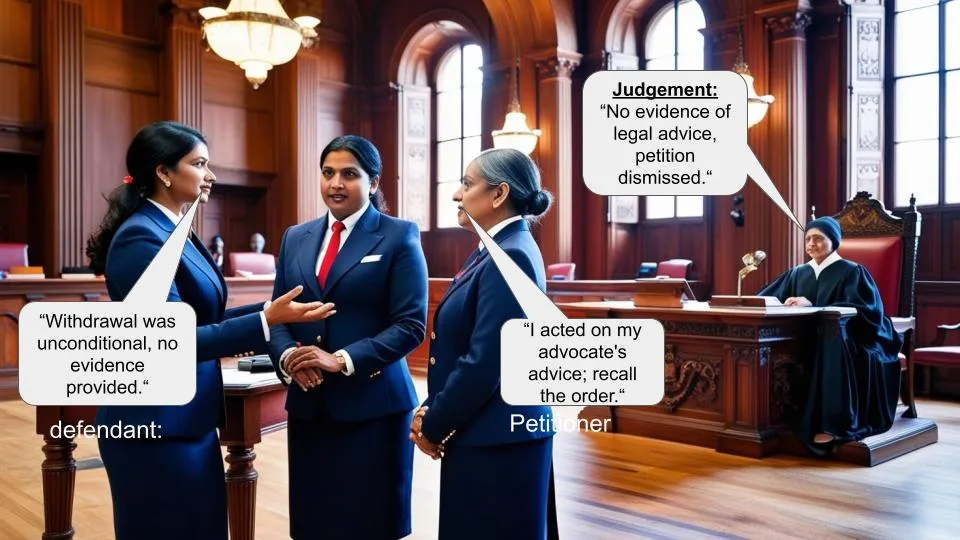
In the case of Jayant D. Sanghavi vs. Income Tax Appellate Tribunal, the High Court dismissed the petitioner's application to recall a previous order dismissing his appeal. The petitioner claimed he withdrew his appeal based on his advocate's advice, but there was no evidence to support this claim. The court found no error apparent on the record and upheld the Tribunal's decision.
For a comprehensive understanding, check out the original judgement of the court order here."
Case Name:
Jayant D. Sanghavi vs. Income Tax Appellate Tribunal
Writ Petition No. 2966 of 2016
Key Takeaways
- The court requires concrete evidence to support claims of acting on legal advice.
- Unconditional withdrawal of an appeal without mentioning legal advice weakens the case for recall.
- Delays in filing applications for recall can negatively impact the case.
- The Tribunal's decision was upheld due to the absence of an apparent error on the record.
Issue
Was there an error apparent on the record that warranted the recall of the Tribunal's order dismissing the appeal?
Facts
- The petitioner, Jayant D. Sanghavi, withdrew his appeal on 7th May 2010, based on an order dated 25th March 2008 by the Commissioner of Income Tax.
- The withdrawal was unconditional and did not mention any legal advice.
- On 8th July 2013, the petitioner filed an application to recall the order, claiming he acted on his advocate's advice.
- The Tribunal dismissed this application on 14th November 2013, citing a lack of evidence and the delay in filing.
Arguments
- Petitioner:
Claimed he withdrew the appeal based on his advocate's advice and should not suffer due to the advocate's mistake. Cited cases: Binaguri Tea Company Pvt. Ltd. vs. Deputy Commissioner of Income Tax and Mahamaya Banerjee.
- Tribunal:
Argued there was no evidence of the advocate's advice and the withdrawal was unconditional. The application for recall was filed after a significant delay.
Key Legal Precedents
- Binaguri Tea Company Pvt. Ltd. vs. Deputy Commissioner of Income Tax [2016] 389 ITR 648:
The appeal was withdrawn based on legal advice, and the application for rectification was made within two months.
- Mahamaya Banerjee [AIR 1989 Cal 106]:
The decision was based on Order 47 Rule 1 of the Code of Civil Procedure, which allows for review based on wrong legal advice, supported by the advocate's testimony.
Judgement
The High Court dismissed the petition, stating there was no error apparent on the record. The petitioner failed to provide evidence that he acted on his advocate's advice. The Tribunal's decision to reject the application for recall was upheld.
FAQs
Q1: Why was the petition dismissed?
A1: The petition was dismissed due to a lack of evidence supporting the claim that the petitioner acted on his advocate's advice and the significant delay in filing the application for recall.
Q2: What is Section 254(2) (of Income Tax Act, 1961)?
A2: Section 254(2) (of Income Tax Act, 1961) allows the Tribunal to rectify any mistake apparent from the record within four years from the date of the order.
Q3: What impact does this case have on future appeals?
A3: This case emphasizes the importance of providing concrete evidence when claiming to act on legal advice and the need to file applications for recall promptly.
Q4: Can the Tribunal review its own decisions?
A4: The Tribunal can rectify mistakes apparent on the record under Section 254(2) (of Income Tax Act, 1961) but does not have the power to review its decisions like a civil court under Order 47 Rule 1 of the Code of Civil Procedure.

1. This petition under Article 226 of the Constitution of India challenges an order dated 14th November, 2013 passed by the Income Tax Appellate Tribunal (the ''Tribunal'). The impugned order dated 14th November, 2013 dismissed the petitioners application under Section 254(2) (of Income Tax Act, 1961) (the 'Act') seeking a recall of its order dated 7th May, 2010 whereby the appeal of the petitioner under Section 254(1) (of Income Tax Act, 1961) was dismissed as withdrawn.
2. Briefly, the facts leading to this petition are as under :
(a) On 7th May, 2010 the petitioners appeal from an order dated 25th March, 2008 by the Commissioner of Income Tax passed under Section 263 (of Income Tax Act, 1961) was dismissed as withdrawn by the Tribunal under Section 254(1) (of Income Tax Act, 1961). The dismissal of the appeal was at the specific request of the petitioner as contained in his letter dated 23rd April, 2010 seeking unconditional leave of the Tribunal to withdraw the appeal.
(b) Thereafter on 8th July, 2013 petitioner filed application for recall of the order dated 7th May, 2010. The basis for the recall of the order dated 7th May, 2010 was that the appeal was withdrawn on 7th May, 2010 in view of the advise given to the petitioner by his Counsel.
(c) On 14th November, 2013 the impugned order dismissing the application of recall of order dated 7th May, 2010 was passed. The impugned order records the fact that the appeal was withdrawn on the specific request of the petitioner himself and in which there is no reference to the fact that the appeal is being withdrawn because of the advise of his Advocate. Therefore the impugned order of the Tribunal concluded that there is no error or mistake apparent from the record leading to its order dated 7th May, 2010, which could require exercise of jurisdiction under Section 254(2) (of Income Tax Act, 1961). The Tribunal also notes the fact that the application for recall of the order dated 7th May, 2010 was filed after three years after the order dated 7th May, 2010.
(d) This petition is also filed almost four years after the impugned order dated 14th November, 2013. However, the petitioner states that the petitioner had filed an appeal to this Court being ITXA No. 1112 of 2014 from the impugned order, within time. We are informed that the above appeal has now been withdrawn i.e. after the filing of this petition.
3. The grievance of the petitioner is that the Tribunal ought to have exercised its powers under Section 254(2) (of Income Tax Act, 1961) and withdrawn / recalled its order dated 7th May, 2010. This would have been in the interest of justice, as the petitioner has acted on advise of the Advocate to withdraw its appeal. It is submitted that no litigant should suffer on account of its Advocate's mistake. In support reliance was placed on two decisions of the Calcutta High Court in Binaguri Tea Company Pvt. Ltd. vs. Deputy Commissioner of Income Tax [2016]389 ITR 648] and in re : Mahamaya Banerjee [AIR 1989 Cal 106].
4. At the very outset we must point out that it is the petitioner's case that he acted on the advise of the Counsel in withdrawing the appeal. However, this submission of the petitioner is without there being anything on record from the Advocate concerned that he advised the petitioner to withdraw his appeal. Further the communication dated 23rd April, 2010 addressed to the Tribunal for withdrawal of the appeal was by the petitioner himself and in that communication he does not mention that the appeal is being withdrawn on account of legal advise. In fact it is an unconditional withdrawal of the appeal. Further, there is no explanation also offered for having made a miscellaneous application for recall of the order dated 7th May, 2010 in July, 2013 i.e. after over a period of three years.
5. Therefore in these facts, particularly in the absence of any evidence to indicate that the petitioner acted on the advise of Advocate to withdraw his appeal it cannot be said there is any error apparent on the record. In the above circumstances, no fault could be found with the order of the Tribunal in rejecting the application by the impugned Order under Section 254(2) (of Income Tax Act, 1961).
6. Reliance placed by Ms.Sathe, learned Counsel appearing for the petitioner on Binaguri Tea Company Pvt. Ltd. (supra) in our view does not assist the petitioners. In the facts of the above case, the appeal was withdrawn by assessee therein on the advise of his lawyer. Further, the letter of the assessee to the Tribunal itself indicated that the appeal is being withdrawn due to advise of his Advocate as there was no chance of success in view of decision of the Tribunal. However, at that time i.e. when the appeal was not presssed there was an jurisdictional High Court Judgment in its favour and not known to the assessee or his Advocate. One more fact is that the application for rectification was made within two months from the date the appeal was dismissed.
7. It was in the aforesaid circumstances and particularly the existence of jurisdictional High Court Judgment at the time when the appeal was dismissed as withdrawn, covering the issue in favour of the assessee. Therefore, it was a clear case of error apparent on record which would necessarily warrant the Tribunal to exercise its jurisdiction under Section 254(2) (of Income Tax Act, 1961).
8. The other decision being relied upon by Ms. Sathe is of the Calcutta High Court in Mahamaya Banerjee (supra). This was a decision rendered in the context of Order 47 Rule 1 of the Code of Civil Procedure i.e. powers of review.
The Tribunal being a creature of the Act is not bestowed with powers of Review. Therefore, the above distinction goes to the root. In any case, as noted by the High Court the principal ground for seeking a review of the order was that litigant had acted under wrong advise of her Advocate and the same was supported by the testimony of the Advocate.
9. In the present facts there is nothing on record in the form of the Advocates letter, etc. to indicate that the petitioner acted upon his legal advise and the same was wrong. Therefore, whether the petitioner acted on advise of his Advocate or not is itself a subject matter of debate. Thus taking the application outside the scope of Section 254(2) (of Income Tax Act, 1961).
10. In the above view, we see no reason to entertain the present petition.
11. Accordingly, petition is dismissed. No order as to costs.
(A.K. MENON,J.) (M. S. SANKLECHA,J.)
×