


Court Upholds Capital Gains Tax on Interim Land Compensation



Full News
Court Upholds Capital Gains Tax on Interim Land Compensation
Court Upholds Capital Gains Tax on Interim Land Compensation
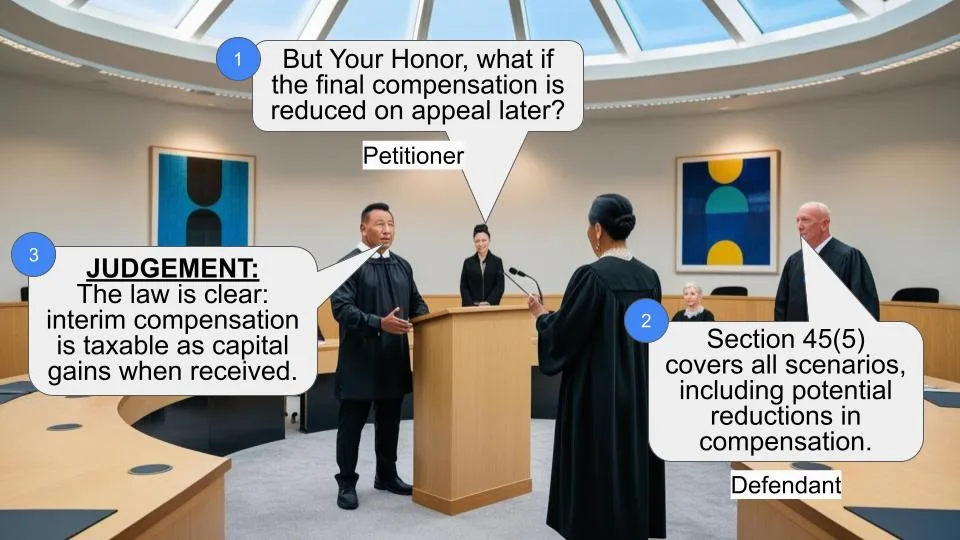
This case involves a dispute between C.P. Jacob (the petitioner) and the Assistant Commissioner of Income Tax regarding the taxation of enhanced compensation received for land acquisition. The High Court ruled that the interim compensation received under a court order is subject to capital gains tax in the year of receipt, as per Section 45(5)(b) (of Income Tax Act, 1961).
Get the full picture - access the original judgement of the court order here
Case Name:
C.P. Jacob vs Assistant Commissioner of Income Tax (High Court of Kerala)
OP. No. 13338 of 1999(K)
Date: 21st November 2007
Key Takeaways:
1. Enhanced compensation received under interim court orders is taxable as capital gains in the year of receipt.
2. Section 45(5) (of Income Tax Act, 1961) provides a comprehensive scheme for assessing capital gains in land acquisition cases.
3. Taxpayers have remedies available if compensation is reduced in subsequent proceedings.
4. The court emphasized the importance of assessing capital gains on a receipt basis in acquisition proceedings.
Issue:
Is the enhanced compensation for land acquisition, received under an interim order of the High Court, chargeable to capital gains tax in the year of receipt under Section 45(5)(b) (of Income Tax Act, 1961)?
Facts:
1. The petitioner's property was acquired in 1984, and he was dispossessed on 11/04/1984.
2. The land acquisition court (sub-court) enhanced the compensation on 25/01/1994.
3. Both the petitioner and the State filed appeals against the sub-court's order in the High Court.
4. On 16/12/1994, the High Court allowed the petitioner to withdraw 50% of the enhanced compensation.
5. The petitioner received this amount in the accounting year relevant to the assessment year 1995-96.
6. The petitioner initially filed a belated return on 31/10/1996, declaring the additional compensation.
7. Later, the petitioner filed a revised return on 11/12/1996, claiming the earlier return was filed under a mistake.
8. The Assessing Officer rejected the revised return and completed the assessment based on the original return.
Arguments:
Petitioner's arguments:
1. The amount released under interim orders cannot be assessed on a receipt basis.
2. There's no provision to reverse the assessment if the High Court allows the State's appeal and orders repayment.
Department's argument:
The amount is assessable on a receipt basis under Section 45(5)(b) (of Income Tax Act, 1961).
Key Legal Precedents:
1. Commissioner of Income Tax vs. Hindustan Housing and Land Development Trust Ltd. (161 ITR 524)
2. Director of Income Tax (Exemption) vs. Goyal Charitable Trust (215 ITR 672)
These cases were cited by the petitioner but were not found applicable by the court in this case.
Judgement:
1. The court upheld the assessment and demand of tax and interest for the year 1995-96.
2. The amount received by the petitioner is compensation awarded by the sub-court and is covered by Section 45(5)(b) (of Income Tax Act, 1961).
3. The court rejected the petitioner's apprehension about the lack of provision for reversal of assessment, citing Section 45(5)(c) (of Income Tax Act, 1961) and the possibility of rectification under Section 154 (of Income Tax Act, 1961).
4. The court suggested that the petitioner could apply for a waiver of interest charged under Sections 234A (of Income Tax Act, 1961) and 234B before the Chief Commissioner of Income Tax.
FAQs:
Q1: What is Section 45(5) (of Income Tax Act, 1961) about?
A1: Section 45(5) (of Income Tax Act, 1961) deals with the taxation of capital gains arising from compulsory acquisition of property, including enhanced compensation awarded by courts.
Q2: Can the assessment be reversed if the compensation is reduced in appeal?
A2: Yes, Section 45(5)(c) (of Income Tax Act, 1961) provides for recomputation of capital gains if the compensation is reduced by any court, tribunal, or authority.
Q3: What if the final judgment reducing compensation comes after the limitation period for rectification?
A3: The court suggested that in such cases, the assessee can approach the High Court under Article 226 of the Constitution for redressal.
Q4: Is there a possibility of waiver of interest in this case?
A4: Yes, the court allowed the petitioner to apply for waiver of interest before the Chief Commissioner of Income Tax, despite the delay due to the pending petition.
Q5: Why is the compensation received under interim orders taxable?
A5: The court held that the amount received is part of the enhanced compensation awarded by the sub-court and falls under Section 45(5)(b) (of Income Tax Act, 1961), making it taxable on receipt basis.

Petitioner’s property was acquired in land acquisition proceedings in the year 1984 and petitioner was dispossessed from the property on 11/04/1984. The land acquisition court (sub court) enhanced the compensation vide order dated 25/01/1994. Both petitioner and the State filed appeal against the order of sub court before the High Court. The High Court vide order dated 16/12/1994 allowed the petitioner to withdraw 50% of the enhanced compensation and petitioner received the amount in the accounting year relevant for the assessment year 1995-96. Even though, petitioner did not file return declaring the additional compensation so received under the Court orders in time, he filed a belated return for the assessment year 1995-96 on 31/10/1996 declaring among other items, the additional compensation received under interim orders of the High Court. The petitioner along with return remitted the tax and interest under Sections 234 (of Income Tax Act, 1961) A and 234 B of the Income Tax Act. However, before assessment was taken up, petitioner filed a revised return on 11/12/1996 stating that the previous return filed earlier was under a mistake as the petitioner was not bound to declare the income received towards additional compensation under the interim orders of this Court. However, the Assessing Officer held that the original return filed by the petitioner on 31/10/1996 being one filed under Section 139(4) (of Income Tax Act, 1961), no such revised return is maintainable under Section 139(5) (of Income Tax Act, 1961). Petitioner appears to have then accepted this view of the officer.
However, after assessment was completed pursuant to the return filed on 31/10/1996 under Section 139(4) (of Income Tax Act, 1961), petitioner filed a rectification application stating that return filed and assessment made thereon are under a mistake and is liable to be rectified. However, the Officer rejected the rectification application, stating as one not maintainable, vide Ext.P6 order. Against this order, petitioner filed revision petition before the Commissioner under Section 264 (of Income Tax Act, 1961), who rejected the same vide Ext.P9. It is against this order, petitioner filed this writ petition.
2. Learned counsel for the petitioner, relying on the decision of the Supreme Court in Commissioner of Income Tax Vs. Hindustan Housing and Land Development Trust Ltd., reported in 161 ITR 524 and the decision of the Delhi High Court in Director of Income Tax (Exemption) Vs. Goyal Charitable Trust, reported in 215 ITR 672, contended that the amount released under interim orders of this Court cannot be assessed on receipt basis. On the other hand, learned standing counsel for the Department contended that the amount is assessable on receipt basis under Section 45(5)(b) (of Income Tax Act, 1961). For easy reference Section 45(5) (of Income Tax Act, 1961) is extracted hereunder :-
Section 45(5) (of Income Tax Act, 1961) : Notwithstanding anything contained in sub- section (1), where the capital gain arises from the transfer of a capital asset, being a transfer by way of compulsory acquisition under any law, or a transfer the consideration for which was determined or approved by the Central Government or the Reserve Bank of India, and the compensation or the consideration for such transfer is enhanced or further enhanced by any court, Tribunal or other authority, the capital gain shall be dealt with in the following manner, namely:-
(a) the capital gain computed with reference to the compensation awarded in the first instance or, as the case may be, the consideration determined or approved in the first instance by the Central Government or the Reserve Bank of India shall be chargeable as (income under the head “capital gains” of the previous year in which such compensation or part thereof, or such consideration or part thereof, was first received); and
(b) the amount by which the compensation or consideration is enhanced or further enhanced by the Court, Tribunal or other authority shall be deemed to be income chargeable under the head “Capital gains” of the previous year in which such amount is received by the assessee;
(c) wherein the assessment for any year, the capital gain arising from the transfer of a capital asset is computed by taking the compensation or consideration referred to in clause (a), or, as the case may be, enhanced compensation or consideration referred to in clause (b), and subsequently such compensation or consideration is reduced by any court, Tribunal or other authority, such assessed capital gain of that year shall be recomputed by taking the compensation or consideration as so reduced by such court, Tribunal or other authority to be the full value of the consideration.
It is clear from the above that the statutory scheme provides for assessment of capital gain in acquisition proceedings, on receipt basis. While clause (a) deals with original compensation received, clauses (b) and (c) deal with variation of compensation in the form of enhancement or reduction in appeal or revision or other proceedings by any court or Tribunal. Clause (b), as in the case of clause (a), states that additional compensation received also shall be assessed on receipt basis in the assessment year following the previous year in which it was received. Clause (c) of the above provision provides for reversal of assessment, if compensation awarded is reduced by Court or tribunal in further proceedings.
3. The contention of learned counsel for petitioner is that it is not a case of enhancement of compensation by the High Court but only an interim order, releasing part payment to the petitioner, and not a final order, and is liable to be reversed in appeal or other proceedings, that was pending before the Court and therefore, it is not a case falling under the purview of clause (b). I do not think the petitioner’s contention is acceptable because what is ordered to be paid by the High Court is the enhanced compensation awarded by the land acquisition court (sub court), which was not paid to the petitioner on account of the contest of the State through the appeals filed by them. The High Court stayed the decree of the sub court enhancing compensation in execution proceedings, on condition of payment of 50% of the compensation. Therefore, the amount received by the petitioner is compensation awarded by the sub court and is covered by clause (b). The apprehension of the petitioner, as highlighted by the counsel, is that if additional compensation released by the High Court under interim orders is assessed under clause (b), there is no provision in the Act to reverse the assessment and grant refund of the tax paid, if High Court allows State Appeal and orders repayment of the released amount. I do not think, this apprehension of the petitioner is justifiable because clause (c) of Seaction 45(5) introduced by Finance Act 2003 w.e.f. 01/04/2004 takes care of such a situation. Even without the aid of Section 45(5)(c) (of Income Tax Act, 1961), I feel an assessee is entitled to get the assessment rectified under Section 154 (of Income Tax Act, 1961), if additional compensation assessed on receipt basis is ordered to be repaid in appeal by court. In other words, even for period prior to the introduction of clause (c) to Section 45(5) (of Income Tax Act, 1961), assessee was not without remedy, if assessed, additional compensation received through court is cancelled or reduced in further appeal by court.
The learned counsel for assessee rightly pointed out that there may be situation, where final judgment in appeal reducing compensation may be delivered beyond the period of limitation provided for rectification of assessment. Here again, I do not think the assessee is helpless because as a last resort assessee can approach the High Court under Article 226 of the Constitution of India to redress his grievance against assessment. In fact, I am surprised why clause 45(5)(c), without which the scheme of assessment of additional compensation received in acquisition proceedings is incomplete, is not given retrospective effect. In any case, the hypothetical situation argued by learned counsel does not arise here, because the appeal has been disposed of by this Court, in fact further enhancing the compensation and without granting reduction.
Therefore, the assessment and demand of tax and interest for the year 1995-96, confirmed by the Commissioner is upheld. However, if petitioner is entitled for waiver of interest, charged under Sections 234A (of Income Tax Act, 1961) and 234B of the Act, it is up to the petitioner to make an application for waiver of interest before the Chief Commissioner of Income Tax, demonstrate before him the circumstances referred to in the relevant circular on special cases for waiver. Since the original petition is pending for the last eight years in this Court, I make it clear that the Chief Commissioner should not dismiss any waiver application filed on ground of delay, if the same is filed within a reasonable time, at least, from receipt of this judgment.
(C.N.RAMACHANDRAN NAIR, JUDGE.)
×
Similar Ripples
Questions
Court Upholds Capital Gains Tax on Interim Land Compensation
Write your CommentSimilar Posts
Generic
- Reportdata/5159.pdf
