


Court Upholds Deduction of Advertising Expenses as Revenue Expenditure




Full News
Court Upholds Deduction of Advertising Expenses as Revenue Expenditure
Court Upholds Deduction of Advertising Expenses as Revenue Expenditure
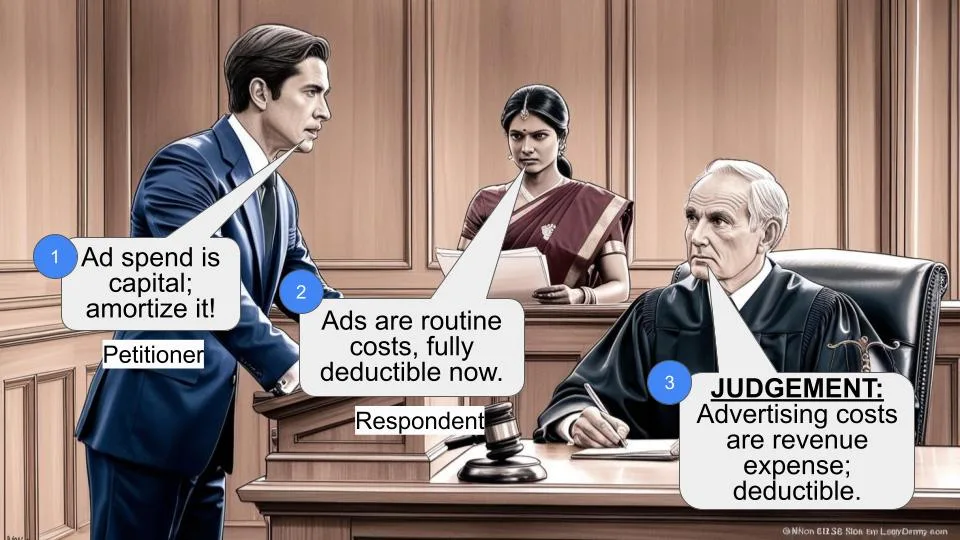
The Income Tax Department (the Revenue) appealed against M/s Godrej Foods Limited (the assessee) regarding the treatment of advertising and sales promotion expenses. The main question was whether these expenses should be treated as revenue expenditure (fully deductible in the year incurred) or capital expenditure (to be spread over multiple years). The Income Tax Appellate Tribunal ruled in favor of the assessee, allowing full deduction of the expenses in the year they were incurred. The High Court dismissed the Revenue's appeal, agreeing with the Tribunal's decision.
Get the full picture - access the original judgement of the court order here
Case Name:
Commissioner of Income Tax Vs M/s Godrej Foods Limited (High Court of Madhya Pradesh)
MAIT No. 140/2007
Date: 23rd January 2020
Key Takeaways:
1. Advertising and sales promotion expenses are generally considered revenue expenditure.
2. These expenses can be fully deducted in the year they're incurred.
3. The court emphasized the importance of consistency in tax treatment across assessment years.
4. The judgment reinforces the distinction between capital and revenue expenditure in tax law.
Issue:
The central question here is: Was the Income Tax Appellate Tribunal justified in deleting the addition of Rs.5,32,75,978/- made by the Assessing Officer on account of deferred revenue expenditure?
Facts:
1. M/s Godrej Foods Limited is in the business of manufacturing and trading Vanaspati, refined edible oils, almonds, and fruit drinks.
2. For the assessment year 2001-02, they claimed a deduction of Rs.6,65,94,973/- as 'deferred revenue expenditure' for advertising, publicity, conferences, market research, etc.
3. The Assessing Officer only allowed 1/5th of this amount (Rs. 1,33,18,995/-) as a deduction, treating the rest as capital expenditure to be spread over five years.
4. The Commissioner of Income Tax (Appeals) allowed the full deduction, which was then upheld by the Income Tax Appellate Tribunal.
5. The Revenue (tax department) wasn't happy with this and appealed to the High Court.
Arguments:
The Revenue's side:
- These expenses provide a continuing benefit to the business and should be spread over multiple years.
- They cited the Supreme Court case of Madras Industrial Investment Corporation Ltd. vs. Commissioner of Income-tax to support their argument.
The Assessee's side:
- These expenses are revenue in nature and should be fully deductible in the year they're incurred.
- Similar claims were allowed in previous assessment years, so consistency should be maintained.
Key Legal Precedents:
1. Madras Industrial Investment Corporation Ltd. vs. Commissioner of Income-tax, (1997) 91 Taxman 340 (SC): This case dealt with the treatment of discount on debentures, which the court ruled should be spread over multiple years.
2. Commissioner of Income Tax vs. M/s Glen Appliances Pvt. Ltd., ITA No. 858/2010: This case specifically dealt with advertising expenses and held that they are revenue in nature and fully deductible in the year incurred.
Judgement:
The High Court dismissed the Revenue's appeal and ruled in favor of the assessee. Here's the gist:
1. The court found no error in the Tribunal's decision to allow full deduction of the advertising expenses.
2. They distinguished this case from the Madras Industrial Investment Corporation case, saying that advertising expenses are different from debenture discounts.
3. The court emphasized that advertising is a necessity and integral part of business activity, not an acquisition of a permanent asset.
4. They agreed with the reasoning in the M/s Glen Appliances Pvt. Ltd. case, which held that advertising expenses are revenue in nature.
FAQs:
1. Q: Why did the court allow full deduction of the advertising expenses?
A: The court considered advertising as a necessary part of business operations, not a capital investment. They viewed it as an ongoing expense rather than something that creates a long-term asset.
2. Q: How does this judgment affect businesses?
A: It's good news for businesses! They can now be more confident in claiming full deductions for their advertising and sales promotion expenses in the year they're incurred.
3. Q: What's the difference between revenue and capital expenditure?
A: Revenue expenditure is for day-to-day operations and can be fully deducted in the current year. Capital expenditure is for long-term assets and is usually spread over multiple years for tax purposes.
4. Q: Does this mean all advertising expenses will always be treated as revenue expenditure?
A: While this judgment strongly supports that view, each case can have unique circumstances. It's always best to consult with a tax professional for specific situations.
5. Q: Why was the Madras Industrial Investment Corporation case not applicable here?
A: That case dealt with debenture discounts, which provide a benefit over a fixed period. The court saw advertising as an ongoing necessity without a fixed benefit period, making it different from debenture discounts.

1.Both the present appeals preferred by the Revenue under Section 260A (of Income Tax Act, 1961) (in short “the Act”) are involving identical substantial question of law framed vide order dated 30.11.2007 and therefore, are disposed of by this common order.
2. The present appeals i.e. MAIT No.140/2007 and MAIT No.142/2007 have arisen out of the orders dated 30.03.2007 passed by the Income Tax Appellate Tribunal, Indore (for brevity “the Tribunal”) in ITA No.615/IND/2005 (assessment year 2001-02) and ITA No.73/IND/2006 (assessment year 2002-03) respectively.
3. For the sake of brevity, the facts are taken from MAIT No.140/2007. The appeal was admitted on 30.11.2007 for determination of the following substantial question of law:-
“(i) Whether in the facts and circumstances of the case the Income Tax Appellate Tribunal was justified in law in deleting the addition of Rs.5,32,75,978/- made by the Assessing Officer on account of deferred Revenue expenditure?”
4. The facts leading to the present appeal are that the assessee is in the status of a Company and engaged in manufacturing and trading of Vanaspati,Refined edible oils, almonds and fruit drinks etc. The assessee submitted its return of income declaring loss of Rs.34,92,86,201/-. The return was processed under Section 143(1) (of Income Tax Act, 1961) and was selected for scrutiny and thereafter, notice under Section 143(2) (of Income Tax Act, 1961) was issued to the assessee.The assessee claimed deduction of Rs.6,65,94,973/- as ‘deferred revenue expenditure’ on account of advertisement, publicity, holding conferences, market research, subsidy, various launch schemes, selling and distribution etc. The Assessing Officer vide order dated 19.03.2004 (Annexure A-1) held that the expenses were incurred for the accounting year below the line in the books of account but the assessee had claimed in full for computing the total income as revenue expenditure incurred during the year. The expenditure was likely to give benefit for not less than five years and therefore, was in the nature of capital expenditure and hence, the above expenditure was added back to the assessee’s income and following the assessment order for the assessment year 2000-01, only 1/5th expenditure of Rs.1,33,18,995/- out of total expenditure of Rs.6,65,94,973/- was allowed to the assessee for the assessment year 2001-02 and remaining amount of Rs.5,32,75,978/- was added to the income of the assessee. Being aggrieved by the order, the assessee preferred an appeal before the learned Commissioner of Income (Appeals-I), Bhopal [for short “the CIT(A)]. The CIT(A) vide order dated 18.05.2005 (Annexure A-2) partly allowed the appeal of the assessee deleting the addition of remaining amount of Rs.5,32,75,978/-. Dissatisfied with that order, the Revenue approached the Tribunal. The Tribunal by order dated 30.03.2007 (Annexure A-3) affirmed the decision of the CIT(A) and dismissed the appeal of the Revenue. Hence, the present appeal by the Revenue.
5. Learned counsel for the appellant submitted that the deduction in question was pertaining to the expenses incurred in advertisement, publicity and sales promotion etc. of the business which would be giving continuing benefit to the business of the assessee-Company and therefore, the Assessing Officer did not commit any error in spreading over the expenditure for five years and allowing only 1/5th thereof for the current assessment year but both the authorities below only on the ground that for the assessment years 1993-94 and 1996-97 similar claim was allowed to the assessee and his appeal claiming the same benefit for the assessment year 2000-01 was allowed by the Appellate Authority on 22.01.2004, deleted the addition of Rs.5,32,75,978/-. To bolster his submission, the learned counsel for the appellant relied upon the judgment of the Supreme Court in Madras ndustrial Investment Corporation Ltd. vs. Commissioner of Income-tax, (1997) 91 Taxman 340 (SC).
6. On the other hand, learned counsel for the assessee argued in support of the impugned order and prayed that cogent reasons have been assigned by the learned Tribunal while passing the order and therefore, this appeal be dismissed.
7. Having heard learned counsel for the parties, we find that there is no merit in the appeals.
8. The learned Tribunal while considering the appeal came to the conclusion that in the earlier years, the Assessing Officer had allowed deduction of the similar advertisement expenses in favour of the assessee in the scrutiny proceedings, which was accepted by the Department. The order had attained finality. The advertisement expenditure, claimed by them assessee, is in the nature of revenue expenditure and since it was adjudged as such, it has to be allowed in the year under consideration in which it was incurred wholly and exclusively for the purpose of business. Learned counsel could not point out any perversity or illegality in the findings recorded by the Tribunal and therefore, no interference is called for on that ground raised by the appellant in these appeals.
9. Examining the case law relied upon by the learned counsel for the appellant, the question before the Supreme Court in Madras Industrial Investment Corporation (supra) was as to whether the discount on debentures could be treated as an expenditure and the entire amount of discount was to be allowed in the year related to the year of issue itself. The Supreme Court held that although while issuing debentures at a discount the assessee has incurred the liability to pay the discount in the year of issue of debentures but by such payment the assessee would secure a benefit over a number of years and there would be a continuing benefit to the business of the company over the entire period and therefore, such liability should be spread over the period of the debentures issued. We have carefully gone through the said decision of the Supreme Court and are of the considered view that the said decision is not applicable to the facts and circumstances of the present case. In the present case, the expenditure on advertisement and sales promotion has been claimed for deduction as revenue expenditure. The advertisement and sales promotion is the necessity of the business and thus, an integral part of the business activity. Therefore, the expenses incurred on advertisement etc. are not for acquisition of an asset or right of a permanent character, therefore, cannot be said to be a capital expenditure. It is but a revenue expenditure.
10. A similar question: as to whether the expenses on account of advertisement, publicity and sales promotion in relation to the business are in the nature of deferred revenue expenditure and although the benefit of such expenses would be availed by the assessee over a number of years but should it be allowed for the relevant assessment year for which assessee claims exemption, also came up for consideration before a Division Bench of Punjab and Haryana High Court in Commissioner of Income Tax vs. M/s Glen Appliances Pvt. Ltd., ITA No.858/2010 decided on 2nd May, 2011. The Bench also considered the judgment of the Supreme Court in Madras Industrial Investment Corporation (supra) and held in favour of the assessee as under:-
“6. We are unable to accept the submission of the learned counsel. The Tribunal while accepting the plea of the assessee had held that the expenses incurred by the assessee on the aforesaid activities were revenue in nature and the entire amount was admissible in the year in which it was incurred. The finding recorded is as under:-
"We have considered the facts of the case and rival submissions. The finding of the AO that even if the claim of the assessee that constant advertisement is needed in view of short public memory is accepted, the benefit accruing to the brand name "GLEN" cannot be ruled out. There is no evidence in support of this finding.
Further, the learned CIT(Appeals) upheld the view of the assessee that the benefit will accrue over a period of two years by relying on the decision of Hon'ble Supreme Court in the case of Madras Industrial Investment Corporation Ltd. (supra). Nothing has been brought on record to show that the benefit will accrue over a period of two years. The advertisement expenses are in the nature of revenue expenses. It is not a case where a loan taken on discount will stay with the assessee for a period of 10 years. Therefore, the decision of Hon'ble Supreme Court in the case of Madras Industrial Investment Corporation Ltd. (supra) is not applicable to the facts of this case. As the expenditure is revenue in nature, the decision of Hon'ble Madras High Court in the case of Brilliant Tutorials (P) Ltd. (supra) supports the case of the assessee for deduction of the expenditure in the year of its incurring. In the case of Amar Raja Batteries Ltd., the Tribunal, after considering the case of India Discount Company, 75 ITR 191, pointed out that the issue in this behalf is clear, i.e. it has to be decided on the basis of law. The expenditure is also in revenue field and, therefore, the whole of the expenditure is to be allowed in the year of its incurring. In view of the aforesaid judgments and the order, we hold that the expenditure is revenue in nature and, therefore, it has to be allowed in full in this year."
8. Learned counsel for the revenue was unable to point out any irregularity or illegality in the aforesaid finding recorded by the Tribunal which may warrant interference by this Court. Accordingly, no substantial question of law arises in these appeals. The appeals being devoid of merit are dismissed.”
11. In view of the foregoing reasons coupled with the fact that the learned counsel for the Revenue has failed to point out any illegality or perversity in the findings recorded by the learned Tribunal warranting any interference,the substantial question of law is answered in favour of the assessee and against the Revenue. Accordingly, both the appeals stand dismissed. Let a copy of this order be retained in the record of MAIT No.142/2007.
×
Similar Ripples
Questions
Court Upholds Deduction of Advertising Expenses as Revenue Expenditure
Write your CommentSimilar Posts

Generic
- Reportdata/6313.pdf
