


Free Hotel Rooms Not Taxable Perquisite for Employee




Full News
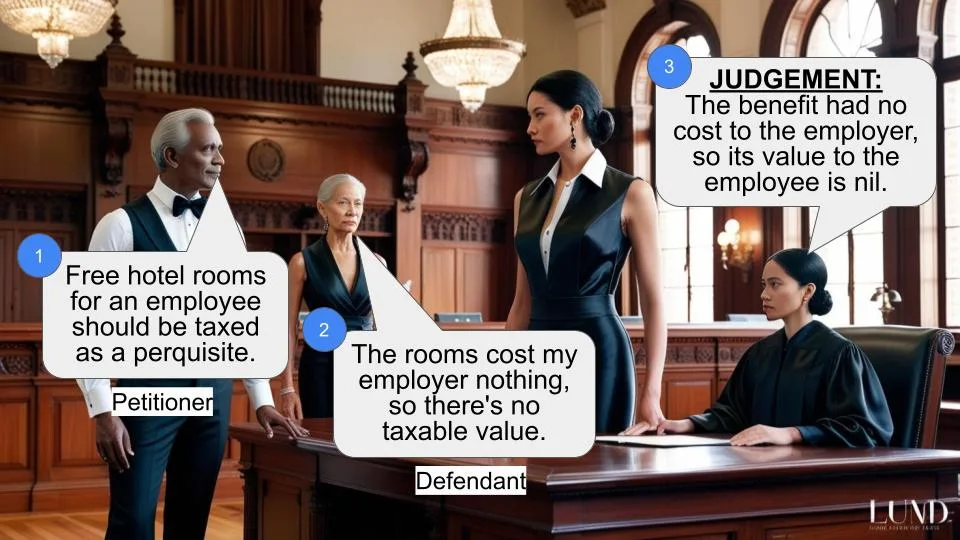
Free Hotel Rooms Not Taxable Perquisite for Employee
Free Hotel Rooms Not Taxable Perquisite for Employee
This case involves the Commissioner of Income Tax (CIT) challenging a decision made by the Income Tax Appellate Tribunal regarding the taxation of free hotel rooms provided to an employee. The High Court dismissed the appeal, agreeing with the Tribunal's finding that the value of the benefit to the employee was nil, and therefore not taxable.
Get the full picture - access the original judgement of the court order here
Case Name:
Commissioner of Income Tax Vs H.A. Braam (High Court of Bombay)
Income Tax Appeal No.511 of 2001
Date: 8th January 2008
Key Takeaways:
1. Benefits passed on to employees at no cost to the employer may not be considered taxable perquisites.
2. The value of a perquisite is determined by the cost to the employer, not the market value of the benefit.
3. Findings of fact by lower tribunals are generally respected by higher courts unless there's a substantial question of law.
Issue
Does the provision of free hotel rooms to an employee constitute a taxable perquisite when the employer receives these rooms at no cost?
Facts
- The employer (Taj Intercontinental Hotel) provided two hotel rooms free of cost to the employer during the tenure of a contract.
- The employer passed on this benefit to the employee (H.A. Braam).
- The Income Tax department sought to tax this benefit as a perquisite in the hands of the employee.
- The Income Tax Appellate Tribunal ruled that the value of this benefit to the employee was nil.
Arguments
The judgment doesn't explicitly state the arguments of both parties. However, we can infer:
CIT's argument:
- The free hotel rooms provided to the employee should be considered a taxable perquisite.
Employee's (H.A. Braam) argument:
- As the rooms were provided at no cost to the employer, there should be no taxable value assigned to this benefit.
Key Legal Precedents
1. Emll Webber Vs. CIT reported in (1993) 200 ITR 483 -
This Supreme Court judgment was relied upon by the Tribunal in making its decision.
2. An unnamed judgment of the High Court reported in 114 ITR 515 -
This was approved by the Supreme Court in the Emll Webber case.
Judgement
The High Court dismissed the appeal of the Commissioner of Income Tax, effectively upholding the Tribunal's decision. The court agreed with the Tribunal's finding that:
1. The employer incurred no cost in providing the benefit to the employee.
2. When a benefit derived by the employer is passed on to the employee at no cost, the value of the benefit or perquisite in the hands of the employee is nil.
3. Therefore, including any element of perquisite on account of rent is unwarranted in this case.
The court also noted that the Tribunal's decision was based on findings of fact, and therefore no substantial question of law arose for the High Court to consider.
FAQs
Q1: Why did the court rule that the free hotel rooms were not a taxable perquisite?
A1: The court agreed with the Tribunal's finding that since the employer incurred no cost in providing the rooms (as they were given free by the hotel), the value of the benefit to the employee was nil.
Q2: Does this mean all benefits provided by employers are not taxable?
A2: No, this ruling is specific to cases where the employer incurs no cost in providing the benefit. Other benefits that have a cost to the employer may still be taxable.
Q3: What is the significance of the court mentioning "findings of fact"?
A3: When a lower tribunal (like the Income Tax Appellate Tribunal) makes findings of fact, higher courts generally respect these unless there's a substantial question of law involved. This limits the scope of appeals to higher courts.
Q4: How might this ruling affect similar cases in the future?
A4: This ruling could potentially be used as a precedent in cases where employers provide benefits to employees at no cost to themselves. However, each case would still be judged on its specific facts and circumstances.
Q5: What is a "substantial question of law"?
A5: A substantial question of law is a significant legal issue that needs to be addressed by a higher court. In this case, the High Court found that no such question arose, which was one reason for dismissing the appeal.

1. The Appellate Tribunal considering the various provisions has recorded a finding of fact that the employer has not to incur any expenditure because the employer himself was benefited by Taj Intercontinental Hotel who allowed two rooms free of costs during the tenure of the contract. The Tribunal then held that when a benefit derived by the employer is passed on to the employee, the cost to the employer is the benefit derived by the employee which in the instant case is NIL and therefore, including any element of perquisite on account of rent is unwarranted in the case. It is clear therefore, that the finding was recorded on the facts of the case and therefore, question No.1 in Paragraph-10 as framed would not arise.
2. In so far as Question No.2 is concerned, the issue has been considered by the Tribunal by placing reliance on the Judgment of the Supreme Court in Emll Webber Vs. CIT reported in (1993) 200 ITR 483 approving the Judgment of this court reported in 114 ITR 515. Considering the above facts the second question would also not arise. Consequently the appeal stands dismissed.
(R.S. MOHITE, J.) (F.I. REBELLO, J.)
×
Similar Ripples
Questions
Free Hotel Rooms Not Taxable Perquisite for Employee
Write your CommentSimilar Posts
Generic
- Reportdata/5042.pdf
