


Penalty must be based on the original grounds, not new ones without notice.



Full News

Penalty must be based on the original grounds, not new ones without notice.
Penalty must be based on the original grounds, not new ones without notice.
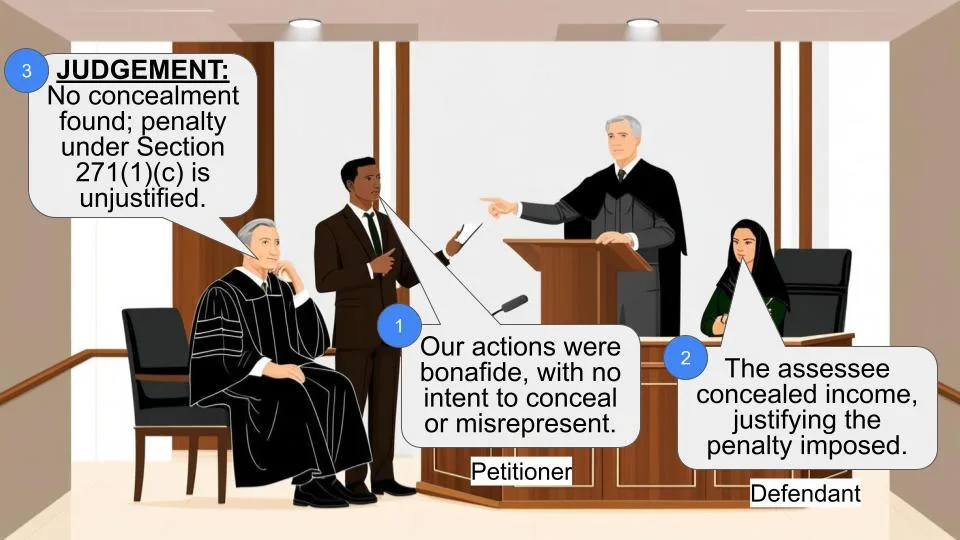
In the case of Commissioner of Income Tax vs. Samson Perinchery, the High Court ruled that penalties under Section 271(1)(c) (of Income Tax Act, 1961) must be imposed based on the specific grounds for which the penalty proceedings were initiated. The court upheld the decision of the Income Tax Appellate Tribunal, which had deleted the penalties imposed on the assessee for various assessment years, citing that the penalty was imposed for a different reason than the one for which the proceedings were initiated.
Get the full picture - access the original judgement of the court order here.
Case Name:
Commissioner of Income Tax vs. Samson Perinchery (High Court of Bombay)
Income Tax Appeal No.953 of 2014
Key Takeaways
- Penalties under Section 271(1)(c) (of Income Tax Act, 1961) must be imposed based on the specific grounds for which the penalty proceedings were initiated.
- Concealment of income and furnishing inaccurate particulars of income are distinct breaches under Section 271(1)(c) (of Income Tax Act, 1961).
- The Assessing Officer must clearly indicate which breach is being penalized.
- The use of a standard proforma without striking out irrelevant clauses indicates non-application of mind by the Assessing Officer.
Issue
Whether the Tribunal was justified in deleting the penalty levied under Section 271(1)(c) (of Income Tax Act, 1961), when the penalty was imposed for a different reason than the one for which the proceedings were initiated?
Facts
- The appeals challenge a common order dated October 11, 2013, by the Income Tax Appellate Tribunal.
- The Tribunal deleted the penalties imposed on the assessee for the assessment years 2003-04, 2004-05, 2005-06, and 2006-07.
- The penalties were initially imposed for furnishing inaccurate particulars of income but were later imposed for concealment of income.
- The Tribunal noted that the notice issued under Section 274 (of Income Tax Act, 1961) was in a standard proforma without striking out irrelevant clauses, indicating non-application of mind.
Arguments
Revenue's Arguments
- There is no difference between furnishing inaccurate particulars of income and concealment of income.
- The deletion of the penalty by the Tribunal is unjustified.
Assessee's Arguments
- The penalty must be imposed based on the specific grounds for which the proceedings were initiated.
- Concealment of income and furnishing inaccurate particulars of income are distinct breaches under Section 271(1)(c) (of Income Tax Act, 1961).
Key Legal Precedents
- Ashok Pai v/s. CIT 292 ITR 11:
Concealment of income and furnishing inaccurate particulars of income carry different connotations.
- CIT v/s. Manjunath Cotton and Ginning Factory 359 ITR 565:
The Assessing Officer must clearly indicate which breach is being penalized.
- Manu Engineering 122 ITR 306 and Virgo Marketing P. Ltd. 171 Taxmn 156:
Levy of penalty must be clear as to the limb for which it is levied.
Judgement
The High Court dismissed the appeals, upholding the Tribunal's decision to delete the penalties. The court emphasized that penalties must be imposed based on the specific grounds for which the proceedings were initiated, and the use of a standard proforma without striking out irrelevant clauses indicates non-application of mind by the Assessing Officer.
FAQs
Q1. What was the main issue in this case?
A1. The main issue was whether the Tribunal was justified in deleting the penalty levied under Section 271(1)(c) (of Income Tax Act, 1961), when the penalty was imposed for a different reason than the one for which the proceedings were initiated.
Q2. What did the court decide?
A2. The court decided that penalties must be imposed based on the specific grounds for which the proceedings were initiated and upheld the Tribunal's decision to delete the penalties.
Q3. What are the implications of this case?
A3. The case reinforces the principle that penalties under Section 271(1)(c) (of Income Tax Act, 1961) must be imposed based on the specific grounds for which the proceedings were initiated, and the Assessing Officer must clearly indicate which breach is being penalized.
Q4. What is the significance of the legal precedents cited?
A4. The legal precedents cited emphasize that concealment of income and furnishing inaccurate particulars of income are distinct breaches under Section 271(1)(c) (of Income Tax Act, 1961), and the Assessing Officer must clearly indicate which breach is being penalized.
Q5. What does the use of a standard proforma indicate?
A5. The use of a standard proforma without striking out irrelevant clauses indicates non-application of mind by the Assessing Officer.

1. These Appeals under Section 260 (of Income Tax Act, 1961)A of the Income Tax Act, 1961 (the Act), challenge a common order dated 11th October, 2013 passed by the Income Tax Appellate Tribunal (the Tribunal). The common impugned order deleted the penalty imposed upon the Respondent-Assessee for the Assessment Years 200304, 2004-05, 2005-06 and 2006-07.
2 All these appeals raises an identical question of law save the difference in the quantum, which read as under:
“ Whether on the facts and in the circumstances of the case and in law, the Tribunal was justified in deleting the penalty levied under Section 271(1)(c) (of Income Tax Act, 1961)?”
3. The impugned order of the Tribunal deleted the penalty imposed upon the Respondent Assessee. This by holding that the initiation of penalty under Section 271(1)(c) (of Income Tax Act, 1961) by Assessing Officer was for furnishing inaccurate particulars of income while the order imposing penalty is for concealment of income. The impugned order holds that the concealment of income and furnishing inaccurate particulars of income carry different connotations. Therefore, the Assessing Officer should be clear as to which of the two limbs under which penalty is imposable, has been contravened or indicate that both have been contravened while initiating penalty proceedings. It cannot be that the initiation would be only on one limb i.e. for furnishing inaccurate particulars of income while imposition of penalty on the other limb i.e. concealment of income. Further, the Tribunal also noted that notice issued under Section 274 (of Income Tax Act, 1961) is in a standard proforma, without having striked out irrelevant clauses therein. This indicates nonapplication of mind on the part of the Assessing Officer while issuing the penalty notice.
4 The impugned order relied upon the following extract of Karnataka High Court's decision in CIT v/s. Manjunath Cotton and Ginning Factory 359 ITR 565 to delete the penalty:
“ The Assessing Officer is empowered under the Act to initiate penalty proceedings once he is satisfied in the course of any proceedings that there is concealment of income or furnishing of inaccurate particulars of total income under clause (c). Concealment, furnishing inaccurate particulars of income are different.
Thus, the Assessing Officer while issuing notice has to come to the conclusion that whether is it a case of concealment of income or is it as case of furnishing of inaccurate particulars. The apex court in the case of Ashok Pai reported in [2007] 292 ITR 11 (SC) at page 19 has held that concealment of income and furnishing inaccurate particulars of income carry different connotations. The Gujarat High Court in the case of Manu Engineering reported in 122 ITR 306 and the Delhi High Court in the case of Virgo Marketing P. Ltd., reported in 171 Taxmn 156, has held that levy of penalty has to be clear as to the limb for which it is levied and the position being unclear penalty is not sustainable. Therefore, when the Assessing Officer proposes to invoke the first limb being concealment, then the notice has to be appropriately marked. Similar is the case for furnishing inaccurate particulars of income. The standard proforma without striking of the relevant clauses will lead to an inference as to nonapplication of mind.”
5. The grievance of the Revenue before us is that there is no difference between furnishing of inaccurate particulars of income and concealment of income. Thus, distinction drawn by the impugned order is between Tweedledum and Tweedledee. In the above view, the deletion of the penalty, is unjustified.
6. The above submission on the part of the Revenue is in the face of the decision of the Supreme Court in Ashok Pai v/s. CIT 292 ITR 11 [relied upon in Manjunath Cotton & Ginning Factory (supra)] – wherein it is observed that concealment of income and furnishing of inaccurate particulars of income in Section 271(1)(c) (of Income Tax Act, 1961), carry different meanings/ connotations. Therefore, the satisfaction of the Assessing Officer with regard to only one of the two breaches mentioned under Section 271(1)(c) (of Income Tax Act, 1961), for initiation of penalty proceedings will not warrant/ permit penalty being imposed for the other breach. This is more so, as an Assessee would respond to the ground on which the penalty has been initiated/notice issued. It must, therefore, follow that the order imposing penalty has to be made only on the ground of which the penalty proceedings has been initiated, and it cannot be on a fresh ground of which the Assessee has no notice.
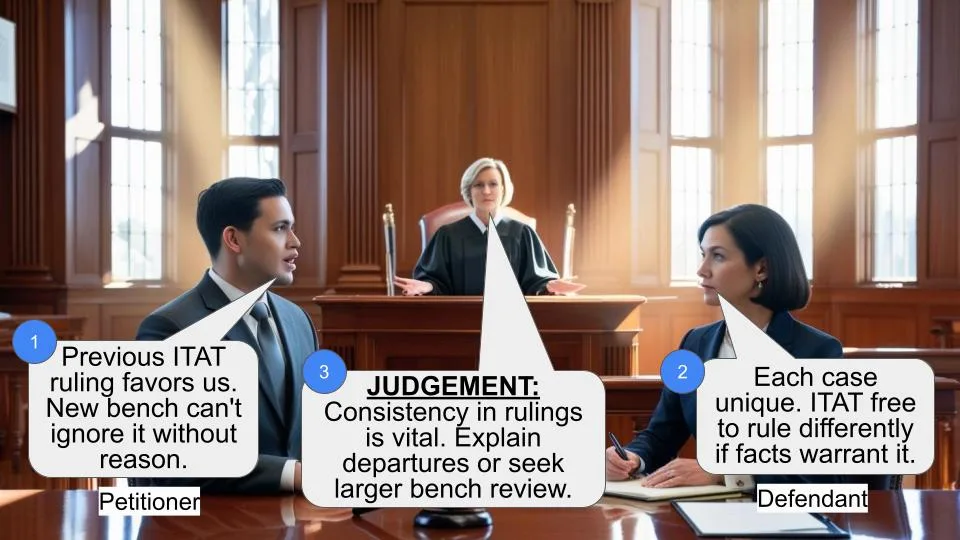
7. Therefore, the issue herein stands concluded in favour of the RespondentAssessee by the decision of the Karnataka High Court in the case of Manjunath Cotton and Ginning Factory (supra). Nothing has been shown to us in the present facts which would warrant our taking a view different from the Karnataka High Court in the case of Manjunath Cotton and Ginning Factory (supra).
8. In view of the above, the question as framed do not give rise to any substantial question of law. Thus, not entertained.
9. Accordingly, all these Appeals are dismissed. No order as to costs.
(A.K.MENON,J.) (M.S.SANKLECHA,J.)
×
Similar Ripples
Questions
Penalty must be based on the original grounds, not new ones without notice.
Write your CommentSimilar Posts

Generic
- Reportdata/11261-HC-Bombay.pdf
