


Settlement Commission's Decision on Disclosure Validity Upheld





Full News

Settlement Commission's Decision on Disclosure Validity Upheld
Settlement Commission's Decision on Disclosure Validity Upheld
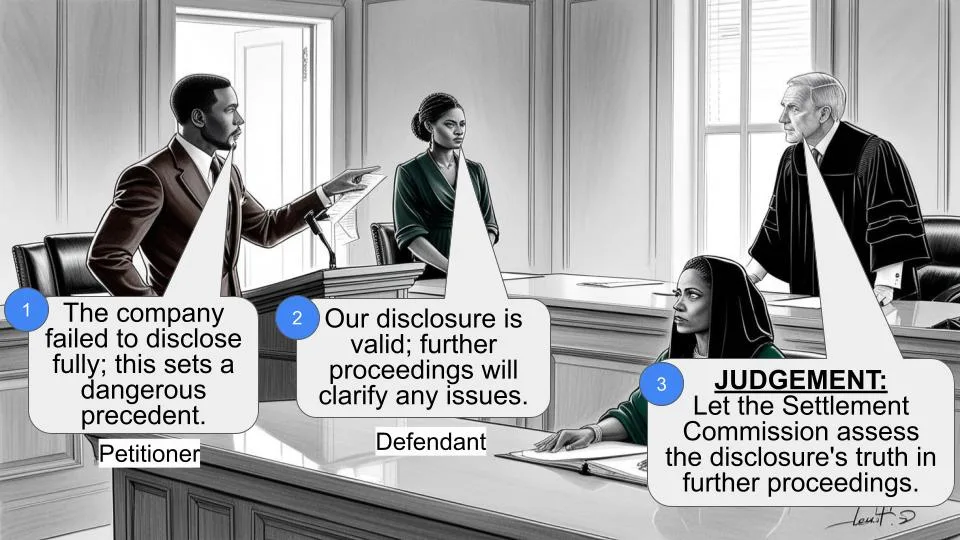
The case involves the Settlement Commission's decision regarding an application by an assessee, RNS Infrastructure Ltd., for settlement of undisclosed income. The main issue was whether the application contained a full and true disclosure of income not previously disclosed to the Assessing Officer. The court upheld the Settlement Commission's decision to proceed with the application, despite objections from the Commissioner of Income Tax (CIT).
Get the full picture - access the original judgement of the court order here
Case Name:
Commissioner of Income Tax vs. RNS Infrastructure Ltd. (High Court of Karnataka)
Writ Petition No. 44007 of 2014 & 2745-2750 of 2015 (T-IT)
Date: 18th January 2016
Key Takeaways:
- The Settlement Commission can proceed with an application if it is satisfied with the disclosure, even if the CIT objects.
- The court emphasized the importance of full and true disclosure in applications under Section 245C (of Income Tax Act, 1961).
- The decision clarifies the procedural requirements for the Settlement Commission under Section 245D (of Income Tax Act, 1961).
Issue
Did the Settlement Commission err in proceeding with the application despite objections from the CIT regarding the disclosure's completeness and truthfulness?
Facts
- A search was conducted at RNS Infrastructure Ltd.'s premises, revealing undisclosed income.
- The Assessing Officer initiated proceedings under Section 153A (of Income Tax Act, 1961).
- RNS Infrastructure Ltd. filed an application under Section 245C (of Income Tax Act, 1961) for settlement.
- The Settlement Commission decided to proceed with the application after a preliminary report from the CIT, despite objections regarding the disclosure's completeness.
Arguments
- Petitioner (CIT): Argued that the application should be rejected due to incomplete disclosure and unpaid taxes. Claimed that the Settlement Commission must adjudicate objections before proceeding.
- Respondent (RNS Infrastructure Ltd.): Contended that the Settlement Commission is not required to adjudicate objections at the initial stage and can proceed if it finds the application not invalid.
Key Legal Precedents
- Ajmera Housing Corporation vs. Commissioner of Income Tax (2010) 326 ITR 642: Emphasized the need for full and true disclosure in settlement applications.
- Commissioner of Income Tax vs. Income Tax Settlement Commission (2014) 365 ITR 87 (Bom): Discussed the procedural aspects of the Settlement Commission's decision-making process.
Judgement
The court upheld the Settlement Commission's decision to proceed with the application, stating that the Commission had not violated any procedural requirements. The court found that the Commission had taken a prima facie view that the application was not invalid and that a final order would be passed only after further reports and satisfaction of full disclosure.
FAQs
Q1: What does this decision mean for RNS Infrastructure Ltd.?
A1: The decision allows RNS Infrastructure Ltd.'s application to proceed, potentially leading to a settlement of their undisclosed income issues.
Q2: Why didn't the court require the Settlement Commission to adjudicate the CIT's objections?
A2: The court found that the Settlement Commission's role at this stage is to determine if the application is prima facie valid, not to adjudicate objections.
Q3: What is the significance of full and true disclosure in this context?
A3: Full and true disclosure is crucial for the validity of a settlement application under Section 245C (of Income Tax Act, 1961), as it forms the basis for the Settlement Commission's decision to proceed.

The facts leading up to these petitions are as follows:-
The respondent is said to be an assessee within the jurisdiction of the petitioner. A search is said to have been conducted at the business premises of the respondent and the residential premises of its Directors, by the Income Tax Department, in exercise of power under Section 132 (of Income Tax Act, 1961) (Hereinafter referred to as the ‘IT Act’, for brevity) as on 16.2.2012. It transpires that incriminating material regarding undisclosed income was found and seized.
The assessing officer is said to have initiated proceedings under Section 153A (of Income Tax Act, 1961), for the Assessment years 2006-07 to 2011-12, by a notice dated 7.12.2012. The respondent is said to have filed a return of income pursuant thereto. And further, during the pendency of the said proceedings, the assessee is said to have filed an application under Section 245C (of Income Tax Act, 1961) before the Settlement Commission, as on 6.2.2014, in Form no. 34B.
The Settlement Commission is said to have issued notice to
Respondent no.1 under Section 245D(1) (of Income Tax Act, 1961). It had then
passed an order under Section 245D(1) (of Income Tax Act, 1961) to proceed with the
application vide proceedings dated 18.2.2014. The Settlement
Commission had then called for a report from the petitioner as
required under Section 245(D)(2B) (of Income Tax Act, 1961). The petitioner
is said to have submitted a report in compliance with the same.
The petitioner had objected to the application filed by respondent
no.1 on the ground that there was no true and full disclosure and
that the requisite tax had also not been paid. It was emphasized
that the unaccounted income detected during the course of search
was not fully disclosed. And hence sought that the application be
rejected. The Settlement Commission however chose to proceed
with the further enquiry. It is the petitioner's contention that the
Settlement Commission was required to adjudicate on the
objection filed by the petitioner. Such adjudication, it is asserted,
is mandatory and should be conducted with due application of
mind and must be followed by a reasoned order. For otherwise,
the exercise of calling for a report from the Commissioner of
Income Tax is rendered an empty formality.
It is in the above background that the present writ petition is
filed.
2. It is contended that the settlement Commission has failed
to take into consideration that the object of the provisions of
Chapter XIX-A is to enable an assessee, who comes clean with
full and true disclosure of his income and explains the manner in
which such income has been derived, to move the Settlement
Commission for settlement of the dispute. An applicant who fails
to disclose fully and truly the income which has not been
disclosed before the Assessing Officer and fails to explain the
manner in which such income has been derived and fails to pay
the additional amount of income tax payable on such income, the
Settlement Commission cannot proceed with the application. If
the Commissioner objects regarding compliance of the above
requirements, the Settlement Commission cannot assume
jurisdiction to consider the application without adjudicating the
objection. Hence, the progress in the application beyond Section
245D(2B) of the IT Act by the Settlement Commission is invalid
and without jurisdiction.
It is contended that the total short fall in the declaration
made by the respondent in the application before the Settlement
Commission with reference to the seized material available with
the Assessing Officer is Rs.105,13,76,527/-. The short fall in
declaration would clearly demonstrate that the declaration in the
application before the Settlement Commission is not a true and
full disclosure of the additional income.
Reliance is placed on the following authorities by the
learned counsel for the petitioner in seeking that the petition be
allowed.
1. Commissioner of Income Tax vs. Income Tax
Settlement Commission, (2014)365 ITR 0087(Bom);
2. Commissioner of Income Tax (Central) vs. Income
Tax Settlement Commission (ITSC),(2014) 361 ITR 068 (Bom);
3. Ajmera Housing Corporation and another vs.
Commissioner of Income Tax; (2010) 326 ITR 0642;
3. On the other hand, the learned counsel Shri A.Shankar
appearing for respondent no.1 would point out that Section
245D(2C) enjoins the Settlement Commission to declare an
application as invalid on the basis of the report of the
Commissioner. It does not contemplate "rejection" of the
application on the basis of the objection by the Commissioner. It
is asserted that Section 245D(2C) (of Income Tax Act, 1961) does not require the Settlement
Commission to adjudicate on the objection filed by the
Commissioner. It is contended that the Settlement Commission
has been empowered to declare whether the application under
consideration is invalid on the basis of the report of the
Commissioner and nothing more. There is no mandate
contemplated under Section 245D(2C) (of Income Tax Act, 1961), for an adjudication on the
objection filed.
It is pointed out that the Commissioner having objected to
the application on the ground that there was no full and true
disclosure, has provided the amount of unaccounted income said
to have been detected by the Investigation wing. The basis for
arriving at the unaccounted income by the Investigation Wing, is
not disclosed to this Court. There is no opportunity provided as
yet, to the respondent - by the Commissioner to dispute the
correctness of the unaccounted income detected.
It is contended that the Settlement Commission has only
taken a prima facie view that the application filed is not 'invalid'.
A final order would be passed under Section 245D(4) (of Income Tax Act, 1961) only after
obtaining the Report of the Commissioner under Rule 9 (of Income Tax Rules, 1962) of the
Income Tax Settlement Commission (Procedure) Rules, 1997
(Hereinafter referred to as the ‘1997 Rules’, for brevity) and on
being satisfied that there is full and true disclosure by the
applicant.
4. In the light of the above contentions, the point that arises
for consideration is, whether the Settlement Commission on
receipt of an application under Section 245C (of Income Tax Act, 1961), and on receipt of the
report called for from the Commissioner of Income Tax,
adjudicate on the report so filed and assign reasons in order to
allow the application to be proceeded with.
The Apex Court has in the case of Ajmera Housing
Corporation v. Commissioner of Income Tax, (2010) 326 ITR 642,
has while interpreting Section 245C(1) (of Income Tax Act, 1961) has held thus :
A bare reading of the provision would
reveal that besides such other particulars, as may
be prescribed, in an application for settlement, the
assessee is required to disclose (i) a full and true
disclosure of the income which has not been
disclosed before the AO; (ii) the manner in which
such income has been derived and (iii) the
additional amount of income tax payable on such
income.
22. It is clear that disclosure of “full and
true” particulars of undisclosed income and “the
manner” in which such income had been derived
are the prerequisites for a valid application under
Section 245C(1) (of Income Tax Act, 1961). Additionally, the
amount of income tax payable on such undisclosed
income is to be computed and mentioned in the
application. It needs little emphasis that Section
245C(1) of the Act mandates “full and true”
disclosure of the particulars of undisclosed income
and “the manner” in which such income was
derived and, therefore, unless the Settlement
Commission records its satisfaction on this aspect,
it will not have the jurisdiction to pass any order on
the matter covered by the application.”
The Settlement Commission has examined the application
and has opined thus in its order at Annexure -B to the petition:
“DECISION
10. We have carefully considered the
submissions of the learned A.R and the facts
available on record. It cannot prima facie be inferred
at this stage that the disclosure made in the
Settlement Application is not full and true. So far as
other conditions are concerned, they stand satisfied
by the Applicant. We, therefore, allow the
Settlement Application to be proceeded with under
Section 245D(1) (of Income Tax Act, 1961).”
From the above, it is evident that the Settlement
Commission has satisfied itself that the application of the assessee
has made, what is claimed as, a full and true disclosure of the
income which has not been disclosed before the Assessing
Officer; the manner in which such income has been derived and
the additional income tax payable on such income.
In so far as the procedure that is to be followed by the
Settlement Commission under Section 245D (of Income Tax Act, 1961), is
discussed by the Apex Court, in the above decision, thus :
“26. The procedure laid down in Section
245D of the Act, contemplates that on receipt of the
application under Section 245C(1) (of Income Tax Act, 1961), the
Settlement Commission is required to forward a
copy of the application filed in the prescribed form
(No.34B), containing full details of issues for which
application for settlement is made, the nature and
circumstances of the case and complexities of the
investigation involved, save and except the
annexures, referred to in item No.11 of the form and
to call for report from the CIT. The CIT is obliged
to furnish such report within a period of 45 days
from the date of communication by the Settlement
Commission. Thereafter, the Settlement
Commission, on the basis of the material contained
in the said report and having regard to the facts and
circumstances of the case and/or complexity of the
investigation involved therein may by an order,
allow the application to be proceeded with or reject
the application. After an order under Section
245D(1) is made, by the Settlement Commission, r.8 (of Income Tax Rules, 1962)
of the 1987 Rules mandates that a copy of the
annexure to the application, together with a copy of
each of the statements and other documents
accompanying such annexure shall be forwarded to
the CIT and further report shall be called from the
CIT. The Settlement Commission can also direct
the CIT to make further enquiry and investigations
in the matter and furnish his report. Thereafter,
after examining the record, CIT’s report and such
further evidence that may be laid before it or
obtained by it, the Settlement Commission is
required to pass an order as it thinks fit on the
matter covered by the application and in every
matter relating to the case not covered by the
application and referred to in the report of the CIT
under sub-section (1) or sub-section (3) of the said
section. It bears repetition that as per the scheme
of the Chapter, in the first instance, the report of
the CIT is based on the bare information
furnished by the assessee against item No.10 of the
prescribed form, and the material gathered by the
Revenue by way of its own investigation. It is
evident from the language of section 245C(1) (of Income Tax Act, 1961) of
the Act that the report of the CIT is primarily on
the nature of the case and the complexities of the
investigation, as the annexure filed in support of
the disclosure of undisclosed income against item
No.11 of the form and the manner in which such
income had been derived are treated as
confidential and are not supplied to the CIT. It is
only after the Settlement Commission has decided
to proceed with the application that a copy of the
annexure to the said application and other
statements and documents accompanying such
annexure, containing the aforesaid information
are required to be furnished to the CIT. In our
opinion even when the Settlement Commission
decides to proceed with the application, it will not
be denuded of its power to examine as to whether
in his application under Section 245C(1) (of Income Tax Act, 1961) of the
Act, the assessee has made a full and true
disclosure of his undisclosed income. We feel that
the report(s) of the CIT and other documents
coming on record at different stages of the
consideration of the case, before or after the
Settlement Commission has decided to proceed
with the application would be most germane to
determination of the said question. It is plain from
the language of sub-section (4) of section 245D (of Income Tax Act, 1961) of
the Act that the jurisdiction of the Settlement
Commission to pass such orders as it may think fit
is confined to the matters covered by the application
and it can extend only to such matters which are
referred to in the report of the CIT under sub-
section (1) or sub-section (3) of the said section. A
“full and true” disclosure of income, which had not
been previously disclosed by the assessee, being a
precondition for a valid application under section
245C(1) of the Act, the scheme of Chapter XIX-A
does not contemplate revision of the income so
disclosed in the application against item No.11 of
the form.” (emphasis supplied)
Even assuming that the Settlement Commission has glossed
over the initial report submitted by the Commissioner of Income
Tax (CIT), as the procedure contemplates a further report to be
submitted by the CIT, after examination of the annexure to the
application, statements and other documents accompanying such
annexure and on the basis of a further enquiry, if any, all of which
is not made available to the CIT in the first instance, and the
Settlement Commission being in a position to still address the
question whether a full and true disclosure of the income which
was not disclosed before the Assessing Officer and being required
to pass an appropriate order, the Revenue cannot be said to be
prejudiced in any fashion.
Therefore, this court is of the opinion that no procedural
violation is caused by the Settlement Commission. It has only
taken a prima facie view that the application is not invalid. A
final order will necessarily have to be passed under Section
245D(4) only after obtaining the report of the Commissioner
under Rule 9 of the 1987 Rules and after being satisfied that there
is full and true disclosure by the applicant.
It is also to be noticed that the legislature in its wisdom
removed the provision of Sub-section (1A) of Section 245D (of Income Tax Act, 1961) by
Finance Act (no.2), 1991. The scope and effect of the amendment
was explained by the Board of Direct Taxes vide Circular no.621,
dated 21.12.1991, thus:
“Simplification of procedure subsequent to the
receipt of an application by the Settlement Commission
65. Under the existing provisions of sub-section (1)
of section 245D (of Income Tax Act, 1961), the Settlement
Commission, on receipt of an application under section
245C, has to call for a report from the Commissioner and
on the basis of the materials contained in such report and
having regard to the nature and circumstances of the case,
etc., the Settlement Commission may allow the application
to be proceeded with or reject the application. Further,
sub-section (IA) of Section 245D (of Income Tax Act, 1961) provides for filing of
objection by the Commissioner against proceeding with the
application made under section 245C (of Income Tax Act, 1961).
65.1 The above provisions cause delay, at times, in
the disposal of applications filed before the Settlement
Commission under section 245C (of Income Tax Act, 1961). In order to expedite the
disposal of such applications, sub-section (1) of section
245D has been amended to provide that the Commissioner
shall furnish the report within a period of one hundred and
twenty days of the receipt of communication from the
Settlement Commission in case of all applications made
under section 245C (of Income Tax Act, 1961) on or after the date on which the
Finance Act received the assent of the President (i.e., 27th
September, 1991) and if the Commissioner fails to furnish
the report within the said period, the Settlement
Commission may make the order on the application
without such report. The provisions relating to filing of
objection by the Commissioner against proceedings with
the application made under section 245C (of Income Tax Act, 1961) contained in
sub-section (1A) of section 245D (of Income Tax Act, 1961), have also been omitted.
65.2 Similar amendment has been made to the
corresponding provisions in section 22D (of Income Tax Act, 1961) of the Wealth-tax
Act.
65.3 These amendments take effect from 27th
September, 1991, i.e., the date on which the Act received
the assent of the President” (emphasis added).”
It would thus appear that the report submitted in the first
instance by the CIT is 'primarily on the nature of the case and the
complexities of the investigation, as the Annexure filed in support
of the disclosure of undisclosed income .... and the manner in
which such income had been derived are treated as confidential
and are not supplied to the CIT', as observed by the Apex Court.
The question of an 'adjudication' on the said report, which is
termed as 'objection', by the petitioner, at that stage - does not
arise.
Hence, the petition is without merit and is dismissed. The
interim order of stay granted has spent itself out.
Sd/-
JUDGE
×
Similar Ripples
Questions
Settlement Commission's Decision on Disclosure Validity Upheld
Write your CommentSimilar Posts


Generic
- Reportdata/3167.pdf
