


Court Quashes Tax Assessment on Land Acquisition Compensation, Upholds Exemption


Full News

Court Quashes Tax Assessment on Land Acquisition Compensation, Upholds Exemption
Court Quashes Tax Assessment on Land Acquisition Compensation, Upholds Exemption
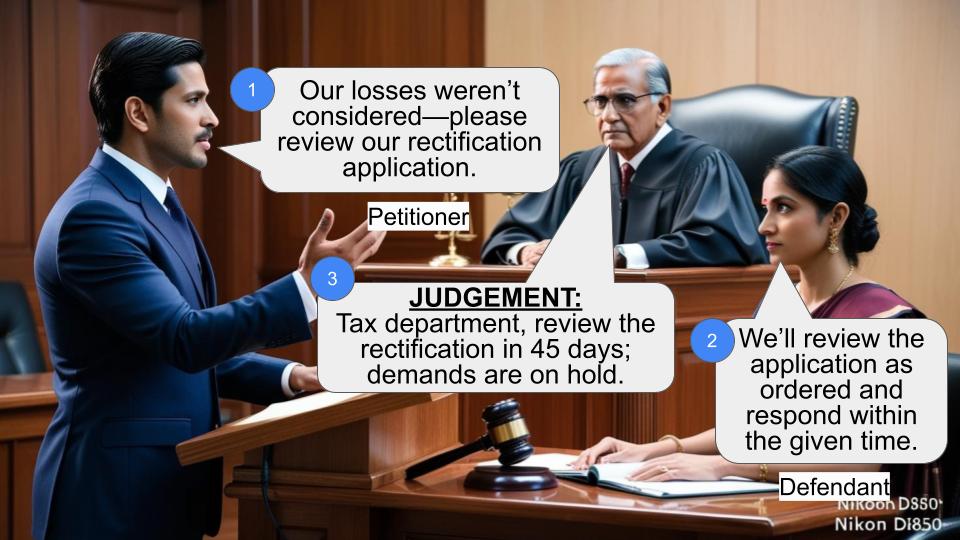
It's about a person (let's call them the petitioner) who received compensation for their land being acquired for a road expansion project. The Income Tax Department tried to tax this compensation, but the petitioner challenged this in court. Long story short, the court sided with the petitioner and quashed the tax assessment order. Pretty big win for the landowner.
Get the full picture - access the original judgement of the court order here
Case Name:
Viswanathan M. Vs Chief Commissioner of Income Tax Department & Ors. (High Court of Kerala)
WP(C).No.3227 OF 2020(C)
Date: 18th February 2020
Key Takeaways:
1. Compensation received for land acquisition under the Right to Fair Compensation Act is exempt from income tax.
2. This exemption applies even if the land is non-agricultural.
3. The court emphasized the importance of following government circulars that clarify tax laws.
Issue:
The main question here was: Is the compensation received for land acquisition under the Right to Fair Compensation and Transparency in Land Acquisition, Rehabilitation and Resettlement Act, 2013 (RFCTLARR Act) exempt from income tax?
Facts:
1. The petitioner owned about 7.33 cents of land in Ernakulam District, Kerala.
2. The government took 3.26 cents of this land for expanding the Thammanam Pullepady Road.
3. Initially, they offered about 10.5 lakhs rupees for the land.
4. Later, through an agreement dated 13.08.2016, the petitioner got about 43 lakhs (80% of the total amount).
5. The Income Tax Department then tried to tax this compensation.
6. They issued an assessment order and a demand notice to the petitioner.
Arguments:
The petitioner's side said:
- "Hey, this compensation should be tax-free under Section 96 of the RFCTLARR Act."
- They pointed to a government circular (No.36/2016 dated 25.08.2016) that says such compensation isn't taxable.
The Income Tax Department argued:
- The petitioner didn't construct a new property within three years, so they can't claim exemption from capital gains tax.
Key Legal Precedents:
Interestingly, this case didn't rely much on previous court decisions. Instead, it heavily referenced the RFCTLARR Act and the government circular we mentioned earlier. These were the key pieces of legislation and policy that guided the court's decision.
Judgement:
The court agreed with the petitioner. They said:
1. The RFCTLARR Act clearly exempts such compensation from income tax.
2. The government circular confirms this exemption applies to non-agricultural land too.
3. The tax assessment and demand notice were not valid and were quashed.
FAQs:
1. Q: Does this ruling apply to all land acquisition cases?
A: It applies to cases under the RFCTLARR Act, 2013, which came into effect on 01.01.2014.
2. Q: What if the land was agricultural?
A: The exemption applies to both agricultural and non-agricultural land.
3. Q: Does it matter if the acquisition was through agreement or compulsory?
A: No, the exemption applies in both cases under this Act.
4. Q: What about the Income Tax Department's argument about construction within three years?
A: The court didn't consider this relevant given the clear exemption under the RFCTLARR Act.
5. Q: Can the Income Tax Department appeal this decision?
A: While it's possible, the clear language of the Act and the government circular make it challenging to overturn.

1.Petitioner, in the instant case, has assailed Exts.P7 and P8, assessment order and notice of demand issued by the Income Tax Department, respectively.
2. Succinctly, the facts which are necessary for adjudication of the controversy involved are that the petitioner is the absolute owner, title holder of a land to the extent of 7.33 cents with three shop rooms and a residential building in Sy. No.170/2 and 170/4 in Elamkulam Village, Kanayannoor Taluk, Ernakulam District, which is situated on the southern side of the Thammanam Pullepady Road. The market value of the land on announcement of Smart City Project, Metro Rail Project and Mono Rail Project, increased many fold. Out of the aforementioned land, about 1.32 Ares (3.26 cents) of land with a building of 1500 Sq. Ft. had been taken for expansion of Thammanam Pullepady Road. The Land Acquisition Officer fixed the value as Rs.10,48,269/- and the improvements at Rs.3,864/-. The notification under the Old Land Acquisition Act was published on 24.04.2013. Thereafter, declaration under Sections 6(1) (of Income Tax Act, 1961) and 17(1) of the erstwhile Land Acquisition Act, 1894, showing the emergency provisions which tantamount to compulsory acquisition were published.
3. The learned counsel for the petitioner submits that the Right to Fair Compensation and Transparency in Land Acquisition, Rehabilitation and Resettlement Act, 2013, which came into force with effect from 01.01.2014 and the award in the aforementioned case has not so far been passed. The fact of the matter is, under the agreement Ext.P1 dated 13.08.2016, entered into between the petitioner and other land owners and Corporation of Kochi, the land was acquired. In other words, the effect of the acquisition under the Land Acquisition Act, 1894 effaced. In terms of the aforementioned agreement a sum of Rs.43,08,268/- (80% of the total amount due, after deducting 1% Income Tax amount of Rs.43,518/-) was released to the petitioner and 20% is still pending, for which W.P.(C) No.208/2020 was filed, which is pending consideration.
4. The grievance in instant writ petition is confined to the impugned assessment order and demand notice whereby the Assessing Officer, after undertaking the assessment order brought the case of the petitioner under scrutiny and issued a notice under Section 143(1) (of Income Tax Act, 1961), 1961. In the result thereof, the petitioner received a show cause notice. Petitioner was represented through an authorised representative and brought to the fact that the aforementioned compensation can be exempted under Section 96 of the Right to Fair Compensation and Transparency in Land Acquisition, Rehabilitation and Resettlement Act, 2013 as it would not fall within the mischief of Section 54F (of Income Tax Act, 1961). In support of the aforementioned contention, reliance has been laid to Circular No.36/2016 dated 25.08.2016 whereby the Central Board of Direct Taxes issued a clarification that if the land is non- agricultural, it would not be taxable as per the provisions of the Income-tax Act, 1961. The assessment order and the demand notice are wholly without jurisdiction, malicious and not sustainable in the eyes of law.
5. Per contra, Sri.Christopher Abraham, the learned Standing Counsel for the Income-tax did not deny the issuance of the Circular No.36/2016 dated 25.08.2016 (Ext.P10) but supports the impugned order on the premise that the occupancy certificate placed on record reveals that the construction was not done within a period of three years, in order to claim exemption from the Capital gain and urges this Court for dismissal of this writ petition.
6. Having heard the learned counsel appearing for both the parties and apprising the paper books, I am of the view that there is force and merit in the submissions. The Right to Fair Compensation and Transparency in Land Acquisition, Rehabilitation and Resettlement Act, 2013 came into force with effect from 01.01.2014. It is a matter of record that the parties to the lis; viz., the petitioner and the acquisition authority, for the purpose of coming out the way development had in unison agreed to acquire and give the land on the basis of certain conditions in fixing the market value. Petitioner, in lieu, thereof received 80% of the amount, i.e., Rs.43,51,786/-. I would not be commenting on the claim of the petitioner with regard to the balance amount, as the matter is subjudice in this Court. The language of Section 96 of the Right to Fair Compensation and Transparency in Land Acquisition, Rehabilitation and Resettlement Act, 2013, do not leave any doubt in the mind that if the land is either acquired or the result of an agreement, it could not fall within the mischief of Income Tax Act, in other words, exemption is liable to be granted. It is in this background of the matter and owing to certain confusions, the Central Board of Direct Tax vide the Circular No.36/2016 dated 25.08.2016 came out with a clarification. For the sake of brevity, only relevant portion of the circular is re-produced herein:- “3. As no distinction has been made between the compensation received for compulsory acquisition of agricultural land and non-agricultural land in the matter of providing exemption from income-tax under the RFCTLARR Act, the exemption provided under Section 96 of the RFCTLARR Act is wider in scope than the tax-exemption provided under the existing provisions of Income-tax Act, 1961. This has created uncertainty in the matter of taxability of compensation received on compulsory acquisition of land, especially those relating to acquisition of non-agricultural land. The matter has been examined by the Board and it is hereby clarified that compensation received in respect of award or agreement which has been exempted from levy of income-tax vide section 96 of the RFCTLARR Act shall also not be taxable under the provisions of income-tax Act, 1961 even if there is no specific provision of exemption for such compensation in the Income-tax Act, 1961.” The aforementioned clarification is totally opposite to what has been assessed by the Assessing Officer. For the reasons aforementioned, the assessment and demand notice cannot sustain and are hereby quashed. The writ petition is accordingly disposed.
×
Similar Ripples
Questions
Court Quashes Tax Assessment on Land Acquisition Compensation, Upholds Exemption
Write your CommentSimilar Posts


Generic
- Reportdata/6281.pdf
